NEW YEAR, NEW GOALS:   Kickstart your SaaS development journey today and secure exclusive savings for the next 3 months!
Check it out here >>
White gift box with red ribbon and bow open to reveal a golden 10% symbol, surrounded by red Christmas trees and ornaments on a red background.
Unlock Your Holiday Savings
Build your SaaS faster and save for the next 3 months. Our limited holiday offer is now live.
White gift box with red ribbon and bow open to reveal a golden 10% symbol, surrounded by red Christmas trees and ornaments on a red background.
Explore the Offer
Valid for a limited time
close icon
Logo Codebridge
AI

Prompt Management for Production AI: How to Version, Test, and Control Prompts Before They Break Your Workflow

Konstantin Karpushin
June 22, 2026
|
14
min read
Share
text
Link copied icon
table of content
Man with short brown hair and beard wearing a white collared shirt against a dark background.
Myroslav Budzanivskyi
Co-Founder & CTO

Get your project estimation!

KEY TAKEAWAYS

Prompt engineering and prompt management are different jobs. Prompt engineering improves the instruction. Prompt management controls what that instruction does once it runs in production.

A production prompt behaves like a release artifact. It needs an owner, a version, a test set, a deployment path, monitoring, and a rollback.

The most expensive prompt failures are quiet. One change can improve a single answer while breaking output format, escalation logic, a safety boundary, or a downstream workflow.

Tools store and version prompts. Architecture decides whether prompts interact safely with data, permissions, actions, and human review.

Prompt readiness is part of AI readiness. A company that cannot change prompts safely after launch is not ready to scale the workflow.

Most companies are already using AI somewhere in their operations. Sometimes it writes text or code. Sometimes it summarizes calls or moves work from one system to another.

It has different outputs but the same basic mechanism.

AI receives input, follows instructions, and produces an output that is not fully deterministic. If you ask the same system twice, you may not get the same result. Or change the instruction slightly, and the behavior can shift more than expected.

That is why the prompt matters. A prompt is the command layer of the workflow. It tells the system what to do, what context to use, what format to return, what tone to follow, what to avoid, when to escalate, and where the boundary is.

This article explains how prompt management helps teams version, test, control, monitor, and roll back prompts before a small change breaks a real workflow.

Prompt asset Why it matters in production
Prompt text Defines task behavior and tone
Variables Control how user, account, workflow, or domain context enters the prompt
Model settings Affect consistency, cost, latency, and output style
Retrieval and context rules Decide what information the system can use
Output format Determines whether downstream systems can process the result
Tool instructions Shape what the AI can suggest, prepare, or execute
Evaluation criteria Define what “good enough to release” means

Once a team treats prompts as production assets, the next distinction becomes important: prompt engineering and prompt management are not the same job.

Prompt Engineering vs Prompt Management

Prompt engineering creates and improves instructions, while prompt management controls how those instructions behave over time. They both matter, but the main difference is which problem each one solves.

Area Prompt engineering Prompt management
Main question What should the prompt say? How do we control this prompt after launch?
Primary goal Improve output quality Maintain reliable AI behavior
Main activity Writing, testing, refining instructions Versioning, approving, evaluating, deploying, monitoring, rolling back
Typical owner AI builder, product expert, domain expert Product, engineering, risk owner, workflow owner
Risk if weak Poor answers Silent production regression
Output A better prompt A controlled release artifact
When it matters most Experimentation and design Production and scale

Prompt engineering stays valuable. The catch is that once real users depend on the system, the management layer carries more weight. The team needs to know what changed, who approved it, how it was tested, where it is deployed, and what to do when it fails. 

So the main distinction is that prompt engineering asks whether the answer got better and prompt management asks whether the business can live with that answer once it runs against real-world inputs.

And very often, the cost of weak prompt management stays invisible until prompts start breaking workflows.

Why Unmanaged Prompts Break Production Workflows

Diagram showing an unmanaged prompt update beneath a working AI interface causing hidden production failures, including behavior regression, format drift, boundary erosion, cost and latency creep, and loss of audit trail.
Unmanaged prompt changes can leave the AI interface looking functional while quietly breaking production behavior, output format, authority boundaries, cost control, and traceability underneath.

Unmanaged prompts usually fail quietly. The system still responds, and the interface still works, but underneath the behavior has shifted. Five failure modes show up again and again.

1. Silent Behavior Regression 

A prompt update improves one scenario and breaks another. A support assistant becomes warmer and more detailed, then starts answering outside approved policy. This is why prompt changes need regression tests, not a "looks good to me" review.

2. Output Format Drift 

The prompt stops producing the expected structure. A CRM enrichment assistant used to return JSON with fixed fields. After a prompt change, it adds explanations, markdown, or extra fields, and the CRM workflow fails. In production AI, format reliability can matter as much as answer quality.

3. Risk Boundary Erosion

The AI starts suggesting, preparing, or taking actions that should require human approval. A sales assistant meant only to prepare outreach begins writing as if the message has already been approved or sent. Prompt management has to connect to authority boundaries, because a prompt cannot be the only control.

4. Cost and Latency Creep

A prompt grows longer, adds examples, expands context, or triggers more retrieval and tool calls. A "better" prompt improves quality by 3 percent and raises cost per task by 40 percent or adds seconds of latency. Prompt releases should compare quality, cost, and latency together, not subjective response quality alone.

5. No Audit Trail

A customer complains about an AI-generated recommendation. The team sees the output but cannot reconstruct the prompt version, the context, the model, or the settings that produced it. Without traceability, incident response turns into guessing.

Failure mode What breaks What prompt management should provide
Silent regression Quality changes without visibility Test cases and release gates
Format drift Downstream automation fails Output validation
Risk boundary erosion AI exceeds its intended role Approval rules and an authority model
Cost and latency creep Unit economics worsen Cost and latency comparison
No audit trail Incidents cannot be explained Versioning and traceability

Preventing this needs a practical production framework, not a policy document.

The Production Prompt Management Framework

A serious prompt management system does not have to be heavy, but it should have clear layers. At minimum, production AI prompts need ownership, versioning, evaluation, deployment control, monitoring, and rollback.

Layer What it controls Output artifact
Ownership Who can edit, approve, and deploy prompts Prompt owner map
Versioning What changed, and where is it deployed Prompt registry
Evaluation Whether the change is safe to release Evaluation report
Deployment How the prompt reaches production Release checklist
Monitoring How behavior is tracked after release Monitoring dashboard
Rollback How failures are reversed Rollback procedure

Layer 1: Prompt Ownership

This layer decides who is allowed to create, edit, approve, and deploy production prompts. The person who understands the domain is often not the person who understands production risk. In a sales workflow, a sales leader knows what the outreach should sound like, while engineering has to make sure the output structure, CRM logic, opt-out handling, and observability still work. In a clinical workflow, domain experts guide the wording, while compliance and engineering control the release boundaries.

The questions to settle: who owns each production prompt, who can propose changes, who can approve them, who can deploy them, whether high-risk prompts get reviewed differently from low-risk ones, and whether there is a named business owner alongside a named technical owner. The artifact is a prompt ownership map.

Role Responsibility
Workflow owner Defines the business goal and acceptable behavior
Domain expert Reviews accuracy and domain fit
Engineering owner Controls integration, release, and rollback
Risk and compliance owner Reviews sensitive workflows and boundaries
Support and ops owner Monitors incidents and user feedback

Layer 2: Versioning and Environment Control

This layer decides how prompt changes get tracked and separated across development, staging, production, experiments, and tenants. Every production prompt should carry a version. The application should call the version that was approved for production, not whatever someone edited last. An unversioned prompt is not a production asset because the system ends up running a moving target.

Practically, this means an immutable version history, release notes, environment labels, staging and production separation, experiment labels, tenant-specific versions where needed, and the model and settings attached to each prompt version. The artifact is a prompt registry.

Field Example
Prompt name Sales research summary prompt
Use case Prepare account research before outreach
Owner RevOps and AI engineering
Version v12
Environment Production
Model and settings Model name, temperature, max tokens
Input variables Company name, CRM notes, LinkedIn context
Output format Structured summary plus recommended next step
Last approved by Product owner / CTO
Release note Improved competitor signal extraction
Rollback version v11

Layer 3: Evaluation Before Release

This layer decides whether a prompt change is safe enough to release. A prompt should not move to production because one or two examples look better. It should pass a relevant test set built from normal use cases, edge cases, bad inputs, missing context, conflicting context, sensitive-data cases, domain-specific examples, output-format tests, refusal and escalation cases, and a cost and latency comparison.

Evaluation type What it checks
Quality evaluation Does the output answer the task correctly?
Regression evaluation Did the new version break previously good behavior?
Format validation Does the output match the required schema?
Safety and risk check Does the prompt respect boundaries and escalation rules?
Cost and latency comparison Is the new behavior economically acceptable?
Human review Does the workflow owner trust the output?

The artifact is a prompt evaluation report. A prompt change that affects the workflow needs a test set before release. Skip that step and the test set becomes your customers.

Layer 4: Controlled Deployment

This layer decides how prompt changes move into production. Prompt deployment should resemble software release management more than document editing. A workable release path runs from a draft change, to a test on internal examples, to the evaluation set, to a review with the workflow owner, to staging, to a limited rollout, to early production monitoring, to full production, with rollback available throughout.

Release level When to use
Direct production release Only for low-risk copy or formatting changes
Staging release The standard path for workflow prompts
Limited rollout For prompts affecting user-facing or revenue workflows
Approval-gated release For regulated, high-risk, or action-taking AI systems
Emergency rollback When quality, safety, or workflow reliability drops

The artifact is a prompt release checklist. The process should match the risk. A low-risk internal summarization prompt does not need the gate that a clinical workflow assistant needs.

Layer 5: Monitoring and Tracing

This layer decides whether the team can see how each prompt version behaves after release. Testing before release is never enough, because production inputs are messier than internal examples. The system needs observability around prompt behavior: the prompt version used, the model and settings, the user and workflow context, output quality scores, user correction rate, escalation rate, fallback rate, hallucination reports, format errors, policy violations, cost per task, latency, and downstream workflow failures.

Metric What it diagnoses
Format error rate Whether downstream automation can trust outputs
Escalation rate Whether the prompt is too uncertain or too cautious
User correction rate Whether humans keep fixing the AI
Cost per task Whether prompt changes hurt unit economics
Latency Whether the workflow still feels usable
Safety event rate Whether risk boundaries are holding
Rollback frequency Whether prompt releases are stable

The artifact is a prompt monitoring dashboard. Monitoring is how a team notices that the AI still runs without errors but has stopped doing its job.

Layer 6: Rollback and Incident Response

This layer decides what happens when a prompt release causes a problem. Production prompt management has to include rollback. If a prompt breaks behavior, the team should not have to redeploy the whole application or search through prompt history by hand. The pieces to define in advance: the rollback version, the rollback owner, the approval path, the affected user and workflow review, the incident log, the root-cause note, and the new test cases added after the incident.

Incident question Why it matters
Which prompt version caused the issue? Reconstructs behavior
Which users or workflows were affected? Defines incident scope
What version should we roll back to? Restores stable behavior
Who approves rollback? Avoids confusion during incidents
What test case was missing? Prevents a repeat failure
Incident question Why it matters
Which prompt version caused the issue? Reconstructs behavior
Which users or workflows were affected? Defines incident scope
What version should we roll back to? Restores stable behavior
Who approves rollback? Avoids confusion during incidents
What test case was missing? Prevents a repeat failure

The artifact is a prompt rollback procedure. A prompt that cannot be rolled back should not control a production workflow.

Prompt Management in Real Workflows

Three production examples show what the framework controls in practice. Each draws on a delivered Codebridge system.

Sales workflow

A multi-agent AI sales system researches accounts, qualifies leads, and drafts outreach across LinkedIn and email, then escalates only high-intent prospects to human reps. In a system like this, prompt management controls outreach tone, qualification logic, CRM context usage, opt-out handling, personalization boundaries, escalation to a human reviewer, and the output format that updates the CRM.

The production risk is concrete. A prompt change meant to improve personalization can produce overconfident claims, ignore prior conversation context, loosen the confidence threshold that decides when to involve a human, or break the CRM field structure. In one delivered system, lead disqualification only happens above a 90 percent confidence threshold, and ambiguous cases route to human reps. A prompt edit that quietly relaxes that boundary is a revenue risk, not a copy tweak.

The prompt management answer: version the prompt, test it against real accounts, validate the output format, track reply quality and correction rate, and require approval before the change reaches production.

Tutoring workflow

A real-time AI tutoring platform holds voice conversations with students through animated avatars, explains concepts, and keeps lesson context across sessions. Prompt management controls explanation style, difficulty, age-appropriate wording, how the tutor handles uncertainty, lesson continuity, escalation to a human teacher or support, and the use of saved learning context.

The production risk is pedagogical. A change can make explanations more engaging and less accurate, push difficulty past the student's level, or contradict an earlier lesson. In one delivered platform, a retrieval layer anchors every response to the active subject curriculum and holds the tutor inside defined tracks, on the view that an off-topic or incorrect tutor is worse than no tutor. A prompt change that loosens that grounding undermines the product's core promise.

The prompt management answer: test prompts against lesson scenarios, track student correction and confusion signals, monitor answer quality, and roll back weak versions quickly.

Executive Checklist

Before a prompt controls a real workflow, leadership should be able to answer these questions.

Ownership

  • Who owns this prompt after launch?
  • Who can edit it?
  • Who can approve production changes?
  • Does business ownership differ from technical ownership?

Versioning

  • Is every production prompt versioned?
  • Can we see what changed between versions?
  • Can we connect each output to the prompt version that produced it?

Testing

  • What test set must the prompt pass before release?
  • Does the test set include edge cases and bad inputs?
  • Do production failures get added back into the test set?

Deployment

  • Does the prompt move through staging before production?
  • Are high-risk prompt changes approval-gated?
  • Can we release to limited traffic first?

Monitoring

  • Do we track quality, format errors, escalation, cost, latency, and user corrections?
  • Can support or engineering investigate a bad output?

Risk and rollback

  • What actions is the AI never allowed to take?
  • What requires human approval?
  • Can we roll back the prompt without redeploying the full application?
  • Who owns rollback during an incident?

If these questions feel too heavy for a given prompt, that prompt is probably not ready to control a production workflow.

When a Prompt Management Tool is Enough, and When Architecture is Needed

Many readers will be weighing tools. Tools are useful. They do not create production discipline on their own.

Situation A tool may be enough Architecture is needed
Internal summarization Yes, if low-risk and manually reviewed If outputs feed automated decisions
Marketing copy generation Often yes If brand, legal, or compliance review is required
Sales assistant Partly If connected to CRM, outreach, scoring, or account data
Clinical assistant Rarely on its own If patient data, auditability, or clinical workflow is involved
AI agent with tool access No Needs permissions, observability, approval, rollback, and incident response

A tool can store and version prompts. Architecture decides how prompts interact with data, systems, permissions, actions, and human review. A platform will not resolve unclear ownership, and it will not define what the AI is allowed to do. Buying a prompt management tool and designing prompt management are two different exercises.

For production AI, prompt management belongs inside the system design: how context enters, how outputs are validated, how actions are constrained, how failures surface, and how humans stay in control.

Conclusion

Prompt management matters because AI systems do not fail only through bad models. They fail through behavior changes that nobody controlled.

Prompts used to read like instructions. In production AI, they behave more like release artifacts. They define how the system interprets context, talks to users, formats output, respects boundaries, and supports the workflow. That means they need ownership, versioning, evaluation, monitoring, and rollback.

The goal is not a beautiful prompt library. The goal is AI behavior that stays controllable after launch. For any company building AI into real workflows, prompt management is one of the control layers that decides whether the system survives production.

Before you scale an AI workflow, pressure-test the control layer around it. If prompts can change production behavior, they need the same discipline as the rest of your system: ownership, evaluation, observability, and rollback.


Review your AI workflow architecture

Can your AI workflow survive a prompt change?

Review your AI workflow architecture

What is prompt management?

Prompt management is the process of controlling prompts across their lifecycle: creation, versioning, testing, approval, deployment, monitoring, and rollback. In production AI, it keeps AI behavior reliable as prompts change over time.

How is prompt management different from prompt engineering?

Prompt engineering focuses on writing better instructions for an AI model. Prompt management focuses on controlling those instructions after launch: who owns them, how they are versioned, how they are tested, where they are deployed, and how they are rolled back when something breaks.

Why is prompt versioning important?

Prompt versioning lets a team track what changed, reproduce past AI behavior, investigate incidents, compare prompt performance, and roll back to a stable version. Without versioning, production AI behavior becomes hard to explain or control.

Do we need a prompt management tool?

A tool helps store, version, test, and deploy prompts, but it is not enough on its own. Production AI also needs ownership, evaluation criteria, monitoring, permissions, human review, and rollback procedures.

How does prompt management fit into AI readiness?

Prompt management is one part of AI readiness. It shows whether a team can safely update AI behavior after launch. If prompts affect real workflows but are not versioned, tested, monitored, or owned, the AI system is not ready for production.

Prompt Management for Production AI: How to Version, Test, and Control Prompts Before They Break Your Workflow

Heading 1

Heading 2

Heading 3

Heading 4

Heading 5
Heading 6

Lorem ipsum dolor sit amet, consectetur adipiscing elit, sed do eiusmod tempor incididunt ut labore et dolore magna aliqua. Ut enim ad minim veniam, quis nostrud exercitation ullamco laboris nisi ut aliquip ex ea commodo consequat. Duis aute irure dolor in reprehenderit in voluptate velit esse cillum dolore eu fugiat nulla pariatur.

Block quote

Ordered list

  1. Item 1
  2. Item 2
  3. Item 3

Unordered list

  • Item A
  • Item B
  • Item C

Text link

Bold text

Emphasis

Superscript

Subscript

AI
Konstantin Karpushin
Rate this article!
Thank you! Your submission has been received!
Oops! Something went wrong while submitting the form.
32
ratings, average
4.7
out of 5
June 22, 2026
Share
text
Link copied icon

LATEST ARTICLES

Codebridge Featured on Selective Industry List of Top AI Agent Development Companies in 2026, Honoring Architecture-First Engineering and Production-Grade Governance
June 17, 2026
|
3
min read

Codebridge Featured on Selective Industry List of Top AI Agent Development Companies in 2026, Honoring Architecture-First Engineering and Production-Grade Governance

Codebridge was recognized by Techreviewer among the top AI agent development companies in 2026 for architecture-first engineering and production-grade governance.

by Konstantin Karpushin
AI
Read more
Read more
AI Readiness Assessment Framework: 8 Layers That Decide Whether AI Can Survive Production
June 19, 2026
|
21
min read

AI Readiness Assessment Framework: 8 Layers That Decide Whether AI Can Survive Production

Most AI readiness frameworks stay too theoretical. Learn an 8-layer framework to assess one real workflow, ask better questions, find production gaps, and decide whether to build, pilot, fix first, or stop.

by Konstantin Karpushin
AI
Read more
Read more
AI Readiness Assessment: How to Know Whether Your Workflow Is Ready for Production AI
June 18, 2026
|
18
min read

AI Readiness Assessment: How to Know Whether Your Workflow Is Ready for Production AI

AI projects fail when workflows, data, systems, and ownership are not ready. Learn what an AI readiness assessment is, why companies need one, and how to evaluate governance, security, and systems before deploying AI.

by Konstantin Karpushin
AI
Read more
Read more
Data Readiness for AI: The First Audit Before You Build Anything
June 16, 2026
|
12
min read

Data Readiness for AI: The First Audit Before You Build Anything

Clean data is not AI-ready data. Use this eight-gate audit to test whether your data can survive a real AI use case in production before you build, buy, or deploy an AI system.

by Konstantin Karpushin
AI
Read more
Read more
Best Voice-to-Text Apps for Mac in 2026: 10 Dictation Tools Compared
June 15, 2026
|
15
min read

Best Voice-to-Text Apps for Mac in 2026: 10 Dictation Tools Compared

Typing is slow, but most dictation apps disappoint. Compare the 10 best voice-to-text apps for Mac in 2026 and learn which tool fits your writing, privacy, language, and budget needs.

by Konstantin Karpushin
IT
AI
Read more
Read more
What Is AI Agent Observability? Metrics, Tracing, and the Visibility Gap in Agentic AI Systems
June 11, 2026
|
13
min read

What Is AI Agent Observability? Metrics, Tracing, and the Visibility Gap in Agentic AI Systems

You have an AI agent, but how do you know if it’s doing its job? Stop guessing. In this article, you will learn how AI agent observability tracks metrics, traces, tools, and failures.

by Konstantin Karpushin
AI
Read more
Read more
Context Engineering vs Prompt Engineering: Why AI Agents Fail When You Treat Context Like a Prompt
June 9, 2026
|
18
min read

Context Engineering vs Prompt Engineering: Why AI Agents Fail When You Treat Context Like a Prompt

Context engineering vs prompt engineering explained for AI agents. Learn when prompts are enough, when context architecture matters, and why agents fail without the right data, memory, tools, permissions, and observability.

by Konstantin Karpushin
AI
Read more
Read more
AI Agent Lifecycle Management: The Control Plane Behind Production AI Agents
June 8, 2026
|
9
min read

AI Agent Lifecycle Management: The Control Plane Behind Production AI Agents

Learn how AI agent lifecycle management controls production agents across ownership, identity, permissions, testing, observability, incidents, and retirement.

by Konstantin Karpushin
AI
Read more
Read more
Top Intelligent Automation Companies in 2026: Best Partners for Complex Workflows
June 10, 2026
|
9
min read

Top Intelligent Automation Companies in 2026: Best Partners for Complex Workflows

Compare top intelligent automation companies in 2026 for complex workflows, AI agents, RPA, data automation, healthcare, SaaS, and custom software systems.

by Konstantin Karpushin
AI
Read more
Read more
Top 10 Business Process Automation Companies for Custom AI Workflows in 2026
June 12, 2026
|
8
min read

Top 10 Business Process Automation Companies for Custom AI Workflows in 2026

Most automation vendors promise efficiency. The harder question is which business process automation companies can handle complexity without creating new technical debt. Compare the top business process automation companies for custom AI workflows and production-grade automation in 2026.

by Konstantin Karpushin
AI
Read more
Read more
Logo Codebridge

Let’s collaborate

Have a project in mind?
Tell us everything about your project or product, we’ll be glad to help.
call icon
+1 302 688 70 80
email icon
business@codebridge.tech
Attach file
By submitting this form, you consent to the processing of your personal data uploaded through the contact form above, in accordance with the terms of Codebridge Technology, Inc.'s  Privacy Policy.

Thank you!

Your submission has been received!

What’s next?

1
Our experts will analyse your requirements and contact you within 1-2 business days.
2
Out team will collect all requirements for your project, and if needed, we will sign an NDA to ensure the highest level of privacy.
3
We will develop a comprehensive proposal and an action plan for your project with estimates, timelines, CVs, etc.
Oops! Something went wrong while submitting the form.
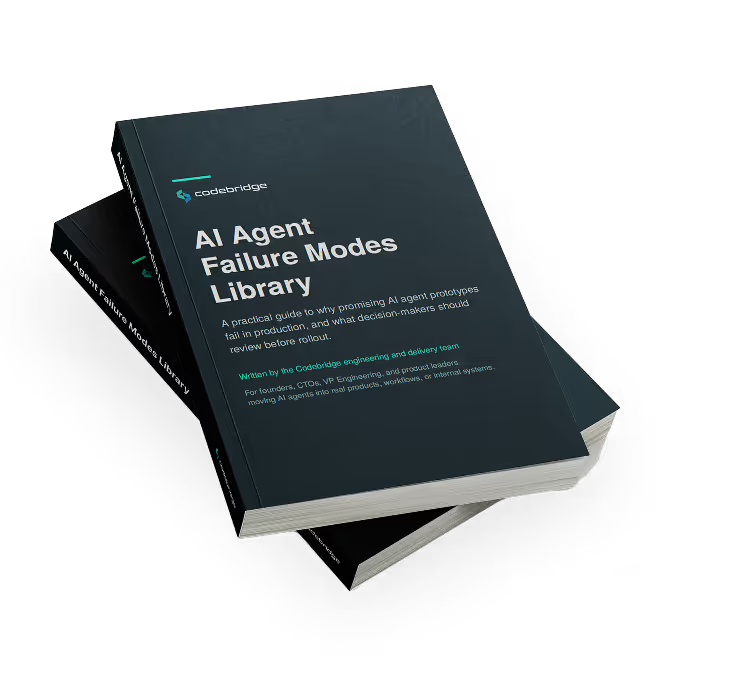
FREE GUIDE
Your Al agent demo worked. But would it survive production?
Download the Al Agent Failure Modes Library and review the execution, decision, context, workflow, and governance gaps that break Al agents after rollout.
5 production failure surfaces
Built for founders & CTOs
Practical rollout review
Instant PDF. No email required.
Thank you! Your submission has been received!
Oops! Something went wrong while submitting the form.