The Short Answer
Three-way matching in accounts payable is a control that compares three documents before an invoice gets paid: the purchase order, the receiving record, and the vendor invoice. When all three agree within set tolerances, the invoice moves to payment. When they disagree, the invoice is held as an exception until someone resolves the difference. The purpose is to confirm that the business pays only for what it authorized, what it received, and what it was billed correctly for.
The 3-way match works by flagging disagreements, so a properly configured match produces exceptions by design. That matters more than most descriptions of the control admit. Invoice exceptions are now the largest operational complaint in accounts payable, and matching is one of their main sources. Running the control well means deliberately setting tolerances and planning for what happens to invoices that fail.
This guide covers the three documents and what each one proves, the matching process step by step with a worked example, how two-way and four-way matching differ and when each is correct, how to set tolerances, which invoice types no match can govern, the exception problem, and how the control functions under an audit.
What is Three-Way Matching in Accounts Payable?
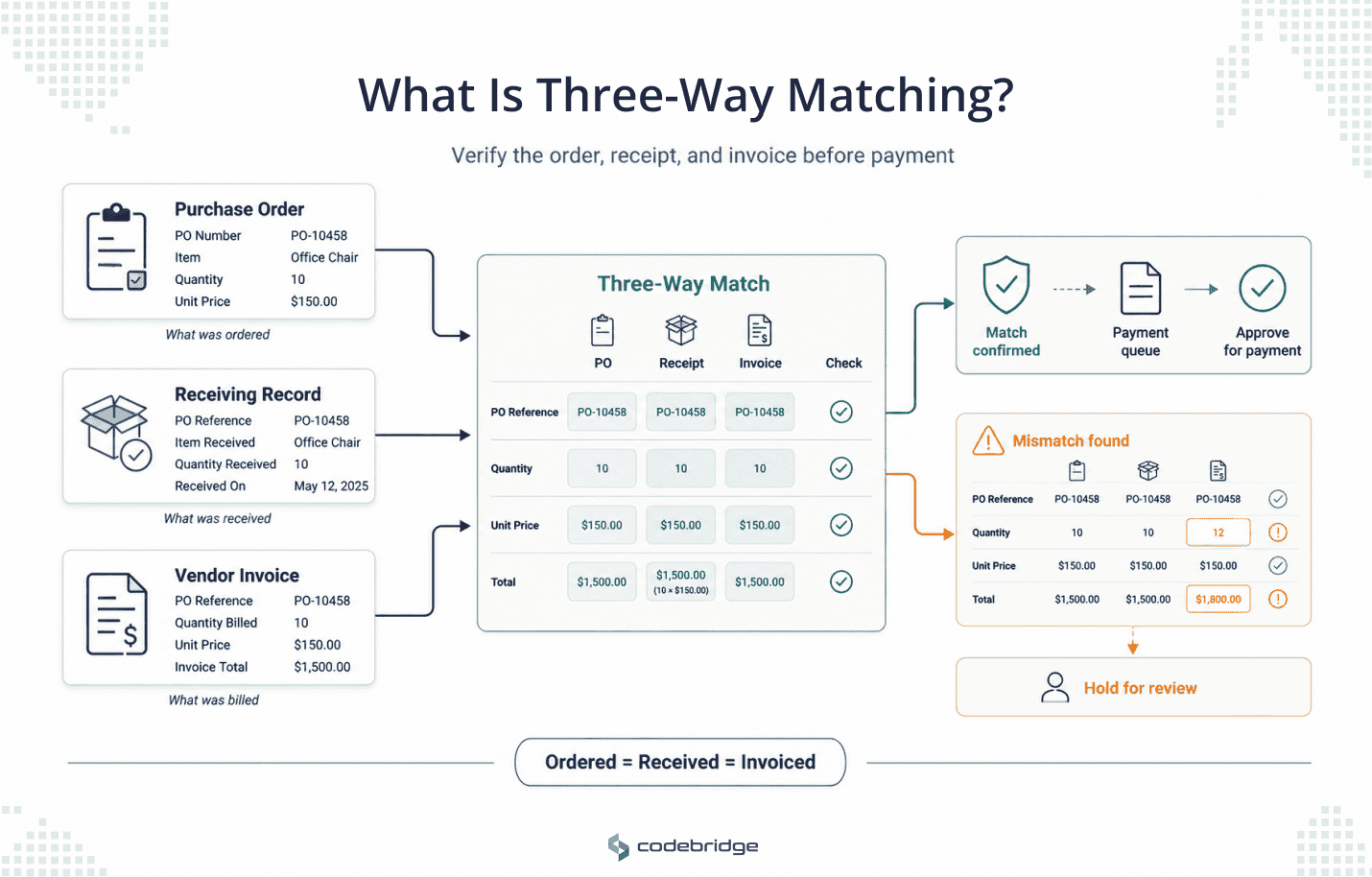
Three-way matching is a verification process that checks a vendor invoice against two internal records before payment: the purchase order that authorized the purchase, and the receiving record that confirms the goods arrived. The check covers the purchase order reference, the quantity, the unit price, and the totals. An invoice that agrees with both documents proceeds to approval. An invoice that disagrees is held.
The control answers three questions in one pass. Did someone with authority approve this purchase before it happened? Did the goods we are being billed for arrive? Does the amount the vendor is claiming match the price we agreed? A business that cannot answer all three is paying on trust.
That risk is also not an abstract. AFP's 2026 Payments Fraud and Control Survey found that 76% of organizations experienced attempted or actual payments fraud during 2025, a slight decline from the prior year but still elevated. Checks remained the method most often affected, with 58% of organizations reporting check fraud.
Matching is one of the few controls that catches a fabricated, inflated, or duplicated invoice before the money is paid. It also catches the far more common problem, which is honest error: a vendor bills the wrong price, ships short, or invoices the same order twice.
The Three Documents in a 3-Way Match
The control depends on three documents created at three different points by three different parties. Before the invoice is approved for payment, the system or accounts payable team checks that the quantities, prices, and receipt details agree within the firm’s defined tolerances.
Each document represents a different stage of the transaction:
- The purchase order records what the business approved.
- The receiving record shows what the business received.
- The vendor invoice states what the supplier expects to be paid.
The Purchase Order
The purchase order is issued by your purchasing function to the vendor before the transaction happens. It records the line items, the quantities, the agreed unit prices, the delivery terms, and a unique PO number that every later document should reference.
PO’s role in the match is to establish authorization. It shows that the purchase was approved under defined commercial terms before the firm became responsible for paying for it. Accounts payable then uses those approved terms as the baseline when reviewing the invoice.
A price difference does not automatically mean that the invoice is wrong. The supplier and the firm may have agreed to a legitimate change after the original order was issued. In that case, AP should be able to find an approved amendment, updated PO, or other documented authorization before releasing the invoice.
Two exceptions deserve particular attention. The first is the invoice that arrives with no purchase order at all, which cannot be matched and has to be treated as an exception requiring separate authorization.
The second is the retroactive PO, raised after the invoice arrives so the paperwork reconciles. A PO created to justify a purchase that already happened records nothing about authorization, and it defeats the control while appearing to satisfy it.
The Receiving Record
The receiving record, also called the goods receipt or goods received note, is created by whoever takes delivery. It records what arrived, in what quantity, on what date, in what condition, and who accepted it.
This document is what makes the match a three-way match. Without it, you can confirm what you ordered and what you were billed, and you have no evidence that anything turned up. The receiving record is the only proof that the business received value for the payment it is about to make.
For services, the equivalent may be a service entry sheet, milestone approval, timesheet, or another record confirming that the work was completed and accepted.
A standard receiving record should not be confused with a formal quality inspection. It confirms receipt, but it may not prove that the goods met every quality or condition requirement. When inspection and acceptance must also be verified before payment, the organization may use a four-way match.
Receiving errors are a common source of matching exceptions. A delivery may arrive without being entered into the system. A partial delivery may be recorded as complete. Returned or damaged items may not be reflected in the receipt quantity. The receiver may also copy the quantity from the packing slip without checking what physically arrived. In each case, the invoice may fail the match even when the underlying purchase is legitimate.
The Vendor Invoice
The vendor invoice is the supplier's request for payment. It states the invoice number and date, the line items, quantities and unit prices, the total, the payment terms, and, when the vendor has done its part, the purchase order reference.
Unlike the purchase order and receiving record, the invoice is typically created outside the buying organization. The purpose of the match is therefore to verify the supplier’s request against the records maintained by the firm.
Common invoice issues include missing or incorrect PO references, duplicate submissions, price differences, and quantities that exceed what was ordered or received. One invoice may also cover several purchase orders, or several invoices may relate to one purchase order, so the process must be able to allocate and match individual lines correctly.
A mismatch does not necessarily mean that the invoice should be rejected. It means that payment should pause until the difference is explained, supported, and approved by the appropriate person.
Why the Three Documents Come From Three Places
The documents are created at separate stages because each stage answers a different control question:
- Purchasing: Was the expenditure approved?
- Receiving: Were the goods or services delivered?
- Accounts payable: Is the supplier billing the correct amount?
No single person controls all three documents, so no single person can authorize a purchase, confirm it arrived, and approve its payment alone.
That separation is what allows the 3-way match to do more than identify clerical errors. It reduces the risk of unauthorized purchases, overbilling, duplicate payment, and payment for goods or services the firm did not receive.
How the 3-Way Match Process Works, Step by Step

A typical process can be described in six stages, although the exact sequence and approval rules vary by organization and accounting system.
1. The Purchase is Approved, and a Purchase Order is Issued
A requester identifies what the business needs, and the purchase goes through the appropriate approval process. Purchasing then issues a PO that records the supplier, items or services, quantities, agreed prices, delivery terms, and PO number.
The purchase should be approved before the order is placed and before the business becomes committed to paying for it.
2. The Delivery is Received and Recorded
When the goods arrive, the receiving team records the actual quantities delivered against the purchase order. Shortages, partial deliveries, damaged items, and returns should be reflected in the receiving record rather than copied from the supplier’s packing slip.
Recording the actual receipt accurately is essential because a standard 3-way match checks the quantity billed against the quantity received.
3. Accounts Payable Captures the Vendor Invoice
The supplier submits its invoice by email, through a vendor portal, by post, or through an electronic invoicing system. Accounts payable or an automated capture tool records the invoice number and date, supplier, PO reference, line items, quantities, unit prices, tax, total amount, and payment terms.
At this stage, the firm may also perform basic validations, such as checking for a duplicate invoice, confirming the supplier record, and verifying that the invoice contains the information required for processing.
4. The Match Runs
This is the step worth understanding in detail, because a three-way match is really three pairwise comparisons rather than one three-sided one.
- Invoice against purchase order. Does the invoice reference a valid PO? Does it come from the vendor named on that PO? Do the unit prices match what was agreed, and do the line items correspond? This comparison tests whether the charge was authorized at the stated price.
- Invoice against receiving record. Does the quantity billed match the quantity received? This comparison tests whether the business is being asked to pay for goods it has.
- Receiving record against purchase order. Does what arrived match what was ordered? This comparison tests delivery performance and catches over-shipments, short shipments, and substitutions.
Systems evaluate these comparisons against configured tolerances rather than demanding exact agreement, since small variances are normal and holding every invoice over a rounding difference would stall the function.
5. Match Within Tolerance is Approved for Payment
When the invoice is within tolerance, and any other required approvals are complete, it can be posted and scheduled for payment according to the agreed terms.
The accounting system should retain a record of the PO, receipt, invoice, matching result, approvals, exceptions, and any manual overrides. This creates the audit trail showing why the invoice was allowed to proceed.
6. Failed Match is Held as an Exception.
When a required document is missing or a difference exceeds the permitted tolerance, the invoice is placed on hold or routed into an exception workflow. It should not be released for payment until the discrepancy has been resolved or an authorized person has approved the variance.
Resolution may involve:
- recording a delivery that was received but not entered;
- correcting an inaccurate receipt;
- updating the PO after an approved commercial change;
- asking the vendor for a corrected invoice or credit note;
- waiting for the remaining goods to arrive;
- or documenting and approving an acceptable variance.
The objective is to ensure that each difference is understood and authorized before the business releases payment.
Worked Example
A purchase order is raised for 400 units at $11.50 each, a total of $4,600. Receiving records 400 units delivered in good condition. The vendor then invoices for 500 units at $12.00 each, a total of $6,000.
Run the three comparisons and each document settles a different question.
- Invoice against PO: the quantity is 100 units higher than ordered and the unit price is $0.50 higher than agreed. Both are variances.
- Invoice against receiving record: the invoice bills for 500 units while the receiving record confirms 400. The business is being asked to pay for 100 units it does not have.
- Receiving record against PO: 400 ordered, 400 received. These agree, so the delivery itself was correct.
The receiving record settles the quantity question, because the business owes for what arrived. The purchase order settles the price question, because $11.50 is what was agreed. The correct payable is 400 units at $11.50, or $4,600, and the invoice overstates it by $1,400. Without the receiving record, the overbilled quantity would be invisible. Without the PO, the price increase would look legitimate.
Two-Way vs Three-Way vs Four-Way Matching
The difference between two-way, three-way, and four-way matching is the evidence required before an invoice can be approved. Two-way matching checks the invoice against the purchase order, while four-way matching adds a separate inspection or acceptance step.
More documents do not automatically make one method better than another. The appropriate match level depends on how the purchase is received, what risks need to be controlled, and which records the business is expected to create.
In a two-way match, the system checks that the invoice agrees with the approved purchase order, usually within configured price and quantity tolerances. It does not validate the invoiced quantity against a receipt record.
Three-way matching adds evidence of receipt. For physical goods, this is normally a goods receipt. For services, it may be a service entry sheet, approved milestone, or another record confirming that the work was completed.
Four-way matching adds a separate inspection or acceptance record. This is appropriate when the business must confirm not only that the delivery arrived, but also that it met defined quality or compliance requirements.
Two-way matching should not be treated simply as an inferior version of three-way matching. It is appropriate when receipt confirmation is not part of the approved purchasing process. At the same time, a business should not select two-way matching merely because its receiving records are routinely missing or inaccurate.
Use two-way matching when authorization and invoice agreement are sufficient, three-way matching when delivery or service completion must also be confirmed, and four-way matching when formal inspection or acceptance is required before payment.
When Three-Way Matching Does Not Apply
Three-way matching governs the purchase of goods. A large share of what a business pays for has no receiving event at all, and no amount of configuration will produce a document that was never going to exist.
The categories where a 3-way match cannot work include:
- Professional services, including legal, audit, and consulting fees
- Software subscriptions and recurring licences
- Utilities, rent, and other fixed recurring charges
- Insurance premiums and financing costs
- Freight and certain pass-through charges
Forcing a three-way match onto these produces one of two bad outcomes. Either the invoices sit as permanent exceptions that staff learn to release without checking, which trains the team to override the control, or a receiving record gets created as a formality, which turns the strongest document in the match into a rubber stamp.
These invoices need different controls. Service-based approval against a contract or statement of work replaces the receiving record. The budget holder who commissioned the work confirms it was delivered.
Recurring charges get validated against the agreed schedule and reviewed for variance against prior periods. The control still exists, but the evidence is contractual.
The Exception Problem 3-Way Matching Creates
Every description of matching sells the upside. Almost none mention that the control generates work by design, because flagging disagreement is its function. A match that never produced an exception would be a match that was not checking anything.
Ardent Partners' State of ePayables 2025 reports an average invoice exception rate of 18.4%, alongside an average processing cost of $9.84 per invoice and an average processing time of 8.2 days. In Ardent's prior edition, invoice exceptions ranked as the top challenge in accounts payable for the first time in nineteen years of the study, cited by 53% of respondents.
Roughly one invoice in five requiring human investigation is a substantial labour line. The cost of a matching programme sits in the handling rather than the matching, because comparing three documents is cheap and chasing a missing receiving record during a month-end close is not. Each exception means finding the right person, gathering the evidence, deciding whether the variance is acceptable, documenting the decision, and releasing or correcting the invoice.
Here is where most organizations stop short. They automate the match, which the system does well, and leave the exception path manual. The bottleneck moves rather than disappearing. The work worth automating is the part that follows a failed match: routing the exception to whoever can resolve it, pulling together the documents and history that person needs, tracking the resolution, and keeping the trail for the audit. A person still decides the cases that need judgment, and stops spending the day assembling context before they can decide anything.
How Codebridge Approaches This
The match itself is well served by existing systems. Comparing three documents against a tolerance is exactly the kind of task software handles reliably, and most ERPs and AP platforms do it competently once configured.
The exception path is where the cost stays. Codebridge builds automation for that part: routing a failed match to the person who can resolve it, assembling the purchase order, receiving record, invoice, and vendor history they need in one place, tracking the resolution, and keeping the documentation trail intact for the audit.
We work on your data, alongside your team, and we hand over the code, so the automation belongs to your business rather than a vendor whose roadmap you do not control.
The engagement starts with a fixed-fee, three-week discovery on your own AP data. You watch the exception workflow run on your real invoices before committing to a build.
Accounting firms running accounts payable as a service line for clients face the same exception economics multiplied across every client they serve, and the firm-side view of which workflows to automate first sits in our guide for accounting firms
If exceptions are consuming your AP team's week, book a 30-minute call, and we will look at where the time goes.











Heading 1
Heading 2
Heading 3
Heading 4
Heading 5
Heading 6
Lorem ipsum dolor sit amet, consectetur adipiscing elit, sed do eiusmod tempor incididunt ut labore et dolore magna aliqua. Ut enim ad minim veniam, quis nostrud exercitation ullamco laboris nisi ut aliquip ex ea commodo consequat. Duis aute irure dolor in reprehenderit in voluptate velit esse cillum dolore eu fugiat nulla pariatur.
Block quote
Ordered list
- Item 1
- Item 2
- Item 3
Unordered list
- Item A
- Item B
- Item C
Bold text
Emphasis
Superscript
Subscript