There is no single accuracy percentage that makes an AI system suitable for accounting automation. A system that classifies incoming documents operates under very different conditions from one that posts journal entries, prepares tax positions, or releases payments. The appropriate standard depends on what the system does, what happens when it is wrong, and what controls sit between its output and a financial consequence.
This distinction is really important because accuracy is often discussed as if it were a product specification. A vendor may report 95%, 98%, or 99% accuracy, but none of those figures tells an accounting firm whether the system is safe to use. A useful evaluation also needs to consider the severity of errors, whether they can be detected and reversed, the volume of transactions, the amount of human review, and the authority given to the AI.
That is why we recommned companies to ask themselves a question: "Is it reliable enough for this specific accounting action, under the controls we have designed around it?"
There Is No Universal Accuracy Threshold for Accounting AI
Lower-risk workflows can tolerate more model error when mistakes are visible, reversible, and caught before they affect the books. Document classification is a good example. If an invoice is sent to the wrong queue but remains available for correction, the operational consequence may be small. The same error rate would be much harder to accept in a system authorized to post entries or move money.
Therefore, the required standard rises with the consequence and authority of the action. An AI system that recommends a GL code can operate under a different threshold from one that posts that code directly to the ledger. A system that prepares a payment for approval is different again from one permitted to authorize the payment.
A useful first approximation is:
The important point is that acceptable error depends on the consequences attached to that error.
Why a Headline Accuracy Percentage Is Misleading
Suppose a system processes 10,000 accounting items each month at 95% accuracy. That means approximately 500 outputs are wrong. Whether that performance is useful or unacceptable depends entirely on what those errors represent. Five hundred documents routed incorrectly but caught before processing are not equivalent to 500 incorrect invoice amounts or 500 incorrect payment decisions.
Average accuracy also hides the distribution of errors. Routine cases usually dominate a dataset, so a system can achieve an impressive overall score while performing much worse on unusual transactions. Those edge cases are often where accounting judgment and operational risk are concentrated.
Recent benchmarks show why this distinction matters. FinBalance, a 2026 benchmark designed around multi-document accounting reconciliation, found that six contemporary language models achieved at most 46% exact final-balance-sheet accuracy. More importantly, models sometimes produced numerically plausible accounting entries while failing to link them correctly to supporting documents or aggregate them consistently.
Structured document extraction shows a similar pattern. ExtractBench evaluated models across 12,867 annotated fields and found that performance deteriorated substantially as schema complexity increased. On its 369-field financial-reporting schema, none of the tested frontier models produced valid output. The benchmark also emphasizes that different fields require different definitions of correctness: an identifier may require an exact match, while a quantity may permit a numerical tolerance.
For an accounting firm, this means that the nature of the errors matters at least as much as the average score.
What Determines the Required Level of Accuracy?
We found six factors that are useful when deciding how reliable an accounting automation needs to be.
Error severity comes first. A wrong document category may create additional administrative work. A wrong journal entry can alter the ledger. An incorrect payment can produce a direct financial loss. These outcomes should not share the same acceptance criteria.
Detectability matters because some errors can be caught independently of the AI. Arithmetic checks, duplicate detection, PO matching, date validation, balance controls, and approval thresholds can all prevent an incorrect model output from becoming an incorrect accounting action. An error that looks plausible and cannot be independently validated is more dangerous.
Reversibility changes the risk again. Correcting a classification or draft is relatively straightforward. Recovering an incorrect payment or unwinding a material posting can be considerably harder.
Volume determines how frequently the residual error rate will appear in practice. At 99% accuracy, one hundred decisions may produce one error, while one hundred thousand decisions may produce roughly one thousand. A percentage cannot be interpreted without knowing the operating volume.
Human review can reduce risk, but only when the reviewer has enough evidence and time to assess the output meaningfully. A nominal approval step where staff routinely accept hundreds of AI recommendations without investigation provides much weaker protection.
Finally, system authority determines how far an AI output can travel before a person or deterministic control intervenes. Reading and classifying information sit at one end of the spectrum; executing transactions and approving consequential decisions sit at the other. The further the system moves toward execution, the stronger its reliability requirements should become.
Accuracy Requirements Change Within the Accounting Workflow
Document intake and extraction are good examples of why one number is rarely sufficient. An extraction system may identify the vendor, invoice number, date, purchase-order number, tax amount, and total. Reporting one average score across those fields obscures their different consequences. A wrong vendor address may create a correction. A wrong invoice total can affect the financial transaction itself. For extraction systems, firms should therefore measure performance at the field level and place stronger validation around financially significant values.
Reconciliation creates a different problem. An unmatched transaction remains visible and can be investigated. A false match can disappear from the exception queue and appear resolved. For this reason, it may be better for a system to automate a smaller set of highly reliable matches and escalate ambiguous cases than to maximize the percentage of transactions handled automatically. The FinBalance results are relevant here because they show that apparently plausible numerical outputs do not guarantee correct evidence linkage.
Journal processing and accounts payable show how accuracy requirements can change inside one workflow. AI may be useful for retrieving evidence, suggesting a GL account, preparing a draft entry, extracting invoice fields, or identifying an approver. The consequences increase once the system is permitted to post the journal or release money. A model that is suitable for preparation is not automatically suitable for execution.
Tax and close workflows require the same distinction. AI can assist with document extraction, research, reconciliation, variance identification, and draft preparation, but material judgments remain subject to professional responsibility. Circular 230 continues to establish competence and diligence requirements for practitioners representing taxpayers before the IRS. Using AI changes the tool used to perform the work; it does not transfer that responsibility to the model.
The appropriate threshold therefore needs to be set at the level of the individual action, not for “AP automation,” “tax AI,” or “month-end close” as a whole.
Accuracy and Automation Coverage Are Different Metrics
A common mistake is to assume that the best system is the one that automates the largest share of the workload. In higher-risk workflows, that can produce the opposite result.
Consider two reconciliation systems. One attempts to automate nearly every transaction but makes occasional false matches. The other automatically resolves only cases that meet a strict confidence and validation threshold and sends the remaining transactions to accountants. The second system may automate less work, but the work it does automate can be considerably safer.
This is the difference between accuracy and coverage. Accuracy measures how often the system is correct on the cases it handles. Coverage measures how much of the total workload it handles without escalation. Those metrics should be evaluated together.
A production system does not need to solve every case. In many accounting processes, a better design is to automate routine cases, identify uncertainty, and send exceptions to the appropriate person. That makes the system's ability to abstain or escalate part of its performance rather than evidence that the automation has failed.
The same principle applies to precision and recall. For transaction matching, false matches may make precision particularly important. For a control intended to identify missing documents or potentially risky transactions, missing a relevant case may make recall more important. The metric should follow the business consequence rather than be chosen because it is standard in a model benchmark.
Human Review and Uncertainty Need to Be Designed Into the Workflow
Human review is useful only if the surrounding process makes it meaningful. Reviewers need to see the information on which the AI based its recommendation, understand why a case was escalated, have authority to override the system, and face a review volume that allows them to exercise judgment rather than approve mechanically.
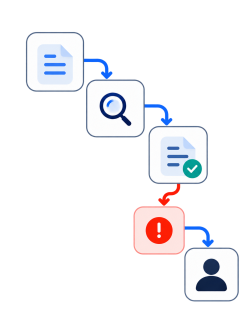
The system also needs a defined response when it does not have enough information to act safely. Depending on the workflow, that response might be to request missing data, retry an integration, apply a deterministic validation rule, send the case for review, or stop entirely. A production system should not be forced to generate an answer simply because an answer is technically possible.
Confidence scores can support this routing, but they should not be confused with measured accuracy. A model reporting high confidence does not prove that its output is correct with the same probability. If confidence is going to determine whether a transaction proceeds automatically, the firm needs to test how those confidence bands correspond to actual performance on its own data.
This leads to an important design principle: uncertainty handling is part of reliability. A system that correctly recognizes when it should not act can be more useful than one with a higher average score but poor escalation behavior.
How Accounting Firms Should Test Accuracy
Testing should use representative accounting data rather than clean examples selected during development. The evaluation set should contain routine transactions, genuine exceptions, poor-quality documents, missing fields, duplicates, conflicting information, unusual values, different entities or clients, and realistic integration failures. If a workflow is expected to encounter a class of problem in production, that problem should appear in evaluation.
The results should also be separated by error type. Overall accuracy can remain useful, but it should sit alongside field-level performance, false-positive and false-negative rates where relevant, critical errors, automation coverage, exception volume, and reviewer corrections. This makes it possible to distinguish a system that occasionally creates minor administrative corrections from one that rarely fails but fails in financially significant ways.
A shadow period is particularly useful before increasing system authority. The AI can process real inputs while the existing human process remains authoritative, allowing the firm to compare the AI's proposed result with the accepted result without exposing the ledger or payment process to unproven automation. The objective is not to demonstrate perfection. It is to understand where the system fails and whether those failures remain inside the controls designed for them.
Evaluation should continue after deployment. New clients, document formats, process changes, integrations, prompts, or model versions can change performance. NIST explicitly treats testing and evaluation as lifecycle activities rather than a one-time predeployment exercise.
How to Evaluate Vendor Accuracy Claims
A vendor claiming 98% accuracy may have an excellent system, but the percentage alone is not enough to evaluate it. The firm needs to understand exactly what was measured. Was the result based on document classification, individual invoice fields, complete invoices, transaction matches, or accounting decisions? Was correctness measured through exact matches, numerical tolerances, or human judgment? Was the test performed on vendor-curated data or on production data comparable to the firm's own?
It is equally important to understand what was excluded. Low-confidence cases may have been removed from the calculation. Unreadable documents may have been rejected before evaluation. The reported number may include human corrections or cover only the simplest cases. None of these choices is necessarily inappropriate, but they materially change what the accuracy figure means.
The firm should also ask for the error distribution, not only the average. Which errors occur most often? Which errors can affect financial records? What percentage of cases is escalated? What happens when the system is uncertain? How often do human reviewers change its decisions?
A useful vendor evaluation should ultimately answer two separate questions: how reliably does the system perform inside its automation boundary, and how well does it recognize cases that belong outside that boundary?
A Practical Standard for Accounting Automation
The objective of accounting automation should not be to make AI as autonomous as possible. It should be to automate as much of the workflow as can be handled reliably while preserving appropriate controls over the remainder.
That usually means keeping deterministic logic where the answer should not be probabilistic. Calculations, permissions, monetary thresholds, approval rules, and many validation checks are better enforced as rules. AI is useful where the workflow involves interpretation of documents, classification, retrieval, drafting, or ambiguous information. Human judgment remains necessary where professional accountability or material decisions require it.
This is also why neither 95% nor 99% should be treated as a universal target. Ninety-five percent may be entirely workable in a low-consequence workflow where the remaining cases are identified and reviewed. Ninety-nine percent can still be inadequate when the residual one percent includes financially material errors that are difficult to detect or reverse.
The appropriate standard is therefore straightforward: define the action first, identify the errors that matter, establish how those errors will be detected and contained, and only then set the performance threshold.
Production-ready accounting AI is not a model that never makes a mistake. It is a system in which the remaining mistakes have been measured, their consequences are understood, and the workflow prevents them from quietly becoming material financial decisions.















Heading 1
Heading 2
Heading 3
Heading 4
Heading 5
Heading 6
Lorem ipsum dolor sit amet, consectetur adipiscing elit, sed do eiusmod tempor incididunt ut labore et dolore magna aliqua. Ut enim ad minim veniam, quis nostrud exercitation ullamco laboris nisi ut aliquip ex ea commodo consequat. Duis aute irure dolor in reprehenderit in voluptate velit esse cillum dolore eu fugiat nulla pariatur.
Block quote
Ordered list
- Item 1
- Item 2
- Item 3
Unordered list
- Item A
- Item B
- Item C
Bold text
Emphasis
Superscript
Subscript