Short Answer
A bounded AI workflow in an accounting firm can usually be implemented in about 4–14 weeks, depending on what the system connects to, how many exceptions it must handle, and what it can do without human approval. Cross-system or multi-agent implementations can take 12–20 weeks or longer.
Those are not industry benchmarks, more like a planning range. There is no credible universal dataset showing that AP automation takes exactly X weeks or reconciliation takes Y. The important distinction is scope.
A prototype may take hours or days. A production system has to work with real data, integrations, permissions, exceptions, controls, monitoring, and human review. Thomson Reuters’ 2026 roadmap for audit firms allocates 8-12 weeks to a pilot alone and another 12-16 weeks to firm-wide rollout.
That is why the fastest project is the workflow with the clearest rules, cleanest data, fewest integrations, and lowest operational authority.
AI Implementation Timeline by Project Type
The ranges below are practical planning bands calculated by Codebridge based on the scientific and practical data for a bounded, production-minded implementation. They synthesize documented accounting implementations, current AI deployment guidance, and the relative engineering complexity of each workflow.
A firm-wide AI adoption program is a different project. Thomson Reuters recommends 4-6 weeks for solution selection, 8-12 weeks for a pilot, and 12-16 weeks for rollout after the strategy phase.
Why Two AI Projects Can Have Completely Different Timelines
Here are five variables that explain most of the difference: workflow complexity, integration surface, data readiness, exceptions, and system authority.
A system that reads an invoice and extracts five fields is relatively bounded. But when a system reads the same invoice, identifies the vendor, matches it against a purchase order, investigates discrepancies, finds the correct approver, and updates the ERP is not.
Integration matters for the same reason. One clean API is different from a workflow that crosses email, document storage, QuickBooks or NetSuite, practice-management software, and client systems.
Also, exceptions often determine the production timeline more than the happy path. Accounting automation has to know what to do when documents are incomplete, references do not match, accounts are ambiguous, or the underlying records disagree.
Finally, authority changes the engineering requirement. A system that recommends an action can usually reach production sooner than one that can execute it.
Document Intake and Data Extraction: 4-8 Weeks
Document intake is generally one of the faster accounting AI projects because the task can be narrowly bounded: receive a document, classify it, extract defined information, and send uncertain cases to review.
The shorter end of the range applies when document types are predictable, fields are known, and the output goes into one system. The timeline grows when the firm handles many document formats, poor scans, multiple client structures, or complex downstream routing.
The scope also matters because extracting fields from invoices is a document-processing problem. Extracting them, validating them against client records, deciding their accounting treatment, and posting them is a larger workflow.
Codebridge’s existing research on accounting document processing reaches the same boundary: collecting files, extracting usable data, and determining whether the firm has everything required are separate problems, and the third is substantially harder.
Best fit: a firm with high document volume, repeatable document types, and a clear human review path for low-confidence cases.
Accounts Payable Automation: 6-10 Weeks
AP takes longer because invoice extraction is only the beginning.
A production workflow may need to capture an invoice, identify the vendor, validate invoice details, match against purchase orders and receipts, assign the GL code, route the invoice through an approval matrix, update the ERP, and preserve an audit trail.
The shorter end of the range is realistic when the vendor master is clean, approval rules are already documented, and the ERP exposes reliable integrations. Non-PO invoices, inconsistent vendor data, entity-specific rules, and unusual approval paths extend the project.
The architecture should also separate deterministic work from probabilistic work. Calculations and approval thresholds belong in rules. AI is more useful for document understanding and ambiguous exceptions. Material payment authority should remain behind defined controls.
Codebridge’s AP workflow research identifies the vendor master and current process baseline as two of the main prerequisites before automation begins.
Bank Reconciliation Automation: 6-10 Weeks
Reconciliation automation is not mainly about teaching AI to find matching numbers. The hard part is defining what happens when the numbers do not match.
A simpler implementation may connect one banking source to one ledger, apply deterministic matching rules, and route the remaining transactions to review.
Complexity rises with multiple entities, inconsistent transaction descriptions, aggregate matches, intercompany activity, missing references, and different accounting systems.
Codebridge’s reconciliation workflow separates the problem into three stages: data ingestion, matching, and exception handling. Many firms focus on matching first even though unreliable ingestion causes the failures and exceptions create most of the operational work.
Current model benchmarks also support caution around autonomous accounting decisions. FinBalance tested six models on multi-document accounting reconciliation and found a maximum exact final-balance-sheet accuracy of 46%. Numerically plausible outputs were frequently not tied correctly to supporting evidence.
Best fit: high-volume reconciliation where standard matching can be automated and a reviewer remains responsible for unresolved items.
Month-End Close Automation: 8-14 Weeks
Close automation takes longer because the close is a dependency chain rather than one task.
Data capture feeds reconciliation. Reconciliation feeds entries and adjustments. Those feed variance review and sign-off. Automating one step does not remove the dependencies around it.
A project that automates one close activity can stay near the shorter end of the range. Building coordination across reconciliation, recurring entries, exception routing, evidence collection, and review requires more integration and testing.
Codebridge’s current close research shows why this matters. A 2026 field study covering 79 businesses associated generative AI use with a 7.5-day reduction in monthly close time, but contemporary benchmarks still show substantial failure rates when models move from deterministic work into accounting judgment.
Best fit: firms that have already stabilized the transactional workflows feeding the close.
Tax Preparation and Compliance Support: 8-14 Weeks
The timeline depends on what “tax automation” means.
Extracting information from standardized source documents and preparing a draft is one project. Allowing AI to interpret unusual facts, determine tax treatment, and produce client-facing conclusions is another.
Tax workflows therefore require a clear line between preparation and professional judgment. The more the system influences conclusions rather than preparation, the more time should be allocated to evidence validation, review rules, access controls, and testing.
Circular 230 continues to place competency and diligence obligations on practitioners representing taxpayers before the IRS. AI changes the tooling, not the practitioner’s underlying professional responsibility.
Best fit: bounded preparation, extraction, research, and review-assistance workflows where a qualified professional remains responsible for the conclusion.
Cross-System and Multi-Agent Automation: 12-20+ Weeks
Multi-agent projects take longer because the problem is no longer one model performing one task. It is a system coordinating actions across several tools while maintaining state, permissions, sequencing, retries, escalation, and auditability.
Several agents can safely read information in parallel. Writing back into operational systems is harder because actions can conflict or occur in the wrong order.
That distinction is particularly important in accounting. The process may cross AP, AR, reconciliation, close management, email, ERP data, and client approvals. The system has to know not only what to do, but what it is permitted to do and when it must stop.
Codebridge’s analysis of multi-agent accounting systems argues for keeping the close sequence deterministic and using agents inside controlled boundaries rather than allowing models to decide the entire process at runtime.
Best fit: firms automating processes that already cross several systems and cannot be handled adequately by a standard product.
Not best for: a firm that needs one standardized capability already solved by existing software.
What Actually Happens During Those Weeks?
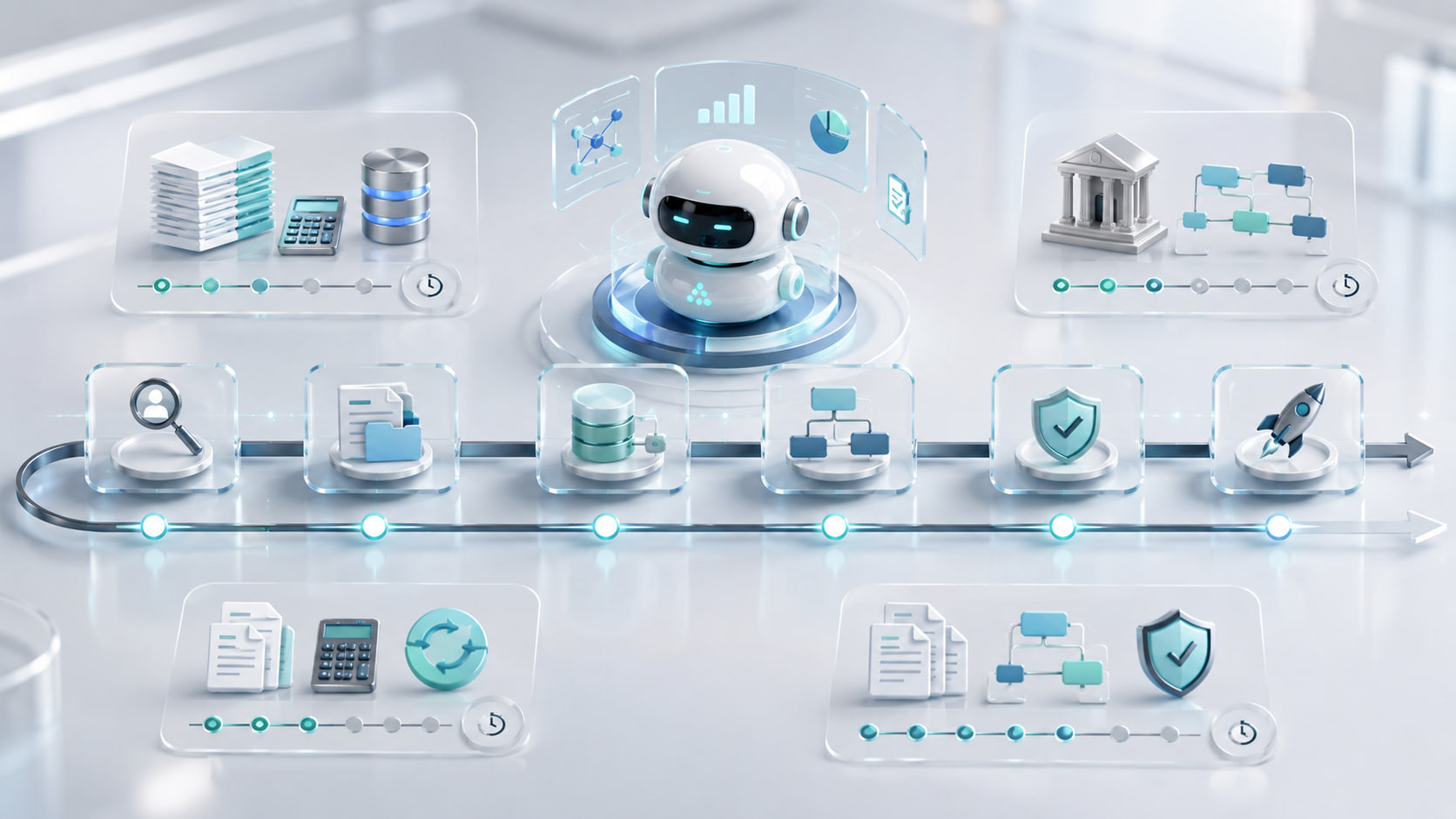
A serious implementation has six stages.
Workflow mapping. Define the current process, systems, baseline cost, exceptions, owner, and system authority.
Data and integration validation. Test real documents, APIs, permissions, and system constraints before committing to the architecture.
Build. Implement the bounded workflow against representative data.
Evaluation. Test normal cases, exceptions, malformed inputs, tool failures, low-confidence outputs, and permission boundaries.
Shadow mode. Run the new system against real work without allowing it to replace the current process yet. Compare its outputs with the human baseline.
Controlled production. Give the system only the authority that testing has justified, then expand that authority if the evidence supports it.
NIST recommends testing AI before deployment and continuing to evaluate it while it operates in production.
Prototype Timeline vs Production Timeline
A prototype and a production implementation should never be quoted as if they were the same deliverable.
The difference is visible in real accounting cases.
At High Rock Accounting, a small internal client-feedback application was built with Claude Code in roughly four to five hours, and another onboarding prototype was created in a few hours.
At the other end, Wiss & Company tested an AI agent platform inside its Client Accounting Services practice for ten months before announcing full deployment.
Both timelines can be true because they describe different scopes and different definitions of “implemented.”
“We built it in two days” and “we can safely rely on it in production after two days” are not equivalent claims.
What Makes an AI Implementation Take Longer?
The most common delays happen before the model becomes the problem.
An undocumented workflow forces the development team to discover the process while building it. Poor integrations expose constraints only after development starts. Dirty historical data creates exceptions nobody scoped. Different partners or teams may run what is supposedly the same process differently.
Authority is another major source of delay. If nobody has decided what AI may execute, what requires approval, and what must remain human, the team cannot design the controls around it.
Evaluation also expands once real exceptions appear. AWS recommends treating evaluation as a formal component of a generative AI system rather than an afterthought, with human review retained as the final quality gate for critical decisions.
The faster way to implement AI is therefore usually to reduce uncertainty before development, not to write software faster.
What Should an Accounting Firm Prepare Before Implementation?
A firm can shorten the project materially by arriving with one bounded workflow rather than a general goal to implement AI.
Document how the workflow operates today, which systems participate, who owns each step, what a successful outcome looks like, and what happens when the standard path fails.
Collect representative real examples, including difficult ones. Establish the current workload or cost baseline. Decide which actions may happen automatically and which require approval. Confirm access to the systems the implementation will need to integrate.
Thomson Reuters similarly recommends starting with focused, repeatable use cases and standardizing workflows before scaling AI across the firm.
How to Estimate Your Own AI Implementation Timeline
Five questions give a better first estimate than asking what model will be used.
A workflow on the left side of the table may fit a 4-8 week implementation.
A workflow in the middle generally moves toward 6-14 weeks.
A workflow concentrated on the right should be treated as a larger production system. Twelve to twenty weeks or more may be more realistic.
The exact estimate should follow workflow and integration discovery.
Can an Accounting Firm Implement AI in 30 Days?
Yes, if the scope is narrow.
A realistic 30-day project has one clearly defined workflow, known systems, representative data, accessible integrations, limited system authority, and a measurable success condition.
Thirty days is not a credible blanket promise for automating an accounting practice or deploying autonomous agents across several workflows.
This distinction matters because even packaged AI adoption usually requires a longer validation period. Thomson Reuters recommends an 8-12 week pilot before a broader audit-firm rollout.
When Should You Extend the Timeline?
Take more time when errors can create material financial consequences, when actions are difficult to reverse, when the evidence trail is incomplete, when integrations have not been tested, or when the system is being given more operational authority.
A slower deployment is also justified when the team cannot yet state when the system should act, retry, escalate, or stop.
AWS recommends restricting autonomous actions to well-defined, lower-risk scenarios and retaining human review for high-risk or unfamiliar situations.
The shortest implementation is not necessarily the cheapest implementation. A week saved before launch has little value if the system creates months of exception handling afterward.
How Codebridge Approaches Accounting AI Implementation
Codebridge starts with the workflow.
Before a full build, the current approach is a fixed-fee, three-week discovery on one workflow using the firm’s own data. The purpose is to determine how the process actually works, where integrations and exceptions sit, what should remain deterministic, and what authority an AI component should receive.
The implementation then moves through bounded development, evaluation, shadow operation, and controlled production.
That sequence matters because an accounting firm does not need an impressive prototype. It needs a workflow that remains reliable when the clean examples run out.
Conclusion
There is no useful answer to “How long does AI implementation take?” without defining the workflow.
A narrow document workflow may take several weeks. AP or reconciliation may take longer because they add integrations and exceptions. Close and tax workflows add dependencies and review requirements. Cross-system agents add orchestration, permissions, and production controls.
The best estimate therefore starts with five questions: what workflow, which systems, how many exceptions, what authority, and what happens when the system is wrong?
Answer those first. Then put a date on the project.











Heading 1
Heading 2
Heading 3
Heading 4
Heading 5
Heading 6
Lorem ipsum dolor sit amet, consectetur adipiscing elit, sed do eiusmod tempor incididunt ut labore et dolore magna aliqua. Ut enim ad minim veniam, quis nostrud exercitation ullamco laboris nisi ut aliquip ex ea commodo consequat. Duis aute irure dolor in reprehenderit in voluptate velit esse cillum dolore eu fugiat nulla pariatur.
Block quote
Ordered list
- Item 1
- Item 2
- Item 3
Unordered list
- Item A
- Item B
- Item C
Bold text
Emphasis
Superscript
Subscript