AI Answer Summary
Month-end close automation means running the repeatable parts of the close on systems rather than on staff hours. It covers data capture, account matching, standard journal entries, exception routing, and status tracking. It does not cover accrual judgment, policy decisions, or final sign-off. Current research indicates those steps should remain with a qualified person.
The close runs as a dependency chain. Each step depends on the one before it, so automating a late step while an early step stays manual produces no reduction in cycle time. Sequence matters more than tool selection. Firms that compress the close automate in a defined order: capture and normalization first, then mechanical tie-outs, then recurring entries, then exception routing.
The measurable gain is real and bounded. A 2026 field study published in the Journal of Accounting Research found generative AI use associated with a 7.5-day reduction in monthly close time across 79 businesses. Also, separate 2026 benchmarks found that no current model completes close tasks reliably enough to work without supervision. Both findings hold. Workflow design explains why.
Why the Close Resists Automation
The month-end close is not a set of parallel tasks, it is a sequence. Its duration is determined less by how fast individual tasks run than by the dependencies between them. Subledgers close before reconciliations begin. Reconciliations complete before accruals are finalized. Accruals post before variance review, and variance review precedes sign-off. A firm that automates variance reporting while its bank reconciliations still run through spreadsheets has automated the last mile of a road that remains blocked at the start.
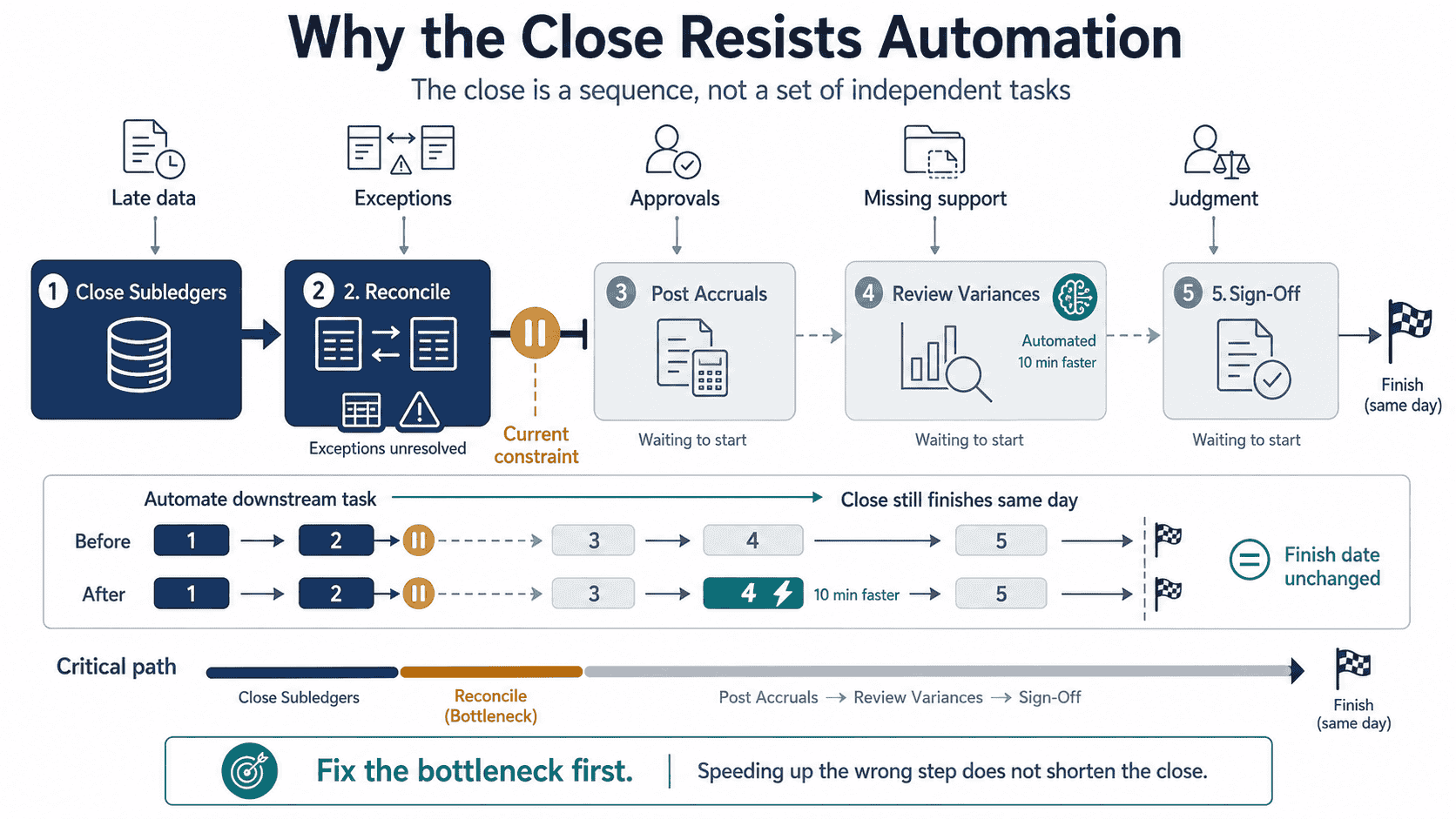
That dependency structure is one reason the close resists piecemeal automation. Late source data, unresolved reconciliation exceptions, manual approvals, inconsistent supporting documents, and judgment-heavy adjustments can all hold up the next step even when another part of the process has been automated. Removing ten minutes from a downstream task does little if the task cannot begin until an upstream exception is resolved.
This explains a common outcome. A firm buys close-management software, staff learn it, and the close takes the same number of days it did before. That does not necessarily mean the software failed. The close behaves like a constraint system: speeding up a task that is not on the critical path does not move the finish date. The software addressed a step that was never the constraint.
Benchmark data on close duration deserves scrutiny before any firm measures itself against it. The figure quoted across most industry content, a median of roughly 6.4 calendar days from trial balance to consolidated financial statements, comes from an APQC Open Standards Benchmarking survey of about 2,300 organizations published in 2018. It remains the most widely available close benchmark at no cost, and it predates the current generation of automation tools by several years. Firms should treat it as a historical reference rather than a current standard.
What has changed since is the evidence base. Between June and July 2026, three separate research efforts published measurements of how well current AI systems perform specific close tasks. That work makes it possible to sequence close automation against evidence.
What the Evidence Shows About Automating The Close
Research published in the Journal of Accounting Research in 2026 provides the strongest available evidence on outcomes. Jung Ho Choi of Stanford and Chloe Xie of MIT combined a survey of 277 professional accountants with transaction-level field data from an accounting platform serving 79 small and medium enterprises, covering more than 200,000 records. Adoption of generative AI was associated with a 7.5-day reduction in monthly close time. The study also recorded a 12 percent increase in general ledger granularity and a reallocation of roughly 9 percent of accountant time away from routine data entry toward client communication and quality assurance.
Firms selected into AI use, so the findings describe association.
The limits are documented with equal precision. APEX-Accounting, a benchmark released in July 2026 by Mercor in partnership with Ramp, tested nine frontier models against 160 close tasks authored by 42 accounting experts, more than half of whom had worked at a Big Four firm. Each benchmark environment is a company frozen at a specific month-end close.
The strongest model met 56.4 percent of grading criteria. No model produced a fully correct output across all eight attempts on more than 2.6 percent of tasks, and 93 of the 160 tasks went unsolved by every model in every run. The benchmark authors concluded that an agent which is usually correct but not reliably correct cannot yet close the books unsupervised.
A second benchmark, FinBalance, published in June 2026 by researchers at BITS Pilani, KIIT Bhubaneswar and the University of Oxford, tested a narrower question: whether models can build a cited ledger and balance sheet from raw source documents. Across six models and 710 records, the highest exact balance-sheet accuracy reached 46 percent. The failures concentrated in specific places.
Source: FinBalance (arXiv:2606.15949v1), six models across 710 records, June 2026. Preprint, not peer reviewed.
Both benchmarks have a similar pattern. Systems perform where a rule defines the correct answer and degrade where a person has to justify a treatment. In the FinBalance results, 52 percent of journal entries carrying the correct account and the correct amount cited the wrong supporting document, and stronger citation instructions moved that rate by 1.4 percentage points.
The problem is evidence selection. In APEX-Accounting, schedules and accruals ranked as the hardest category for every one of the nine models tested, trailing each model's strongest category by 7 to 21 percentage points.
These two sets of findings are consistent with each other. In the field study, accountants intervened selectively where the system reported low confidence. The time saving followed from that division of labor. It is a property of how the workflow was designed.
The Automation Sequence: Seven Steps in Dependency Order
The close should not be automated in the order tasks happen to appear on a checklist. It should be automated in the order that reduces dependency risk.
Two principles order the work.
First, automate in descending order of determinism. A deterministic task is one where the same inputs should produce the same accounting treatment under a rule the firm can state in advance. The more often a task depends on estimates, missing context, unusual transactions, or client-specific judgment, the later it belongs in the automation sequence.
Second, move human review from routine processing to defined exceptions. Routine items should pass automatically when they satisfy the firm's rules. Items that breach a materiality threshold, lack evidence, fall outside expected patterns, or require accounting judgment should route to a person. This does not remove formal control points: final approval and period lock remain human responsibilities.
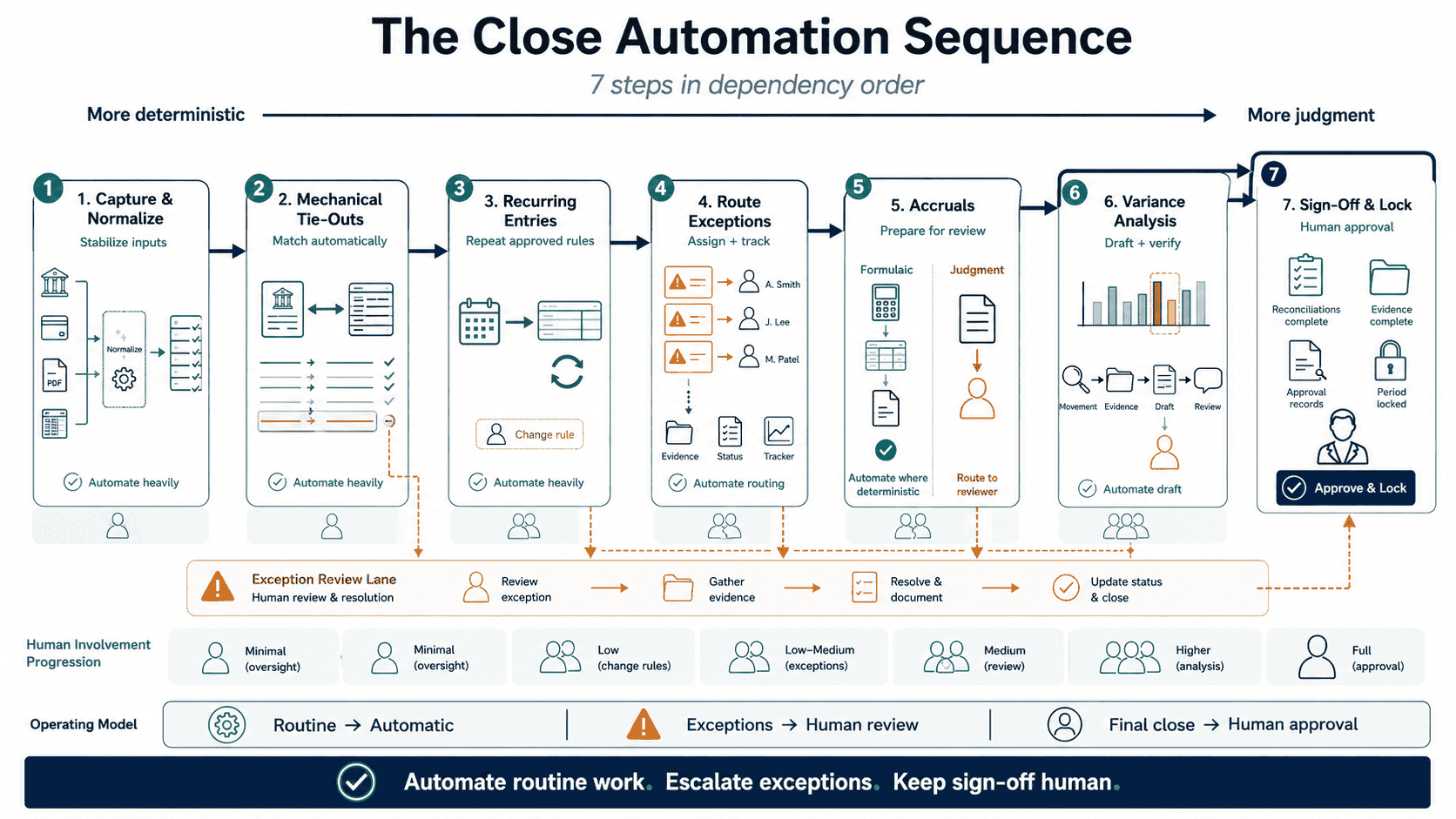
This is an automation sequence, not necessarily a seven-stage close calendar. Several activities can run in parallel. The sequence describes the order in which a firm should remove manual work: stabilize the inputs first, automate mechanical processing next, and leave judgment-heavy decisions until the system can reliably assemble the evidence a reviewer needs.
1. Capture and normalization
Start with bank feeds, card feeds, document intake, transaction coding, and the normalization of data arriving from client systems.
This is usually the highest-automation-ceiling part of the close because most of the work is governed by repeatable rules. If transactions still arrive through spreadsheets, PDFs, email attachments, or inconsistent exports, every downstream process inherits that inconsistency.
The objective is to automate the routine population and normalization of the ledger while routing unsupported or ambiguous transactions to a person.
Capture should be treated as the first readiness gate rather than an absolute requirement to rebuild what already works. If feeds, integrations, and intake are already reliable, the firm can move directly to the first unresolved dependency.
Automate: data ingestion, normalization, document extraction, recurring coding rules, duplicate detection.
Keep with a person: new transaction types, unsupported classifications, unusual client-specific treatment.
Move on when: most routine transactions reach the ledger without someone manually preparing the underlying data.
2. Mechanical tie-outs
Next automate the work where two known records should agree: bank reconciliation, card reconciliation, payment matching, inter-account transfers, and subledger-to-general-ledger tie-outs.
This category has one of the clearest automation boundaries in the close. A system can match transactions, compare balances, identify contradictions, and surface the items that do not reconcile. A person should resolve the reason for the break when the evidence does not support an automatic disposition.
Benchmark results place system reliability at its highest on these narrowly defined reconciliation tasks, including contradiction detection above 90 percent on some balance and transfer mismatches. That should not be interpreted as evidence that an end-to-end reconciliation process can operate autonomously at the same reliability. The practical conclusion is narrower: automate the matching and let staff work the exceptions.
The goal is to change reconciliation from a search exercise into an exception queue.
Automate: matching, balance comparison, transfer detection, duplicate identification, break detection.
Keep with a person: unexplained differences, missing transactions, incorrect postings, material breaks.
Move on when: staff spend most of their reconciliation time resolving genuine exceptions rather than finding and matching routine transactions.
3. Standard recurring entries
Once the underlying records are stable, automate entries governed by schedules or formulas that rarely change: depreciation, amortization, prepaid releases, recurring allocations, and similar journals.
Rebuilding these entries manually each month introduces variance without adding control.
Stable schedules can be prepared or posted automatically within predefined rules. Changes to the underlying schedule, amount logic, account mapping, useful life, allocation method, or effective period should trigger review.
The important distinction is between repeating an approved accounting rule and deciding what that rule should be. The first is an automation problem. The second remains an accounting decision.
Automate: schedule-based calculation, journal preparation, template posting, recurring support generation.
Keep with a person: changes to assumptions, schedules, account mappings, or accounting treatment.
Move on when: routine recurring entries no longer require staff to reconstruct the same calculation every month.
4. Exception routing and evidence capture
The next step is not primarily about automating accounting judgment. It is about automating the movement of work around that judgment.
When a reconciliation breaks, a document is missing, or a transaction breaches a rule, the system should assign the issue to a named owner, record its status, preserve the supporting evidence, and track the decision through resolution.
This is where a significant amount of close friction can disappear without asking AI to make accounting decisions.
Without structured exception routing, breaks sit in spreadsheets, email threads, chat messages, and individual memory. Managers spend time asking who owns an issue, whether supporting documents arrived, and whether an item was cleared. The close may be technically progressing while nobody has a reliable picture of what remains open.
Evidence capture should happen as the work happens. An invoice, reconciliation note, approval, calculation, and disposition should remain attached to the underlying close item rather than being assembled retrospectively before review or audit.
Automate: assignment, reminders, escalation, status tracking, evidence filing, completeness checks.
Keep with a person: the accounting disposition and resolution of the exception.
Move on when: every material break has an owner, a status, supporting evidence, and a recorded resolution.
5. Accruals and schedules
Accruals have a lower automation ceiling because the work often combines incomplete information with accounting judgment.
The category should not, however, be treated as uniformly manual.
Separate formulaic accruals from judgmental estimates. A payroll accrual based on an established formula is different from an accrual whose amount depends on incomplete vendor information, uncertain utilization, a bonus estimate, or a management assumption.
For stable rules, a system can assemble the schedule, apply the formula, compare the result with prior periods, and prepare the proposed entry. Where the amount or accounting treatment depends on assumptions, incomplete evidence, or a material estimate, a person should make the decision.
The purpose of automation here is therefore less about replacing the accountant and more about delivering a review-ready package.
Automate: schedule assembly, known calculations, prior-period comparison, movement flags, supporting-document collection.
Keep with a person: material estimates, assumptions, unusual treatments, and judgment over what should be booked.
Move on when: reviewers receive a complete schedule and supporting evidence without having to assemble it manually.
6. Flux and variance narrative
Once balances are stable, automate the preparation of variance analysis.
A system can identify which accounts moved, compare results with prior periods or expectations, retrieve the transactions contributing to the movement, and draft a first version of the commentary.
The important control is that the explanation must remain grounded in evidence.
The system should not simply observe that an expense increased and generate a plausible reason. It should trace the movement to underlying transactions, schedules, client inputs, or other evidence and show the reviewer what supports the proposed explanation.
The sequence should therefore be:
- detect the movement
- retrieve the evidence
- identify likely drivers
- draft the commentary
- have a person verify the explanation
The person remains accountable because this is the point where numbers become a business explanation that a client, partner, controller, or auditor may rely on.
Automate: variance detection, account prioritization, supporting-data retrieval, first-draft commentary.
Keep with a person: causal explanation, materiality judgment, and final narrative.
Move on when: every material variance presented for review is accompanied by the evidence behind the proposed explanation.
7. Sign-off and lock
Final sign-off remains human.
Automation should make sign-off smaller and better informed, not remove the accountable reviewer.
Before the period locks, the system can verify that required reconciliations are complete, material exceptions have been dispositioned, supporting evidence exists, scheduled journals were processed, required approvals were recorded, and unresolved items are explicitly documented.
The reviewer should not have to redo the close. The reviewer confirms that the control framework has operated as intended and accepts responsibility for closing the period.
Automate: completeness checks, unresolved-item reports, evidence verification, approval routing.
Keep with a person: final approval and period lock.
Move on when: a named reviewer can see the complete evidence trail and explicitly approve the close.
What to Automate at Each Step
For a client accounting services practice, this sequence also becomes a standardization plan.
Steps 1 through 4 are particularly important because they create the operating layer that can be reused across a book of clients: common intake rules, normalization patterns, reconciliation logic, and review controls.
Client accounting services was the fastest-growing service line among Accounting Today's 2026 Top 100 Firms, with 85 percent of the 88 responding firms reporting growth. That growth makes standardization more important because the firm cannot scale by designing a completely different close process for every new engagement.
The scalable asset is one operating model with client-specific rules configured on top.
A firm that standardizes that operating model can improve it once and apply the improvement across many engagements. A firm that redesigns the workflow around every client's quirks continues to scale headcount alongside revenue.
The Validation Layer: Three Controls an AI-Assisted Close Requires
The seven-step sequence determines where automation belongs. A separate question determines whether the automated output can be trusted.
That requires a validation layer running across the close rather than another step at the end of it. Three controls test three different failure modes: whether the accounting output is internally correct, whether the underlying evidence is consistent, and whether the conclusion can be traced back to the evidence that supports it.
1. Deterministic replay: does the output follow from the entries?
When an AI system proposes journal entries or reports a resulting balance, do not ask the same system to verify its own arithmetic.
Recompute the result independently from the posted or proposed entries using deterministic accounting logic, then compare that result with what the system reported. Any difference should surface before the workflow progresses.
The principle is simple: Use AI to propose. Deterministic systems to prove.
In FinBalance, researchers returned ledger differences to the model and allowed one revision. Exact balance-sheet accuracy improved by roughly 30 to 32 percentage points across the three tested model families. It was the largest improvement in reported balance-sheet accuracy among the benchmark's tested interventions.
The production implication is narrower than asking AI to become better at arithmetic. Where an accounting system or ledger already provides the authoritative calculation, use it. AI can propose entries, classify transactions, retrieve evidence, identify anomalies, and draft explanations. It should not become the second source of truth for a balance the ledger can calculate deterministically.
For a firm, the replay control therefore asks:
- Do the proposed entries produce the balance the automation claims they produce?
- Does the subledger still tie to the general ledger after those entries?
- Do debits, credits, roll-forwards, and period movements recompute independently?
- If they do not, does the item stop before approval?
But a balanced replay, proves only that the numbers are internally consistent.
2. Independent contradiction detection: should these inputs be reconciled at all?
This is where the FinBalance results become more important.
The same ledger-feedback intervention that improved balance-sheet accuracy reduced the models' ability to identify contradictions in the source material. The decline was 13, 17, and 52 percentage points across the three tested models.
The mechanism matters more than the percentages.
Once a system is told that its numbers do not reconcile and is asked to fix them, reconciliation becomes its objective. In many cases, that is exactly what the firm wants. In others, the correct conclusion is that the documents cannot legitimately be reconciled because something in the evidence is missing, inconsistent, or wrong.
Consider a simple close exception. A vendor statement shows $18,400 outstanding. The AP subledger shows $15,900. A payment advice appears to explain the $2,500 difference, but no corresponding payment appears in the bank feed.
A reconciliation-first system is rewarded for finding a treatment that closes the $2,500 gap.
The correct operational response may instead be:
Stop. The evidence is inconsistent. Confirm whether the payment occurred before changing the books.
That is why contradiction detection needs its own lane.
The contradiction check should receive the underlying evidence independently of the instruction to make the accounts reconcile. Its output should answer a different question:
Are these records mutually consistent enough for reconciliation to continue?
Possible outcomes are not only pass and fail. They should include:
- evidence is consistent;
- evidence contains a contradiction;
- evidence is incomplete;
- the difference requires human investigation.
"Independent" does not necessarily mean another AI vendor or another model. It means an independent objective and execution path. A later reconciliation should not be allowed to erase an earlier contradiction simply because the system found a way to make the numbers balance.
A close that always balances is not the same as a close that is correct. Optimizing only for the first can make the second less likely.
3. Evidence lineage: does the conclusion point to the right support?
The third control sits between the first two.
An entry can balance correctly. The underlying documents can contain no direct contradiction. The close can still be indefensible if the system cannot show which evidence supports the accounting conclusion.
Every material automated output should therefore preserve a trace back to its source.
For a proposed journal entry, that means identifying the invoice, contract, schedule, bank transaction, approval, or other evidence supporting the amount and treatment.
For an accrual, it means preserving the calculation, assumptions, source data, and reviewer decision.
For a reconciliation exception, it means recording what caused the difference and what evidence cleared it.
For variance commentary, it means linking the explanation to the transactions or schedules that actually produced the movement rather than allowing a model to generate a plausible narrative from the balance alone.
The control asks more than whether a document exists. It asks:
- Is this the correct supporting document?
- Does it support the amount?
- Does it support the accounting treatment?
- Does it belong to the correct entity and period?
- Was the evidence available when the decision was made?
- Can a reviewer follow the same path from source to conclusion?
This is why evidence capture in Step 4 of the automation sequence matters. Filing support while the close happens is not administrative housekeeping. It creates the lineage that later allows an automated decision to be reviewed and defended.
Correct number plus wrong evidence is still a failed control.
The three controls catch different failures
The distinction matters because each control can pass while another fails.
These controls should run across the automation sequence rather than after it.
Replay becomes relevant wherever the system proposes accounting outputs. Contradiction detection should run before ambiguous evidence is allowed to disappear inside a reconciliation or accrual calculation. Evidence lineage begins at intake and follows the item through exception resolution, review, and final sign-off.
The architecture is therefore two-dimensional:
The seven-step sequence determines where to automate.
The three controls determine what must remain true while automation runs.
At final sign-off, the reviewer should not be reconstructing either dimension manually. The system should be able to show that material outputs replay correctly, unresolved contradictions have been escalated, and the evidence trail from source documents to accounting conclusions is complete.
This validation layer does not replace the firm's existing financial controls. Journal approvals, access controls, segregation of duties, materiality policies, management review, and final sign-off still apply. The three controls address the additional failure modes introduced when AI participates in the close.
They also explain why the control layer is more specific to the firm than the underlying model.
The model may be interchangeable. The firm's definitions of an acceptable difference, a material exception, sufficient evidence, a contradiction, an authorized reviewer, and a condition that permits automatic progression are not.
Those rules are the operating architecture of the automated close.
A firm can own that layer or depend on a vendor to encode and maintain it. What matters is that someone has explicit responsibility for it, because the defensibility of the close ultimately depends less on which model generated an answer than on the controls that decide whether that answer is allowed into the books.
How Codebridge Approaches This
Codebridge builds close automation as an operational service rather than a software subscription. The engagement begins with a fixed-fee three-week discovery run on the firm's own data, which produces a working prototype against real client files instead of a demonstration environment. The firm owns the resulting code.
The approach reflects the company's origins. Codebridge was founded by a team from KPMG and has delivered more than 700 projects across regulated and data-sensitive environments, including HealthTech and FinTech deployments where an incorrect output carries consequences beyond a delayed report.
That background shapes how the control layer described above gets designed: deterministic checks first, defined escalation paths, and a documented boundary around what the system decides on its own.
Firms evaluating this work should start with the sequence in this article. Identify which of the seven steps the firm has genuinely solved and which it has purchased software for without solving. That assessment usually takes an hour and determines whether an automation engagement is worth scoping at all.
Book a 30-minute call to review where your close sequence breaks and whether a three-week discovery would resolve it.














Heading 1
Heading 2
Heading 3
Heading 4
Heading 5
Heading 6
Lorem ipsum dolor sit amet, consectetur adipiscing elit, sed do eiusmod tempor incididunt ut labore et dolore magna aliqua. Ut enim ad minim veniam, quis nostrud exercitation ullamco laboris nisi ut aliquip ex ea commodo consequat. Duis aute irure dolor in reprehenderit in voluptate velit esse cillum dolore eu fugiat nulla pariatur.
Block quote
Ordered list
- Item 1
- Item 2
- Item 3
Unordered list
- Item A
- Item B
- Item C
Bold text
Emphasis
Superscript
Subscript