The Short Answer
Yes, there is an accountant shortage, and it is structural rather than a passing hiring cycle. Fewer graduates are entering the profession, a large share of experienced CPAs are retiring, and demand for accounting work keeps rising. The Bureau of Labor Statistics projects around 124,200 accounting and auditing openings a year through 2034, against roughly 55,000 accounting degrees awarded annually.
The shortage is real, and the honest version matters for how you plan, because it is not uniform. The decline is concentrated in public accounting and in tax, and some of the pressures that pushed people out, long hours and pay, have eased at many firms. Firms should plan for a real and lasting shortage rather than a uniform crisis.
For a firm, the shortage is a capacity problem before it is a hiring problem. Its cost shows up as the realization you lose when expensive people do work that should sit below them, and as the clients you turn away for lack of hands. The durable fix is freeing the people you already have from routine processing so their hours move to billable work.
Why the Accountant Shortage is Real, and Where It Is Overstated
To answer this question, you should begin with the long-term causes of the shortage, because they are what make this a lasting condition instead of a cycle you can wait out.
The pipeline has been shrinking for over a decade. The CPA Journal reports that first-time CPA exam candidates fell from about 48,000 in 2016 to roughly 32,000 in 2021, a decline of nearly a third. The AICPA's 2025 Trends Report shows accounting degrees and new CPAs at multi-year lows.
The profession is also aging, as the AICPA has reported that around 75% of its members reached retirement eligibility by 2020. The 150-hour rule, which in practice requires a fifth year of education to sit for the CPA exam, adds cost and time that steer students toward finance, consulting, and technology. Those fields offer comparable starting pay for a four-year degree, so a talented student weighing accounting against them sees a worse deal on time and money. Demand has not cooperated, because regulatory complexity and the shift toward advisory work keep pulling on a supply that is contracting.
As a result, almost all qualified accountants are already employed, so firms are competing against one another for the same limited group of professionals rather than hiring from a pool of unemployed candidates.
According to Robert Half, unemployment among accounting professionals sits near 1 to 2%, which means nearly everyone qualified is already working somewhere. You are competing to pull someone out of another firm, because there is almost no one available to hire directly.
However, the crisis headlines skip one part. The shortage is uneven. Research in The CPA Journal finds the decline concentrated in public accounting and in tax, with audit employment roughly stable. And a study of more than 14,000 accountants, forthcoming in Accounting Horizons, found that workloads have decreased and job satisfaction risen as firms raised pay and improved work-life balance.
Both things are true at once: the shortage is real and structural, and the profession has made some ground on the conditions that caused it. A firm that plans for a permanent but uneven shortage will make better decisions than one reacting to the scariest number it read.
What the Accountant Shortage Means for Firm Capacity
For a mid-market firm, the shortage does its damage through capacity, and capacity shows up on the P&L as realization.
Walk the mechanism. A senior role goes unfilled for months, and the work does not wait, so it moves up. A partner picks up review a manager should own, a manager takes on preparation a senior should handle, and a senior spends busy season on data entry.
Every one of those people bills at a rate the work below them does not support, so the firm collects less on the same effort. Picture a partner billing at the firm's top rate keying figures on a March evening because the seat below them sits empty.
The work gets done at a cost the firm never bills for. That gap is realization, and it is the number your Managing Partner watches. A recovered point of realization is worth six figures at a firm your size, and the shortage erodes exactly that, all year, without ever appearing as a line item.
The second cost is growth you cannot take. When a firm runs out of capacity, it stops saying yes. Partners turn away new clients or narrow the services they offer, because there is no one to staff the work. The AICPA's PCPS survey puts finding and keeping qualified staff at the top of partners' concerns, and firms in tight markets are already declining engagements. For a growing firm that is the sharpest cost of all, because the demand is sitting right there and the firm cannot convert it. A shortage that caps your revenue is a strategic problem before it is an HR one.
The third cost compounds the first two. Stretched teams miss deadlines, quality slips, and the people carrying the extra load burn out and leave, which widens the gap that caused the strain. The firm then spends to recruit and train a replacement who takes months to reach full productivity, if the firm can find one at all.
It traces back to the most expensive people in your firm spending their days on work that does not earn their rate. That is why the shortage is a capacity problem first, and why the fix has to change the work rather than chase the hire.
Why You Cannot Hire Your Way Out of the CPA Shortage
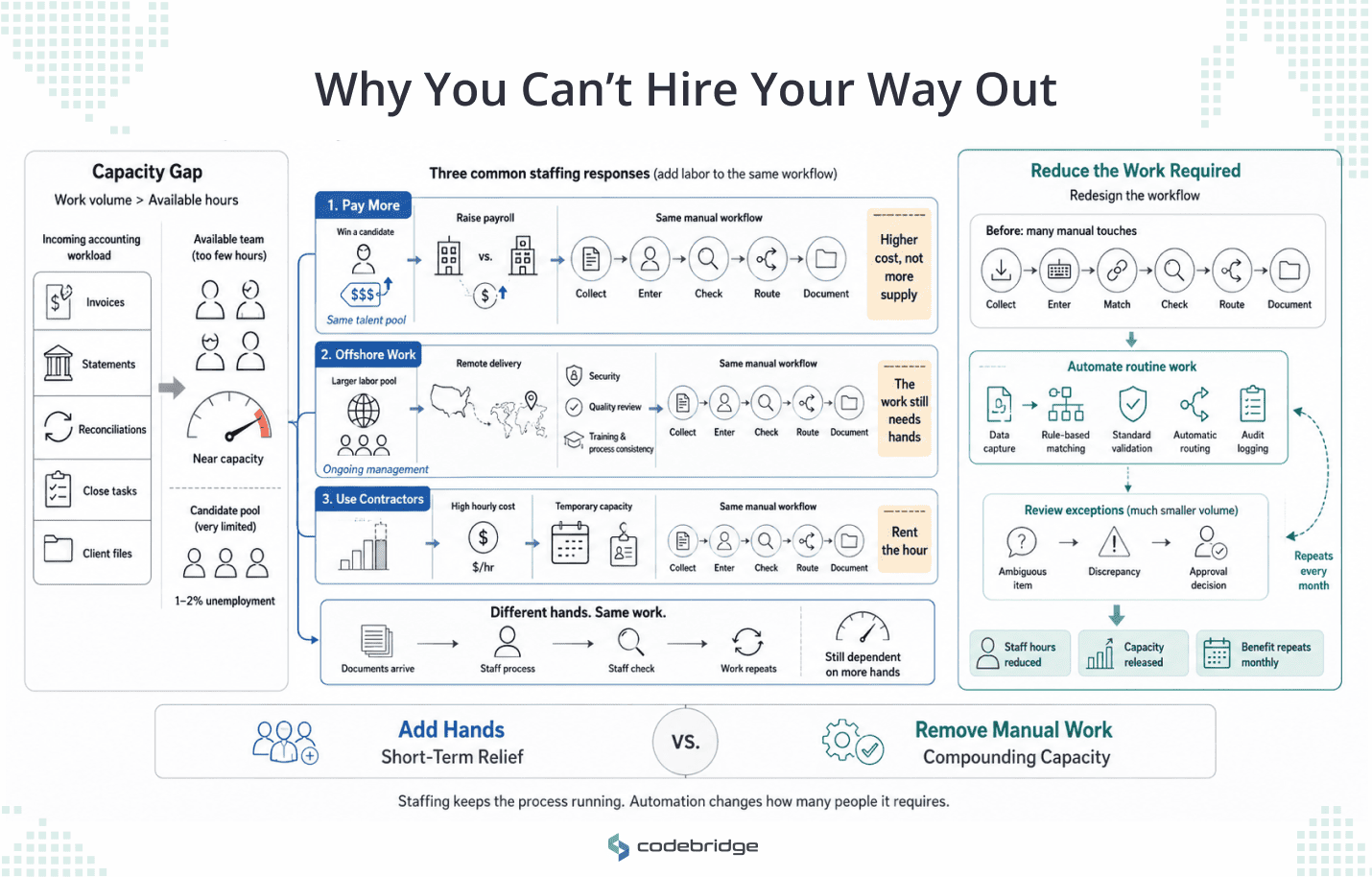
The instinct is to solve a staffing shortage by staffing harder. Three responses dominate, and each has a real use and a real ceiling.
The first is to pay more. Raising salaries and offering signing bonuses can win a specific candidate, and many firms have done it. What it cannot do is create accountants who do not exist. When unemployment in the field sits near 1 to 2%, higher pay mostly moves the same scarce people between firms and lifts everyone's cost base. You can win a bidding war and still be short-staffed, now on thinner margins. The raise that wins one hire also resets pay expectations across your existing team, so the cost lands on the whole payroll rather than one line.
The second is to send work offshore. Nearshore and offshore teams give a firm access to a larger labor pool and can carry real volume, and for some firms that is a sound part of the mix. The tradeoffs are also real. You take on data-security and client-confidentiality exposure, you manage quality and training across a distance, and you still depend on a supply of people, now in another market with its own competition. The work that tends to go offshore is the same routine processing you could automate, so you are paying an ongoing labor cost to move a problem rather than remove it. Offshoring changes where the hands are. It leaves the work needing hands.
The third is flexible and contract staffing: fractional controllers, interim help, busy-season contractors. This works for peaks and gaps, and it keeps things running when someone leaves. It is also the most expensive way to buy an hour, and it is still renting the hour.
The common thread is that all three push more hands into a market that is short of hands. They treat the symptom. They can keep a firm running, and sometimes that is what a quarter needs. What none of them do is reduce how many hands the work requires in the first place, which is the only move that compounds.
The Durable Answer: Capacity Your Firm Owns
The move that compounds is to reduce the number of hands the work requires. You do that by taking the routine, low-judgment processing off the people you already have, so their hours shift to the review, judgment, and advisory work clients pay a premium for. Your headcount stays the same while your capacity grows.
A 2025 field study from researchers at MIT Sloan and Stanford, covering 79 small and mid-sized firms, found that accountants using AI supported 55% more clients per week than those who did not. The same accountants closed the books faster and moved time from processing to higher-value work. That capacity was already in the building, trapped in manual work.
Two conditions decide whether this works, and the how-to guide covers both. First, standardize the workflow before you automate it. Automation added to a chaotic process creates work creep, where tasks expand to fill the time you thought you saved. Second, automate the workflow that costs you the most in real hours, rather than the one that annoys the loudest partner.
Read more: www.codebridge.tech/articles/how-to-automate-accounting
The freed hours have somewhere to go. Reviewers spend more time on judgment and less on inputs, and the firm can take on advisory work that bills above compliance rates, which is where the recovered realization comes from. One honest caveat belongs here. When software handles the routine work that used to train junior staff, a firm has to build judgment on purpose rather than assume it accrues from repetition. The firms that get this right pair the automation with structured development, so the next generation still learns to review.
There is also an ownership point worth stating once. The workflows that free the most capacity are the ones specific to how your firm runs, and those are the ones worth owning rather than renting from a vendor whose roadmap and pricing you do not control. The short version is that you buy the commodity software and own the automation that carries your firm's specific work. Which workflows to own and which to buy is its own decision.
Read: www.codebridge.tech/articles/accounting-automation-software-build-vs-buy
Treated this way, AI is a capacity strategy for a firm that cannot hire its way to the capacity it needs. The team stays. What changes is how much of their day goes to work that earns their rate. That is why the shortage, for all the alarm around it, is a solvable operating problem for the firms willing to change the work.
Read: www.codebridge.tech/articles/ai-for-accountants-guide
How Codebridge Approaches This
Codebridge builds custom automation for mid-market firms as a service. We work on your data, alongside your team, and we hand you the code, so the capacity you gain belongs to your firm. Our roots are in KPMG, which means we scope the work the way a firm operator does: which workflow costs the most in hours, what a clean version looks like, and what stays with your reviewers.
The engagement starts with a fixed-fee, three-week discovery on one of your workflows, run on your own data. You see the capacity the automation frees before you commit to a full build, and you decide from evidence. We fix the price and the date, and because you keep the code, there is no lock-in.
If the shortage is capping what your firm can take on, the next step is a 15-minute call. We will look at where your capacity is leaking and which workflow would give the most of it back.














Heading 1
Heading 2
Heading 3
Heading 4
Heading 5
Heading 6
Lorem ipsum dolor sit amet, consectetur adipiscing elit, sed do eiusmod tempor incididunt ut labore et dolore magna aliqua. Ut enim ad minim veniam, quis nostrud exercitation ullamco laboris nisi ut aliquip ex ea commodo consequat. Duis aute irure dolor in reprehenderit in voluptate velit esse cillum dolore eu fugiat nulla pariatur.
Block quote
Ordered list
- Item 1
- Item 2
- Item 3
Unordered list
- Item A
- Item B
- Item C
Bold text
Emphasis
Superscript
Subscript