The Short Answer
Managed AI services mean a provider builds AI automation for your firm's workflows and then runs it for you: monitoring it, fixing it when it breaks, adjusting it as your work changes, and reporting on whether it still delivers what it promised. AI software is the other model, where you subscribe to a product, your team operates it, and the vendor maintains that product for every customer rather than maintaining your firm's version of the work.
The distinction matters as the work does not end when an AI workflow goes live. The automation must continue to adapt as source documents, client processes, integrations, and business rules change.
With AI software, your team is usually responsible for configuring the product and adjusting how it is used. With managed AI services, the provider takes responsibility for keeping the workflow operational and aligned with the outcome it was built to deliver. For firms without dedicated in-house AI or automation specialists, that difference can determine whether the system remains useful after the initial implementation.
This guide covers four things: how managed AI services and AI software differ across adaptation, cost shape, and exit; the three operating models available to a firm; when a managed service is unnecessary, and a tool will do; and the dependency risk built into every managed model, along with the contract terms that resolve it.
What Managed AI Services Means for an Accounting Firm
The term managed AI services is used for several different types of offering. In this guide, it refers specifically to a partner that builds AI automation around an accounting firm’s workflows and remains responsible for operating it after launch.
It does not refer to managed IT services or the infrastructure used by machine learning teams. The table below separates these three models.
For a firm COO, the relevant model is managed AI operations for internal workflows, as the provider does not simply deliver the automation and leave the firm to manage it. It monitors performance, resolves issues caused by changing inputs or integrations, updates the workflow as business rules evolve, and helps bring new clients or entities into the process. It may also support exception handling and report on whether the automation continues to produce the expected operational results.
These are standard responsibilities for any system that supports day-to-day operations. However, they are often missing from the initial automation plan. Firms may define the workflow, implementation cost, and launch date without deciding who will maintain the system once processes or connected tools begin to change. That responsibility becomes especially important when the automation supports time-sensitive work such as reporting or filing deadlines.
Why AI Managed Services Exist: Automation is a Living System
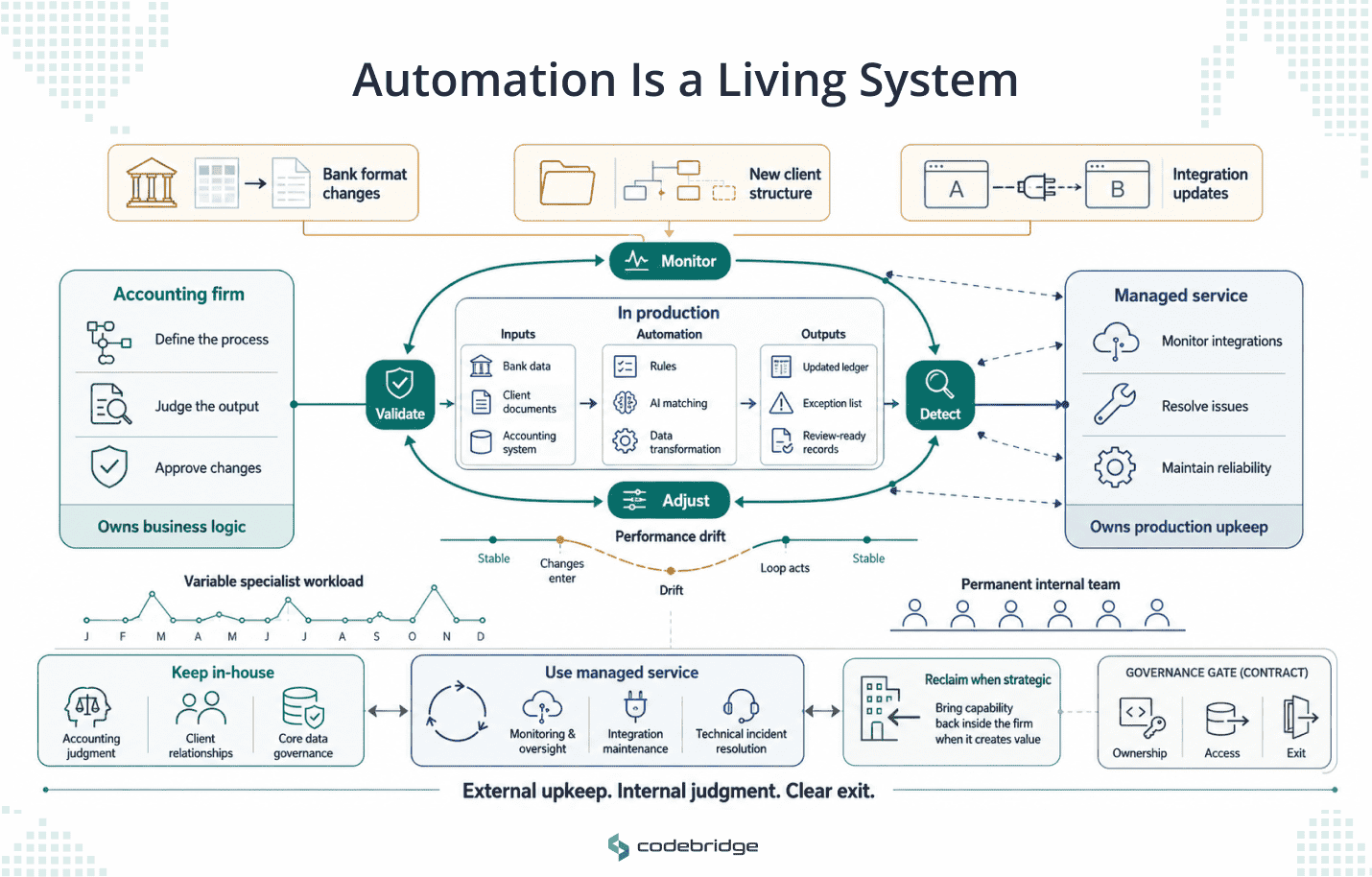
Managed AI services exist because launching an automation is not the same as keeping it useful. When the workflow is in production, someone still needs to monitor its performance and adjust it as the firm’s processes evolve.
The causes are usually routine. For example, a bank changes its export format, a new client uses a different chart of accounts, or a document platform updates an integration. Any one of these issues may be minor, but without clear ownership, they can gradually reduce the accuracy and reliability of the workflow.
This is the gap a managed service is designed to fill. Many mid-market accounting firms have people who can define the process and judge whether the output is correct. What they may not have is a dedicated team responsible for monitoring integrations and resolving technical issues as they appear. Building that capability internally can be difficult to justify when the workload is specialized and varies from month to month, particularly when firms are already managing capacity constraints in their core accounting teams.
Suggested read: Is There Really an Accountant Shortage?
The market is moving in this direction for the same reason. Deloitte’s Global Outsourcing Survey reports that 57% of executives are increasing their managed-services budgets, while 83% already use AI within outsourced services. The same research also finds that 70% have selectively brought previously outsourced work back in-house over the past five years. Together, those findings point to a more mature approach: companies are using managed providers where external ownership adds value while retaining or reclaiming the capabilities they want to control directly.
The supply side has changed as well. Trade reporting on the Big Four suggests that agentic AI is making some managed services less dependent on large delivery teams and more suitable for recurring, multi-year engagements. That helps explain why more providers are entering the category. It also makes the ownership terms and exit conditions more important than the promises made during the sales process.
Managed AI Services vs AI Software
The difference comes down to who the product serves. A software vendor operates one product for thousands of customers, so it improves toward what the market needs on average. A managed provider operates automation built for your firm, so it adapts to your work, your exceptions, and your clients. Both models are legitimate, but they solve different problems.
AI software is the right choice when a workflow is largely standardized across firms, and a mature product already handles it well. In those cases, the vendor can spread the cost of development, maintenance, and support across thousands of customers, giving your firm capabilities that would be expensive to reproduce independently. Paying for a managed service to operate a process that an established product already covers usually adds cost without creating much additional value. Our guide to the categories worth buying is available here: Best AI Tools for Accountants.
Managed AI services are more useful when the workflow depends on how your firm operates. That may include a client intake process built around your service model or exception rules that reflect the risks your firm is willing to accept. A standard product may support parts of that process, but it is unlikely to match the full workflow without significant configuration or manual workarounds. A managed service can build around those firm-specific requirements and continue adjusting the automation as they change.
In practice, most firms will use both models. They may buy software for standardized functions such as document collection or practice management. At the same time, they will use a managed service for workflows that are more specific to their clients, controls, or operating model.
The mistake is treating either approach as the answer to every problem. Managed services are unnecessarily expensive for work a proven product already handles, while subscription software becomes difficult to rely on when the firm must constantly adapt its process to fit the product.
The Three Operating Models for AI in a Firm
After choosing the right AI tool or automation, a firm still needs to decide who will operate it after launch. That includes monitoring the workflow, managing changes, resolving technical issues, and maintaining the connections between systems. There are three main operating models, each offering a different balance of internal effort, provider support, and long-term control.
Running it yourself works while the automation lives inside one system and rarely changes. The ceiling arrives faster than most firms expect. Administering a practice-management suite is a different skill from maintaining an automation that spans your ledger, your document store, and your client portal, and the person who can do the second one is usually the person you cannot spare.
Renting a fully managed service is how most of this market is sold, and it suits firms that want the outcome and nothing else. You get a working automation and somebody else's problem when it breaks. The cost is structural: the provider holds the code, the configuration, and the institutional knowledge of how your workflow runs, so your firm's ability to change providers erodes with every month the arrangement continues.
Partner-run and firm-owned splits the difference. The provider carries the operational load, and your firm holds the asset: the code, the data, the documentation. You keep the option to change who operates it. The requirement is timing. Ownership terms have to be agreed before the build starts, because renegotiating them afterward is close to impossible once the work exists on somebody else's terms.
This operating-model decision is separate from the question of how the automation is initially acquired. A firm may buy an existing product, build internally, or commission a custom system it owns. That decision is covered in our separate build-versus-buy framework here: Accounting Automation Software: Build vs Buy Guide
When Your Firm Does Not Need a Managed AI Service
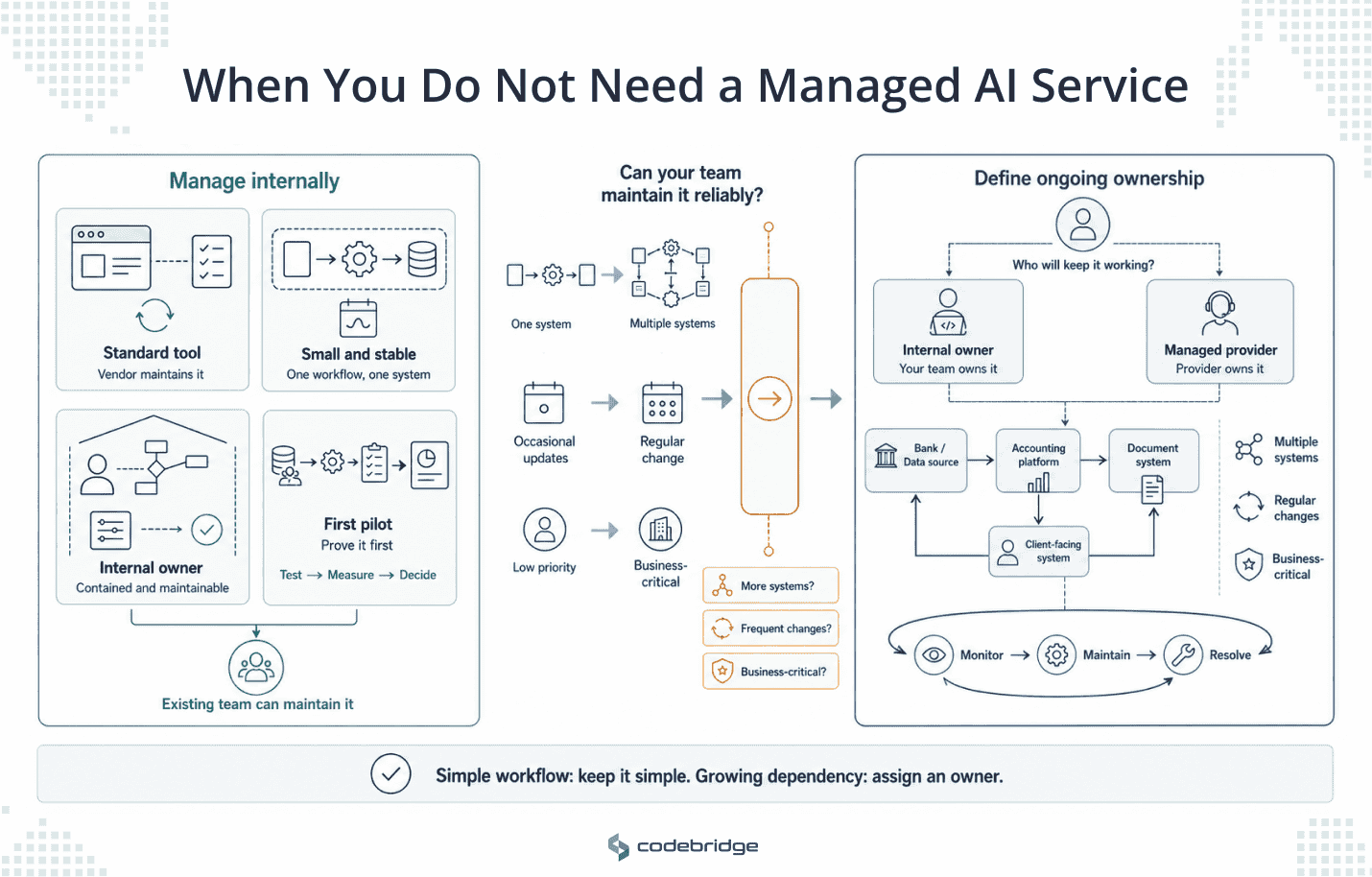
It is important to mention that managed AI services are not necessary for every automation project. When the workflow is standardized and easy for the firm to maintain, an existing product or internal owner is often the simpler and more economical choice.
- The workflow is standard and a tool already handles it. The vendor operates the product, updates it, and fixes it. A service layer on top adds cost without adding capability.
- The automation is small and stable. One workflow, inside one system, touched twice a year. Your existing team can carry that.
- You have a capable operations person and the workflow stays in one place. Someone who administers your systems well can own a contained automation without outside help.
- You are running a first test. Automating one workflow to see whether the approach works does not need a service contract wrapped around it. Prove the thing first.
The need for a managed service usually becomes clearer as the workflow grows more operationally important. An automation that connects several systems or changes regularly with the firm’s procedures needs defined responsibility for monitoring, maintenance, and issue resolution. At that point, the decision is who will keep it working over time.
The Dependency Nobody in This Category Mentions
A managed service removes much of the operational burden from the firm, but it can also create dependency on the provider. When the provider controls the code, configuration, documentation, and hosting environment, the firm’s ability to maintain or move the automation may depend heavily on that relationship continuing.
Accounting firms have seen how quickly vendor risk can become an operational problem. Even a well-funded technology company with a functioning product can shut down or change direction with little notice, leaving customers to recover their data, replace the service, and protect business continuity under pressure.
Read about vendor risk: How to Automate Bookkeeping After Botkeeper: What the Shutdown Taught Firms.
The category is getting more concentrated, which sharpens the risk. Investors have been acquiring support and finance-operations providers and rebuilding them around AI agents, with pricing shifting toward per-outcome models. Acquisition-built providers introduce continuity and governance questions that a standard vendor review was never designed to catch, and a firm signing a multi-year operating contract is exposed to all of them.
This applies to Codebridge as much as to anyone else in the market. Any provider running your automation is a dependency, and saying otherwise would be dishonest. What changes the exposure is ownership. If your firm owns the code, the data, and the documentation, the provider becomes replaceable: you can move the work to another team, or bring it in-house, and the automation keeps running. The service stays valuable because it is good, rather than because leaving is impossible.
Two questions should be answered before an engagement starts: Who owns the code and configuration created during the project? What assets, access, and support will transfer to the firm if the relationship ends? The answers should be specific, documented, and reflected in the contract.
How Codebridge Approaches This
Codebridge builds custom automation for mid-market firms and runs it as a service. We work on your data, alongside your team, and we hand over the code, so your firm holds the asset while we carry the operational load. Support covers monitoring, updates, and reporting on whether the automation still delivers, and it stays optional by design rather than working as a lock-in mechanism.
Our roots are in KPMG, so we scope this the way a firm operator does: which workflow costs the most, what a clean version looks like, what stays with your reviewers, and who keeps it running afterward.
The engagement starts with a fixed-fee, three-week discovery on one of your workflows, run on your own data. You watch it work before committing to a build, and the ownership terms are set at the start rather than negotiated later.
If you are weighing whether to buy a tool or have someone run automation for you, book a 30-minute call, and we will give you a straight read on which one your workflow needs.













Heading 1
Heading 2
Heading 3
Heading 4
Heading 5
Heading 6
Lorem ipsum dolor sit amet, consectetur adipiscing elit, sed do eiusmod tempor incididunt ut labore et dolore magna aliqua. Ut enim ad minim veniam, quis nostrud exercitation ullamco laboris nisi ut aliquip ex ea commodo consequat. Duis aute irure dolor in reprehenderit in voluptate velit esse cillum dolore eu fugiat nulla pariatur.
Block quote
Ordered list
- Item 1
- Item 2
- Item 3
Unordered list
- Item A
- Item B
- Item C
Bold text
Emphasis
Superscript
Subscript