The Short Answer
AI adoption is no longer the main question for accounting firms in 2026. Most firms already use it somewhere in their work. Intuit’s 2026 Accountant Technology Survey found that 88% of US accounting professionals had used AI for at least one client service during the previous year, while 86% had used it for an internal firm operation. Common applications include data processing, client communication, forecasting, and invoicing.
But for firm leaders, widespread use does not necessarily mean structured adoption. Thomson Reuters found that 52% of tax firm respondents using generative AI relied on general-purpose tools such as ChatGPT, compared with 17% using an industry-specific product. Karbon’s 2026 research also found that fewer than half of firms were actively investing in AI training. It means that AI may already be present across the firm without consistent rules for approved tools, client-data handling, or accountability.
This guide covers the real adoption numbers and where they come from, the gap between using AI and having a strategy, how deployment differs across firm sizes, what separates the firms getting measurable results, and a short diagnostic for placing your own firm. The conclusion for most mid-market firms is that they are not behind on adoption and are exposed on governance.
What AI for Accounting Firms Looks Like in Practice
Two recent surveys provide a useful benchmark for how accounting firms are using AI in 2026. Together, they show that adoption is already widespread, but most use cases still support individual tasks rather than automate complete workflows.

Intuit's Firm of the Future 2026 Accountant Technology Survey covered 725 US accounting and bookkeeping professionals. It found 88% had used AI for at least one client service in the previous twelve months and 86% for at least one firm operation. Both numbers held steady from 2025, which tells you the adoption curve has flattened at a high level. The growth story is over; nearly everyone is in.
That flattening changes what the benchmark is worth. Two years ago, "we use AI" placed a firm ahead of its peers. In 2026, it places a firm exactly in the middle, alongside almost everyone else, which means a partner asking whether the firm has adopted AI is asking a question that no longer separates anyone. The useful question moved to what the firm does with it.
Karbon's State of AI in Accounting 2026, drawing on roughly 600 accounting professionals, breaks the usage down by task and finds communication at the top.
Read the list honestly, and a pattern emerges. The most common use cases include communication, meeting transcripts, research, brainstorming, and data processing. These tools can save time and reduce repetitive work, but they usually assist a person rather than run an accounting process from beginning to end.
That distinction between assistive use and automated process is the one that explains why two firms with identical adoption rates can end the year in different positions.
The Gap Between Using AI and Having an AI Strategy
Widespread AI use does not mean accounting firms have developed an AI strategy. A strategy requires deliberate decisions about which tools are approved, who owns implementation, how employees are trained, and how results are measured. Current research suggests that adoption has moved ahead of many of those decisions.
Most firm AI use runs through consumer tools. Thomson Reuters found 52% of tax firm respondents already using a generative AI tool are using open-source technology such as ChatGPT, with only 17% using an industry-specific tool. In operational terms, the profession's AI adoption is largely individual professionals opening a general-purpose chatbot and pasting work into it.
That happened for understandable reasons. A consumer chatbot needs no procurement process, no IT project, no partner vote, and no budget line. A staffer facing a deadline found something that helped and used it, which is what capable people do. The problem is not the judgment of the person who opened the tab. The problem is that the firm never made a decision, so nobody set a boundary, and usage spread through the practice without anyone owning it.
Client data has already moved into those tools. Research from KPMG on AI adoption across finance functions found that 46% of US accounting firms have inadvertently entered confidential client information into public AI services. Close to half the profession has had the incident, and most of those firms learned about it after the fact, if at all. For a practice whose obligations around client confidentiality are professional rather than optional, a firm that cannot say where its client data went has a problem that exists independently of any AI strategy.
Almost no one is training people. Karbon reports that 46% of firms actively invest in AI training, while the time savings rise 28% at firms whose leaders make that investment. Training is the cheapest multiplier available in this whole category, and most firms skip it, then conclude the tools underdelivered.
Projects stall on skills rather than software. Thomson Reuters reports 61% of firms have stalled or halted AI projects over skill shortages. That number connects to a capacity problem the profession already knows well, and which we cover separately here: Is There Really an Accountant Shortage?
Put the four together, and the diagnosis is straightforward. The profession has near-universal AI usage, mostly ungoverned, largely untrained, and concentrated in tools nobody selected deliberately. A firm reporting that it uses AI has said nothing about whether it has an AI strategy.
AI in Accounting Firms by Size: Who Deploys What
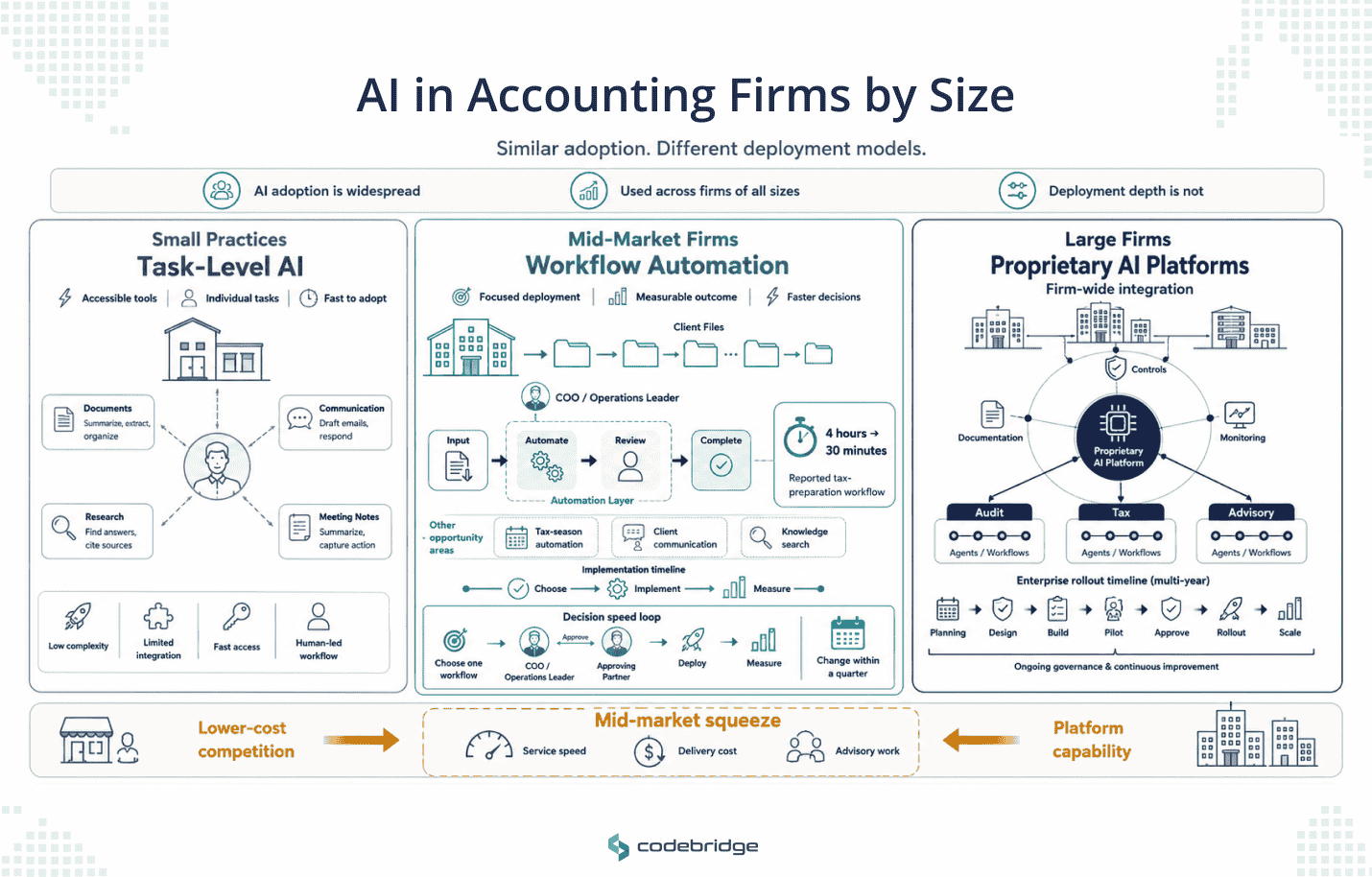
AI adoption is widespread across accounting firms, but the way it is deployed varies significantly by firm size. Large firms invest in proprietary platforms, and smaller practices tend to use accessible tools for individual tasks. The adoption rate may look similar, but the level of integration, governance, and investment is not.
Large firms are building purpose-designed platforms and extending them into agent-based workflows across audit, tax, and advisory services. The Big Four each operate proprietary systems with governance, documentation, and firm-wide controls built into them, which we cover in the main guide (Read: AI for Accountants: A Mid-Market Firm's Guide). The relevant lesson for a mid-market firm is that the budgets and implementation timelines behind these platforms are fundamentally different.
Mid-market and regional firms are where the concrete deployments live, and where the results are legible to a COO. The pattern across this segment is document processing, tax-season workflow automation, client communication, and internal knowledge search. Reported outcomes at this size are specific rather than sweeping. One regional firm, LBMC, has been reported to cut tax preparation from roughly four hours to 30 minutes per return. That is a workflow-level result, and it beats another Big Four platform announcement as a benchmark.
Smaller practices cluster around document processing and client communication, mostly through general-purpose tools, which is a rational choice at that size.
The competitive picture is the part worth taking to a partner meeting. Accounting Today's reporting in January 2026 found that AI has widened the productivity gap: early-adopting firms turn work around faster and at lower cost, and smaller firms using AI can now compete with mid-tier firms for advisory work. For a mid-market firm, the squeeze arrives from both directions. The large firms have capabilities you cannot match on budget, and the small firms are closing in on service lines you assumed were safely yours.
The advantage a mid-market firm holds in that squeeze is speed of decision. A 90-person firm can change how a workflow runs in a quarter, because the people who run the work and the people who approve the change sit in the same building. The Big Four spend years aligning a platform across member firms. A regional firm that picks one workflow and fixes it properly can show a result before a large firm finishes its pilot, and that is the only structural advantage available at this size.
What Separates the Firms Getting Results
The firms seeing measurable returns from AI tend to make four different choices from those using it without much operational impact.
Together, these choices move AI from an individual productivity tool into firm infrastructure. Once that happens, two further decisions become necessary: who will build the automation, and who will remain responsible for operating it after launch.
Where This is Heading: AI Agents and the Governance Question
The direction of travel is toward software that acts rather than assists. PwC's AI agent survey found 44% of finance teams expecting to use agent-based AI in 2026, against roughly 7% the year before. That is a fast shift by any standard, and it changes the risk profile.
An agent does more than draft a paragraph. It works across documents and systems, makes decisions at each step, and produces records that have to survive an audit. In accounting, that means client financial data, an audit trail, and outputs a regulator may later review.
Three questions belong to the firm before any agent runs on live client work. Where does the data go, and who can see it? When does a person review the output, and what triggers that review? And can you reconstruct what the agent did and why, months later, for someone who was not there?
Those questions have detailed answers, including the current regulatory position on who remains accountable for AI output. We cover them in the main guide.
Where Your Firm Stands
Five questions place a firm against the benchmarks above. Answer them honestly, and the gap becomes specific enough to work on.
- Can you name which AI tools your staff used last week? If not, you have adoption without visibility, which is the position most of the profession is in.
- Do you have a written policy on what client data may enter which systems? If not, you are exposed to the same incident 46% of US firms have already had.
- Has any AI use been built into a firm process, rather than left to individual habit? If not, you have usage without a capacity gain, and next year's numbers will look like this year's.
- Has anyone been trained deliberately? If not, you are leaving the largest documented multiplier untouched.
- Would you know if an automation stopped working correctly? If not, nobody owns its health, and the failure will surface during a deadline.
Most mid-market firms answer yes to the first question and no to the rest. That is the honest state of the profession in 2026, and it is a better position than it sounds, because the gap is depth and governance rather than adoption. Both are fixable with decisions rather than budget.
How Codebridge Approaches This
Codebridge builds custom automation for mid-market firms as a service. We work on your data, alongside your team, and we hand over the code, so the automation belongs to your firm. Our roots are in KPMG, so we scope the work the way a firm operator does: which workflow costs the most, what a clean version looks like, what stays with your reviewers, and who keeps it running afterward.
The engagement starts with a fixed-fee, three-week discovery on one of your workflows, run on your own data. You see the automation work on your records before committing to a build.
If the diagnostic above left you with a gap you can name, a 30-minute call is the next step. We will tell you which workflow is worth automating first and what a bounded project would look like on your numbers.













Heading 1
Heading 2
Heading 3
Heading 4
Heading 5
Heading 6
Lorem ipsum dolor sit amet, consectetur adipiscing elit, sed do eiusmod tempor incididunt ut labore et dolore magna aliqua. Ut enim ad minim veniam, quis nostrud exercitation ullamco laboris nisi ut aliquip ex ea commodo consequat. Duis aute irure dolor in reprehenderit in voluptate velit esse cillum dolore eu fugiat nulla pariatur.
Block quote
Ordered list
- Item 1
- Item 2
- Item 3
Unordered list
- Item A
- Item B
- Item C
Bold text
Emphasis
Superscript
Subscript