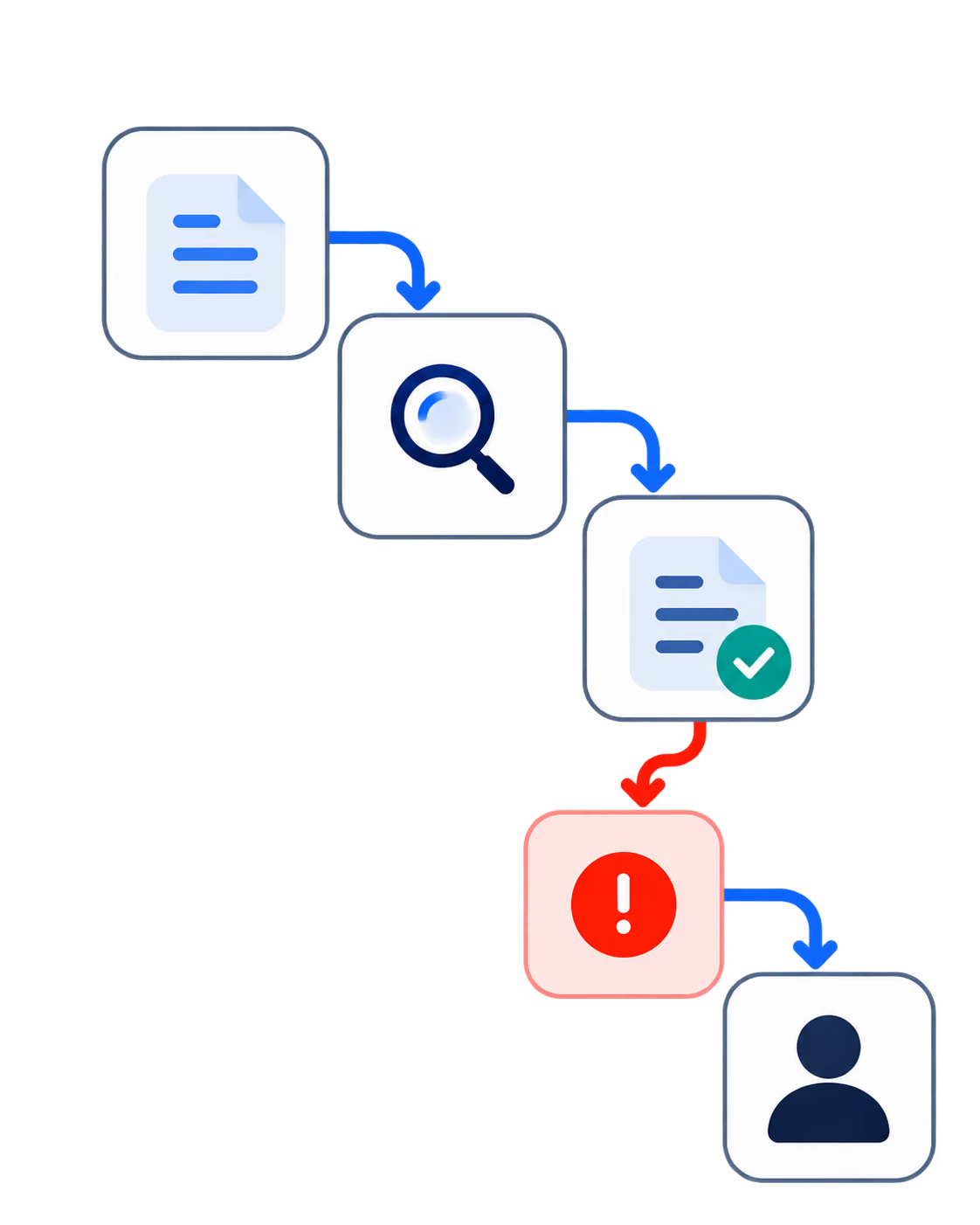
Most companies have dashboards, CRM exports, finance sheets, and so many reports that finding the useful one becomes its own job.
But companies need someone(or something) to verify the numbers, compare them with last quarter, explain why they moved, and decide whether the move matters.
That gap is why nearly 80% of companies have deployed generative AI in some form, while a similar share report no material impact on the bottom line. Now tools are everywhere, but decisions are still slow.
At this point, AI agents for business intelligence become interesting. Their value is in the shorter distance between a business signal and a business action. That value depends on what sits underneath the agent, such as the metrics the company trusts, the systems those metrics live in, the ownership structure around them, and the rules about what the agent is allowed to do.
This piece is for leadership teams weighing whether to build one. It works through the cases where BI agents have produced real business outcomes, the operational risks that kill most projects before production, and the architecture trade-offs that determine whether the system is worth keeping at all.
What AI Agents for Business Intelligence Should Actually Improve
A useful BI agent helps traditional BI by shortening the loop between data and decision. It may include what changed this week, why it changed, whether it matters, and what to do next. From the executive seat, that comes down to six business factors:
The wrong way to frame this
Most pitches for BI agents stay at the surface as they answer questions, automate dashboards, generate reports, and replace analysts. Those framings aren't wrong, but they're just not enough for a CEO trying to decide whether to fund the project.
The framing that matters
Instead, the question for CEOs is "which recurring decision will AI agents for BI improve?" Weekly revenue review, churn-risk review, product adoption review, finance variance review, operational bottleneck review: each is a place where a faster and sharper signal would change what the business does next.
An agent tied to one of those reviews is easier to justify than an agent that is built around "lets people chat with data".
Where BI Agents Create Real Business Value
After working on hundreds of analytics, BI, and AI projects, we noticed that the strongest BI agent use cases usually appear where the business already has a reporting rhythm, but the rhythm is too slow for the decision it supports.
It is important because many operational and financial problems are discovered late. After all, the signal is buried inside reports or team updates that someone has to manually interpret.
Operational performance
In operations, this can change how leaders see execution problems. A support backlog, onboarding delay, queue buildup, or repeated handoff failure may look small inside one team. Across the business, it may explain why customers are waiting longer or why a revenue process keeps getting stuck.
The practical value is that an agent can watch the operating system of the company at a frequency that humans usually cannot maintain. That does not mean every anomaly deserves an alert. A good BI agent should separate noise from business-relevant movement: delays that affect customers, bottlenecks that create cost, or process failures that repeat across teams.
Financial and planning intelligence
Finance has the same problem, just with a different language. Many CFO organizations still operate on quarterly variance investigations and forecast reviews when a number is already uncomfortable. A BI agent can compress that cycle by checking actuals against planning assumptions more often, surfacing unusual cost movement, and explaining where forecast risk is building.
IBM’s Enterprise Performance Management work shows what becomes possible when the architecture supports that level of visibility. IBM reports reducing more than 500 financial applications to fewer than 20, empowering more than 30,000 employees with real-time AI-driven dashboards, and using AI-driven forecasting with roughly 95% model accuracy. The important lesson is not only the AI layer. IBM first reduced fragmentation enough for AI-powered planning to become credible.
Many companies miss it, but it is crucial to understand that AI-powered BI rarely fixes a fragmented finance stack. It usually exposes it. If revenue, cost, utilization, and margin live in disconnected systems with different definitions, the agent may produce faster explanations, but the business will still argue about whether the explanation is trustworthy.
Reporting automation
Reporting automation is often the easiest place to start because the pain is visible. Someone already produces a weekly campaign report or operational update by hand. The business case becomes stronger when that report influences an actual decision.
Natura Cosméticos is a good benchmark. Its Databricks GenAI-powered CRM reporting work delivered 64% faster reporting cycles, a 23.5% increase in CRM-driven revenue, and more than 20 automated reports across six countries in Portuguese and Spanish. Databricks also notes that the system helped planners respond to daily campaign results while campaigns were still active, instead of waiting until the reporting cycle was over.
In this case, the value was not only automated reports. The value was a shorter commercial feedback loop. When campaign teams can see what is happening early enough to adjust segmentation, messaging, channels, or spend, reporting stops being administrative work and becomes part of revenue execution.
For founders and CTOs, this leads to a simple filter:
- Start with reporting workflows where speed changes behavior.
- Avoid automating reports that nobody uses to make decisions.
- Treat finance and operational BI agents as trust systems, not only productivity tools.
- Measure value through shorter decision cycles, fewer manual hours, fewer report errors, earlier risk detection, and better business response.
A BI agent is worth building when the company can point to a specific delay and say: If we had understood this sooner, we would have acted differently.
The Business Risks Before You Build a BI Agent
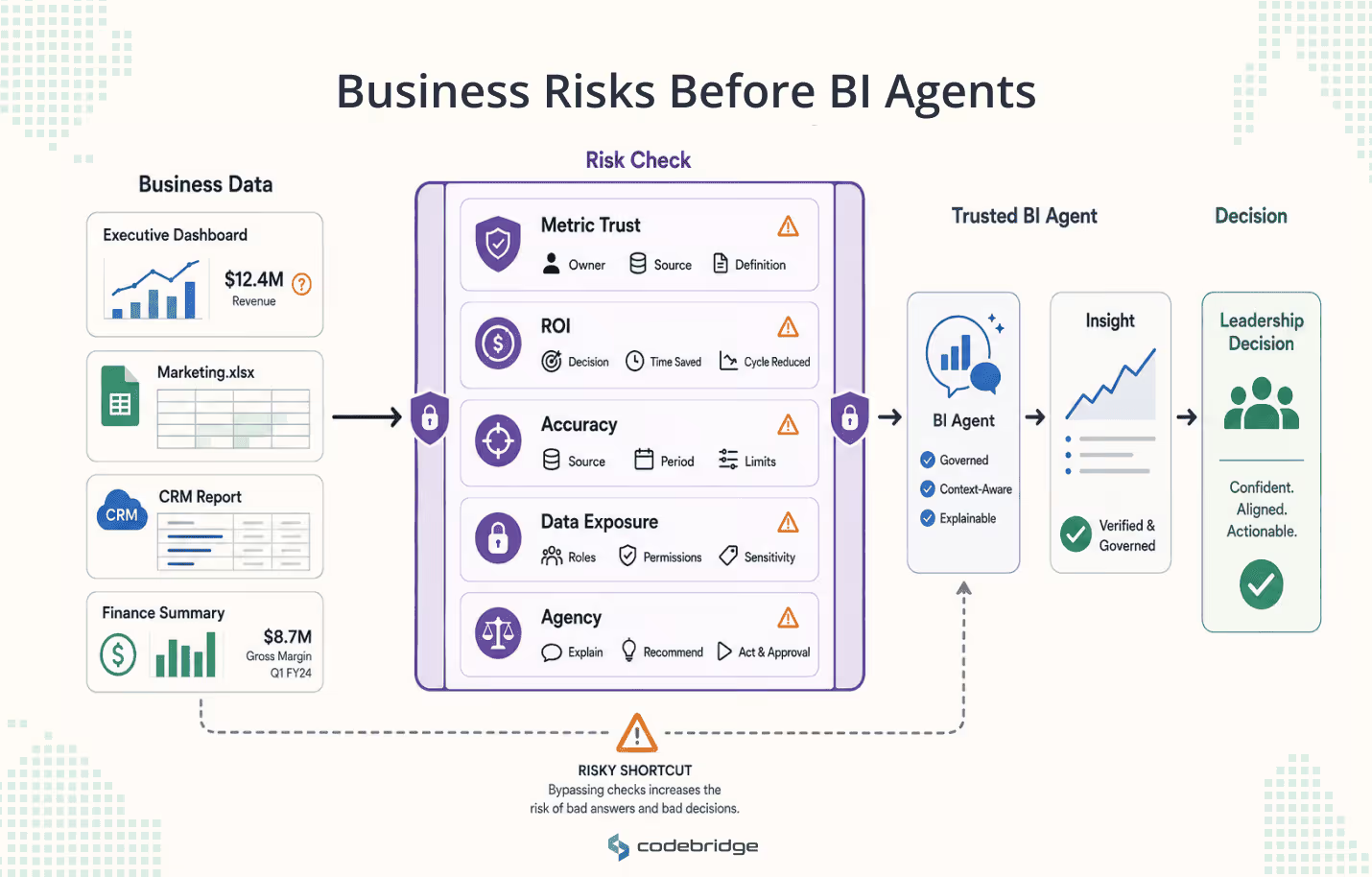
The biggest risks in BI agent projects usually appear before anyone chooses a model, framework, or data connector.
They sit inside already existing, unclear metrics, inconsistent ownership, low trust in reports, fragmented permissions, and the way leadership makes decisions. A BI agent makes these issues more visible, faster, and sometimes more expensive.
That is why the first risk assessment should start with one uncomfortable question: Do people already trust the numbers this agent will use?
If the answer is no, the agent will not create trust. It will produce confident summaries of a reporting system that people already doubt.
Risk 1: Automating numbers nobody trusts
If three teams already define "active customer" three different ways, a BI agent doesn't resolve the disagreement. It produces faster, more polished versions of all three. The same applies to "qualified lead," "pipeline," "revenue," "margin," "retention," and "usage," terms that mean different things to CRM, finance, product, and leadership reporting.
Before building, the operational pick the ten to fifteen metrics leadership uses to run the business and documents each one's owner, formula, source system, update frequency, allowed interpretation, and known limitations.
This is not documentation for documentation’s sake. It is the operating agreement that the BI agent will depend on. Google Cloud’s data governance framing supports the same idea by reporting that AI-ready data has to be accurate, secure, available, and governed before it can support reliable AI systems.
Risk 2: Curiosity-driven ROI
"Wouldn't it be useful to ask our data questions in natural language?" is not a business case. It's the question that gets BI agent projects approved and then shelved a year in, when the answer turns out to be "nice, but not measurable."
A stronger starting point is more specific:
- Which recurring decision is too slow?
- Which report is too expensive to produce manually?
- Which business risk is detected after the damage is already visible?
- Which team spends too many hours reconciling numbers?
- Which metric movement should already trigger action?
This changes the ROI conversation as now the goal is not to have more AI queries, but a measurable improvement in how the business operates.
Useful ROI signals include reporting hours saved, reporting cycle time reduced, fewer report errors, faster campaign adjustment, earlier churn detection, better forecast accuracy, shorter operational cycle time, and fewer meetings spent debating which spreadsheet is correct.
If a BI agent answers interesting questions but does not change a decision, it may become a popular internal toy, but not a business infrastructure.
Risk 3: Confidence faster than accuracy
A bad BI agent influences hiring decisions, budget cuts, sales targets, pricing, product priorities, and which customers get attention. The same fluency that makes it useful makes its wrong answers harder to catch.
The familiar failure modes:
- Comparing the wrong time periods
- ignoring seasonality
- missing one-time events like a contract renegotiation or product launch
- mixing bookings with recognized revenue
- Treating correlation as causation
- working from incomplete data
- explaining a real business change with generic reasoning
For high-impact answers, require the agent to surface the source data, time period, metric definition, confidence level, assumptions, known limitations, and a path to human review.
NIST's Generative AI Profile frames the same expectation across the AI lifecycle: trustworthy AI requires risk management in design, development, use, and evaluation. (NIST)
Risk 4: Sensitive information disclosure
BI agents often touch the most sensitive information in the company, such as revenue, margins, salaries, patient records, customer learning data, or regulated operational data.
A natural-language interface does not make that information less sensitive, but it can make exposure easier. Because users may not realize what their question is asking the system to reveal.
A sales manager asking about “high-risk accounts” may accidentally receive margin data. A product lead asking about enterprise usage may see contract value. A support manager asking about customer complaints may surface restricted customer or patient information.
OWASP lists sensitive information disclosure as a major LLM risk because failures in this area can lead to legal exposure, privacy violations, and loss of competitive advantage.
The fix is not to copy existing dashboard permissions and hope they work. BI agent permissions should be designed around business roles, decision needs, and data sensitivity.
A CFO, sales manager, product lead, support lead, and customer success manager should not automatically receive the same answer to the same question.
Risk 5: Excessive agency
There's a real difference between an agent that explains a metric and one that updates a CRM field or triggers an operational workflow. The first risks a confident wrong answer. The second risks a confident wrong action taken without human review.
Separate the three capability levels in design:
- Explain. The agent summarizes, compares, and surfaces causes.
- Recommend. The agent suggests an action, leaving the decision to a human.
- Act. The agent updates business records, creates tasks, and changes operational state.
Start with an explanation. Move to recommend after accuracy holds up under scrutiny. Add act last, behind audit, approval, and rollback. AWS Bedrock AgentCore guidance describes the same boundary: agent flexibility creates security challenges when systems misinterpret business rules or act outside intended authority.
Architecture Decisions That Become Business Decisions
Most architecture decisions for a BI agent are business decisions in disguise. Which workflow does the agent attach to? Which numbers are allowed to trust? Who can see which answers? What is it allowed to do without a human in the loop? Seven of these decisions shape every BI agent project. They tend to land in front of the CTO, but the answers depend on the CEO, the CFO, and the function leaders running the work.
Decision 1: Which business decision will the agent support?
This is the question to answer first, before model choice, before build vs. buy, before integration scope. A BI agent attached to a recurring leadership decision has an obvious budget conversation and an obvious success metric. A BI agent attached to nothing in particular has neither.
The candidate decisions are the same recurring reviews from earlier in this article: weekly revenue review, churn-risk review, product adoption review, campaign performance review, finance variance review, and operational bottleneck review. Pick one. Build the first version against that. Add others after the first has earned its place in the workflow.
The trap is generally. "Let people ask any question about any number" sounds ambitious in a planning meeting and feels like a research project six months in. Specific decisions ship. Open-ended ambitions stall.
Decision 2: Build, buy, or extend?
Custom is the right answer when the company's decision logic, data complexity, permission model, or workflow integration can't be handled by the off-the-shelf path. McKinsey's framing on this is direct: high-impact agents should be deeply aligned with company logic, data flows, and value-creation levers. Generic agents produce generic answers. (McKinsey)
For companies with proprietary workflows, fragmented systems, regulated data, or production SaaS platforms with thousands of users, custom is also less optional than it looks. The work goes beyond connecting a model to a database: business logic, product architecture, data architecture, permission design, and workflow integration around the agent. None of that ships from a vendor.
Decision 3: Which capabilities does the agent get on day one?
Risk 7 introduced the explain/recommend/act distinction. Decision 3 is where that distinction becomes a budget conversation. Each capability tier carries different business value and different risk exposure.
The bottom of the table is where the project stops being an analytics conversation and becomes an operating-model conversation. Add capabilities downward after the company can audit the agent's behavior at the tier above. Skipping rungs is how a BI agent ends up updating forecasts nobody approved.
Decision 4: Which data does the agent get to trust?
A BI agent without a source-of-truth map can't distinguish between sources. Finance, CRM, product analytics, support, HR, and the data warehouse all answer "what is our active customer count" differently. Whichever the agent queried last wins, unless leadership has told it which one to defer to.
A working source-of-truth map for most companies looks something like this:
- Finance system: recognized revenue, margin, cost
- CRM: pipeline, deal stage, account ownership
- Product analytics: usage, activation, retention signals
- Support system: tickets, SLA risk, complaint themes
- HR system: headcount, resource allocation
- Data warehouse: governed cross-functional metrics
This is a leadership agreement, not a data engineering deliverable. The map encodes whose numbers run the company. If finance and revenue ops disagree about pipeline reporting, that disagreement needs to be resolved before the agent ships.
Decision 5: Who sees what?
Risk 6 framed permissions as a security problem. Decision 5 is the architectural answer. With dashboards, users see only what someone has provisioned in advance. With a natural-language interface, users can ask questions that cross permission boundaries they didn't know existed.
A sales manager asking about churn risk shouldn't end up reading account margin. A product lead asking about enterprise usage shouldn't surface contract values. A support lead asking about complaint themes shouldn't receive personally identifiable information.
The design pattern: access by business role, data sensitivity tier, and decision need. Dashboard permissions are a starting point at best. They were designed for a different access model, and copying them straight across is how regulated data ends up in the wrong inbox.
Decision 6: Who owns the agent after launch?
Engineering can own the system. The business has to own the meaning of the numbers. Launching without a clear ownership split is how every disagreement about what a metric should say turns into an engineering ticket.
Without a named business owner for each row, the agent will produce answers nobody is willing to defend. That's the version of failure that doesn't show up in technical metrics but kills adoption within a quarter.
Decision 7: How does the company know it's working?
Most BI agents pass a technical evaluation and fail a business one. Latency, hallucination rate, and cost per query matter, but don't decide whether the project earns renewal. The full evaluation has three layers:
Technical: answer accuracy, metric correctness, source grounding, hallucination rate, latency, cost per query.
Behavioral: permission behavior, escalation patterns, unsafe action attempts, refusal accuracy.
Business: adoption rate, reduction in reporting time, decision-cycle improvement, and measurable outcome on the workflow it was built for.
NIST's AI RMF Generative AI Profile makes the same argument: trustworthy AI requires risk management across the full lifecycle, with evaluation continuing past launch. (NIST)
The version of this that fails is the one that ships, gets a passing technical score, and never measures the third layer.
Founder and CTO Checklist Before Building















Heading 1
Heading 2
Heading 3
Heading 4
Heading 5
Heading 6
Lorem ipsum dolor sit amet, consectetur adipiscing elit, sed do eiusmod tempor incididunt ut labore et dolore magna aliqua. Ut enim ad minim veniam, quis nostrud exercitation ullamco laboris nisi ut aliquip ex ea commodo consequat. Duis aute irure dolor in reprehenderit in voluptate velit esse cillum dolore eu fugiat nulla pariatur.
Block quote
Ordered list
- Item 1
- Item 2
- Item 3
Unordered list
- Item A
- Item B
- Item C
Bold text
Emphasis
Superscript
Subscript