Your AI system may already be further into production than your governance. For instance, Ssomeone connected a model to customer support or tested an agent that can update CRM records.
However, now the question is: when the AI can execute tasks, make decisions, and even spend company's money, what data can the it access and what it can control. And this is exactly where AI governance becomes very important.
For software companies, AI governance should start as a production control system. It defines what the AI system is allowed to access, what it is allowed to decide, what it is allowed to change, who supervises it, how it is monitored, and what evidence exists when something goes wrong. This checklist is built for that moment.
AI Answer Summary
An AI governance checklist helps a software company evaluate whether an AI system is ready to move from experiment to production. It checks whether the company has clear ownership, risk classification, data boundaries, authority limits, human oversight, audit trails, monitoring, vendor controls, and regulatory triggers before AI touches real users, real business workflows, or regulated data.
For software companies, AI governance should be tied to a specific system, not discussed as a vague company principle. A customer-facing AI agent, internal productivity assistant, clinical workflow tool, lending model, hiring recommender, or CRM automation each carries a different level of risk. The checklist should help teams classify the use case, understand whether EU AI Act or US governance concerns may apply, and identify whether domain-specific requirements are relevant in HealthTech, FinTech, LegalTech, EdTech, HRTech, SalesTech, or regulated SaaS.
This checklist is designed to be used immediately. Start with the 10-minute triage, build an AI system inventory, classify the use case by impact, map data boundaries, define authority and human oversight, check EU and US governance exposure, review domain-specific controls, and score the system using a 0–4 readiness model. The result is not a legal compliance certificate. It is a practical view of whether the AI system is ready for a controlled pilot, blocked by governance gaps, or mature enough for production review.
Who This AI Governance Checklist Is For
This AI governance checklist is designed for software companies that are building, integrating, or deploying AI systems in real products and business workflows. It is especially relevant for SaaS companies, product teams, AI-enabled platforms, and technology businesses that are moving beyond experimentation and preparing AI systems for production use.
The checklist is most useful when AI already has access to meaningful business context. That may include customer records, clinical information, financial data, legal documents, product analytics, internal knowledge bases, or operational workflows. At that point, AI governance becomes a question of system design and production risk.
Important: The checklist is not a replacement for legal advice, security review, clinical validation, financial compliance review, or formal certification work. It does not attempt to explain every article of the EU AI Act, every US state-level AI rule, every ISO requirement, or every sector-specific regulation. That would make it too broad to be useful for product and engineering teams.
Instead, this checklist gives software companies a practical way to identify governance gaps before they become production problems. It helps teams understand whether the basic control layer like ownership, data boundaries, risk classification, and regulatory escalation points exist.
The distinction matters because many companies do not need a 60-page AI policy as their first step. They need to know which AI systems exist, what they are allowed to do, who supervises them, and whether the company can prove what happened after the fact.
How to Use This Checklist
Use this checklist for one AI system at a time. Do not start by scoring the whole company, because company-level AI governance may quickly become abstract. Pick one concrete object like one AI feature, one model, one agent, or one decision-support system.
For example, you can apply the checklist to an AI support agent connected to your helpdesk, a generative AI feature inside a SaaS product, an internal sales assistant, a clinical workflow assistant, a fraud-risk model, a recruiting recommendation tool, or an AI agent that updates CRM records. The more specific the system, the more useful the governance assessment becomes.
For each checklist area, score the system from 0 to 4.
This scoring model is not intended to prove legal compliance. And a high score does not mean the system automatically satisfies the EU AI Act, NIST AI RMF, HIPAA, PCI DSS, FDA expectations, financial-services rules, or any other regulatory requirement. It means the company has enough operational clarity to support a serious legal, security, technical, or domain-specific review.
In the same way a low score does not always mean the AI project should stop. It means the company should not confuse experimentation with production readiness. An internal prototype can operate with lighter controls. A customer-facing AI agent, regulated workflow, decision-support system, or action-taking AI system needs a stronger governance layer before it reaches users or production data.
The practical way to use the checklist is simple:
- Select one AI system.
- Complete the 10-minute triage.
- Build or update the AI system inventory.
- Classify the use case by impact and risk.
- Check data boundaries, authority boundaries, human oversight, audit trails, monitoring, vendor risk, and regulatory triggers.
- Score each area from 0 to 4.
- Use the final score to decide whether the system is ready for discovery, controlled pilot, production review, or remediation.
The goal is is to make AI risk visible early enough that product, security, compliance, and leadership can make better decisions before the system becomes difficult to change.
The 10-Minute AI Governance Triage
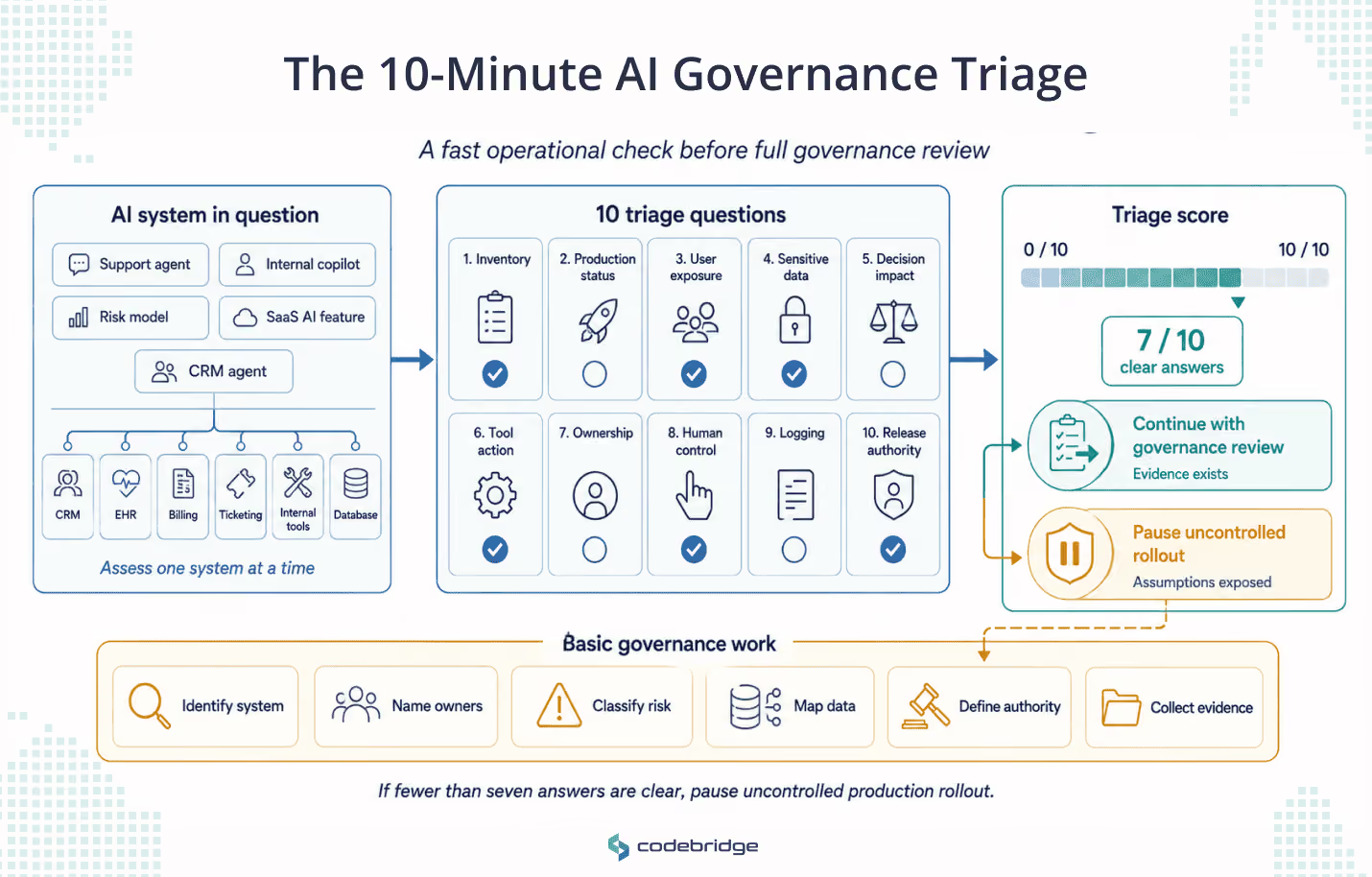
Before a company starts a full AI governance review, it should run a short triage on the AI system in question. Again, this is not a replacement for legal, security, or compliance review. It is a fast way to understand whether the company already has enough operational clarity to continue safely.
The triage should be completed for one AI system at a time because a broad company-wide discussion usually becomes too abstract.
Start with these ten questions:
The value of this triage is in exposing where the company is relying on assumptions. If the team cannot answer most of these questions, the system may still be suitable for discovery or controlled experimentation, but it should not be treated as production-ready AI governance.
A useful practical threshold: if fewer than seven of these ten questions can be answered clearly, the company should pause any uncontrolled production rollout and complete the basic governance work first.
The next step is not necessarily to create a large AI policy. The next step is to identify the system, name the owner, classify the risk, map the data, define the authority boundary, and decide what evidence must be collected.
Build an AI System Inventory
AI governance starts with visibility. A company cannot govern AI systems it has not listed, classified, or assigned to an owner. This is one of the most common early governance gaps, especially in software companies where AI appears inside product experiments, internal tools, vendor platforms, support workflows, analytics systems, sales operations, and developer environments at the same time.
The inventory should include both internally built and third-party AI systems. A company may think it only has one AI product feature, while employees are also using AI inside customer support, documentation, sales research, meeting notes, code generation, testing, data analysis, and marketing operations. From a governance perspective, these systems may not carry equal risk, but they still need to be visible.
For each AI system, capture the basic operating facts:
A simple inventory table is enough at this stage. The goal is to make hidden systems visible.
The inventory should be created before procurement, before development, before a pilot, before production release, and after any major workflow change. It should also be updated when a vendor is added, a model changes, a new data source is connected, or the AI system receives permission to take new actions.
This step matters because most downstream governance depends on it. Without an AI system inventory, the company cannot classify impact, define ownership, manage vendor exposure, control data access, document human oversight, monitor outputs, or respond properly when something goes wrong. Inventory is not the whole governance process, but it is the point where governance becomes concrete.
Classify the AI Use Case by Impact
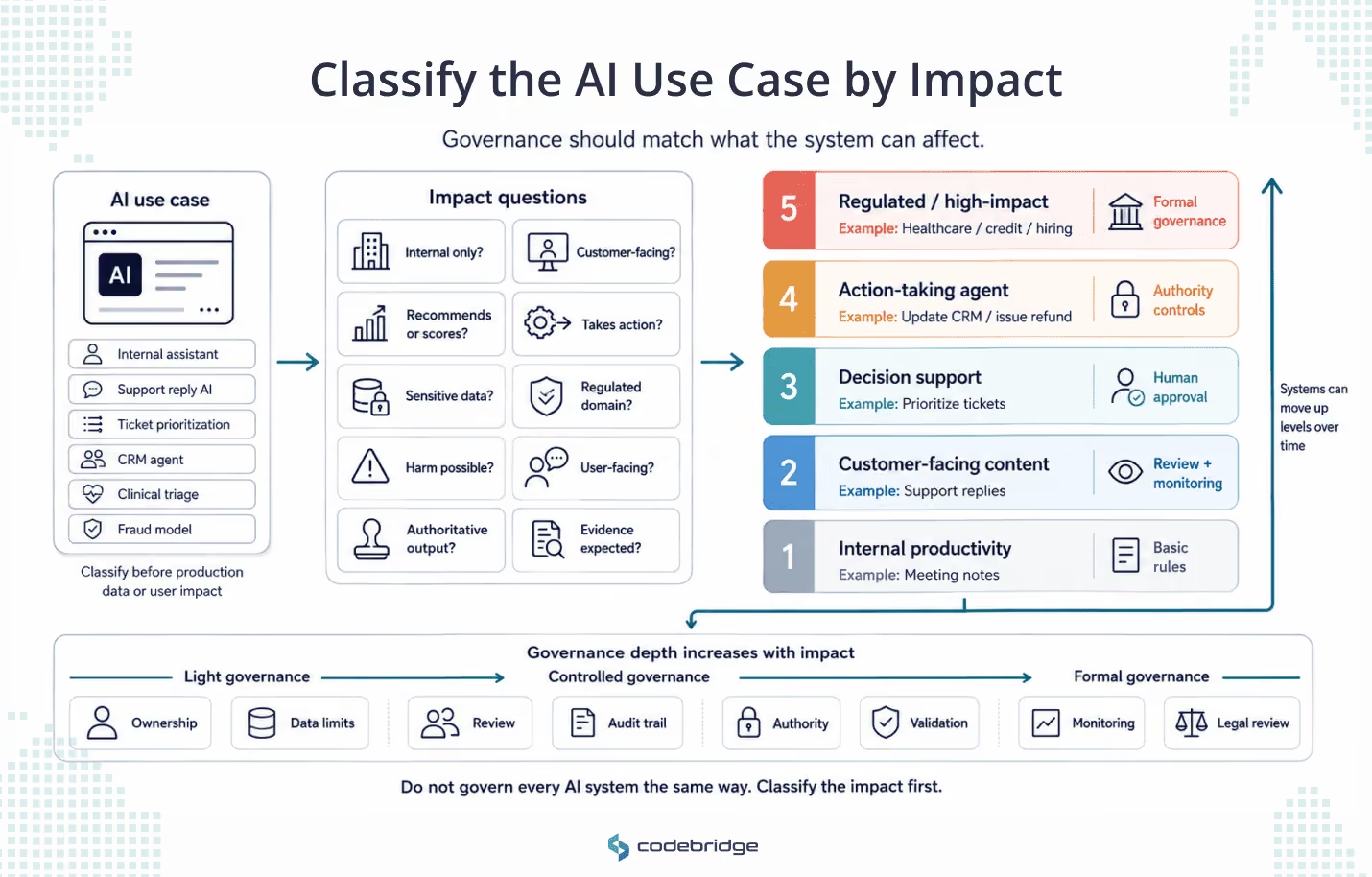
After the AI system is listed, the next step is to classify its impact. This prevents two common mistakes. The first is over-governing low-risk productivity tools until nobody follows the process. The second is under-governing high-impact systems because they started as small experiments and slowly became operational infrastructure.
Governance should be proportional to the system’s role. An internal assistant that summarizes meeting notes does not need the same governance depth as a model that supports clinical triage, fraud detection, hiring recommendations, credit decisions, insurance eligibility, customer refunds, or legal research. The relevant question is not only what technology the system uses. The more important question is what the system can affect.
Use these questions to classify the AI system:
A practical risk ladder helps product and engineering teams decide how much governance the system needs.
This classification should be completed before the system is connected to production data or allowed to affect users. A system can move from one level to another over time. For example, an internal assistant may begin as a Level 1 tool, then become Level 3 when its recommendations start influencing customer prioritization, and Level 4 when it receives permission to update CRM fields or trigger workflows.
The purpose of classification is to make sure the governance burden matches the actual operating risk. Low-impact tools should not drown in unnecessary process, but systems that touch sensitive data, regulated domains, customer rights, or automated actions need stronger controls before they scale.
Map Data Governance and Data Boundaries
AI governance becomes concrete when data enters the system. Once the AI system is connected to customer records, clinical information, payment data, or internal knowledge bases, governance becomes a question of what the system can see, use, store, expose, and pass to third parties.
The first step is to trace one complete workflow from input to output. Identify what data enters the AI system, where that data comes from, how it is processed, where the output goes, and whether any part of the workflow is logged, stored, retrieved, or sent to an external vendor.
This should include both obvious data sources, such as databases and uploaded files, and less visible sources, such as chat history, retrieval indexes, CRM notes, transcripts, system prompts, embedded documents, analytics tools, and vendor-side logs.
For each AI system, answer the following questions:
A basic data-boundary table can be enough for the first review:
The most important part of this step is the conversation the table forces. Many AI systems become risky because the team connects a useful data source without deciding whether the model should have access to every field, every document, every customer segment, or every historical record inside that source.
For example, an AI support assistant may need access to order status, product documentation, and previous support tickets. It may not need access to payment details, internal account notes, private sales comments, identity documents, or unrelated customer records.
Data boundaries should be checked before the AI system is connected to production data. They should also be reviewed whenever a new data source is added, a retrieval system is changed, a vendor is introduced, a model is fine-tuned, or an AI agent receives access to business systems. In practice, many governance failures begin not with the model itself, but with data that was never classified properly before the model started using it.
Define Authority Boundaries and Human Oversight
After data boundaries, the next governance question is authority. What is the AI system allowed to do with the information it receives?
This is especially important for AI agents and decision-support systems. A model that summarizes a document has one risk profile, but a system that recommends a clinical next step, prioritizes loan applications, updates CRM fields, or triggers operational workflows has a very different risk profile. The difference is authority.
Many companies use the phrase “human-in-the-loop” too broadly. It often sounds reassuring but does not explain how the system actually works. A useful governance checklist should be more specific. Where does the human review happen? Which actions require approval? Who can override the AI? What happens when the AI is uncertain? Can the system be paused?
For each AI system, define the authority boundary clearly:
A practical authority matrix can make this visible:
The authority matrix should not be written only by engineering. Product, security, compliance, operations, customer-facing teams, and domain experts should be involved when the system affects users, money, medical workflows, legal interpretation, hiring, education, or regulated decisions. The purpose is to make sure the AI system’s permissions match the company’s tolerance for risk and its obligations to customers, users, and regulators.
This is also where AI-specific security belongs. If an AI system can access tools, retrieve private knowledge, or execute actions, the company needs to test whether users can manipulate it into doing something outside its intended authority. Prompt injection, sensitive information exposure, improper tool use, retrieval from unauthorized documents, excessive agency, and unsafe output handling are not separate from governance. They are part of the same question: can the AI system be pushed beyond the boundaries the company believes it has set?
Before production, teams should test whether the AI system can reveal confidential data, ignore instructions, access documents outside a user’s permission level, call tools it should not call, or send unreviewed outputs into business systems. Tool permissions should be scoped narrowly. Retrieval systems should respect access control. Outputs should be filtered or reviewed when the system operates in high-impact workflows. Action-taking agents should have clear limits, escalation paths, and emergency stop mechanisms.
This section is where governance becomes architecture. A company does not have reliable AI governance just because it wrote that humans remain responsible. It has governance when authority boundaries are implemented in the workflow, enforced in the system, visible to owners, and supported by logs.
Create Documentation, Audit Trails, and Evidence
AI governance depends on evidence. If an AI system produces a harmful output, leaks sensitive information, misclassifies a user, makes an incorrect recommendation, or takes the wrong action, the company needs more than a general statement that the system was reviewed. It needs a record of what happened and how the system was controlled.
This does not mean every AI system needs the same documentation burden. A low-risk internal assistant may only require basic ownership, acceptable-use rules, and data restrictions. A high-impact or regulated AI system may require detailed documentation of purpose, risk classification, data sources, model behavior, evaluation results, human oversight, monitoring, incidents, and changes over time. The documentation depth should match the system’s impact level.
For each AI system, check whether the following evidence exists:
The evidence layer should cover both technical and operational records.
Auditability is especially important when AI systems interact with users or regulated workflows. A support agent should leave a record of the customer context it used and the action it took. A decision-support tool should preserve the recommendation, the evidence shown to the human reviewer, and the final human decision. A clinical, financial, legal, or employment-related AI system should be able to show not only the output, but also the boundaries, review process, and escalation logic around that output.
The goal is not to collect logs for their own sake. Logs without ownership, review, and retention rules can create new risks. The goal is to create enough evidence for the company to monitor the system, investigate failures, support enterprise review, and show that governance controls were not only described, but actually operated.
A practical rule is that every AI system should have documentation strong enough to answer four questions after an incident: what happened, why it happened, who was responsible for review or intervention, and what changed afterward. If the company cannot answer those questions, the governance layer is not yet mature enough for serious production use.
Set Monitoring and Post-Launch Governance
AI governance does not end when the system is approved for release. In production, the behavior of an AI system can change because the model changes, the prompt changes, the retrieval source changes, the workflow changes, users behave differently, or the system receives access to new tools and data. A governance review that happens only before launch leaves the company exposed after the system starts operating in real conditions.
Monitoring should be designed around the actual role of the AI system. A low-risk internal assistant may only need usage tracking, data-boundary review, and occasional output checks. A customer-facing AI agent, decision-support system, or regulated-domain workflow needs stronger monitoring because its errors may affect users, customers, operations, or compliance obligations.
For each AI system, define what should be monitored and what action should follow when thresholds are breached. The relevant metrics may include output quality, hallucination rate, false positives, false negatives, escalation rate, override rate, unresolved cases, user complaints, latency, cost, drift, policy violations, and incidents. For AI agents, monitoring should also cover tool use, failed actions, unauthorized action attempts, handoff quality, and cases where the agent reaches the edge of its authority.
A practical monitoring table should include the metric, why it matters, the threshold, the owner, and the required action.
Monitoring should not only produce dashboards. It should produce decisions. If a metric crosses a defined threshold, the company should know whether the system needs prompt adjustment, model review, workflow redesign, permission reduction, human review expansion, vendor escalation, rollback, or temporary suspension.
Post-launch governance should also define ownership of change. If a model version changes, a prompt is updated, a retrieval source is refreshed, or an AI agent receives new tool permissions, the company should decide whether the system needs re-testing before the change goes live. AI systems should not be treated as static software features once released. They require operational ownership because their behavior depends on models, data, context, and workflow conditions that can change over time.
A mature governance process should be able to answer five production questions: who monitors the system, which signals matter, when the system must be reviewed, who can pause it, and how the company learns from incidents. Without those answers, the system may function technically while remaining weak from a governance perspective.
Review Vendor and Third-Party AI Risk
Many software companies do not build their AI systems from one controlled internal stack. They rely on foundation model providers, cloud infrastructure, vector databases, orchestration tools, analytics platforms, data-labeling vendors, customer support platforms, CRM integrations, workflow automation tools, and third-party AI features embedded in existing SaaS products.
This means AI governance must include vendor and third-party risk. The company may own the product experience, but parts of the data processing, model behavior, retention, security, availability, and cost structure may depend on external providers. If that dependency is not reviewed, the company can end up with hidden governance risk inside a vendor contract, API integration, or model provider setting.
For each vendor involved in an AI system, answer the following questions:
A simple vendor register can help product and engineering teams identify where external dependencies sit inside the AI system.
Vendor risk should be assessed before the system enters production, but it should not be treated as a one-time procurement task. Vendors change models, infrastructure, policies, prices, regions, sub-processors, and terms. A provider that is acceptable during a prototype may not be acceptable when the system starts handling customer data, enterprise accounts, regulated workflows, or high-volume production traffic.
The most important question is whether the vendor controls something the company cannot easily replace. If a vendor controls the model layer for a low-risk internal assistant, the risk may be manageable. If a vendor controls the avatar layer, clinical workflow component, underwriting model, customer-agent reasoning layer, or transaction-critical automation path, vendor risk becomes product risk.
This is where governance and architecture overlap. A company should know which dependencies are acceptable, which need contractual review, which require technical isolation, and which should be replaced or abstracted before the system scales. The goal is not to avoid vendors entirely. The goal is to understand where third-party AI dependencies affect data protection, reliability, auditability, user trust, compliance readiness, and the economics of the product.
Check EU AI Act Risk
For software companies serving customers in Europe, AI governance needs an EU AI Act risk screen. This screen should not attempt to replace legal review. Its purpose is narrower and more practical: to help product and engineering teams identify whether an AI system may fall into a category that requires deeper regulatory assessment before launch.
The first question is whether the AI system is placed on the EU market, used by EU customers, or affects people located in the EU. The second question is what role the company plays. A company may be a provider, deployer, importer, distributor, or product manufacturer depending on whether it builds the AI system, integrates it into a product, deploys it internally, or makes it available to others.
Once exposure is possible, the company should classify the AI system by risk category. The EU AI Act uses a risk-based approach, with prohibited practices, high-risk systems, limited-risk systems, and lower-risk use cases treated differently. For software companies, the most important early task is to identify whether the AI system touches a sensitive use case such as employment, education, healthcare, credit, insurance, essential services, biometric identification, migration, law enforcement, or other areas where AI can affect people’s rights, opportunities, safety, or access to services.
Use these questions as an EU AI Act risk screen:
The most useful output from this section is not a final legal conclusion. It is a routing decision. If the AI system is low-impact and internal, the company may continue with standard governance controls. If the system affects people in high-impact contexts, interacts with users, generates synthetic content, or operates inside a regulated product, the company should escalate to legal, compliance, security, and domain specialists before production release.
As of June 2026, the EU AI Act timeline also matters. The Act entered into force on 1 August 2024 and is being applied through staged timelines. Under the political agreement on the AI Omnibus, the rules for systems used in certain high-risk areas are set to apply from 2 December 2027, while rules for high-risk AI systems integrated into products such as lifts or toys are set to apply from 2 August 2028. Software companies should avoid treating the AI Act as a distant future concern, but they should also avoid assuming that every obligation applies immediately to every AI system. The practical approach is to identify the use case, classify risk, document the reasoning, and confirm the result with qualified legal or regulatory counsel.
Check US AI Governance Requirements
US AI governance is different from EU AI governance because there is no single universal US AI Act that applies in the same way across all software companies. Instead, US AI governance is shaped by a combination of voluntary frameworks, federal agency expectations, state laws, privacy rules, sector-specific regulation, model risk practices, cybersecurity requirements, procurement reviews, and customer expectations.
For B2B software companies, this matters because governance pressure often arrives through the buyer before it arrives through a regulator. Enterprise customers may ask how the AI system is monitored, whether data is used for training, whether human review exists, whether audit logs are available, whether vendor controls are documented, and whether the company can explain how AI-supported decisions are made. In regulated industries, these questions become more specific and more serious.
NIST AI RMF is the strongest cross-sector reference point for US-facing AI governance. It is not a regulation by itself, but it gives companies a practical structure for managing AI risk through four functions: Govern, Map, Measure, and Manage. For software teams, this is useful because it translates AI governance from abstract principles into operational work: assign responsibilities, understand the context, measure risks, and manage controls across the AI lifecycle.
Use these questions as a US AI governance screen:
A practical US governance map should include both formal requirements and commercial expectations.
In financial services, software companies should be especially careful with the phrase “model risk management.” Traditional banking model-risk practices still matter for many quantitative models, validation practices, monitoring controls, documentation, and governance expectations. At the same time, the revised 2026 US banking model-risk guidance states that generative and agentic AI models are outside its scope because they are novel and rapidly evolving. Software companies should not assume that older model-risk approaches fully resolve GenAI or AI agent governance. The safer approach is to preserve the durable controls: validation, explainability, monitoring, documentation, vendor review, fair-lending awareness where relevant, and payment-data security when cardholder data is involved.
The US section should lead the reader to one practical conclusion: even when a single AI law does not apply, governance still matters. A serious software company needs to prove that AI risks are identified, assigned to owners, measured, monitored, and controlled before the system reaches users or enterprise customers.
Add Domain-Specific Governance Overlays
Base AI governance is not enough when the AI system operates in a regulated or high-stakes domain. The same technical architecture may require very different controls depending on whether it supports a clinical workflow, financial decision, legal research process, recruiting workflow, educational assessment, customer service operation, or CRM automation.
This is why the checklist should include a domain overlay after the general governance review. The overlay does not replace domain-specific legal, security, clinical, or compliance work. It helps the team identify which additional controls should be considered before production.
The point of this table is to prevent teams from applying one generic AI governance standard to every system. A generic support bot, an AI-assisted recruiter, a radiology workflow assistant, and a FinTech risk model may all use AI, but they do not carry the same operating risk. Governance has to follow the actual workflow, the user impact, the data sensitivity, and the domain obligations.
For software companies, this also affects product strategy. A system that looks simple during an internal demo may become much more complex when it enters a regulated domain, enterprise procurement process, or customer-facing workflow. The domain overlay helps teams see that complexity before the architecture is already built around the wrong assumptions.
AI Governance Readiness Scoring Model
After completing the checklist, score each area from 0 to 4 and calculate an overall readiness percentage. The score should be applied to one AI system at a time. It should not be used as a broad company maturity claim unless the company has assessed every meaningful AI system separately.
The scoring model is deliberately simple. It is designed to help teams decide what should happen next: discovery, controlled pilot, production review, remediation, or scale.
Prepare legal, security, domain, and enterprise review with evidence from documentation, monitoring, audit trails, and operational controls.
The score should not be treated as proof of compliance. A high score does not automatically satisfy the EU AI Act, NIST AI RMF, HIPAA, FDA expectations, PCI DSS, financial-services obligations, employment rules, or other legal requirements. It means the company has enough governance structure to support serious review.
The score is also not permanent. An AI system may score well when it is only summarizing information, then require a new review when it receives access to customer data, starts generating user-facing content, becomes connected to tools, or enters a regulated workflow. Any material change to model, data, workflow, vendor, authority, or domain should trigger a reassessment.
What to Do After You Score Your AI System
The scoring process should lead to action. A checklist that produces only a number is not useful. The purpose of scoring is to decide what kind of governance work should happen before the AI system moves forward.
If the system scores below 30%, the company should not treat it as production-ready. The priority is to establish basic visibility and ownership. Build the AI system inventory, name the business and technical owners, classify the use case, map the data sources, and define whether the AI can only suggest or can take action. At this stage, the system may remain in discovery, prototype, or internal experimentation, but it should not be connected broadly to users, sensitive data, or autonomous workflows.
If the system scores between 31% and 60%, a controlled pilot may be possible, but production release is risky. The company should focus on authority boundaries, human review, logging, vendor review, security testing, and escalation paths. This is the stage where many AI systems look useful enough to ship, but the governance layer is still too thin to support real operating risk. Product and engineering teams should limit scope, restrict data access, define human approval points, and monitor the system closely.
If the system scores between 61% and 80%, the company may be close to production readiness, but the remaining gaps should be treated seriously. At this stage, the focus should move to monitoring, auditability, incident response, domain-specific review, and enterprise-readiness evidence. The system should have clear owners, documented controls, tested workflows, and enough records to support investigation if something goes wrong.
If the system scores above 80%, it may be a strong candidate for production review. That does not mean the system is automatically safe or compliant. It means the company is in a better position to engage legal, security, compliance, domain experts, enterprise buyers, or regulators with a clear explanation of how the AI system is controlled.
The most important result of the scoring process is prioritization. The company should know which governance gaps must be fixed immediately, which can be handled before scaling, and which belong in a longer-term governance roadmap. For software companies with multiple AI systems, the same scoring model can also help prioritize governance work across the portfolio. Systems that touch sensitive data, make or influence decisions, interact with users, or take action through tools should be reviewed first.
Where Codebridge Fits
AI governance becomes difficult when it has to move from policy into architecture. Many companies can write a responsible AI statement. Fewer can translate that statement into data flows, permission models, human review points, audit logs, monitoring rules, vendor boundaries, rollback paths, and production-ready workflows.
This is where Codebridge fits. Codebridge helps software companies turn AI governance from a document into production architecture. The work usually starts by mapping the AI system: what it does, what data it touches, which systems it connects to, what decisions it supports, which actions it can take, and where human oversight belongs. From there, governance becomes a set of technical and operational controls rather than a separate compliance layer sitting outside the product.
For AI systems moving into production, Codebridge can help with:
- AI system discovery and workflow mapping;
- data-flow and integration mapping;
- authority-boundary design for AI agents and decision-support systems;
- human-in-the-loop and human-on-the-loop architecture;
- audit logging and evidence design;
- monitoring, escalation, and rollback planning;
- vendor-risk architecture and build-versus-buy decisions;
- regulated-domain readiness for HealthTech, FinTech, LegalTech, SaaS, EdTech, HRTech, SalesTech, and customer-facing AI systems.
This work matches the kind of software environments Codebridge is built for: complex products, sensitive data, high-load SaaS systems, regulated workflows, and integrations where AI cannot live as a detached demo. Codebridge’s Big Four roots also matter here. They show up in the way customer-facing AI systems are designed: with operational discipline, clear ownership, documented controls, auditability, and respect for risk.
The practical proof is visible in the type of systems Codebridge has delivered. In RadFlow AI, Codebridge built a human-in-the-loop radiology workflow assistant inside a clinical environment, with auditability, validation, PACS integration, and regulated-domain constraints treated as part of the architecture. In the Multi-Agent AI System for Sales Pipeline Automation, the governance lesson is bounded autonomy: AI could support qualification, outreach, and pipeline management, but CRM context, orchestration, and human SDR focus remained part of the operating model. In RecruitAI, the system automated early-stage screening and technical validation while preserving human-in-the-loop control at final decision points. In TutorAI, the challenge was not only the model, but latency, session state, cost, recovery, and infrastructure strong enough to turn an AI tutoring demo into a production platform.
These examples matter because AI governance is not separate from implementation. The system either records the right evidence or it does not. It either enforces authority boundaries or it does not. It either gives humans meaningful control at the right point in the workflow or it does not. Good governance has to be designed into the product before scale exposes the missing parts.
If you are planning to move an AI feature, AI agent, or AI workflow into production, start with the governance architecture. Map the system, classify the risk, define data boundaries, decide what the AI can and cannot do, design human oversight, and make sure the evidence exists before the system becomes difficult to control.













Heading 1
Heading 2
Heading 3
Heading 4
Heading 5
Heading 6
Lorem ipsum dolor sit amet, consectetur adipiscing elit, sed do eiusmod tempor incididunt ut labore et dolore magna aliqua. Ut enim ad minim veniam, quis nostrud exercitation ullamco laboris nisi ut aliquip ex ea commodo consequat. Duis aute irure dolor in reprehenderit in voluptate velit esse cillum dolore eu fugiat nulla pariatur.
Block quote
Ordered list
- Item 1
- Item 2
- Item 3
Unordered list
- Item A
- Item B
- Item C
Bold text
Emphasis
Superscript
Subscript