The Short Answer
There are four reasons why finance teams look for a Ramp alternative, and all four trace back to how Ramp's corporate card program is underwritten rather than to any missing feature: a $25,000 minimum balance in your business bank account to qualify, credit limits that move when that balance moves, capability you assumed was free sitting behind a paid tier, and email-first support unless you're paying for more.
Three alternatives are worth naming, and each one answers a different one of those gaps rather than all of them.
Most of these limits descend from one design decision, which is that Ramp issues a charge card underwritten against your own cash rather than a revolving credit line. Once that's clear, the question stops being which platform is better and becomes whether your business is the shape this model was built for.
Why Finance Teams Look For a Ramp Alternative
Four frictions come up often enough, across enough independent sources, to treat as patterns.
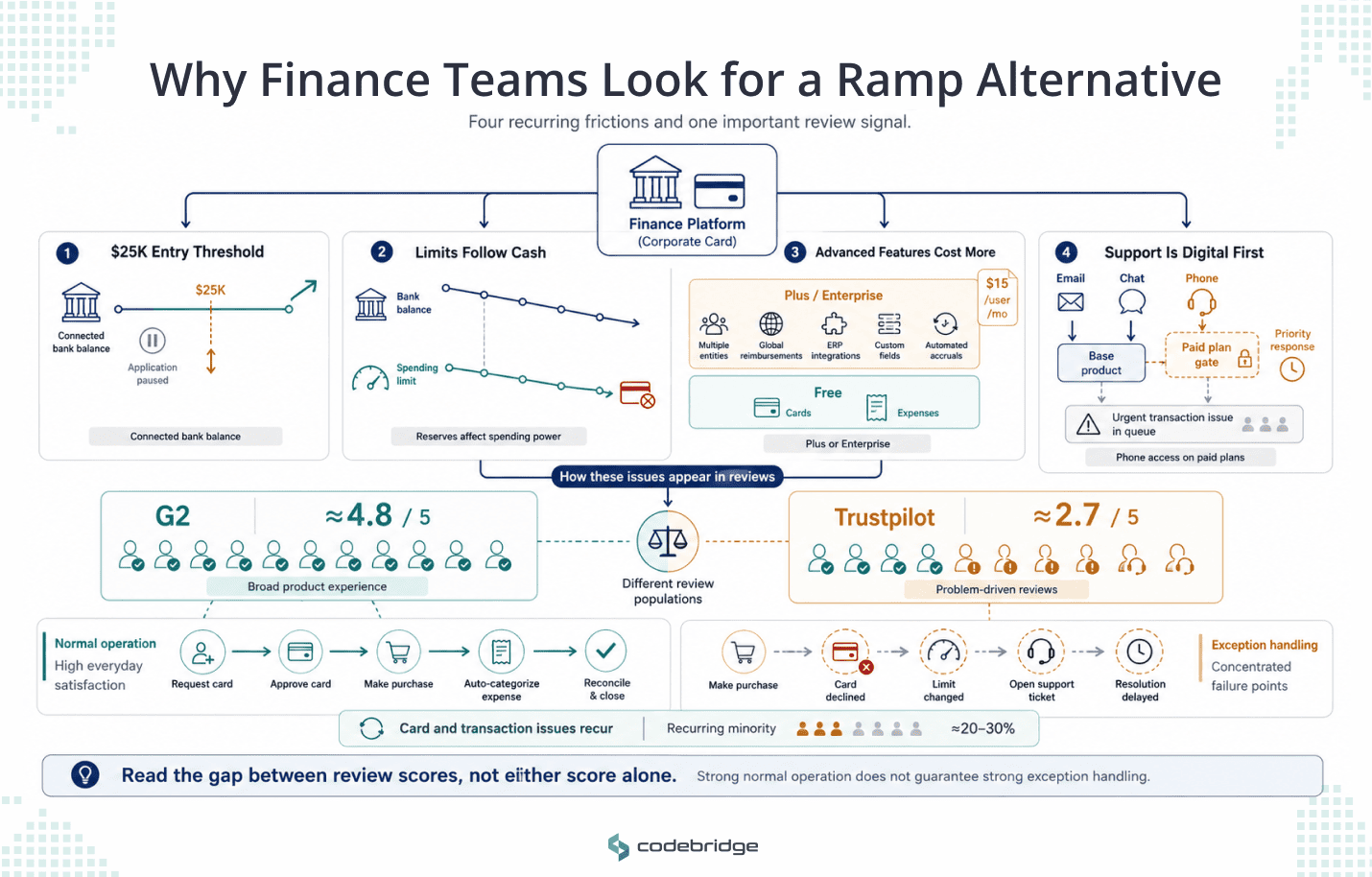
The $25,000 minimum bank balance. A documented eligibility requirement rather than a complaint: Ramp expects $25,000 in a US business bank account at application. It came down from $75,000 in early 2024, so the threshold moves and is worth checking rather than assuming.
Credit limits that move with your balance. Ramp's underwriting monitors your connected bank balance continuously, so a dip in reserves can cut spending power without notice. Ramp's own documentation on transaction declines lists locked funds among common causes, and notes persistent issues need support escalation.
Capability behind the paid tier. Multi-entity management, global reimbursements, deeper NetSuite and Sage Intacct integration, custom fields, and automated accruals sit on Ramp Plus at around $15 per user per month, or Enterprise, rather than the free tier.
Support that's email and chat first. Phone access and priority response are reserved for paying customers, and difficulty reaching a human on urgent issues recurs across Trustpilot and Reddit.
Now the part most comparison pages report and abandon. Ramp holds roughly 4.8 out of 5 on G2 across more than 2,000 reviews, and roughly 2.7 on Trustpilot. Both are accurate, but they measure different populations.
G2 reviews are substantially vendor-solicited, sampling the broad base of people using a product without incident. Trustpilot collects unsolicited reviews, which over-samples people who hit a wall and went looking for somewhere to say so. Neither method is dishonest, and neither is complete alone.
What makes the gap informative is its direction and size. A product scoring high on solicited review and materially lower on unsolicited review is telling you something specific: it works well in normal operation and concentrates its failures in exception handling.
That reading holds against a separate aggregation of G2's own review themes, where card and transaction issues appear in 98 reviews, roughly one reviewer in twenty. Not dominant. Too consistent to wave away.
That split is one of the more reliable signals available when evaluating any finance tool, and it recurs across this category rather than at one vendor. Check both numbers on anything you're considering, and read the size of the gap rather than either score alone.
The Charge-Card Model Behind Most of These Limits
Ramp issues a charge card, not a revolving credit card. The balance is paid in full each cycle by automatic debit from your linked business checking account; there's no interest if you pay on time, and the card stops working if the funds aren't there.
That single design choice explains nearly everything in the section above.
Because there's no revolving credit, there's no traditional credit underwriting to lean on. Ramp underwrites your spending power against the cash it can see in your linked account, and it checks that balance continuously.
So the minimum balance is the model's collateral requirement. The limit that moves without warning is the underwriting running on a loop. And the requirement that your spend flow through Ramp's own card is what makes that spend visible enough to underwrite and categorize in the first place.
None of this is carelessness, which is how most competitor pages frame it. It's a coherent model, and a well-built one. It's also not unique: several alternatives underwrite against your own money too, with different thresholds. What varies between platforms is the requirement, not whether there is one.
Our own view, and this is a judgment about fit rather than a criticism of the product: coupling spending power to cash position is fine, even elegant, when your cash flow is steady. It's the wrong property in a business with lumpy revenue, because the month your balance dips is the month you most need the card to keep working. If your revenue arrives in irregular chunks, you're not looking at a product flaw. You're looking at a model built for a different shape of business than yours.
What Ramp Costs Once You Need the Whole Product
Verify current pricing and the balance threshold before deciding. Both have moved before.
Two illustrative calculations, using round numbers rather than anyone's real invoice.
A ten-person finance team that needs multi-entity support and deeper ERP integration moves to Plus, so roughly $150 a month, or about $1,800 a year, for capability many teams assume comes with the free product.
A business spending $200,000 a year with vendors who bill in other currencies pays around $6,000 a year in conversion fees at 3%.
Neither figure is scandalous, and for many businesses both are reasonable for what they replace. The point is that the free tier's headline price and the real cost of the configuration you need are different numbers. Run that arithmetic with your own figures first.
Three Alternatives Worth Considering
Each of these answers a different gap from the list above, which is why three is enough.
For AP depth: Bill.com. Ramp's accounts payable capability is real and shallower than purpose-built platforms once you hit complex procurement, multi-entity structures, or invoices spanning several purchase orders.
Bill.com is built AP-first. Where it doesn't fit: it carries its own documented problems, principally payments held during automated risk review and support that's hard to reach when a hold happens, which we cover in our Bill.com alternatives guide.
Read the guide: Bill.com Alternatives
Trading one platform's constraints for another's is only progress if the second set matters less to you.
For international operation: Airwallex. Built around cross-border activity from the start, with multi-currency accounts and card issuance across multiple markets, which addresses both Ramp's US-centric design and that 3% conversion fee directly. Where it doesn't fit: a domestic-only business is buying complexity it will never use.
If the cash requirement is the blocker: a no-minimum-balance platform. Rho comes up consistently, with no minimum balance requirement and no personal guarantee for a corporate card. Where it doesn't fit: it restricts accounts to registered US corporations, excluding sole proprietorships, so it removes the balance wall and keeps a different eligibility wall. Check its current terms directly, since most of what's published about it comes from competitors.
Note what follows from the mechanism above: two of these three underwrite against your own money too. The requirement changes; the existence of one doesn't.
When Ramp is Still the Right Call
Most people reading this should stay where they are, and it's worth saying that plainly on a page about alternatives.
Ramp is the strongest default in this category for an incorporated US business with steady cash flow, domestic vendors, and spend management as the primary problem rather than AP depth. The free tier really is free for qualifying businesses, the automation is well regarded by a large base of daily users, and that 4.8 on G2 reflects real satisfaction rather than marketing. If that describes your business, pick a lane and stop reading comparison pages.
The mechanism above also tells you when it isn't: irregular revenue, international vendor payments, unincorporated status, or AP complexity as your dominant problem rather than card spend.
How Codebridge Approaches This
We don't sell a card or a spend platform, so we have no stake in which one you pick.
The gap we see repeatedly in finance stacks built on these tools is connective rather than featural. Payments made outside the platform don't always sync cleanly back to the ERP, which creates double-entry work and reconciliation drift, and it's one of the more consistently reported frictions with Ramp. That work tends to become somebody's standing weekly job without anyone deciding it should.
That connective layer is what we build, along with the multi-entity and custom-field logic that otherwise sits behind a per-user subscription you rent indefinitely. We work on your data, alongside your team, and hand over the code, so it belongs to your business.
If the reconciliation work around your spend platform has turned into a recurring task nobody scheduled, that's worth 30 minutes.















Heading 1
Heading 2
Heading 3
Heading 4
Heading 5
Heading 6
Lorem ipsum dolor sit amet, consectetur adipiscing elit, sed do eiusmod tempor incididunt ut labore et dolore magna aliqua. Ut enim ad minim veniam, quis nostrud exercitation ullamco laboris nisi ut aliquip ex ea commodo consequat. Duis aute irure dolor in reprehenderit in voluptate velit esse cillum dolore eu fugiat nulla pariatur.
Block quote
Ordered list
- Item 1
- Item 2
- Item 3
Unordered list
- Item A
- Item B
- Item C
Bold text
Emphasis
Superscript
Subscript