The AI Ownership Mistake
Right now, a company can have five AI initiatives running at the same time, but still have no AI ownership.
For example, the marketing department tests ChatGPT’s new API, the product adds an AI feature, IT worries about tools, access, and security. Then the CEO asks where the ROI is.
Many start to suspect that the problem lies in tool adoption. However, the deeper problem is actually the accountability. Each team owns a piece of activity, but nobody owns the business result, customer impact, or governance boundary.
This is why many companies have an AI ownership problem. AI enters the organization faster than decision rights are defined.
Short Answer: AI Should Be Owned by Decision Rights
To answer the question about ownership, first, the company needs to ask which decision needs an owner.
As AI touches business value, systems, and risk at the same time, one person physically cannot own all of that alone. But each important decision must have one clear owner.
This is the AI ownership model - shared execution, clear accountability.
Why “Everyone Owns AI” Usually Means Nobody Owns AI
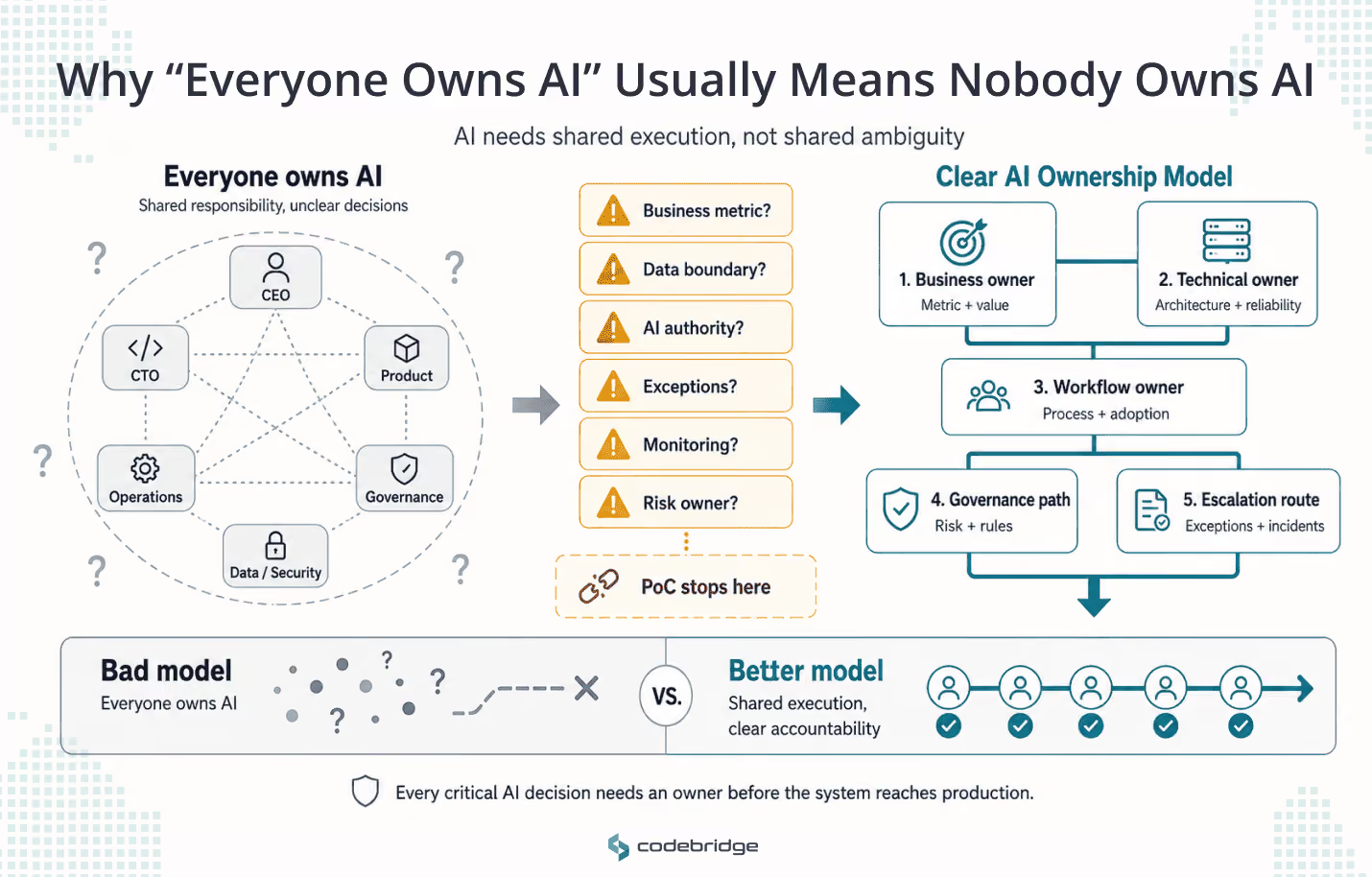
“Everyone owns AI” problem in a team sounds collaborative, but it often produces ambiguity. When responsibility is spread too loosely, basic ownership questions stay unanswered:
- No one defines the business metric
- No one approves the data boundary
- No one decides what AI is allowed to do
- No one owns exceptions
- No one monitors model behavior after launch
- No one is accountable when the output creates risk
Gartner found that by the end of 2025, at least 50% of GenAI projects were abandoned after proof of concept because of poor data quality, inadequate risk controls, escalating costs, or unclear business value.
A serious AI initiative needs one business owner, one technical owner, one workflow owner, one governance path, and one escalation route. Here, cross-functional execution is necessary, not the shared ambiguity.
4. The AI Ownership Model: Who Owns What?
Business outcome ownership
The CEO or business leader does not need to manage prompts, models, or implementation tasks. Their responsibility is to define why the company is using AI and what must be improved. A practical business outcome definition includes:
- Current baseline: What is slow, expensive, risky, or inconsistent today?
- Target result: What should improve and by how much?
- Business owner: Who is accountable for the result?
- Time horizon: When will the company evaluate whether it worked?
- Stop condition: When will the company kill or redesign the initiative?
Example: reduce average customer support resolution time by 30% within 90 days without reducing CSAT or increasing escalation errors.
Technical architecture ownership
The CTO owns whether the AI system can survive production. This includes data quality, integrations, security, latency, observability, and maintainability. The CTO should define:
- what data AI can access
- where the data lives
- how permissions work
- what systems AI can call
- how outputs are logged
- how errors are detected
- who maintains the system after launch
Product ownership
Product owns whether AI actually improves the user or customer experience. AI should not be added because it looks innovative. It should solve a user problem better than the existing workflow. Product should define:
- the user job
- the user expectation
- what the AI should and should not say or do
- what happens when confidence is low
- how the user can correct or override AI
Operations ownership
Operations owns whether AI becomes part of how work is actually done. A tool is not adopted just because it is available. Operations should define:
- the current workflow
- the future workflow
- new handoffs
- exception handling
- training requirements
- adoption rhythm
- operational KPIs
Governance ownership
Governance owns the boundaries. Governance is not only policy, but it is also the operating control system around AI. The NIST AI Risk Management Framework treats governance as a cross-cutting function that runs through AI risk management, with roles, responsibilities, oversight, documentation, and review defined across the lifecycle. Governance should define:
- authority boundaries
- human review points
- audit trails
- monitoring
- escalation
- vendor risk
- compliance triggers
The Practical Rule: The Owner Depends on What AI Is Allowed to Do
The more authority AI has, the more ownership must move from local experimentation to executive, technical, and governance control.
Use this rule:
- If AI only assists a person, ownership can stay closer to the team using it
- If AI changes a customer experience, Product and Operations must be involved
- If AI takes action inside systems, the CTO and Governance must be involved
- If AI affects risk, money, customers, or regulated decisions, the CEO cannot delegate accountability completely.
Cisco’s AI Readiness Index shows why this matters. Only 24% of organizations can control agent actions with proper guardrails and live monitoring, compared with 84% of AI Pacesetters. Without control, AI risk scales faster than AI value.
A Simple AI Ownership Checklist for CEOs
Before approving an AI initiative, the CEO should ask:
- What business metric does this improve?
- Who owns that metric?
- What workflow will change?
- Who owns the workflow after launch?
- What data will the AI use?
- Who approves access to that data?
- What is AI allowed to decide or do?
- Where is human review required?
- What happens when AI is wrong?
- What evidence will we log?
- Who monitors performance after launch?
- Who has the authority to pause or shut down the system?
If these questions do not have clear answers, the company has an AI experiment.
Where Codebridge Fits
Codebridge helps companies turn AI ownership from a leadership discussion into system architecture and workflow implementation.
Before building AI, a company needs to define the operating model around it:
- business outcome,
- technical architecture,
- data access,
- authority boundaries,
- workflow adoption,
- governance evidence,
- monitoring and escalation.
This is where architecture-first implementation matters. AI ownership is not only a leadership chart. It becomes real in system design, integrations, permissions, logs, human review points, and production controls.
At Codebridge, we treat AI ownership as part of the architecture. Before AI touches a workflow, customer, or decision, the company needs to know who owns the result, who owns the system, who owns the workflow, and who owns the boundary.
Conclusion
AI ownership should be simple enough to explain and strict enough to operate.
The CEO does not need to own every AI tool. The CTO should not be left alone to own every business consequence. Product and Operations cannot treat AI as a feature or workflow shortcut without technical and governance control.
A serious AI ownership model starts with decision rights: who owns the value, who owns the system, who owns the workflow, who owns the user experience, and who owns the risk.











Heading 1
Heading 2
Heading 3
Heading 4
Heading 5
Heading 6
Lorem ipsum dolor sit amet, consectetur adipiscing elit, sed do eiusmod tempor incididunt ut labore et dolore magna aliqua. Ut enim ad minim veniam, quis nostrud exercitation ullamco laboris nisi ut aliquip ex ea commodo consequat. Duis aute irure dolor in reprehenderit in voluptate velit esse cillum dolore eu fugiat nulla pariatur.
Block quote
Ordered list
- Item 1
- Item 2
- Item 3
Unordered list
- Item A
- Item B
- Item C
Bold text
Emphasis
Superscript
Subscript