The Short Answer
Melio's plans are metered by ACH transaction count rather than by feature set: the entry plan gives you five free bank transfers a month and charges fifty cents for each one after that. A business paying fifteen vendors crosses that line before its first month is out, and one paying fifty covers forty-five transfers at fifty cents each, around $22.50, before anything spent on cards, checks, or speed.
That structure explains most of why people go looking for a Melio alternative, and it is worth understanding before you switch anything, because most of what has gone wrong is a threshold you crossed rather than something the product broke.
This guide names the three thresholds, separates the complaints that belong to Melio from the ones that belong to your bank, and maps each threshold to the direction it points.
Melio is Priced to Be Outgrown
Melio is free at the door and priced by the meter, and those two facts tell you more about the product than any feature comparison will.
The tiers are built around transaction count rather than capability: five free ACH transfers monthly on the entry plan with one user, twenty on the next, fifty on the next, uncapped on the $80 plan, with every transfer past your allotment costing fifty cents.
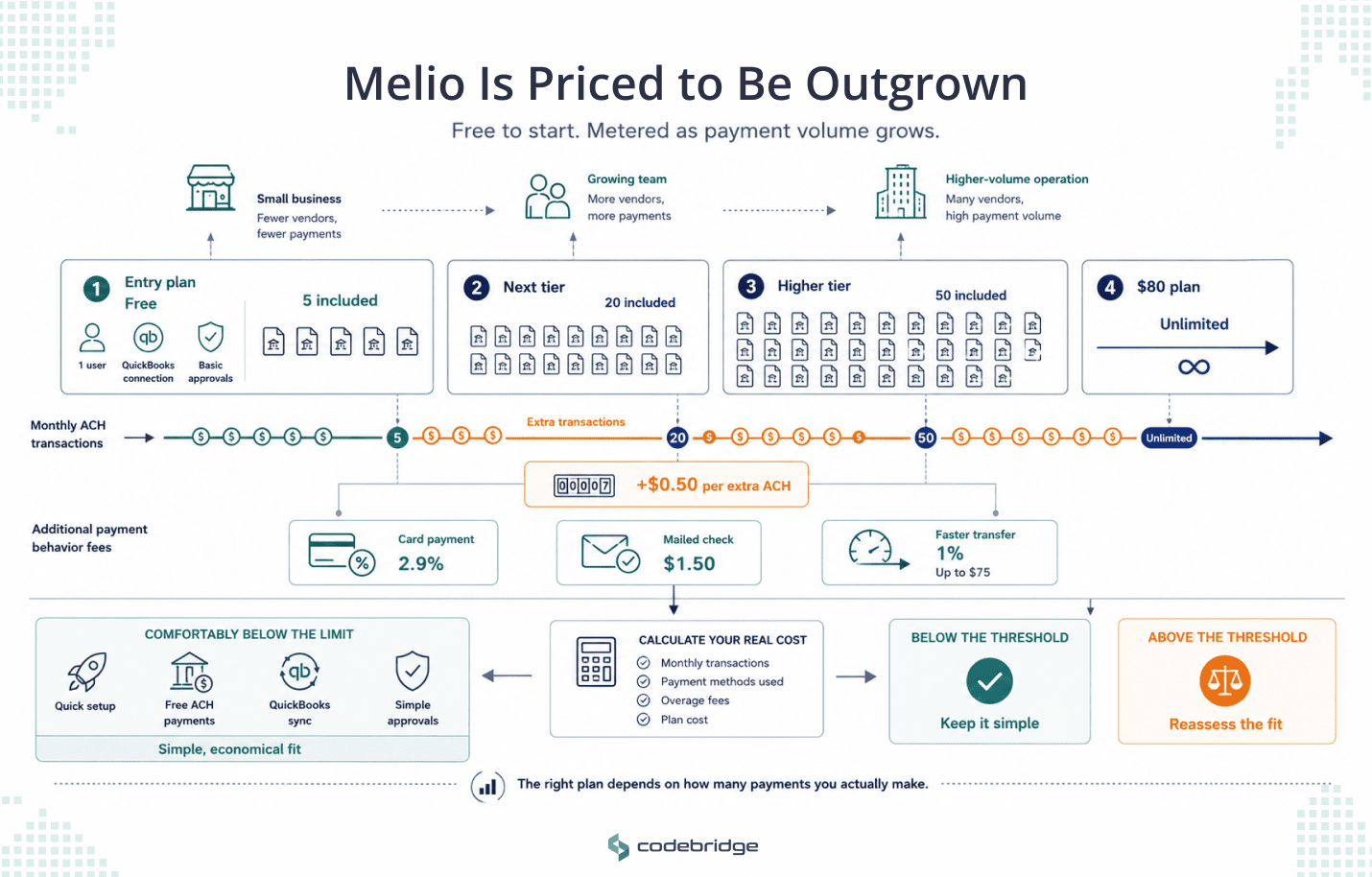
Three other charges sit alongside that meter, each attaching to a behaviour that increases as a business grows. Card payments cost 2.9 percent, mailed checks $1.50, and moving money faster than standard costs one percent capped at seventy-five dollars, non-refundable once initiated.
My own read, and the reason a pricing page is often more informative than a feature list: free in payments almost always means metered, and the only honest way to evaluate a free tier is to count your own monthly transactions and price them against the tiers rather than reading the headline. Do that arithmetic and Melio tells you plainly what size of business it was designed for.
None of this is a criticism.
Below its thresholds, Melio does what it was built to do, and reviewers say so consistently: quick setup, a clean QuickBooks sync, free ACH, workable approval permissions. If you are still comfortably under the line, the most useful thing you can do with this page is close it.
The Three Thresholds
Threshold 1: Volume
The meter is the first wall most businesses reach, and it arrives earlier than the word free suggests. At fifty vendor payments a month on the entry plan you are paying for forty-five of them, and the meter does not care whether each took two seconds or twenty minutes to prepare. Add a few card payments at 2.9 percent and some mailed checks at $1.50 and the monthly total stops resembling zero.
One caution, because several published comparisons make a claim their own arithmetic does not support. Whether moving up a tier costs less than paying overages depends on what the middle tiers charge in subscription, a comparison you can only make by checking current prices against your real transaction count. Ten minutes with your last three months of volume settles it more reliably than any article, including this one.
Threshold 2: Certainty
The second threshold is quieter, and it catches people out. Melio publishes no formal service level agreement on payment delivery, and its own documentation frames the three-business-day ACH window as an estimate rather than a commitment. Payments above $100,000, or payments to a vendor you have never paid, may attract compliance review that stretches the timeline further.
For a business paying a handful of vendors who know it well, an estimate is entirely adequate. For a business whose vendor agreements contain payment terms, an estimate is exposure.
This is the signal I would watch most closely when evaluating any payment tool, and the reasoning is structural rather than cynical. A delivery guarantee costs money to honour, because honouring it means absorbing the loss when something goes wrong, and a product priced at zero for its core function has nowhere to absorb that from. The absence of a guarantee is what the price implies.
Threshold 3: Complexity
The third threshold arrives in two shapes. International payments are a documented weak point, with users reporting failed transfers, fee disclosure that surfaces too late to be useful, and no way to inspect recipient details once a payment is submitted. Approval structure is the second, and here the honest description is depth rather than absence: Melio does provide approval workflows and user permissions, and reviewers value them, so the ceiling is not a missing feature but a setup that works cleanly for one or two approvers and strains once several people must review in sequence with an audit trail behind it.
What the Complaints Tell You, and What They Don't
Public reviews of Melio contain a recognisable pattern, and reading it correctly matters more than counting it. Payments held or delayed with thin explanation. Payments pulled before their scheduled date and causing overdrafts, which is the opposite failure and specifically documented. Accounts of ACH payments that never arrived and were never traced.
Support that handles routine questions by email but struggles once something is properly stuck. G2's aggregated tags give this proportion rather than drama: delays in seventeen reviews, payment issues in sixteen, payment delays in fourteen, poor support in thirteen, against more than 2,260 reviews total.
Now the part almost no comparison page bothers with, and the reason most roundups on this topic are close to useless. A meaningful share of what gets blamed on Melio is imposed by the reader's own bank. Chase caps ACH at $10,000 per transaction and $25,000 daily, and Bank of America restricts some accounts to $1,000 per transaction.
Those ceilings can stretch delivery to between three and seven business days, and Melio cannot override them, so a review describing a slow payment may be describing a bank's risk policy rather than a platform failure.
Separating those is the difference between diagnosing your problem and merely resenting it. Before you move anything, find out whether your delays originate with your bank, with a compliance review, or with the platform, because only the third gets solved by switching.
Which Threshold You Hit Tells You Where to Go
The first row deserves more emphasis than a table gives it, because the cheapest move is often not a move. If your only real problem is that the meter ran out, pricing Melio's own higher tiers against your actual transaction count may settle it without a migration, and no vendor writing about Melio alternatives has any reason to tell you that.
Two honest notes on the other rows. Bill.com carries documented problems of its own around payment holds and support, covered in its own guide.
Ramp underwrites spending power against your linked bank balance and expects a $25,000 minimum, which rules out a fair number of businesses reading this.
One pattern worth naming: the direction you outgrow Melio in says something useful about what your business has become, whether that is heavier on approvals, on cards, or on cross-border work. The threshold you hit describes your growth rather than your judgement in picking Melio.
The Part Nobody Prices: Moving
Every comparison page treats switching as a decision. It is also a project, with a cost nobody puts on the page.
Your vendor records, payment history, approval rules, and accounting integration all have to move, and vendor data is the part that reliably goes wrong, because duplicate and incomplete records that were survivable in one system turn into exceptions in the next. We cover that problem in our guide to automating accounts payable.
My view, and it explains a lot of what I see in finance stacks: businesses stay on tools they have outgrown longer than they should, because nobody has scoped the migration, so it stays a vague dread instead of work with a size. Scoping it is not complicated: count your active vendors, check how many are duplicated or missing payment details, list the approval rules that must survive, and confirm what your accounting system expects to receive. That turns the dread into a number.
Codebridge does that migration and the connective work around it, on your data, with the code handed to you.
If you are weighing a switch and cannot tell whether it is a two-week job or a two-month one, a short call will get you closer than another comparison table.















Heading 1
Heading 2
Heading 3
Heading 4
Heading 5
Heading 6
Lorem ipsum dolor sit amet, consectetur adipiscing elit, sed do eiusmod tempor incididunt ut labore et dolore magna aliqua. Ut enim ad minim veniam, quis nostrud exercitation ullamco laboris nisi ut aliquip ex ea commodo consequat. Duis aute irure dolor in reprehenderit in voluptate velit esse cillum dolore eu fugiat nulla pariatur.
Block quote
Ordered list
- Item 1
- Item 2
- Item 3
Unordered list
- Item A
- Item B
- Item C
Bold text
Emphasis
Superscript
Subscript