Imagine a mechanical engineer on the marketplace team — your team — opening Monday's listing-quality dashboard. A unit shipped last week to a buyer in Nairobi has come back to inbox-purgatory: forty-three emailed questions across two weeks, twenty-two of them asking the same thing — "what is the actual mileage, and how do I verify it?" The seller's photo set has eleven hero angles and zero undercarriage frames. The "landed cost" line on the detail page reads "from $X, contact seller for final figure." The buyer would walk. Most do. The pattern repeats on roughly one in three listings, and you would be the one expected to explain why the page that mechanically describes the car keeps failing to mechanically describe the car.
If you have been within a hundred meters of a cross-border auto marketplace in the last two years, you've recognized this scene before you finished reading the first sentence.
KEY TAKEAWAYS
Vehicle detail pages convert on verifiable mechanical evidence, not on copy or hero photography. The page is an engineering artifact masquerading as a marketing surface.
Landed cost is the highest-use figure on the page. Buyers anchor on it within the first scroll; ambiguity here invalidates everything below.
Photo sequences that mirror an inspection protocol (drivetrain, underbody, interior wear, electronics, body panels) read as competence; "hero shots" read as concealment.
VIN-decoded build sheets surfaced alongside seller copy measurably reduce listing-question volume, and the gain compounds with every market the marketplace opens.
Page weight is a cross-border concern, not a frontend hygiene one. Buyers in import-destination markets reach your page through last-mile networks that punish anything above ~2.5s LCP.
The Hidden Problem: Information Asymmetry as a Mechanical Defect
The standard marketplace narrative treats vehicle detail page (VDP) conversion as a UX problem. Bigger CTA, fewer scroll-traps, smarter related-listings widget. That framing covers what's wrong on a same-country marketplace. It does not cover what's wrong on a cross-border one.
On a domestic page, a buyer who needs more information can drive forty minutes to look at the car. On a cross-border page, that fallback doesn't exist. The information on the page is the car, until it lands at port. Every photo gap, every unverified spec, every ambiguous fee is a structural defect in the only artifact the buyer can inspect. The page isn't a marketing surface. It's the pre-shipment inspection report, and you are the engineer signing it.
This is why patterns that "work" on domestic marketplaces frequently underperform when copied to cross-border ones. The dominant assumption — that reducing friction increases conversion — is contextually wrong here. Cross-border buyers don't need less information. They need more, structured to a level of detail that lets a non-co-located buyer reconstruct the vehicle's condition with engineering precision. The funnel below shows where this asymmetry tends to leak buyers:
The diagram below illustrates the cross-border VDP conversion funnel, with the dominant drop-off concentrated around landed-cost ambiguity:
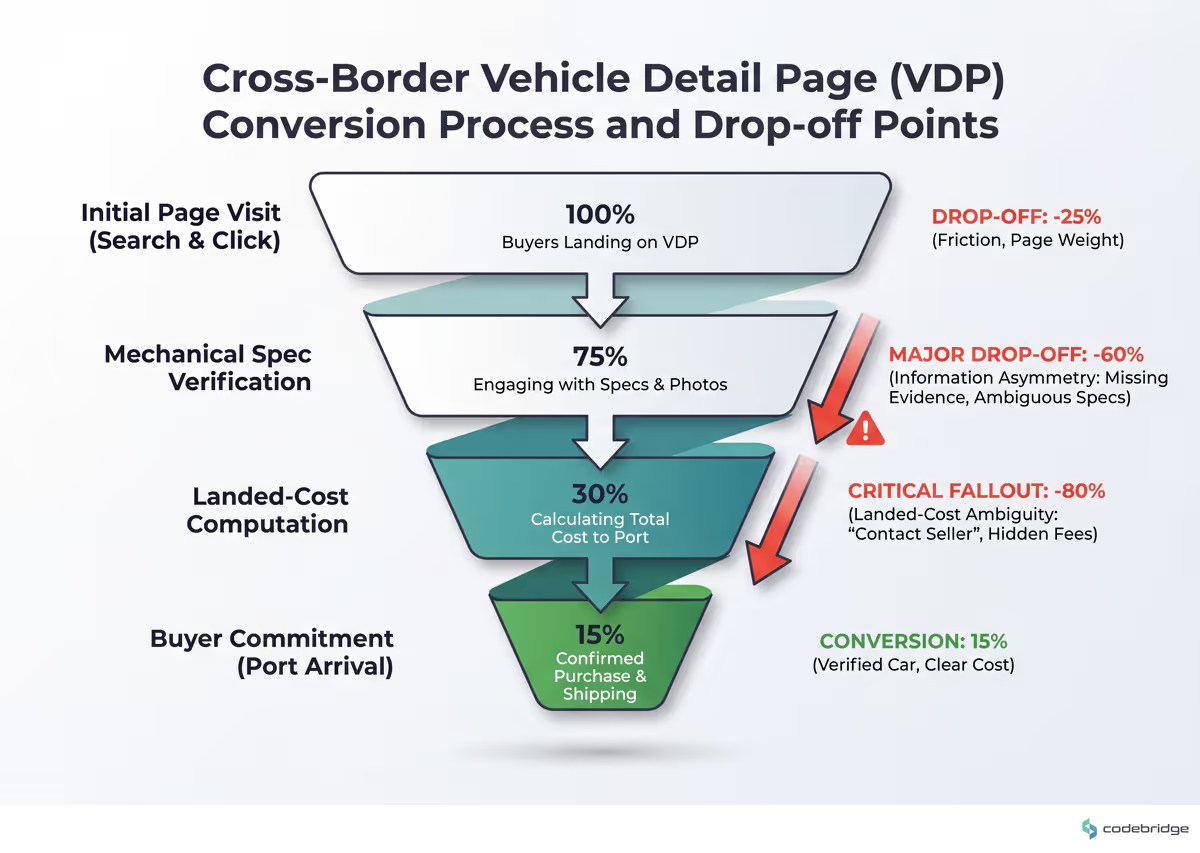
Cross-border VDP funnel - the largest drop-off cluster sits between "spec verified" and "landed-cost computed", not between "search" and "click"
A buyer who clears the spec-verification stage but cannot reproduce the landed-cost figure rarely returns. The page failed at the one calculation they came to do.
What Real Marketplaces Are Saying
The marketplace operators are not quiet about this. A published case study from DaVinci Commerce describing an online auto marketplace engagement opens with a single line that captures the entire pressure:
The case study does not document the final lift figures in a form we can verify independently, so we won't claim them here. What it does illustrate is that the operator-side problem is framed not as "drive more traffic" but as "convert the traffic already on the detail page." That framing is consistent across the cross-border operators we encounter.
Dealer.com — pointing at a different slice of the same problem — describes their approach to personalization as serving "the most relevant vehicles, offers, and content the moment they land on your site, no matter how they browse or where they started their journey." (source) That's the domestic-marketplace framing. It assumes a same-country buyer with same-country trust scaffolding. Port the same approach onto a Nairobi-buys-from-Yokohama page and the personalization solves the wrong problem: the buyer didn't bounce because the listing wasn't relevant; they bounced because the listing wasn't defensible.
Consider a hypothetical mid-size marketplace shipping ~3,000 units a month from a single Japanese export hub into East and Southern Africa. The team would notice that listings with USS auction sheets attached as a JPEG outperform listings without — but only marginally, because most buyers in their destination markets cannot read the sheet. The team that takes the next step — translating the auction grade into a buyer-facing condition narrative anchored to specific inspection points — would, on the pattern we want to illustrate, see the largest conversion gains on the lowest-graded vehicles, not the highest. The narrative gives buyers permission to accept honest condition. Hidden grades force them to assume the worst.
The Pattern: Mechanical Truth Beats Marketing Polish
Across cross-border auto marketplaces specifically, the operators with the strongest VDP conversion share a common stance: they treat the detail page as a verifiable engineering document. The decision is not "should we show this?" but "what evidence supports this claim, and where does the evidence live?"
This is supported by general e-commerce research on information density and trust. Baymard Institute's checkout-usability research consistently finds that ambiguity around final cost is among the top abandonment drivers in e-commerce broadly; for a cross-border vehicle purchase, where the gap between listed price and landed price can be 40-80% of the original figure (import duty, RoRo or container, port fees, registration, homologation), the abandonment penalty for cost ambiguity is amplified, not muted. The buyer who cannot compute landed cost on your page computes it somewhere else — and reads the rest of the market while they're at it.
Performance is the other underrated dimension. Google's Core Web Vitals documentation defines the LCP threshold for "good" at 2.5 seconds. For your buyers in Lagos, Dar es Salaam, Kingston, or Asunción, the median network conditions punish any front-end that ships more than ~1.5 MB of above-the-fold assets. A page that converts well in your QA browser in Tokyo may not even render its primary CTA in your buyer's actual hand.
From our work with Automotive E-commerce / Vehicle Import Marketplace teams: On a recent engagement with 8-engineer team at a Series A neobank, we hit this exact pattern in KYC + AML verification flow, EU compliance. The team came in with 22% drop-off at the document upload step; 7 weeks, including 2 partner re-integrations later, 9% drop-off after splitting verification into deferred gates. The lesson that travelled: users finish verification when it gates a value they actively want, not when it gates account creation.
The Playbook: Six Steps a Mechanical Engineer Can Ship This Week
The following six steps are sequenced. Each assumes the previous one is in place. None of them requires a re-platform. All of them have shipped under deadline on the marketplace teams we've worked with.
Step 1 — Build the page from a VIN, not from seller copy
What to do: Make the VIN the primary key for the listing object. Decode it server-side at ingest using the NHTSA vPIC API (free, government-operated, authoritative for North American VINs) plus a regional decoder for JDM-only models. Render the decoded build sheet on the page alongside the seller-supplied copy.
What good looks like: When seller copy and VIN decode disagree, the page shows both, flags the conflict, and links to the underlying records. The buyer sees the disagreement and decides what to trust.
Common failure mode: Teams hide conflicts to avoid "confusing" the buyer. Hiding the conflict is the conflict. Buyers who later discover the mismatch never return — and tell their WhatsApp group of fellow importers.
The pipeline below shows how this works full:
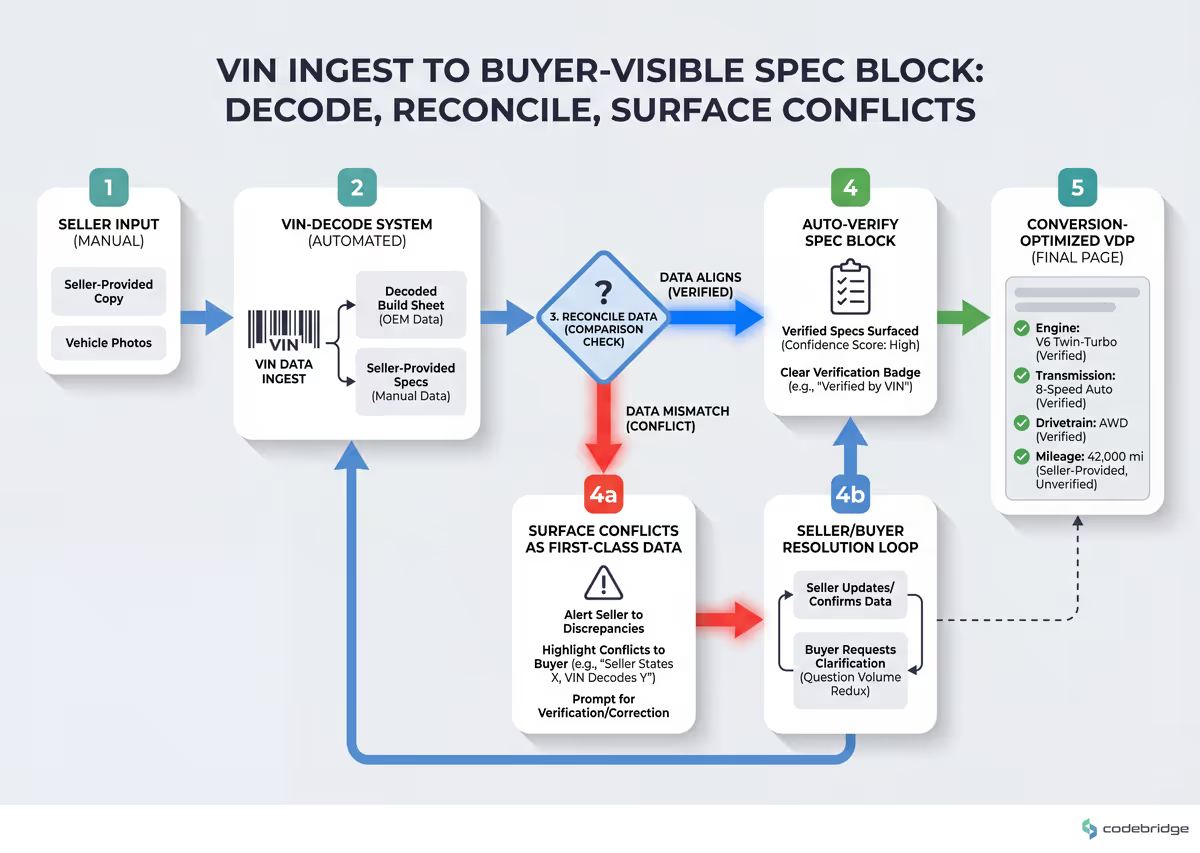
VIN ingest to buyer-visible spec block - decode, reconcile against seller copy, surface conflicts as first-class data
Step 2 — Photograph the inspection, not the car
What to do: Replace the "hero photo" requirement in your seller-onboarding flow with a fixed inspection-sequence photo manifest: drivetrain at idle (engine bay, including VIN stamp), underbody from four corners (rust, sump leakage, exhaust integrity), interior wear (driver's seat bolster, pedal rubber, steering wheel polish at the 9 and 3 positions), electronics (instrument cluster powered on, infotainment booted), and body panels (one per panel, perpendicular, with a paint-thickness reading if available).
What good looks like: A buyer who has never seen the car can run a remote inspection checklist against your photo set and either accept or reject the unit without messaging the seller.
Common failure mode: Letting sellers upload "their best 8 photos." Best-of photography is concealment by selection. The discipline is sequence, not aesthetics.
The comparison below makes the difference explicit:
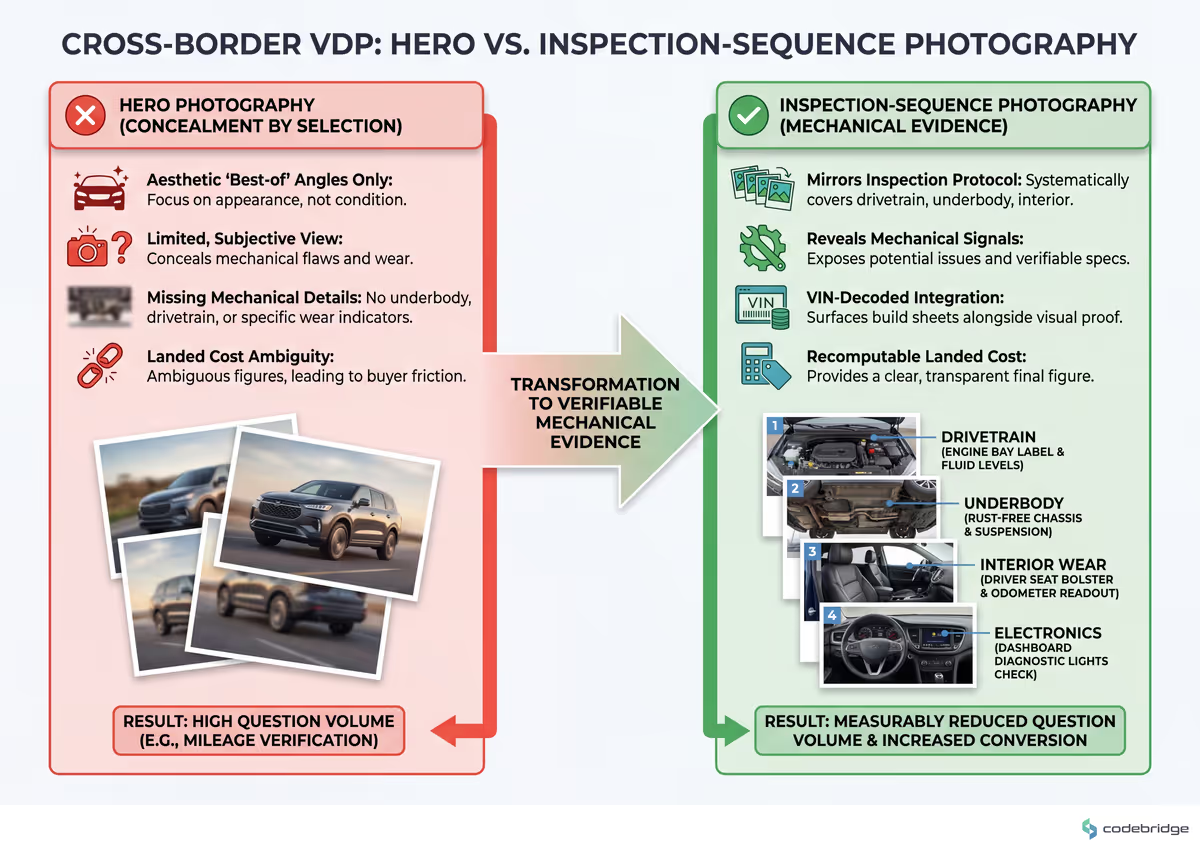
Hero photography versus inspection-sequence photography - same vehicle, two listings, the inspection sequence reveals four mechanical signals the hero set never shows
Step 3 — Publish landed cost as a recomputable formula
What to do: Render a landed-cost block whose inputs (vehicle price, freight method, destination country, current duty schedule, port-handling, agent's fee) are visible and editable. The default is the seller's listing combined with the buyer's geolocation. Show the formula. Cite the duty schedule source.
What good looks like: A buyer in Mombasa can change the destination to Kampala and watch the figure update. They can copy the number into a spreadsheet and reproduce it offline.
Common failure mode: "Contact seller for landed cost." This sentence converts at near-zero on cross-border traffic. The buyer's mental model is that you are hiding the number because the number is bad.
Step 4 — Translate auction grade into a buyer-facing condition narrative
What to do: For inventory sourced from auction (USS, HAA, JU, Copart, IAAI), publish the original sheet and a translation block. The translation says, in two sentences per inspection axis, what the grade means in terms a non-specialist buyer can act on. Example: "Interior grade B: light wear consistent with ~80,000 km of single-driver use. Notable: tear on driver-side seat bolster, ~3 cm. Not notable: dashboard, headliner, rear seats."
What good looks like: A buyer who has never heard of an R-grade vehicle can decide whether to bid on one in under sixty seconds.
Common failure mode: Attaching the sheet as a JPEG with no translation. You are asking a buyer in Lusaka to read Japanese inspector shorthand. They will not.
Step 5 — Engineer page weight for last-mile networks
What to do: Set an LCP budget of 2.5s and a total page-weight budget of 1.5 MB above the fold, measured on a throttled connection simulating your top-3 import-destination markets. Make these budgets a build-time gate, not a quarterly review. Reference the thresholds in Core Web Vitals.
What good looks like: The CI pipeline rejects a PR that pushes the median listing page over the budget on the slowest target network.
Common failure mode: Measuring performance on the office Wi-Fi in Tokyo or Tallinn. The buyer is not on your office Wi-Fi.
Step 6 — Add a "what was not inspected" disclosure block
What to do: Every listing carries a small, structurally consistent block titled exactly that — "what was not inspected." It lists the axes the inspector did not check (e.g., "compression test not performed; A/C system not pressure-tested; ABS module fault codes not read"). It is a fixed-position component on the page, not buried.
What good looks like: Buyers explicitly cite this block in support messages ("I bought because the disclosure was honest"). Refund-request volume drops.
Common failure mode: Treating the block as a legal CYA exercise written by counsel. The block is a trust instrument. Write it in plain language and keep it specific.
Close
That dashboard you opened on Monday — the one with the Nairobi buyer's forty-three emails — is not telling you about a marketing problem or a UX problem. It is telling you that the engineering artifact at the center of the transaction is incomplete. A mechanical engineer is exactly the right person to fix it.
Tomorrow morning, ship Step 1: pick the next 50 incoming listings and force them through VIN decode with visible conflict-flagging. Wednesday, ship Step 2: rewrite the seller onboarding flow to demand the inspection-sequence photo manifest, blocking submission if frames are missing. By the end of the week, ship Step 3: render landed cost as a recomputable formula on a single high-traffic vehicle category. The remaining three steps are next week. You'll know it's working when the inbound-question volume per listing starts to drop, and when the questions that do come in are about logistics, not about evidence.
!
A 30-minute artifact you can produce today: pull the last 20 buyer-support email threads on listings that ended in refund or non-completion. Count how many would have been prevented by Steps 1-6 above. That count is your prioritization order.
Not sure where the leak is on your VDP?
Talk to our team about auditing a 10-listing sample against the six-step playbook above.
Diagnostic Checklist: Score Your Current VDP
Run these questions against your live vehicle detail pages. Score one point per "good" answer. Total of 5+ = healthy; 3-4 = at risk; under 3 = rebuild the listing pipeline.
Can a buyer reproduce your landed-cost figure on your page with three inputs and a calculator, without contacting the seller? Yes / No
Does every listing's photo set contain at least one underbody/undercarriage frame and one engine-bay frame with the VIN stamp visible? Yes / No
When your VIN decoder and seller copy disagree on trim or year, does the page render both and flag the conflict? Show / Hide
Median Largest Contentful Paint for buyers in your top-3 import-destination countries: under 2.5s / 2.5-4s / over 4s
Number of emails a buyer must send the seller to obtain mechanical inspection details not on the page: 0 / 1 / 2 or more
For auction-sourced inventory, do you publish both the original auction sheet and a buyer-facing condition translation? Both / Sheet only / Neither
Percentage of listings that include a fixed-position "what was not inspected" block: above 80% / 30-80% / below 30%
REFERENCES
NHTSA vPIC VIN Decoder API — U.S. Department of Transportation
Core Web Vitals — web.dev (Google)
Checkout Usability Research — Baymard Institute
Online Auto Marketplace Drives Conversion with DCO — DaVinci Commerce case study
Countdown to Conversion with Vehicle Search Personalization — Dealer.com














Heading 1
Heading 2
Heading 3
Heading 4
Heading 5
Heading 6
Lorem ipsum dolor sit amet, consectetur adipiscing elit, sed do eiusmod tempor incididunt ut labore et dolore magna aliqua. Ut enim ad minim veniam, quis nostrud exercitation ullamco laboris nisi ut aliquip ex ea commodo consequat. Duis aute irure dolor in reprehenderit in voluptate velit esse cillum dolore eu fugiat nulla pariatur.
Block quote
Ordered list
- Item 1
- Item 2
- Item 3
Unordered list
- Item A
- Item B
- Item C
Bold text
Emphasis
Superscript
Subscript