Enterprise software vendors are rebranding chatbots and RPA tools as "autonomous agents" to ride the current AI wave. Meanwhile, Gartner projects that over 40% of agentic AI projects will be canceled by the end of 2027 due to cost overruns, unclear value, or weak risk controls. Both signals point to the same gap: most organizations lack a clear framework for deciding when to use rules-based automation and when to use LLM-driven agents.
The distinction between RPA and agentic AI is architectural. RPA executes known, deterministic paths. Agentic AI pursues goals through probabilistic reasoning. Choosing the wrong model for a given workflow creates either a brittle system that breaks on every exception or an expensive, unpredictable one that delivers less reliability than a shell script. The rest of this article provides a framework for making that choice.
Defining the Models: Determinism vs. Agency
To make an effective architectural decision, leaders must first strip away vendor terminology and look at the underlying logic of the systems.
Robotic Process Automation (RPA)
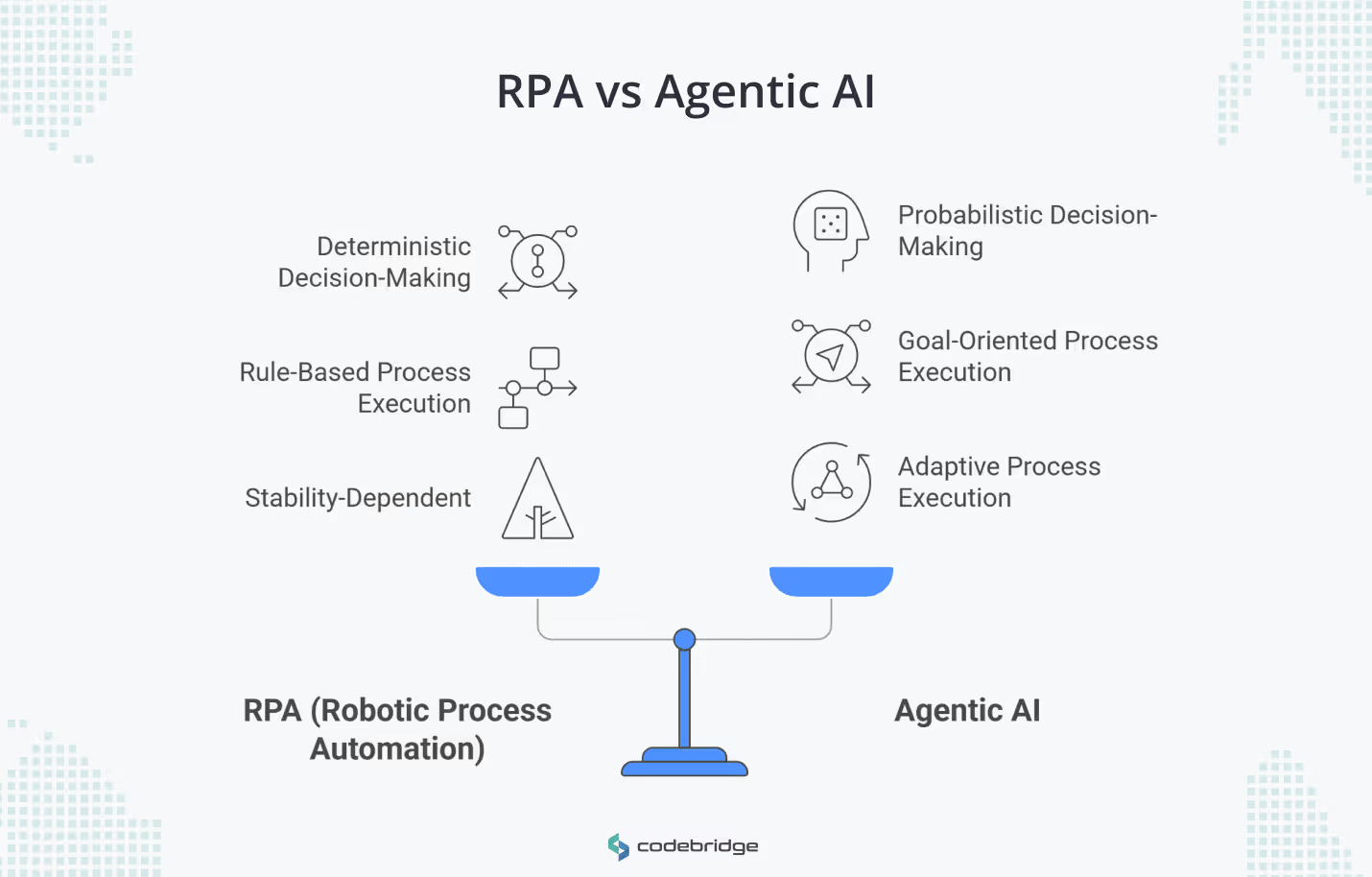
RPA refers to software bots that replay rule-based interactions at the UI layer or through API calls. Microsoft frames RPA primarily as a bridge for legacy systems that lack modern interfaces. You define a script; the bot follows it. For a given input, the output is identical every time. That determinism is the entire value proposition, and it depends on process stability: same screens, same fields, same sequence.
Key Characteristics:
- Deterministic: For a given input, the output is always identical based on predefined logic.
- Rule-Based: It follows a fixed decision tree; it cannot "understand" context or infer meaning from unstructured data.
- Stability-Dependent: It is designed for environments where the UI and the process steps remain constant.
Agentic AI
Agentic AI uses a Large Language Model as a reasoning engine. Instead of a script, the system receives a goal ("resolve this invoice dispute") and determines the steps at runtime. It can call APIs, query databases, and invoke RPA bots as part of its plan. Decisions are probabilistic, based on pattern recognition across unstructured inputs. When conditions change mid-process, the agent can re-plan.
Key Characteristics:
- Probabilistic: Decisions are based on patterns and real-time data rather than fixed rules.
- Goal-Oriented: Instead of a script, the agent is given a goal (e.g., "Resolve this invoice dispute") and dynamically determines the necessary steps.
- Adaptive: The system can re-plan its strategy when it encounters changing circumstances or new information.
The operational difference between these two is that RPA gives you repeatability; agentic AI gives you adaptability. Every architectural decision in this space is about where you need which property and what you're willing to pay for it.
Advantages and Disadvantages
The "intelligence" of agentic AI comes with a specific set of operational costs that RPA does not share. Conversely, the rigidity of RPA creates long-term maintenance burdens.
RPA: Tactical Efficiency and Fragility
RPA's strength is predictability. When you automate payroll runs, standard data migrations, or structured invoice entry, you get a system that does the same thing every time and produces an audit trail you can hand to a regulator.
The failure mode is fragility. RPA bots that interact at the UI layer break when a screen layout changes, a field moves, or an application updates. Organizations routinely report spending a decent amount of their RPA budget on maintenance alone. When a bot fails, it stops. A human fixes the script, and the bot restarts.
Agentic AI: Strategic Autonomy and Unpredictability
Agentic AI handles work that RPA cannot touch: unstructured inputs like free-text emails, scanned documents with inconsistent formats, or support tickets that require cross-referencing customer history. Development is faster because you write prompts, not step-by-step workflow maps. In controlled benchmarks, agentic approaches have cut development time significantly compared to equivalent RPA implementations.
The cost of that flexibility is non-determinism. An LLM-driven agent can hallucinate, take an inefficient reasoning path, or perform actions you didn't anticipate. You cannot guarantee that the same input will produce the same output. In stable, high-volume environments, agents are also slower and less reliable in raw execution than a well-built RPA bot. That performance gap matters when you're processing thousands of transactions per hour.
Decision Framework: Choosing the Right Model
The choice between RPA and agentic AI depends on six properties of the workflow and the environment it runs in.
When RPA Is the Better Choice
Standardized invoice entry into an ERP from structured templates. SAP GUI automation where no API exists. Scheduled report extraction and distribution across portals. These are high-volume, low-variability tasks where the process is stable and the cost of a wrong output is high.
When Agentic AI Is the Better Choice
Customer service triage that requires reading sentiment and cross-referencing account history. Fraud investigation workflows that span multiple systems and require contextual judgment. Sales qualification that involves researching prospects across the web and drafting tailored outreach. In each case, interpretation determines the next step, and the range of possible inputs is too wide to script.
The Hybrid Architecture: Separating Logic from Execution
The strongest production architectures separate decision-making from system writes.
In a hybrid model, the agentic layer handles interpretation and routing. It reads an incoming email, classifies the request, extracts the relevant data points, and determines which downstream process to trigger. The execution layer, such as an RPA bot, an API integration, or a database write handles the actual system update through a deterministic path.
This separation matters because it constrains where non-determinism can cause damage. The agent's judgment affects which process runs, but the process itself follows a fixed script. If the agent misclassifies a request, the failure is a routing error, not a corrupted database record. You can log the agent's reasoning, audit its classification, and build review workflows around the decision boundary without retrofitting the entire execution pipeline.
For example: an agent reads an inbound invoice, identifies a discrepancy against the purchase order, and classifies it as a dispute. It assembles the relevant context and routes it to the dispute resolution workflow. The RPA bot handles the actual ERP updates once a human approves the resolution. The agent never touches the system of record directly.
Practical Use Cases and Execution Realities
Finance and Operations
In accounts payable, RPA handles recurring data entry from standard vendors. However, invoice dispute resolution, which requires interpreting vendor contracts and checking them against delivery logs, is an agentic use case.
Some demos show these agents operating with built-in escalation capabilities, where the AI gathers all relevant context but pauses for a human expert to approve the final resolution.
Regulated Workflows
In healthcare, financial services, and similar regulated environments, the operating model is supervised autonomy. An agent can parse referral documents, extract clinical details, and propose a classification. A licensed professional validates that classification before it posts to the system of record.
This pattern aligns with frameworks like the NIST AI Risk Management Framework, which emphasizes human oversight for high-consequence decisions. The key constraint: automation speed cannot come at the cost of diagnostic integrity or regulatory compliance. Design the approval gate first, then build the agent around it.
Knowledge-Intensive Environments
Where the primary task is finding, synthesizing, and routing information across fragmented sources, agentic systems deliver the most visible productivity gains.
Centralizing disparate knowledge assets behind an intelligent search layer has, in documented implementations, reduced information retrieval times by 40% and improved overall task throughput by 30%. The value in these environments comes from the agent's ability to synthesize across sources, not from automating a click path.
What Mature Teams Do Differently
Teams that ship reliable automation systems tend to follow a consistent sequence.
Decompose the Workflow
Break the role or process into functional areas (macro), individual processes within those areas (meso), and discrete tasks within each process (micro). This decomposition is the foundation for every downstream decision about which technology to apply where.
Classify Each Task by Variability
For each micro-level task, determine whether the inputs and logic are stable enough for a deterministic script or whether the task requires interpretation, judgment, or adaptation. This is the decision boundary.
Assign the Right Component
High-volume, low-variability tasks go to RPA or direct API integrations. Tasks with frequent exceptions, unstructured inputs, or context-dependent logic go to an agentic layer. The hybrid architecture from Section 4 applies at this boundary.
Define Control Boundaries
Every agent needs explicit constraints: kill switches, escalation paths to human reviewers, and role-based access controls. Decide these before deployment, not after the first incident.
Build Observability From the Start
For non-deterministic systems, step-level traces and audit trails are not optional. You need to see what the agent decided, why it decided it, and what it did as a result. Treat observability as an architectural requirement, not a monitoring add-on.
Conclusion
RPA remains the right tool for structured, stable, high-volume tasks where determinism is the requirement. Agentic AI is the right tool for exception-heavy, interpretation-dependent workflows where scripting every path is impractical. The strongest production architectures use both: agents for reasoning and routing, deterministic systems for execution, and system writes.
The risk is misapplication in either direction. Forcing RPA into workflows full of exceptions produces brittle systems that consume their own ROI in maintenance. Deploying agents where a simple script would suffice introduces cost, latency, and unpredictability without a corresponding benefit. Match the technology to the workflow's actual characteristics and you avoid both failure modes.











Heading 1
Heading 2
Heading 3
Heading 4
Heading 5
Heading 6
Lorem ipsum dolor sit amet, consectetur adipiscing elit, sed do eiusmod tempor incididunt ut labore et dolore magna aliqua. Ut enim ad minim veniam, quis nostrud exercitation ullamco laboris nisi ut aliquip ex ea commodo consequat. Duis aute irure dolor in reprehenderit in voluptate velit esse cillum dolore eu fugiat nulla pariatur.
Block quote
Ordered list
- Item 1
- Item 2
- Item 3
Unordered list
- Item A
- Item B
- Item C
Bold text
Emphasis
Superscript
Subscript