NEW YEAR, NEW GOALS:   Kickstart your SaaS development journey today and secure exclusive savings for the next 3 months!
Check it out here >>
White gift box with red ribbon and bow open to reveal a golden 10% symbol, surrounded by red Christmas trees and ornaments on a red background.
Unlock Your Holiday Savings
Build your SaaS faster and save for the next 3 months. Our limited holiday offer is now live.
White gift box with red ribbon and bow open to reveal a golden 10% symbol, surrounded by red Christmas trees and ornaments on a red background.
Explore the Offer
Valid for a limited time
close icon
Logo Codebridge
AI

Vertical vs Horizontal AI Agents: Which Model Creates Real Enterprise Value First?

April 21, 2026
|
8
min read
Share
text
Link copied icon
table of content
photo of Myroslav Budzanivskyi Co-Founder & CTO of Codebridge
Myroslav Budzanivskyi
Co-Founder & CTO

Get your project estimation!

You have a budget for AI agents, a board expecting results within two quarters, and you have an engineering team that will maintain whatever you ship. The question you face is where to start. A general-purpose agent that works across your whole organization, or a narrow agent built for one workflow?

KEY TAKEAWAYS

Governance cost decides first, the article frames the real decision around how much effort your organization will spend securing, monitoring, permissioning, and explaining the system before it pays for itself.

Horizontal fits retrieval better, the article says broad agents work for permissions-aware search, but the difficulty rises when the agent starts taking action inside production systems.

Vertical reaches proof faster, the article argues that a narrow agent can move into production sooner because ownership, access, and success criteria are easier to define around one workflow.

Start narrow, expand later, the recommendation is to prove one workflow first, then reuse the governance and monitoring pattern before evaluating a horizontal layer.

Most founders frame this as a trade-off between breadth and depth. In practice, the decision turns on something harder to see during a demo – governance cost. How much organizational effort will you spend securing, monitoring, permissioning, and explaining this system before it pays for itself?

This article breaks down the operational and governance differences between horizontal and vertical agents so you can match the right model to your team's capacity, your data maturity, and your timeline for results.

Horizontal AI Agents Solve the Wrong Problem First
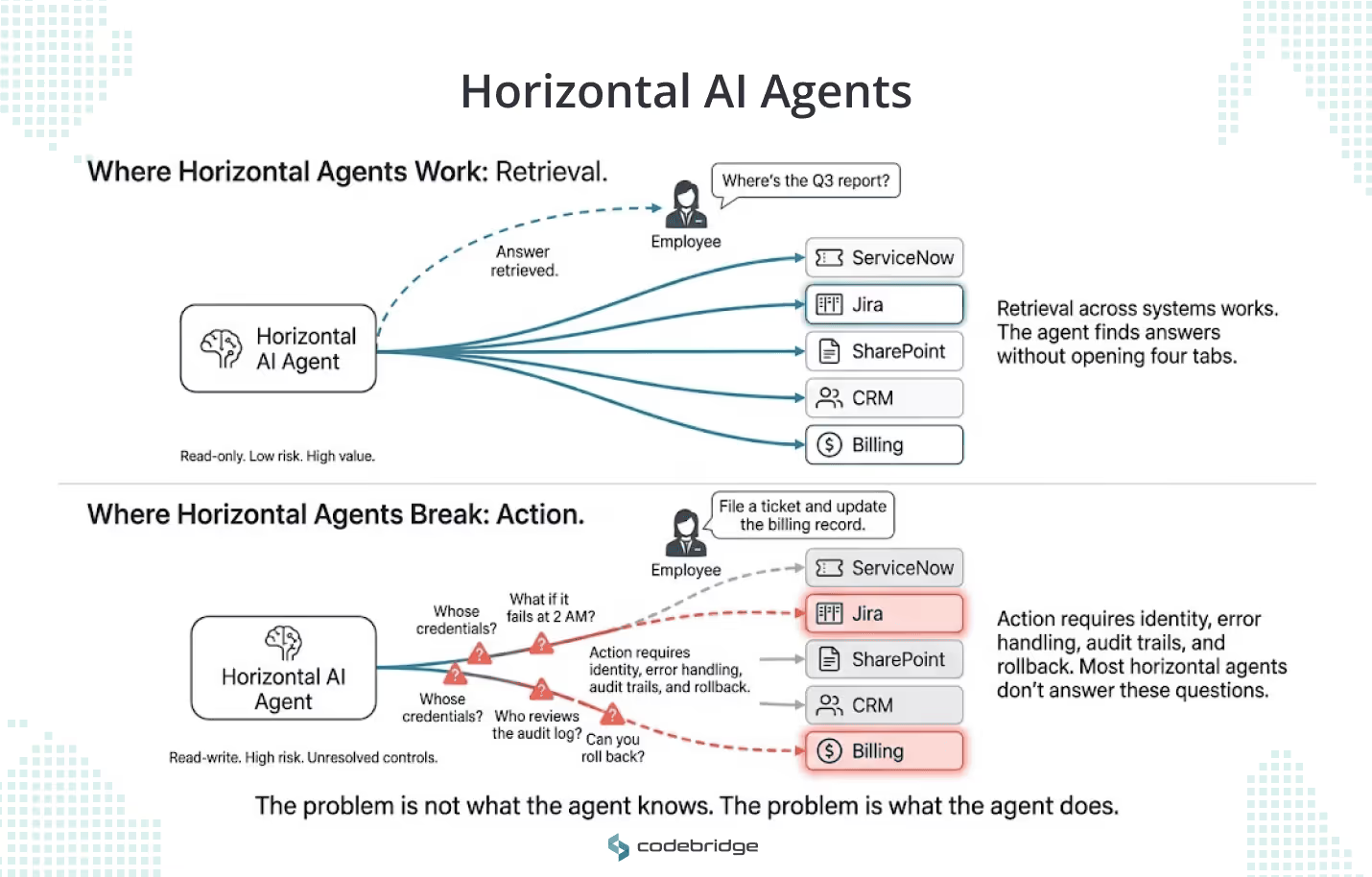
Diagram titled “Horizontal AI Agents” showing where horizontal agents work and where they break. The top section shows an employee asking for a Q3 report, with the agent retrieving answers across ServiceNow, Jira, SharePoint, CRM, and Billing in a read-only, low-risk flow. The bottom section shows the same agent asked to file a ticket and update a billing record, with warnings around credentials, failure handling, audit logs, and rollback, highlighting that action across systems creates unresolved control and governance risks.
Horizontal AI agents work well for cross-system retrieval, but risk rises when they move from read-only access to action across production systems.

Horizontal agents are general-purpose systems designed to operate across multiple functions, teams, and industries rather than being tailored to a single use case. These systems typically rely on large, foundational models trained on diverse datasets, allowing them to adapt to scenarios ranging from answering questions to analyzing data across an entire organization. 

Companies often prioritize horizontal models because of their broad internal applicability and the narrative of a single platform that can be reused across departments.

Google built Gemini Enterprise on this model: permissions-aware search across ServiceNow, Jira, and SharePoint, with a multimodal interface layered on top. For a 200-person company running six or seven SaaS tools, that pitch sounds like a direct fix for the daily friction of context-switching.

And for retrieval, it works. Your team asks a question, the agent finds the answer across systems, and nobody has to open four tabs. The problem starts when you ask the agent to do something. File a ticket, update a record, or send a notification. The moment an agent takes action inside a production system, you need to answer a different set of questions: whose credentials does it use? What happens when it makes a mistake in your billing system at 2 AM? Who reviews the audit log?

If your product handles patient data, financial records, or regulated workflows, those questions land on your desk before the agent writes its first Jira ticket.

🔐

Compliance implication, in regulated workflows, the article ties deployment readiness to least-privilege scoping, assigned identity, scoped permissions, and full audit trail requirements.

Why Horizontal AI Agents Become Harder to Govern at Scale

Every system your agent touches adds a layer of access control, data sensitivity review, and failure-mode analysis. Microsoft's enterprise agent framework treats each agent as a digital worker: assigned identity, scoped permissions, full audit trail. That guidance exists because Microsoft watched early adopters deploy broad agents without those controls and spend months cleaning up the results.

⚠️

Key risk, once a horizontal agent moves from retrieval to action, the organization must decide whose credentials it uses, what happens when it makes a mistake, and who reviews the audit log.

For a Series A SaaS company with 40 engineers, this overhead compounds fast. Your team needs to map permissions across every connected system. You need escalation paths for each integration. You need someone to own the monitoring. And you need all of that before the agent handles its first production request.

The cost shows up in three places that founders tend to underestimate. 

  1. Data quality: a horizontal agent that searches across your knowledge base, Slack history, and CRM will surface whatever inconsistencies exist in those systems. If your API documentation contradicts your onboarding guides, the agent will confidently serve both answers to different people. 
  2. ROI attribution: when an agent helps everyone a little, you cannot tie that improvement to a revenue line or a cost reduction your CFO will sign off on. 
  3. Team load: someone on your engineering team will own each integration, and that someone has other priorities.

OWASP and NIST both emphasize least-privilege scoping as a baseline for trustworthy AI systems. In practice, least-privilege design for a horizontal agent means writing and maintaining permission logic for every system it touches. For a scale-up with limited DevOps capacity, that is a real constraint on what you can ship next quarter.

Why Vertical AI Agents Often Deliver Enterprise ROI Faster
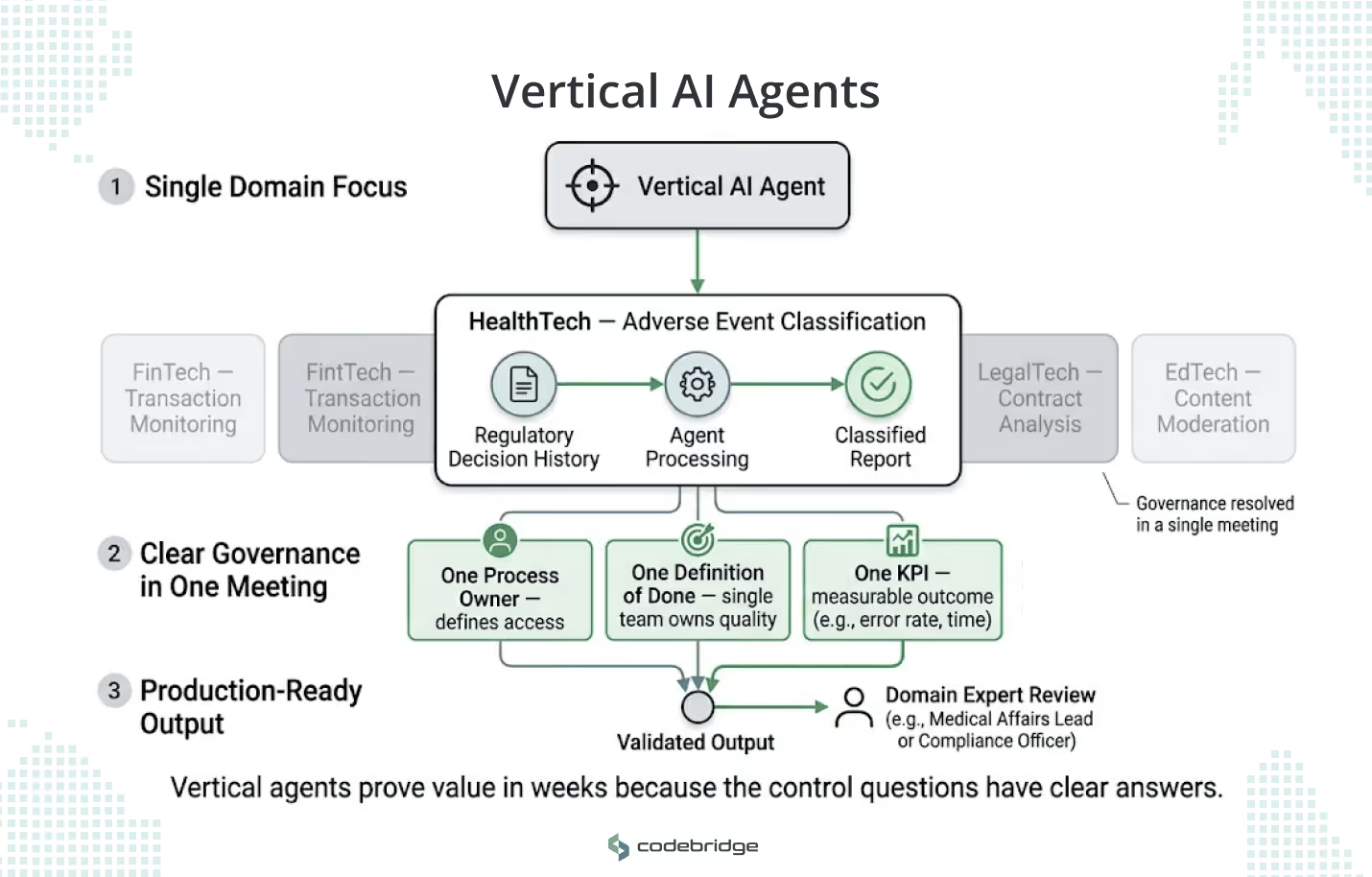
Diagram titled “Vertical AI Agents” showing a vertical AI agent focused on a single domain. The central example is HealthTech adverse event classification, where regulatory decision history flows through agent processing to a classified report. Supporting governance boxes show one process owner defining access, one team defining done, and one KPI measuring outcome, followed by validated output and domain expert review. Faded side examples reference other domain-specific use cases such as FinTech transaction monitoring, LegalTech contract analysis, and EdTech content moderation.
Vertical AI agents narrow scope to one workflow, which makes governance, ownership, and outcome measurement easier to define before moving into production.

Vertical AI agents are designed to operate deeply within a specific industry, function, or use case. By focusing on a single domain — such as supply chain optimization, claims handling, or financial risk analysis — these agents deliver more accurate insights and predictions than horizontal alternatives. 

These agents reach production faster because you can answer the governance questions in a single meeting. One process owner decides what the agent can access. One team defines what "done" looks like. One KPI (claim processing time, error rate, review throughput) tells you whether it worked.

AWS found that the most successful early agent deployments "collapse handoffs" in a specific workflow, removing the hours or days of back-and-forth between a request and a resolution. That pattern maps to how most growing tech companies actually operate: you have a bottleneck in a specific process, and a person or small team owns that process end-to-end.

Consider what this looks like inside a HealthTech company processing clinical trial data. A vertical agent built for adverse event report classification can train on your regulatory team's decision history, operate within your existing compliance framework, and produce outputs your medical affairs lead can validate against a known standard. Compare that to deploying a general-purpose agent across your entire R&D operation and asking five different team leads to each define what "correct" means for their workflows.

The same logic holds for FinTech transaction monitoring, LegalTech contract analysis, and EdTech content moderation. Wherever you have a repeatable process with clear inputs, defined exceptions, and a measurable outcome, a vertical agent can prove value in weeks. A horizontal agent covering the same ground will still be in its permissioning phase.

The choice between horizontal and vertical AI agents is an architectural and budget-allocation decision, not merely a tech category selection. While horizontal agents appear attractive for their broad utility, enterprise value is realized only when an agent improves a workflow with acceptable risk, clear ownership, and measurable output.

The following table serves as a strategic decision framework for CEOs and CTOs to evaluate these models based on governance-adjusted ROI and operational reality.

Strategic Comparison: Vertical AI Agents vs. Horizontal AI Agents

Decision Factor Horizontal Agents Vertical Agents
Primary Goal Reducing visible friction from cross-functional context-switching. Automating specific workflows or collapsing handoffs in a decision chain.
Technical Scope Spans multiple tools, teams, and data surfaces (e.g., enterprise search, summarization). Operates deeply within one industry or function (e.g., claims handling, risk analysis).
Governance & Risk High Exposure: Rising complexity in identity management and permissioning across multiple systems. Bounded Autonomy: Narrow task boundaries and explicit escalation rules for human intervention.
Context Quality High risk of "shallow integration" when improvising across fragmented systems. Grounded in rich domain context, specific jargon, and industry-specific variables.
ROI Measurability Often fuzzy; improvement is generalized across many users rather than one workflow. Anchored in specific KPIs like cycle time, error rate, throughput, or unit cost.
Budget Alignment Positioned as a shared platform utility or infrastructure investment. Maps to one process owner, one specific pain point, and one measurable outcome.
Decision Lens Map: Acts as an access and orchestration layer for knowledge retrieval. Engine: Drives the precision required for high-stakes operational actions.

Execution Reality: Why Vertical Agents Usually Win First

Founders and CTOs often find that horizontal agents win executive demos because they appear broadly useful, but vertical agents win buying decisions because they are easier to secure and measure.

  1. The Governance Tax: As soon as an agent moves from simple information retrieval to taking action, horizontal models face massive governance requirements. Organizations must define whose permissions the agent uses across dozens of systems and how to audit failures that span multiple departments.
  2. Workflow Clarity: AWS and Anthropic emphasize that value appears only when work is defined in "painful detail". Horizontal agents struggle with this because their "done state" is often vague. Vertical agents, by contrast, address one specific piece of work with a clear start, end, and purpose.
  3. Measurability: It is difficult to prove a business case for a system that helps "everyone a little". A vertical agent designed for invoice exception processing or contract review has a direct link to labor cost reduction and queue wait times.

Strategic Recommendation

For technology-driven companies, the most resilient path is to start vertical and expand horizontally later.

  • When to go Vertical: Use when precision matters, such as in highly regulated environments (finance, healthcare) or for workflows with high-stakes decision-making where you need tight control over "least-privilege" permissions.
  • When to go Horizontal: Use when the primary need is permissions-aware retrieval or knowledge discovery, the organization already has clean data and strong identity controls, and the goal is broad productivity uplift rather than autonomous action.

Vertical agents define the first successful operating model for real enterprise AI, while horizontal agents eventually define the long-term interface for how employees interact with those systems.

Enterprise AI Strategy: Start with Vertical Agents, Expand Horizontally Later

If you are a founder or CTO planning your first agent deployment, here is a sequence that reduces risk at each step.

Phase 1: Pick one workflow. Find a process with a clear start, clear end, and defined tools. Write a job description for the agent as if you were hiring a contractor for this role. If you cannot write that job description in a single page, the scope is too broad.

Phase 2: Design governance before code. Define permissions, escalation triggers, and observability requirements before your team writes the first line of agent logic. This step feels slow. It saves you from rebuilding the system when your security review catches what you skipped.

Phase 3: Prove the outcome. Run the agent with one owner and a specific KPI. Measure for four to six weeks. If the numbers move, you have a business case. If they do not, you have a cheap lesson.

Phase 4: Replicate the pattern. Take the governance templates, integration patterns, and monitoring setup from Phase 3 and apply them to an adjacent workflow. Each deployment should cost less engineering time than the last.

Phase 5: Evaluate a horizontal layer. Once you have three or four vertical agents running in production with stable governance, assess whether a cross-system retrieval layer would reduce friction for your broader team. At this point, you have the operational foundation to support it.

Conclusion 

Horizontal agents may become the default interface between your team and your digital systems over the next few years. The companies building toward that future on a stable foundation will get there. The companies that skip the foundation work and deploy broad agents into ungoverned environments will spend their engineering budget on incident response and permission remediation instead of product development.

Your first agent deployment sets the pattern for every deployment that follows. Start with a workflow your team understands, build the governance to match, prove the value, and expand from that base. The technical capability of the model matters less than whether your organization can operate it with confidence at the current stage of your data maturity and team capacity.

For engineering leaders at SaaS, HealthTech, FinTech, and LegalTech companies building products used by thousands of users, the calculus is straightforward. You already manage complex integrations, compliance requirements, and architectural trade-offs. Apply that same discipline to your agent strategy. The rigor you bring to system design is the same rigor that makes an agent deployment succeed or fail in production.

Planning your first agent deployment?

Review your workflow and governance model with Codebridge

What are vertical AI agents?

Vertical AI agents are agents built to operate deeply within a specific industry, function, or workflow rather than across the whole organization. In the article, they are positioned as better suited to repeatable processes with clear inputs, defined exceptions, and measurable outcomes.

What is a horizontal AI agent?

A horizontal AI agent is a general-purpose system designed to work across multiple functions, teams, and tools instead of being tailored to one use case. The article describes this model as broadly useful for cross-functional retrieval and knowledge access.

What is the difference between vertical and horizontal AI agents?

The article draws the difference across scope, governance, and measurability. Horizontal agents span multiple systems and teams, while vertical agents focus on one workflow or function. Horizontal agents offer broader utility, but vertical agents are easier to secure, govern, and measure against specific KPIs.

Why do vertical AI agents often deliver enterprise value faster?

According to the article, vertical agents reach production faster because ownership, access, and success criteria can be defined around one workflow. One process owner, one team, and one KPI make it easier to prove value and control risk.

Why are horizontal AI agents harder to govern at scale?

The article explains that every connected system adds more access control, permissioning, data sensitivity review, and failure-mode analysis. Once the agent starts taking action instead of only retrieving information, governance requirements expand quickly across multiple departments and systems.

When should a company choose a vertical AI agent first?

The article recommends going vertical when precision matters, especially in regulated environments or workflows with high-stakes decisions. It also points to vertical agents as the stronger starting point when teams need tight control over permissions, ownership, and measurable outcomes.

Should companies start with vertical AI agents and expand later?

Yes. The article’s recommendation is to start with one workflow, design governance before code, prove the outcome with one owner and one KPI, and then replicate the pattern. Only after several vertical agents are running with stable governance does it suggest evaluating a broader horizontal layer.

Team members at a meeting table reviewing printed documents and notes beside an open laptop in a bright office setting.

Heading 1

Heading 2

Heading 3

Heading 4

Heading 5
Heading 6

Lorem ipsum dolor sit amet, consectetur adipiscing elit, sed do eiusmod tempor incididunt ut labore et dolore magna aliqua. Ut enim ad minim veniam, quis nostrud exercitation ullamco laboris nisi ut aliquip ex ea commodo consequat. Duis aute irure dolor in reprehenderit in voluptate velit esse cillum dolore eu fugiat nulla pariatur.

Block quote

Ordered list

  1. Item 1
  2. Item 2
  3. Item 3

Unordered list

  • Item A
  • Item B
  • Item C

Text link

Bold text

Emphasis

Superscript

Subscript

AI
Rate this article!
Thank you! Your submission has been received!
Oops! Something went wrong while submitting the form.
78
ratings, average
4.7
out of 5
April 21, 2026
Share
text
Link copied icon

LATEST ARTICLES

Team of professionals discussing agentic AI production risks at a conference table, reviewing technical documentation and architectural diagrams.
April 20, 2026
|
10
min read

Risks of Agentic AI in Production: What Actually Breaks After the Demo

Agentic AI breaks differently in production. We analyze OWASP and NIST frameworks to map the six failure modes technical leaders need to control before deployment.

by Konstantin Karpushin
AI
Read more
Read more
AI in education classroom setting with students using desktop computers while a teacher presents at the front, showing an AI image generation interface on screen.
April 17, 2026
|
8
min read

Top AI Development Companies for EdTech: How to Choose a Partner That Can Ship in Production

Explore top AI development companies for EdTech and learn how to choose a partner that can deliver secure, scalable, production-ready AI systems for real educational products.

by Konstantin Karpushin
EdTech
AI
Read more
Read more
Illustrated scene showing two people interacting with a cloud-based AI system connected to multiple devices and services, including a phone, laptop, airplane, smart car, home, location pin, security lock, and search icon.
April 16, 2026
|
7
min read

Claude Code in Production: 7 Capabilities That Shape How Teams Deliver

Learn the 7 Claude Code capabilities that mature companies are already using in production, from memory and hooks to MCP, subagents, GitHub Actions, and governance.

by Konstantin Karpushin
AI
Read more
Read more
Instructor presenting AI-powered educational software in a classroom with code and system outputs displayed on a large screen.
April 15, 2026
|
10
min read

AI in EdTech: Practical Use Cases, Product Risks, and What Executives Should Prioritize First

Find out what to consider when creating AI in EdTech. Learn where AI creates real value in EdTech, which product risks executives need to govern, and how to prioritize rollout without harming outcomes.

by Konstantin Karpushin
EdTech
AI
Read more
Read more
Stylized illustration of two people interacting with connected software windows and interface panels, representing remote supervision of coding work across devices for Claude Code Remote Control.
April 14, 2026
|
11
min read

Claude Code Remote Control: What Tech Leaders Need to Know Before They Use It in Real Engineering Work

Learn what Claude Code Remote Control is, how it works, where it fits, and the trade-offs tech leaders should assess before using it in engineering workflows.

by Konstantin Karpushin
AI
Read more
Read more
Overhead view of a business team gathered around a conference table with computers, printed charts, notebooks, and coffee, representing collaborative product planning and architecture decision-making.
April 13, 2026
|
7
min read

Agentic AI vs LLM: What Your Product Roadmap Actually Needs

Learn when to use an LLM feature, an LLM-powered workflow, or agentic AI architecture based on product behavior, control needs, and operational complexity.

by Konstantin Karpushin
AI
Read more
Read more
OpenClaw integration with Paperclip for hybrid agent-human organizations
April 10, 2026
|
8
min read

OpenClaw and Paperclip: How to Build a Hybrid Organization Where Agents and People Work Together

Learn what usually fails in agent-human organizations and how OpenClaw and Paperclip help teams structure hybrid agent-human organizations with clear roles, bounded execution, and human oversight.

by Konstantin Karpushin
AI
Read more
Read more
group of professionals discussing the integration of OpenClaw and Paperclip
April 9, 2026
|
10
min read

OpenClaw Paperclip Integration: How to Connect, Configure, and Test It

Learn how to connect OpenClaw with Paperclip, configure the adapter, test heartbeat runs, verify session persistence, and troubleshoot common integration failures.

by Konstantin Karpushin
AI
Read more
Read more
Creating domain-specific AI agents using OpenClaw components including skills, memory, and structured agent definition
April 8, 2026
|
10
min read

How to Build Domain-Specific AI Agents with OpenClaw Skills, SOUL.md, and Memory

For business leaders who want to learn how to build domain-specific AI agents with persistent context, governance, and auditability using skills, SOUL.md, and memory with OpenClaw.

by Konstantin Karpushin
AI
Read more
Read more
OpenClaw and the future of personal AI infrastructure with user-controlled systems, local deployment, and workflow ownership
April 7, 2026
|
6
min read

What OpenClaw Reveals About the Future of Personal AI Infrastructure

What the rise of OpenClaw reveals for businesses about local-first AI agents, personal AI infrastructure, runtime control, and governance in the next wave of AI systems.

by Konstantin Karpushin
AI
Read more
Read more
Logo Codebridge

Let’s collaborate

Have a project in mind?
Tell us everything about your project or product, we’ll be glad to help.
call icon
+1 302 688 70 80
email icon
business@codebridge.tech
Attach file
By submitting this form, you consent to the processing of your personal data uploaded through the contact form above, in accordance with the terms of Codebridge Technology, Inc.'s  Privacy Policy.

Thank you!

Your submission has been received!

What’s next?

1
Our experts will analyse your requirements and contact you within 1-2 business days.
2
Out team will collect all requirements for your project, and if needed, we will sign an NDA to ensure the highest level of privacy.
3
We will develop a comprehensive proposal and an action plan for your project with estimates, timelines, CVs, etc.
Oops! Something went wrong while submitting the form.