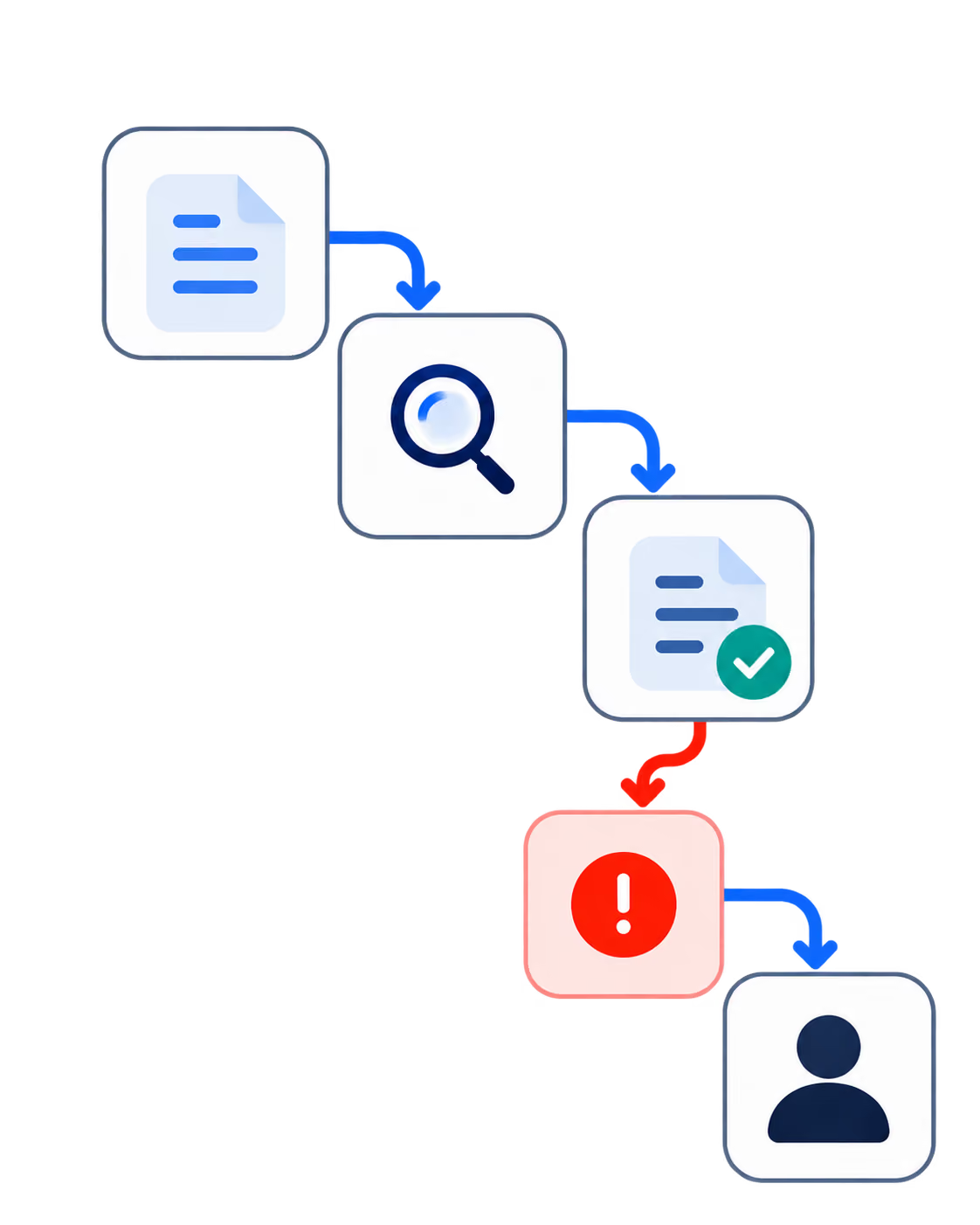
Hiring an AI team can look like a strategic move. It signals ambition, technical maturity, and long-term commitment. But it can also become a very expensive way to discover that the company has not yet proved what the team should actually build.
Before hiring an AI team, leadership should prove that at least one workflow deserves one.
That means the workflow has a measurable cost today, a clear owner, repeatable steps, usable data, a realistic integration path, and enough upside to justify permanent AI capacity. Without that proof, a $750k+ team can become a research function with delivery expectations attached to it.
The mistake is hiring engineers before the business can answer a simpler question: which workflow can produce measurable value in production?
This article explains how to make that decision before you hire. We will compare in-house AI development, outsourced AI development, SaaS tools, and partner-led validation, then show how executives can decide which path fits the workflow, the risk, and the economics.
The Mistake of Hiring Before Workflow Proof
In-house AI development makes sense when AI is core to the product or the long-term operating model. A clinical decision support vendor, a fraud detection platform, or a marketplace pricing engine eventually needs internal AI capability because model behavior and governance are part of the product itself.
The problem becomes visible when companies hire that team before they have proved what the team should build. Hiring first locks in fixed cost before the business case is validated. A serious AI team is also not one “AI engineer.” It usually requires product ownership, data engineering, ML or AI engineering, backend integration, MLOps, QA, security input, and a business owner who decides when the system has drifted from “good” to “dangerous.”
Mid-market companies routinely underestimate the non-model work. The real effort often sits in permissions, data cleaning, system integration, observability, fallback logic, human review design, retraining, monitoring, and adoption. This is the work that determines whether the system survives ninety days in production.
In-house AI teams are not the problem at all. However, they become expensive learning vehicles when the use case has not been validated. And the real cost is not only salaries, but months of paid discovery, architecture correction, and workflow learning that a focused diagnostic could often surface much earlier.
What a $750k AI Team Really Buys, and What It Does Not
The Visible Cost: Salaries and Hiring Time
Treat $750k not as a universal number, but as a modeled scenario. A credible internal capability usually requires an AI or ML lead, a backend or integration engineer, a data engineer, MLOps, a product manager, plus QA, security input, and management overhead.
Mid-tier US salaries for that mix land between $650k and $900k all-in. A real AI production function is a team, not one prompt-savvy engineer.
The Hidden Cost: Production Ownership
A real AI production function also carries cloud infrastructure, model and API spend, data preparation, security review, integration maintenance, retraining, and management overhead. Independent vendor benchmarks put ongoing production agent operations at roughly $3,000–$13,000 per agent per month, separate from the people running it.
Picture what production ownership looks like in a single quarter. The CRM vendor changes a field schema, breaking an upstream integration; an engineer spends three days mapping the fix and updating tests. Evaluation scores on a support-routing agent drift downward as new product lines launch, and the team realizes its eval set no longer reflects current ticket distribution.
Rebuilding it takes a sprint. A compliance review surfaces a question about how the agent handles PII in escalation logs, requiring audit logs no one specified in the original build. All of them are operating costs that show up only after the system has been live for sixty days.
In addition, most internal AI programs underbudget two line items in particular. They are the evaluation infrastructure and exception handling. Evaluations tell you the system is still doing what you hired it to do. Exception handling is what happens when it is not. Both require ongoing engineering attention, and both tend to be the first work that gets deprioritized when a new feature lands on the roadmap.
The Opportunity Cost: Eight Months Before Proof
Hiring an AI lead can take three to six months. Onboarding that person, aligning stakeholders, defining the first use case, and standing up an initial system can take another three to six months.
That means a company may spend most of its first year discovering that the workflow was too fragmented, the data quality was worse than expected, the use case belonged inside an existing SaaS tool, users did not adopt the new process, the ROI was too small, or the prototype could not pass security review.
This is why time-to-proof matters. Gartner predicts that more than 40% of agentic AI projects will be cancelled by the end of 2027 because of escalating costs, unclear business value, and inadequate risk controls. Those are not just technology problems. They are often workflow validation problems discovered too late.
A fixed-scope diagnostic can surface the most important evidence much earlier. In two to six weeks, it should produce a yes/no recommendation on a specific workflow, supported by an integration map, authority model, risk view, and ROI logic. The goal is not to replace an AI team. The goal is to decide whether hiring one is justified.
The Workflow Test: 5 Questions To Answer Before Hiring
.avif)
During early project calls, we start by trying to build the full picture with the client. It includes the workflow, the business goal, the systems involved, the risks, the ownership model, and the economics behind the idea.
Over time, those calls showed us that a few questions can quickly separate a serious AI opportunity from an expensive experiment. They force leadership to see whether the workflow is ready, whether the value is real, and whether hiring a team is actually the next logical step.
1. Is the workflow expensive enough to matter?
Start with workflow economics, not AI feasibility. A workflow earns investment when it has measurable cost, delay, risk, revenue leakage, or quality impact.
- How many hours per month does it consume?
- What is the cost of a one-day delay?
- What is the cost of an error, and how often do errors happen?
- Does the workflow affect revenue, margin, churn, compliance, or customer experience in a way that someone tracks?
A support team handling repetitive tier-one tickets is a strong candidate because volume, resolution time, escalation rate, and cost per resolution are already measured.
Aerotech, running a sales operations agent, reported an 18-hour-per-week reduction in seller admin time. PKO Leasing's call center deployment saved over 550 hours per month. The baselines were known, so the deltas were provable. A vague "knowledge assistant for everyone" is weak: no defined process, no baseline, no owner.
2. Is the process stable enough to automate?
AI does not create operational clarity. It exposes whether clarity exists.
Before a company hires an AI team or builds a custom workflow, leadership should check whether the process is stable enough to automate.
Claims intake, lead routing, invoice matching, CRM hygiene, and onboarding checklists tend to work because the steps are repeatable and the exceptions are bounded.
An approval process that changes every week is different. That is not an AI opportunity yet. It is a process design problem that should be fixed before an LLM gets anywhere near it.
3. Are the data and systems ready?
A workflow that crosses five systems is an integration architecture problem.
- Which systems must the AI read from?
- Which must it write into?
- Are stable APIs available?
- Who owns the data and can grant access?
- Is the data accurate, deduplicated, and current?
- What permission boundaries are required? Are audit logs needed?
The defensible zone for a serious AI implementation is a cross-system orchestration, governance, ROI evaluation, non-standard approvals and handoffs, and deep process redesign. That is also where most projects underspend and discover the gap during the second sprint.
4. Is the AI allowed to act, or only assist?
Business value changes based on what the AI is allowed to do. A system that only summarizes information and a system that updates CRM records may look similar in a demo. In production, they are completely different products.
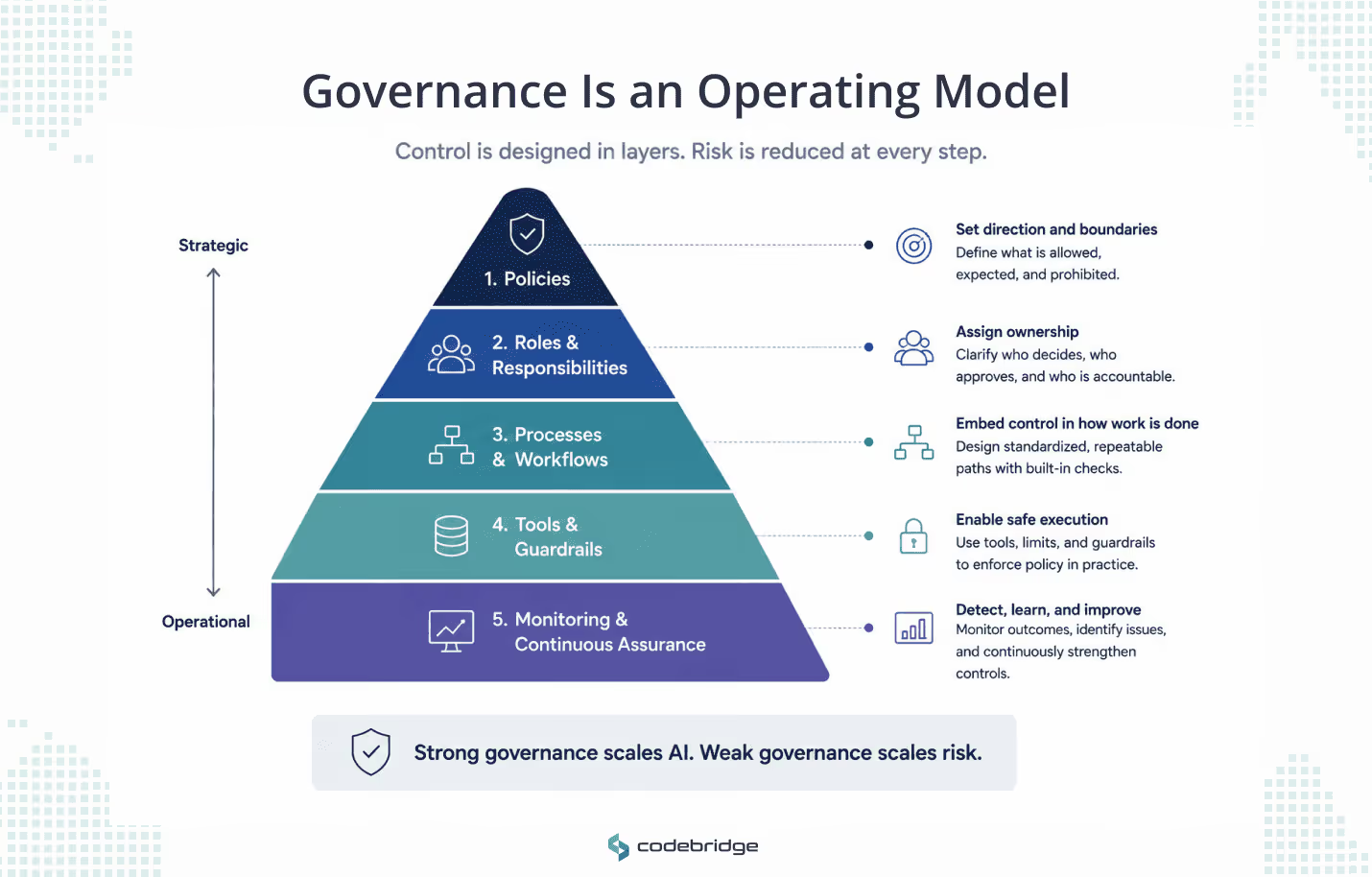
The main difference is authority. Before leadership approves an AI initiative, the team should define what the system is allowed to read, recommend, prepare, execute, or automate without review.
Safe AI automation depends on choosing the right authority level early. Each step up the ladder increases the integration surface, security review, audit requirements, user training, and cost of failure.
A “recommend” agent that drafts a follow-up email may only need read access, a review screen, and a human approval step. An “execute with approval” agent that updates CRM fields needs write credentials, permissions, action logs, and rollback. An autonomous agent needs all of that plus monitoring, alerts, and a named human owner when something goes wrong.
Choosing too much authority too early is one of the fastest ways to turn a promising AI pilot into a six-month security conversation that never ships.
5. Who owns the workflow after launch?
A workflow becomes production-ready when someone owns accuracy, exceptions, access, monitoring, adoption, and business outcomes. Not when the model works once.
Before launch, the company should know who reviews exceptions, who changes prompts and thresholds, who handles integration failures when an upstream API changes, who monitors cost and quality, and who is accountable when AI takes the wrong action.
For a revenue operations workflow, the owner is usually not “the AI team.” It is often the Head of RevOps, while the CTO owns security, integration boundaries, and system reliability. The same logic applies in other functions: finance owns finance workflows, support owns support workflows, clinical operations owns clinical workflows.
If the company cannot name the owner before launch, the workflow will not fail dramatically. It will usually fail quietly. Exceptions pile up, prompts drift, users stop trusting the output, and the system slowly becomes another abandoned internal tool.
Build, buy, or partner: the executive decision model
After the five questions are answered, three paths remain.
Build in-house when AI is strategic IP
Build internally when AI is part of the product's defensible core, the company has multiple validated use cases, the data advantage is proprietary, the CTO can support long-term AI infrastructure, and there is enough sustained workload to justify permanent specialists.
A HealthTech company building proprietary diagnostic workflow software will eventually need internal capability because model governance, clinical workflow expertise, and product IP are central to its future.
What that team buys in year two is the ability to defend the system in front of regulators, retrain models on proprietary clinical data without exposing it to a vendor, maintain audit trails that map to specific clinical decisions, and ship product changes faster than a contract partner can re-scope. None of that is purchasable from a SaaS vendor.
A B2B SaaS firm whose product margin depends on per-request inference cost is in a similar position for different reasons. The internal team owns the inference economics: model selection, prompt optimization, caching strategy, and fallback logic that move gross margin by points. A vendor cannot tune those tradeoffs against your unit economics, because it does not see them.
These are real cases, and a minority of mid-market situations. There is nothing wrong with hiring in-house. There is something wrong with hiring in-house first, by default, before the workflow has earned the investment.
Buy SaaS when the workflow is standard
Buy software when the use case lives mostly inside one platform, the workflow is common, speed matters more than customization, and the vendor already owns the system of record. Helpdesk AI inside Zendesk or Intercom, CRM summarization inside Salesforce or HubSpot, meeting notes inside productivity tools, revenue intelligence inside Gong. These categories have mature offerings that outpace anything a five-person internal team can build in a year. Zapier reports 450,000+ agents built across its ecosystem and over 593 million AI tasks automated since early 2023.
But SaaS becomes limiting when the workflow spans several systems, requires custom controls, or needs ownership of code and data boundaries. A helpdesk AI inside Zendesk that also needs to update CRM, trigger a billing exception, and notify Slack on high-value escalations stops being a Zendesk-shaped problem fairly quickly.
Partner first when the workflow is valuable but unproven
Partner first when ROI is unproven, the process crosses CRM, support, billing, ERP, the data warehouse, or internal tools, security matters, leadership needs a working proof before hiring, internal teams are busy with core product work, and executives need a decision memo rather than a demo.
A specialized partner does not replace future internal capability. It reduces uncertainty before the company decides whether to build it. The MIT/NANDA "GenAI Divide" research, cited for the headline that only 5% of integrated pilots reached meaningful P&L impact, contains a more useful finding: in that sample, purchases from specialized vendors and partnerships succeeded roughly 67% of the time, while internal builds succeeded about one-third as often. Treat the ratio as directional. Production impact depends on workflow integration, ownership, and adoption, and specialized partners typically bring more reps in those areas than a newly hired team.
Codebridge is positioned for this case. The question is which workflow AI should touch, how it should be integrated, what authority it should have, and what would make it safe enough to run in production.
Example decision scenarios
Scenario 1: B2B SaaS RevOps team drowning in CRM and pipeline admin
A 120-person B2B SaaS company. Sales and customer success spend hours per week updating CRM fields, cleaning notes, routing leads, and preparing reports. The bad first move is to hire an AI engineer to "automate sales": mandate too broad, success criteria vague, ownership split across three departments. The better first move is to pick one workflow (lead qualification, CRM enrichment, pipeline risk, renewal risk, or meeting-to-CRM update) and run the five-question test.
Buy SaaS if the issue lives inside one platform. Partner first if the workflow crosses CRM, email, enrichment, calendar, support, and BI. Hire later if multiple validated revenue workflows justify a permanent function. Tackle reported a 40% reduction in forecasting time after deploying a RevOps agent. That is provable in six weeks. Hiring a team to build it first reverses the order of the evidence.
Scenario 2: HealthTech workflow with clinical or operational constraints
A HealthTech company wants AI to reduce operational pressure, but the workflow has regulatory, audit, and integration constraints. The bad first move is to build a general AI assistant without authority boundaries: audit risk is high, surface area is too large to validate. The better first move is to define what AI can safely read, prioritize, summarize, or route inside existing systems, against one workflow. Build in-house if AI is core clinical IP. Partner first if the workflow requires integration with existing systems and production controls. Avoid automation entirely if the risk boundary cannot be made clear.
Scenario 3: Mid-market back-office process with spreadsheet dependency
Finance, operations, or admin teams move data manually between invoices, spreadsheets, billing systems, and dashboards. Leadership calls it "spreadsheet hell." The bad first move is to hire a full AI team to automate the back office: the work splits across half a dozen processes with no shared architecture, and the team spends its first quarter on process discovery that a focused partner does in three weeks. The better first move is to validate whether the workflow is rule-based automation, document AI, RPA, LLM-assisted review, or a better SaaS configuration. Buy SaaS if standard. Use low-code if risk is low. Partner if approvals, auditability, and integration matter. Hire only after a portfolio of repeatable automation needs justifies permanent capacity. Evros reduced invoice processing time by roughly 80% (from 20 hours per week to 4) without standing up a permanent AI team.
The executive checklist before hiring an AI team
Ten questions, each tied to a hiring risk:
A hiring decision built on ten clear answers looks like capital allocation. A hiring decision built on three of them looks like hope.
When hiring an in-house AI team is the right decision
The conditions for hiring are covered in the build-in-house case above: several validated workflows, AI tied to core product or operational advantage, internal teams that can maintain production systems, and external partners who have helped define the architecture and handoff path.
Outsourcing and in-house development are not enemies. For many companies the right sequence is partner first, prove the workflow, then internalize. The partner accelerates the first production deployment; the internal team takes the second wave with a working architecture and a real playbook. This sequence costs less, fails less, and produces a stronger team than starting with a hire.
Conclusion
An in-house AI team can be a smart investment. For many mid-market companies, the first AI hire is not a person. It is a proof process.
Before committing to permanent payroll, executives should know which workflow matters, what baseline it improves, what systems it touches, what risk it creates, what value it can return, and who will own it in production. The five-question test and the ten-item checklist above are the minimum conditions for the hire to pay back.
The question is not whether AI should be built in-house or outsourced. The better question is whether the workflow has earned the right to become a permanent AI investment.












Heading 1
Heading 2
Heading 3
Heading 4
Heading 5
Heading 6
Lorem ipsum dolor sit amet, consectetur adipiscing elit, sed do eiusmod tempor incididunt ut labore et dolore magna aliqua. Ut enim ad minim veniam, quis nostrud exercitation ullamco laboris nisi ut aliquip ex ea commodo consequat. Duis aute irure dolor in reprehenderit in voluptate velit esse cillum dolore eu fugiat nulla pariatur.
Block quote
Ordered list
- Item 1
- Item 2
- Item 3
Unordered list
- Item A
- Item B
- Item C
Bold text
Emphasis
Superscript
Subscript