On the surface, insurance workflows appear ideally suited for autonomous agentic systems. It is document-heavy, relies on repetitive intake processes, and requires constant handoffs between fragmented systems. Most CTOs evaluating this space can see the high-volume process work that should lend itself to automation.
But the primary tension in deploying agentic AI lies in the industry’s dependence on human judgment and regulatory accountability. A misclassified claim triggers regulatory exposure. An unsupervised coverage determination can create liability that lands on the carrier, not the vendor. Regulators and policyholders expect a human to be accountable for risk decisions, and no agent architecture changes that expectation.
The practical question for engineering leaders is narrower than "how do we adopt agentic AI?" It is: where can an agent take action within a bounded workflow, with governance built into the execution path, without requiring a human to verify every output? Claims triage, submission enrichment, and service orchestration are the first places where that boundary holds.
The current market situation: why insurance executives should care now
76% of U.S. insurers have deployed some form of generative AI. Only 7% have brought an AI initiative to production scale. That ratio tells you where the industry actually stands: most teams have run pilots, few have shipped systems that handle real workload.
Three forces are compressing the timeline for engineering leaders who want to close that gap.
- Financial Strain: Catastrophe losses have exceeded $100 billion in insured damages for six consecutive years. Carriers need faster, more accurate claims response, and manual processes cannot absorb the volume spikes that follow a major weather event.
- Talent Shortages: The actuarial and underwriting talent pool is not growing fast enough to match demand. Carriers sitting on decades of policy and claims data cannot put it to use because they lack the specialized staff to interpret and act on it at the pace their books require.
- Competitive Inflection: Early movers that have embedded agent workflows into core operations report roughly three times the return of companies still running isolated AI tools. That gap will widen as platform vendors follow the same direction.
Guidewire, for example, has begun shipping agent-layer APIs into its policy and claims infrastructure, a signal that the integration surface for agentic systems is becoming a platform expectation, not a custom build.
This shift indicates that the real value no longer resides in an AI’s ability to answer questions, but in its ability to coordinate work across fragmented insurance workflows.
Where Agentic AI Creates Real Value in the Insurance Industry
Agentic AI in insurance sounds compelling at the architecture level. Autonomous systems handling document-heavy workflows, reducing cycle times, freeing up specialized talent. But for an engineering leader building a business case, the question is more specific: which workflows justify the integration cost and have a decision space narrow enough that an agent can act without open-ended judgment?
Not every insurance workflow qualifies. Policy negotiation, complex commercial risk selection, and disputed claim adjudication depend on contextual reasoning that agents cannot reliably replicate. The viable starting points sit in a different category: high volume, repeatable structure, and bounded decision logic, where confidence thresholds can govern when the system acts versus when it escalates.
Claims intake and FNOL triage
Adjusters at most mid-size carriers spend one to three days per claim gathering documents, cross-referencing policy terms, and assembling a file before any evaluation begins. That preparation work is where agent systems create the clearest gains.
A well-scoped agent layer sitting on top of existing claims infrastructure can normalize intake data from mobile uploads, call-center notes, and emailed PDFs into a single structured record. From there, it can match claim facts against policy coverage, flag total-loss indicators from photo analysis (removing the wait for a physical inspection), and set preliminary reserves. For low-complexity claims, the system can trigger downstream logistics like tow dispatch or rental scheduling without adjuster involvement.
The key architectural constraint: confidence-based routing. The agent handles intake and classification autonomously when confidence exceeds a defined threshold. Ambiguous or high-severity claims escalate to a senior adjuster with the structured file already built. The agent reduces preparation time; the adjuster still owns the decision.
Underwriting Submission and Data Enrichment
Commercial underwriters receive broker submissions as a mix of loss runs, financials, property schedules, and supplemental documents, rarely in a consistent format. An underwriter can spend hours normalizing a single submission before evaluating the risk.
Agent systems in this workflow extract and structure submission data, pull diagnoses from physician reports or structural details from building permits, and flag coverage gaps or missing information.
The underwriter receives a structured summary with risk indicators instead of a stack of raw documents. Extraction that took one to two days of manual review runs in seconds. The underwriter's time shifts from data assembly to risk selection and pricing.
Service Operations and Workflow Guidance
Most service workflows today route customer requests to a queue and wait for a human to pick them up. An agent-based service layer changes the sequence: the system identifies the request type, pulls missing documentation, updates billing or policy records, and notifies the customer of status changes before a human touches the case. Carriers running this model have reported reductions in complaints of 50-65% and faster liability assessment cycles. The agent handles the coordination; the service rep handles exceptions and relationship management.
Why Most Agentic AI Initiatives in Insurance Fail Before Production
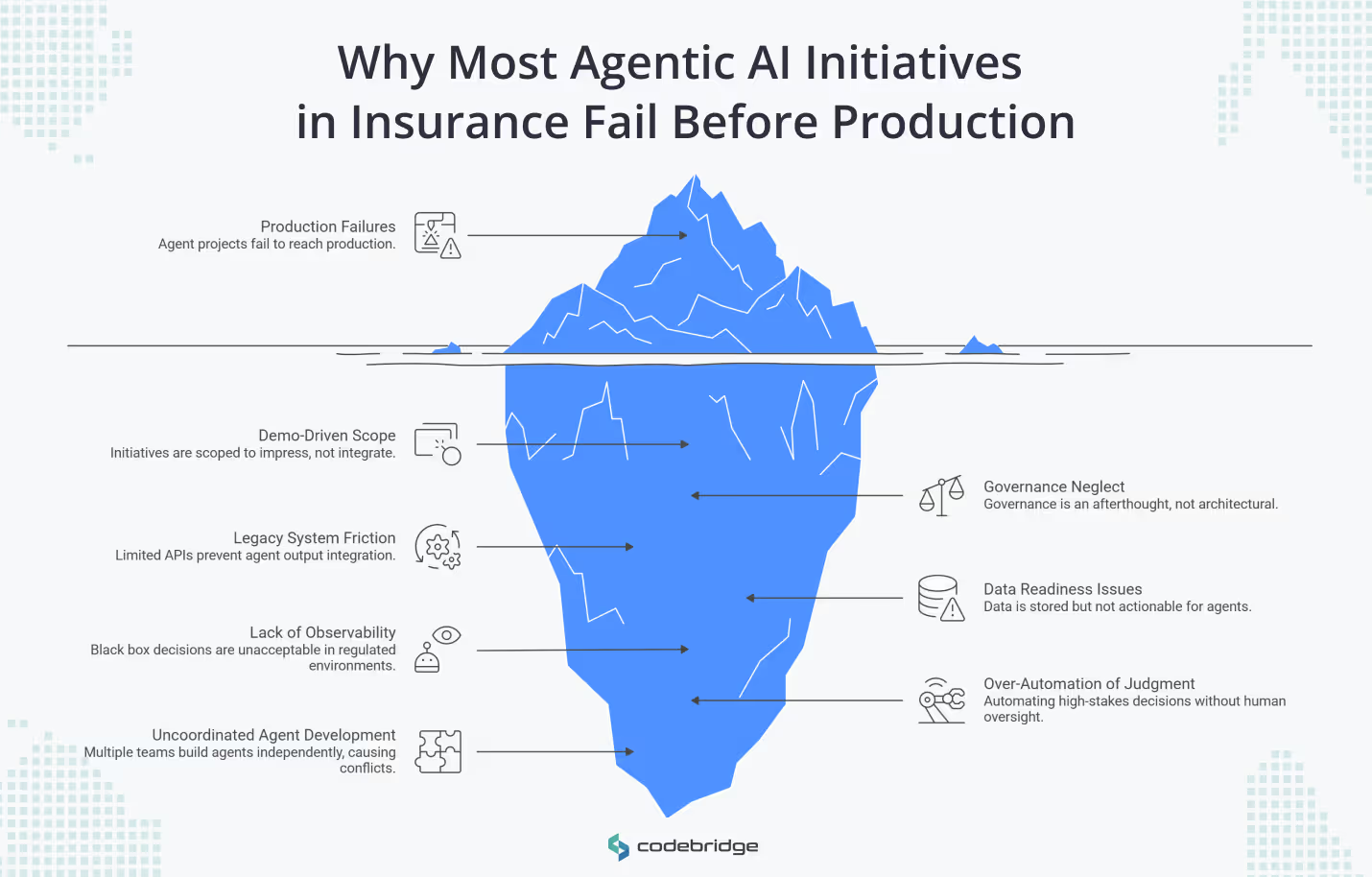
Most agent projects in insurance fail to reach production, and the model is rarely the reason. The initiatives stall because they were built as demos: scoped to impress, not to survive integration with the systems that actually run the business.
Governance has to be an architectural decision, built into the execution layer, not written up as a policy document after deployment. When it isn't, the same failure modes show up across carriers regardless of which model or vendor they chose.
Legacy System Friction
An agent classifies a claim or structures a submission, then has nowhere to write the result. Policy admin, billing, and document management systems at most carriers still expose limited or no API surface.
The agent produces an output; a human copies it into the legacy system manually. The efficiency gain disappears. Any agent initiative that doesn't start with an honest assessment of core system integration costs is building on sand.
Data Readiness is Not Data Storage
Carriers have decades of claims, policy, and actuarial data. Most of it sits in formats and systems that can't feed a real-time agent workflow. Production-grade agent systems need data pipelines with provenance tracking, version control, and validation against source systems. Storing data is not the same as having data that an agent can act on with confidence.
Lack of Observability and Audit Trails
In a regulated environment, "black box" decisions are unacceptable. If a system cannot explain its reasoning or provide a cryptographic audit trail of its decisions, it will fail governance reviews. Most pilot architectures don't include this instrumentation because they were never designed to face a regulator.
Over-Automation of Judgment
Initiatives often fail when they attempt to remove humans from high-stakes decisions too quickly. Customers and regulators alike demand human accountability, particularly in risk classification and claim denials.
Risk classification and claim denial are the two places where carriers face the most regulatory and legal exposure. Initiatives that automate these decisions without a human-in-the-loop governance layer tend to be shut down quickly, either by internal compliance teams or by regulators following an adverse outcome.
The line between "agent-assisted" and "agent-decided" has to be drawn at the architecture level, with explicit confidence thresholds and escalation rules.
Agents Multiply Without Coordination
When multiple teams build agent capabilities independently, you get overlapping extraction logic, inconsistent validation rules, and model versions that drift apart. One team's update breaks another team's workflow. Without a control plane that governs agent boundaries, versioning, and lifecycle management, the system becomes harder to maintain than the manual process it replaced.
Each of these failure modes is an engineering problem with a known solution. The section that follows walks through what a production-grade implementation looks like when these risks are addressed from the start.
Implementing Agentic AI in Insurance: What Production Architecture Looks Like
Moving from an AI vision to a production-ready rollout requires a partner that understands the harder half of the problem: integration-heavy systems in regulated environments. Codebridge’s relevance in this space is not simply "adding AI," but engineering complex software that survives real-world scale and rigorous compliance.
The previous section listed five failure modes that stop agent initiatives before they reach production. Each one is an engineering problem. The implementation question is how to address all five within a single architecture.
The harder part of delivering agentic AI in insurance is the integration layer: connecting agent outputs to core policy, billing, and claims systems that were not designed for real-time programmatic interaction, while maintaining the audit and governance requirements that regulators enforce. That integration work is where most projects either succeed or die.
How the Architecture Fits Together
We determined four main layers that production-grade agent deployment in insurance requires.
1. Workflow Mapping
Before writing any agent logic, the engineering team defines exactly where human-agent handoffs occur in the target process. Each handoff point gets a confidence threshold:
- Above the threshold, the agent acts autonomously
- Below it, the system escalates with a structured summary for the human reviewer.
Getting these boundaries right determines whether the system actually reduces workload or just creates a new review queue.
2. RAG-Based Grounding
Every agent decision references verified, company-specific knowledge:
- claims handling guidelines
- coverage exclusion rules
- state regulatory requirements
- internal authority limits
This grounding layer reduces hallucination risk and ensures that outputs reflect the carrier's actual policies, not generic training data.
3. Observability and Audit Infrastructure
In a regulated environment, "the system made a decision" is not an acceptable answer. The implementation needs structured logging of every agent action: model version, input data, confidence score, retrieved context, and the reasoning chain.
Alerting on confidence drops, drift detection on agent accuracy over time, and audit-ready export for compliance reviews. This is heavier engineering than most teams anticipate.
4. Core System Integration
The agent layer needs to read from and write back to policy admin, billing, and document management systems. If the carrier's core platform lacks a modern API surface, the implementation includes an integration middleware that handles data normalization, transaction management, and error recovery. Without this layer, agent outputs sit in a separate system, and humans re-key the results manually.
What This Looks Like Applied to Claims Intake
A regional P&C carrier receives FNOL data through web forms and emailed PDFs. Adjusters spend one to two hours per claim assembling and normalizing these inputs before any evaluation begins. During catastrophic events, the preparation backlog compounds and response times stretch.
Codebridge's approach for this type of engagement was to build an agent-assisted orchestration layer on top of the carrier's existing claims infrastructure. The solution architecture included:
- Intake Normalization: Standardizing data from multiple entry points into a single decision layer.
- Automated Classification: Using "Utility Agents" to extract key loss facts and summarize unstructured attachments.
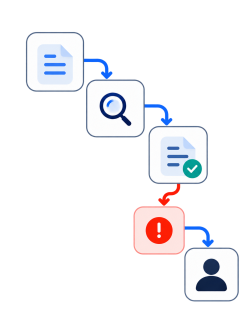
- Confidence-Based Routing: Implementing a logic gate where agents recommend actions only when confidence exceeds a set threshold (90%), escalating ambiguous or high-risk cases to senior adjusters.
- Immutable Audit Logs: Ensuring every automated recommendation is logged with the model version and reason for any clinician or adjuster override.
The outcome for this architecture: 30-35% reduction in file-preparation time per claim, materially faster first contact with claimants, and a stronger audit position than the manual process it replaces.
Why This Matters for Insurance Engineering Leaders
The model is the most replaceable component in an agentic AI system. Models improve, costs drop, and new capabilities ship quarterly. The integration architecture, the governance layer, and the observability infrastructure are the parts that determine whether the system runs reliably at scale in a regulated environment. Those are the parts that take the most engineering effort to get right, and the parts that are hardest to retrofit after deployment.
Codebridge builds in that layer. The team's work in HealthTech, professional services, and recruitment follows the same discipline that insurance requires: complex system integration, confidence-based autonomy boundaries, and audit-grade observability, delivered for environments where unreliable software has real regulatory and business consequences.












Heading 1
Heading 2
Heading 3
Heading 4
Heading 5
Heading 6
Lorem ipsum dolor sit amet, consectetur adipiscing elit, sed do eiusmod tempor incididunt ut labore et dolore magna aliqua. Ut enim ad minim veniam, quis nostrud exercitation ullamco laboris nisi ut aliquip ex ea commodo consequat. Duis aute irure dolor in reprehenderit in voluptate velit esse cillum dolore eu fugiat nulla pariatur.
Block quote
Ordered list
- Item 1
- Item 2
- Item 3
Unordered list
- Item A
- Item B
- Item C
Bold text
Emphasis
Superscript
Subscript