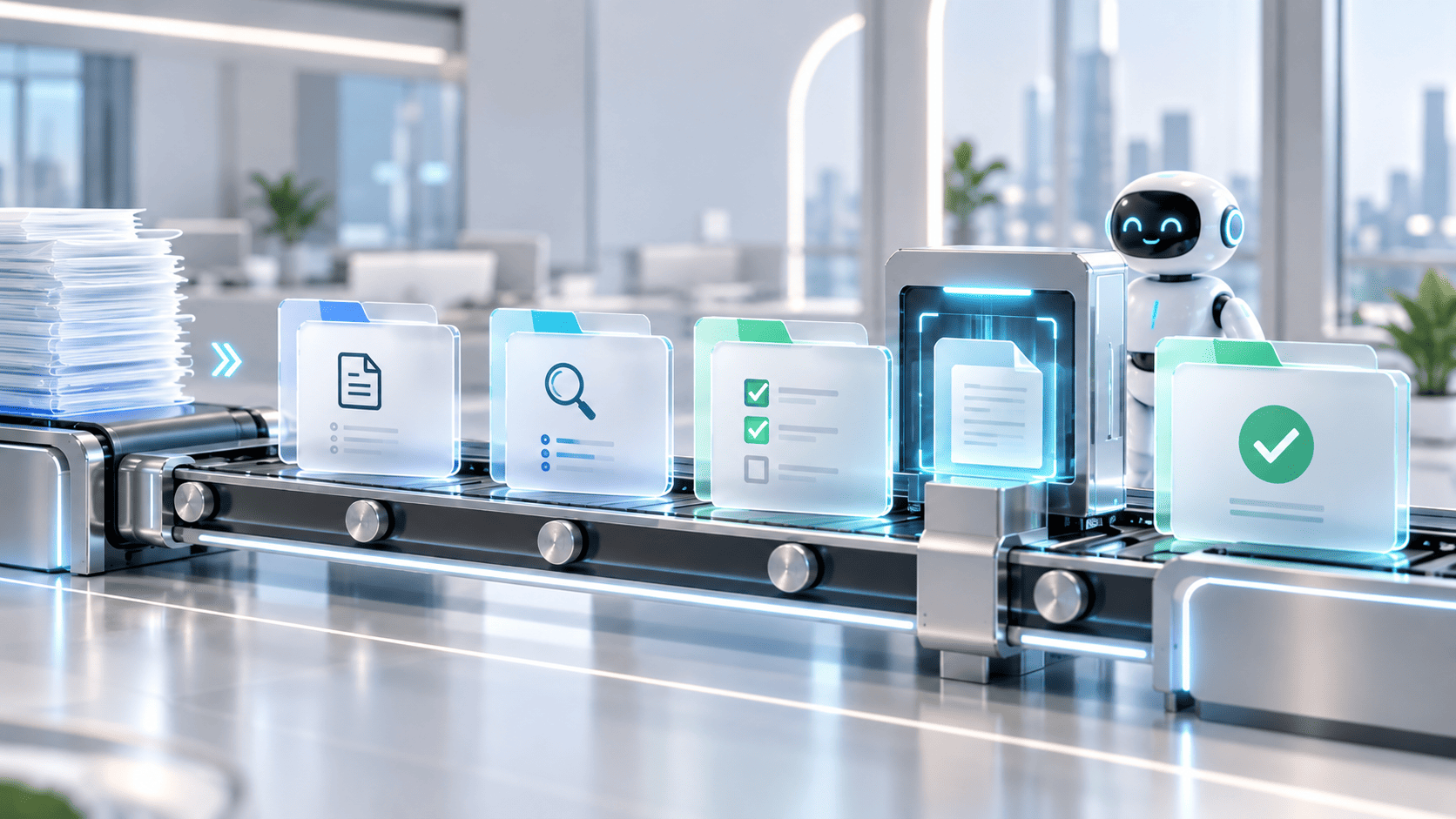
AI agent lifecycle management is the end-to-end discipline of governing autonomous AI systems from initial use-case approval through design, testing, deployment, real-time monitoring, and ultimate decommissioning.
In a production environment, an AI agent is a system of action capable of accessing sensitive data, invoking external tools, and influencing business decisions without constant human intervention. This autonomy creates a unique set of management challenges: organizations must maintain clear visibility into who owns each agent, precisely what systems it is permitted to access, which versions of prompts and models are active, and how the system is safely retired to prevent residual risk.
Effective lifecycle management provides a continuous control plane that ensures agents remain accountable digital entities throughout their entire operational life. This article explains why traditional SDLC, MLOps, and LLMOps fall short for software that acts on its own, and sets out a practical control-plane model for managing production agents across ownership, identity, permissions, evaluation, observability, incident response, and decommissioning.
Introduction: The Agent Does Not End at Launch
Many technical teams view the successful deployment of an AI agent as the finish line. In reality, launching an agent is the simplest phase; the accumulation of operational risk begins the moment that agent begins interacting with live workflows. The most dangerous moment for an organization is when it continues to work, accessing systems and making decisions, while its internal logic and external dependencies drift away from their intended state.
Without a structured lifecycle management process, autonomous software becomes a system that consumes resources and creates security gaps in silos that central IT cannot see or control.
Lifecycle management is becoming a foundational production discipline because autonomous systems require rigorous limits, persistent ownership, and an enforced end-of-life process.
What Is AI Agent Lifecycle Management?
AI agent lifecycle management (ALM) is defined as the structured process for governing an AI agent through every stage of its existence: ideation, evaluation, deployment, monitoring, and retirement. Unlike standard software modules, AI agents interpret context, make decisions, call external tools, reach into systems beyond their own code, adapt based on interactions, and generate non-deterministic outputs that can change even when the underlying code remains static.
This adaptive nature necessitates a governance model that operates continuously rather than at periodic checkpoints.
AI agents differ from traditional applications because they are living systems. They depend on live data and user interactions that can shift their logic over time. ALM provides the necessary structure to manage this complexity, ensuring that as agents get smarter or their environments change, they remain within the guardrails of the enterprise's security and compliance policies.
Why Traditional SDLC, MLOps, and LLMOps Are Not Enough
As organizations scale their AI initiatives, there is a common misconception that existing frameworks like Software Development Life Cycle (SDLC), MLOps, or LLMOps can be extended to cover AI agents. However, each of these disciplines targets a different primary object and falls short of the holistic management required for autonomous systems.
- SDLC is built around deterministic code and releases. It assumes that once a piece of software is released, its behavior will remain consistent until the next code update. AI agents break this assumption because their behavior is model-driven and varies based on input and context.
- MLOps focuses on the lifecycle of a model. Training, deployment, and retraining. It does not govern the tools an agent uses, the autonomous workflows it triggers, or the complex multi-step reasoning it performs.
- LLMOps manages prompts, retrieval-augmented generation (RAG) quality, and model evaluations. While critical for performance, it typically lacks the mechanisms to handle enterprise identity, tool access permissions, or the long-term business accountability for an agent's actions.
- AgentOps focuses heavily on the tracing, monitoring, and debugging of agents in production. It is excellent for operational visibility, but for AgentOps it can become a “dashboard watching the fire” if it is not integrated into a broader governance and ownership framework.
At a glance, the gaps line up like this:
ALM must govern the whole agent as an acting system. It requires connecting IT, security, legal, and business units to ensure that when an agent acts autonomously, it does so as an identifiable and limited representative of the organization.
The AI Agent Lifecycle Control Plane
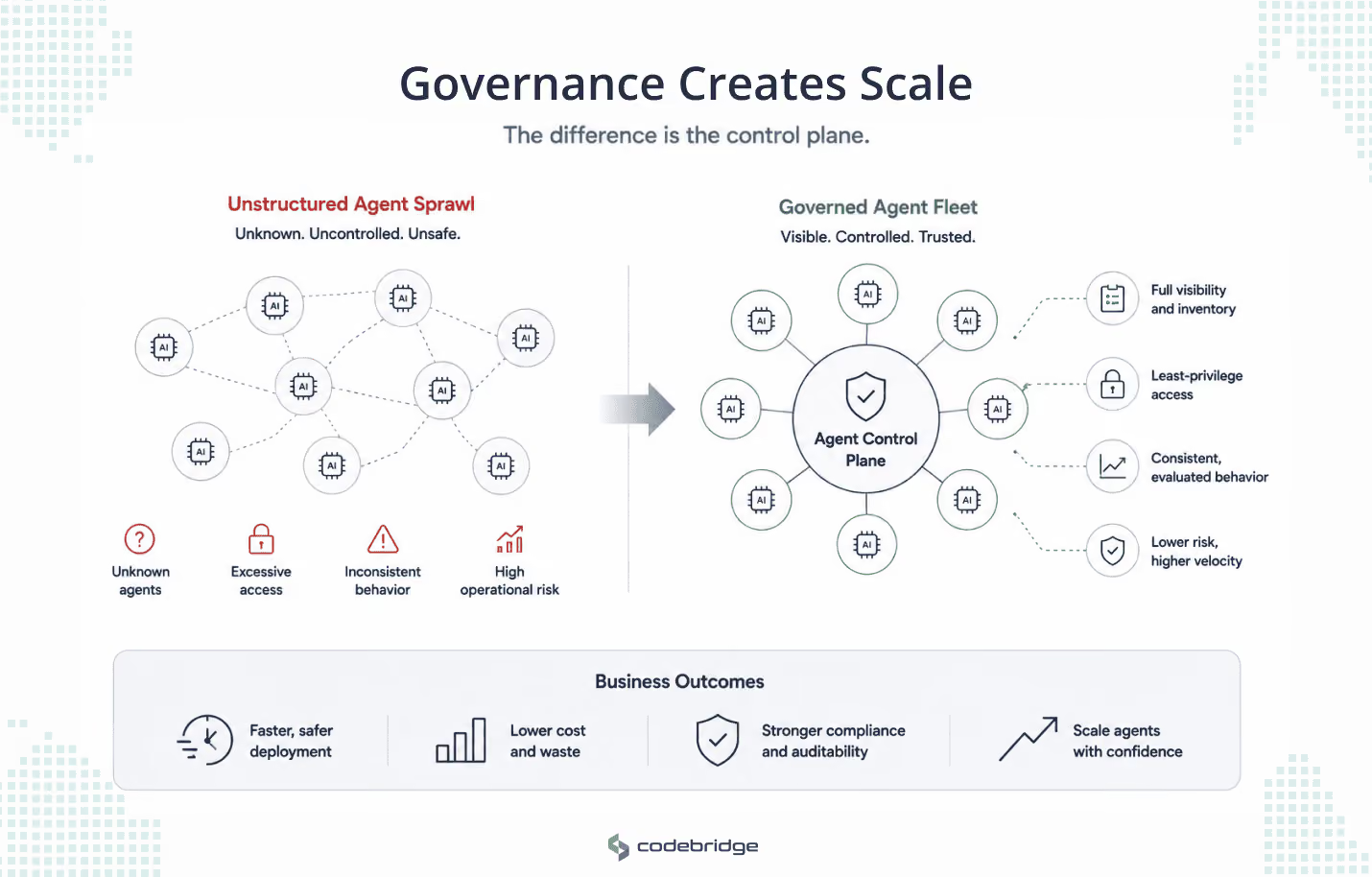
The centerpiece of a production-ready AI strategy is the lifecycle control plane. This is a combined system of records, permissions, policies, and operational processes that makes the agent fleet governable.
If a lifecycle diagram shows you where an agent is in its journey, a control plane shows you how it is being managed at that moment.
5.1 Agent Registry: Managing the Inventory
The first step in preventing agent sprawl is an enterprise-wide registry. You cannot govern what you cannot inventory. Every production agent must be registered with metadata that includes:
- its business purpose
- named technical and business owners
- current lifecycle state (e.g., active, suspended, retired)
- Its risk classification
A complete record goes even further: the agent name, the connected systems it touches, the model in use, the active prompt or policy version, the tools available to it, the permissions granted, its current evaluation status, and the date of its last review. This registry serves as the single source of truth for the entire organization. It ensures that there are no shadow AI agents operating outside of formal oversight.
5.2 Identity and Access: Agents as First-Class Citizens
Production AI agents must be treated as first-class identities within the enterprise ecosystem. Organizations must move away from shared API keys and vague service accounts that remove accountability and make it impossible to trace actions back to a specific actor.
Assigning each agent a unique, cryptographically verifiable identity allows for tighter authentication and easier auditing. This identity-first approach ensures that if an agent's credentials are leaked, the blast radius is limited to that specific identity rather than multiple systems.
This means least-privilege access granted through defined roles, permissions that are time-limited rather than permanent, access reviewed on a fixed schedule, ownership transferred cleanly when staff changes, and credentials revoked the moment the agent is retired.
An AI agent should never become a ghost user holding standing access that nobody remembers granting.
5.3 Tool and Action Permissions: Authority Management
A critical component of the control plane is separating what an agent can say from what it can do. Lifecycle management must govern an agent's execution scope. Companies must limit the combination of actions an AI agent can take to ensure it remains within its intended purpose.
This requires fine-grained authorization at the resource and action level, rather than broad application-wide entitlements.
The risk of an agent is not only the quality of its answer, but also the authority attached to that answer.
5.4 Prompt, Model, and Context Versioning: Controlling Drift
Because agent behavior is non-deterministic, a small change in a system prompt, a model version bump, or a change in the retrieval source can lead to significant behavioral drift.
Organizations must implement version control for every element that influences an agent's reasoning. It includes the model weights, the tool instructions, and the knowledge base context.
Behavior can move when any of these change: the system prompt, the tool instructions, the model version, the retrieval source, the knowledge base, the memory layer, the API schema, the underlying business rules, or the safety policy. When an agent starts behaving differently, the team has to be able to say exactly what changed.
This is essentially “Governance-as-Code” (GAC); it ensures that every action is verified against a specific version of a policy engine, making it possible to identify exactly what changed when an agent's output deviates from the baseline.
5.5 Evaluation and Testing: Beyond “It Works.”
Testing agents requires more than verifying that the code executes. Continuous evaluation must be embedded into the CI/CD pipeline to catch regressions early. This includes:
- Intent Resolution: How accurately the agent identifies user requests.
- Task Adherence: How well it follows instructions across multi-step plans.
- Tool Call Accuracy: The correctness of arguments passed to external APIs.
- Safety and Red Teaming: Proactively simulating adversarial attacks to uncover vulnerabilities like prompt injection or sensitive data leakage.
- Groundedness: whether answers are supported by the retrieved source material.
- Hallucination and refusal behavior: what the agent does when it lacks an answer or should decline.
- Escalation behavior: whether it hands off to a human at the right threshold.
- Latency and cost per task: the operational profile of each run.
- Sensitive-data handling: how the agent treats regulated or confidential inputs.
- Behavioral regression: re-running the full set after any prompt, model, or tool change.
Agents need behavioral regression testing because a small prompt or tool change can produce a large change in production behavior.
5.6 Runtime Observability: Capturing the “Why”
Monitoring production agents is about more than just checking for uptime; it is about achieving deep visibility into the reasoning paths and tool selection choices that lead to specific outcomes.
At minimum, capture inputs, outputs, tool calls, reasoning traces where available, failures, retries, escalations, policy violations, latency, token and API cost, user feedback, drift, and human override events. This requires specialized metrics, such as “groundedness scores” for RAG agents to measure factual accuracy against source documents.
Effective observability must also track token usage and API costs per successful task to prevent “invisible cost” risks where unchecked agents run repeatedly and drive unbudgeted cloud expenses.
5.7 Incident Response and Rollback: The Central Kill Switch
Monitoring without a clear incident response plan is merely watching a disaster unfold. The failures worth planning for are concrete: the agent updates the wrong record, sends the wrong message, exposes sensitive data, calls a tool too often, escalates too late, or starts producing more expensive runs.
The control plane must feature a centralized “kill switch” or universal logout mechanism that can immediately revoke an agent's permissions if it deviates from its intended task or accesses data unexpectedly. Furthermore, teams need structured rollback processes to revert an agent to a known-good configuration of prompts and model versions when performance regressions are detected.
A complete response capability also names an incident owner, restricts specific tools, defines a human-escalation path, reviews the relevant traces, runs a root-cause analysis, and folds the failure back into the evaluation set so the same problem is caught next time.
5.8 Retirement and Decommissioning: Managing the End-of-Life
The final pillar of lifecycle management is the secure retirement of agents. AI agents do not “quietly fade away”. They often retain cached tokens, active API keys, and persistent memory stores.
Proper decommissioning involves a structured workflow to revoke all credentials, archive logs for compliance, and update documentation to ensure no downstream automation still relies on the retired agent.
A thorough retirement also documents the agent's final state, transfers any useful knowledge it accumulated, removes its dependencies, updates the workflow documentation, confirms that no downstream automation still calls it, and records who approved the shutdown. Without this, dormant agents become hidden vulnerabilities and unmonitored entry points for attackers.
What Breaks Without Lifecycle Management
Ignoring lifecycle management leads to technical debt that accumulates faster than with traditional software. Because agents are autonomous, their failures are often quiet, manifest in unexpected ways, and can spread rapidly across integrated systems.
These failure modes are easiest to see in practice. A sales agent updates CRM records from weak context, and the pipeline slowly fills with bad data. A support agent escalates too late because its thresholds were set once and never reviewed, so customers wait while it retries. Each one erodes trust, data, or budget while the dashboard still shows green.
A Practical First-Step Checklist
A company does not need to deploy a complete, high-complexity platform to begin managing agents properly. The first objective should be making the agent population visible, owned, and measurable.
The 30-Day Action Plan:
Conclusion: Agents Need Retirement Plans Too
The primary challenge of the next five years will be the operational challenge of managing many AI agents simultaneously. As agents quietly become part of the organizational operating model, lifecycle management is the only way to prevent them from becoming invisible employees with unsupervised API keys.
A truly useful production agent must have a clear purpose, a named owner, a limited identity, rigorous testing, complete logs, defined escalation paths, an incident-response plan, and a defined end-of-life process.
Companies that invest in a robust lifecycle control plane early will be the ones that scale their AI operations with confidence. Those who ignore these disciplines will eventually find they have not built a sophisticated AI platform, but rather a collection of autonomous shortcuts that no one fully controls.














Heading 1
Heading 2
Heading 3
Heading 4
Heading 5
Heading 6
Lorem ipsum dolor sit amet, consectetur adipiscing elit, sed do eiusmod tempor incididunt ut labore et dolore magna aliqua. Ut enim ad minim veniam, quis nostrud exercitation ullamco laboris nisi ut aliquip ex ea commodo consequat. Duis aute irure dolor in reprehenderit in voluptate velit esse cillum dolore eu fugiat nulla pariatur.
Block quote
Ordered list
- Item 1
- Item 2
- Item 3
Unordered list
- Item A
- Item B
- Item C
Bold text
Emphasis
Superscript
Subscript