A lot of executive teams track AI adoption. They count the tools in use, the teams experimenting, and the features shipped. But these numbers say little about whether a company's AI spending will hold up once the market grows more skeptical.
That skepticism has arrived. We have recently noticed that Interest in the phrase "AI bubble" has climbed more than 1,581% year over year, according to DataForSEO search data as of July 2026.
In June 2026, technology stocks led the sharpest sell-off in over a year, and investors who had stayed quiet began taking public positions against parts of the AI trade. No confirmed measure says a bubble has formed. The change is that the question has moved from financial commentary into ordinary boardroom vocabulary.
For CEOs, that shift matters before any verdict on valuations. Budgets respond to confidence sooner than they respond to final evidence. When the outside narrative was positive, weak AI projects survived on promise. As the narrative turns, the same projects face a question: what can you defend?
What does an "AI bubble" mean
An AI bubble does not mean AI lacks value. The technology works, and the productivity gains in specific tasks are real.
AI bubble describes a gap between what people believe, what companies spend, and what returns have been proven. Expectations, valuations, and capital commitments can run ahead of demonstrated economic payoff.
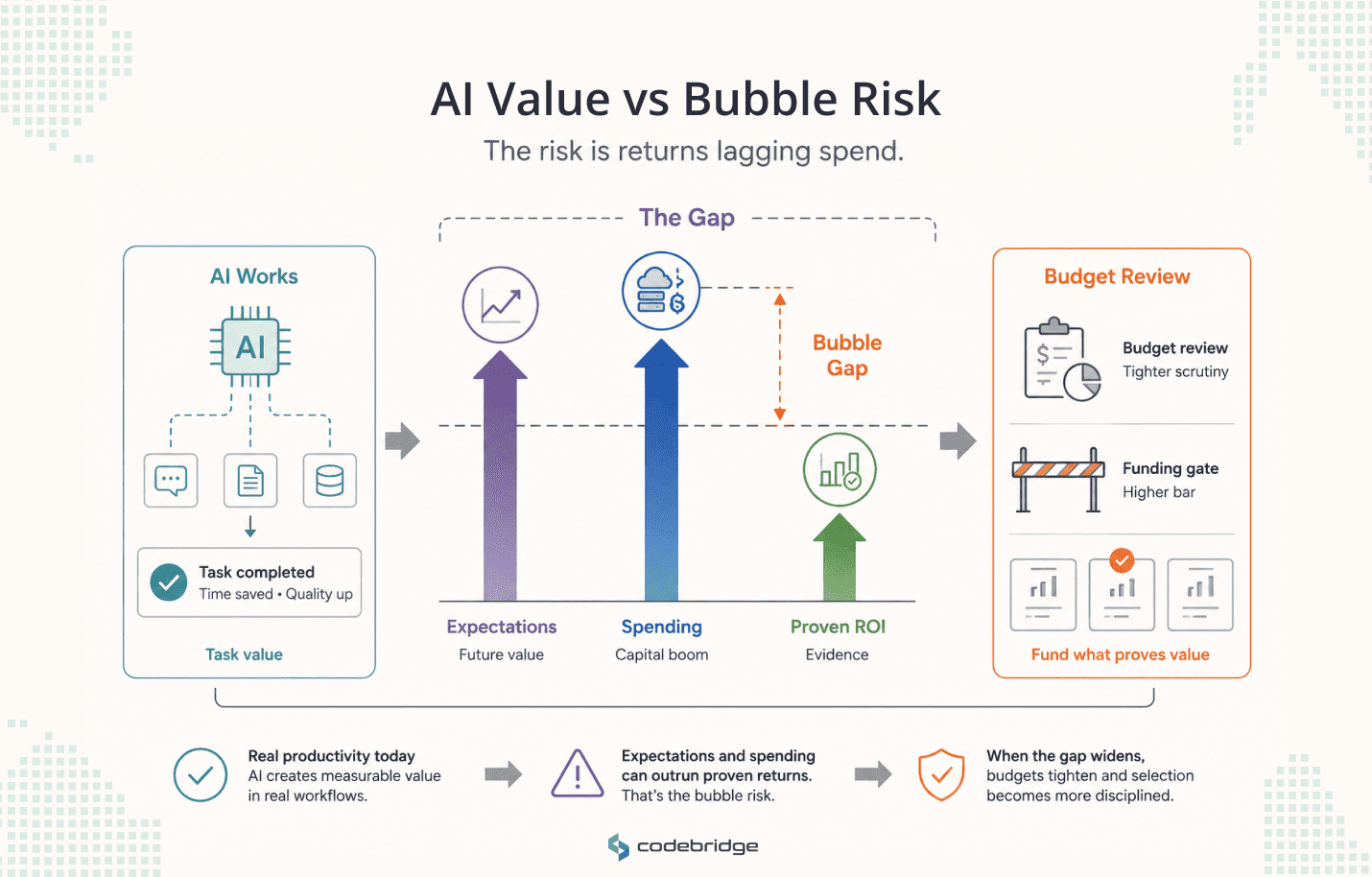
The spending numbers explain why the question carries weight. In its Annual Economic Report 2026, the Bank for International Settlements estimated that the five largest hyperscalers are set to spend over one trillion dollars on AI-related capital spending from 2025 through 2026 combined. The BIS noted that these commitments are outpacing the earnings and free cash flow of those firms, leading some to issue debt to cover the difference. It warned that a disappointment in returns could trigger a pullback in financing and turn the capital boom into a longer investment bust.
The BIS is the central banks' central bank, a body that coordinates monetary authorities, not a short seller. When an institution of that kind places AI spending in the same category as earlier infrastructure manias, the conversation stops being speculative.
For a CEO, the macro forecast matters less than one practical consequence. The funding environment around AI can tighten, and that tightening reaches internal budgets.
Why is the Conversation Rising Now
Three forces put this question on the table at the same time.
The first is capital intensity. AI has moved out of software subscriptions and into data centers, chips, electricity, and multi-year cloud contracts. That kind of spending commits a company for years and lands on the balance sheet in ways a SaaS license never did.
The second is a delayed enterprise return. Companies adopted AI at speed, and many have yet to convert experiments into measurable enterprise value. The distance between adoption and proof is where budget risk collects.
The third is narrative fatigue. The market question has shifted from "who is using AI?" to "who is getting measurable returns from AI?" Rising public interest in the bubble, visible in the search trend, signals that skepticism has become measurable rather than anecdotal.
High hyperscaler spending ties market expectations to a future payback that has not yet landed. Many enterprise initiatives remain hard to measure, so internal budgets need firmer evidence to survive review. Together, these pressures push AI spend from the innovation column toward operating discipline, and that is where weak projects become harder to defend.
Adoption is rising, and confidence is becoming selective
The data shows both sides of the tension. McKinsey's State of AI 2025, published in November 2025, found that 88% of organizations regularly use AI in at least one business function, up from 78% a year earlier. Adoption is close to universal. The value picture is thinner. About one-third of organizations have begun scaling AI across the enterprise, and only 39% report any enterprise-level EBIT impact from AI, with most of those putting that impact below 5%.
IBM's 2025 CEO Study, which surveyed 2,000 CEOs, points in the same direction from a different angle. Over the past three years, CEOs reported that only 25% of AI initiatives delivered the ROI they expected, and only 16% scaled enterprise-wide.
The two studies measure different things: one, the share of firms seeing bottom-line impact, the other, the share of initiatives meeting ROI expectations. They agree on the shape of the problem. Usage is high. Proven return is scarce.
Skeptical investors and boards press on exactly this gap. Most metrics on a typical executive AI dashboard describe activity, and they leave the harder question, whether that activity produces defensible value, unanswered. The table below separates the two.
The leadership question is changing
For two years, the dominant question inside most companies was whether they were doing enough with AI. Boards asked about it. Competitors invited comparison. The pressure ran toward more pilots and faster adoption.
The question is turning into something more demanding: which AI investments can we defend if the market becomes more skeptical? Under a positive narrative, many projects survived with weak evidence because no one had a reason to challenge them. Under review, the labels stop protecting them. An "AI pilot" becomes a budget line with an owner attached. A "strategic experiment" has to name the strategy. A "productivity tool" has to show workflow impact rather than a demo. An "agent roadmap" has to account for authority boundaries, monitoring, and escalation paths.
The right response is discipline, not alarm. In a tighter cycle, projects with evidence behind them tend to keep their funding, and the ones resting on narrative tend to lose it.
What leadership should track
A better dashboard tracks defensibility, not activity alone. It starts with sentiment velocity, the speed at which the outside narrative around a technology changes. Search trends around "AI bubble" and "AI ROI," investor and board questions, customer objections about AI reliability, and internal questions from finance, legal, and security all move before the financials do. A CEO who watches sentiment velocity sees the review coming and prepares for it.
From there, four more areas turn confidence into something a leadership team can inspect.
A leadership team that can answer these five questions holds a defensible position regardless of where the market lands. One that cannot be exposed, whether or not a bubble turns out to be real.
What survives a confidence correction
The AI work that survives skepticism shares a set of traits, and none of them is the model itself. It sits inside a real workflow. It has a business owner accountable for the outcome. Its value can be measured. It has clean data access, defined system boundaries, production monitoring, human escalation, and enough architecture to scale past the pilot.
If your team is already investing in AI, the next useful step is not another broad discussion about tools. It is a closer look at which initiatives can be defended with real workflow value, clear ownership, and production-ready architecture.
At Codebridge, we help companies assess AI opportunities before they become expensive experiments, from workflow selection and technical feasibility to system boundaries, integration risks, and implementation planning.
Start with one AI initiative. Make sure it can survive a more skeptical room.














Heading 1
Heading 2
Heading 3
Heading 4
Heading 5
Heading 6
Lorem ipsum dolor sit amet, consectetur adipiscing elit, sed do eiusmod tempor incididunt ut labore et dolore magna aliqua. Ut enim ad minim veniam, quis nostrud exercitation ullamco laboris nisi ut aliquip ex ea commodo consequat. Duis aute irure dolor in reprehenderit in voluptate velit esse cillum dolore eu fugiat nulla pariatur.
Block quote
Ordered list
- Item 1
- Item 2
- Item 3
Unordered list
- Item A
- Item B
- Item C
Bold text
Emphasis
Superscript
Subscript