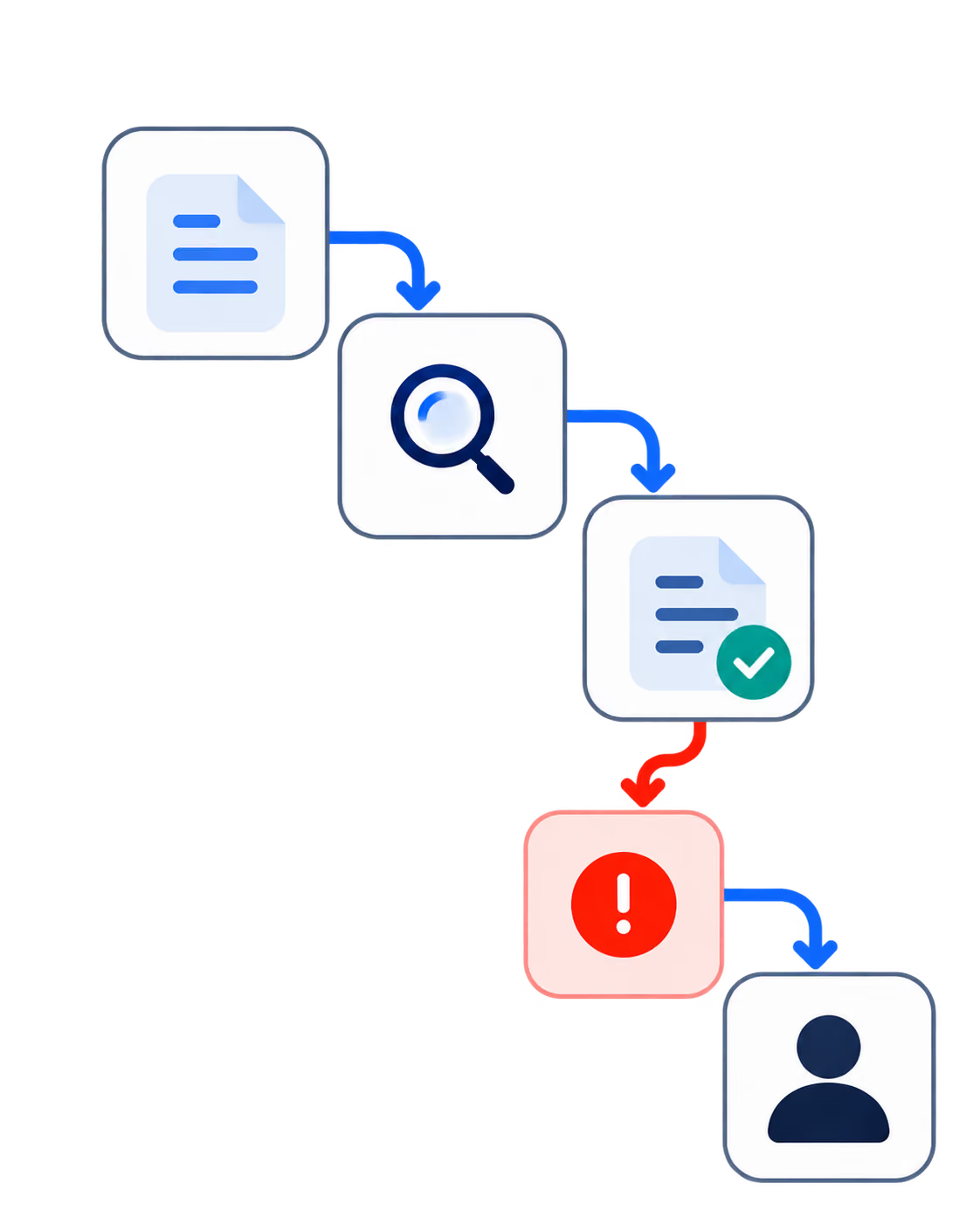
Intake gets a client to yes. Onboarding turns that yes into a matter ready for work, through five gates, most of them set by professional rules or by the client. What each gate requires, who clears it, a checklist, and what a system can check before a lawyer decides.
AI Answer Summary
Law firm client onboarding turns an accepted client into a matter ready for substantive work. Intake gets the client to yes and onboarding takes it from there. The two meet at the engagement letter.
Onboarding passes five gates. The firm accepts the client after clearing conflicts and making a risk-based inquiry. It agrees engagement terms in the form its state's rules require. It places any advance fee in the client trust account. It opens the matter, including the client's billing setup. And it agrees with the client how the matter will run.
Professional rules or the client set most of these gates, and a matter that moves past one before it is cleared creates a problem someone has to fix later. A system can hold a matter at each gate until the prerequisite is recorded. The decisions at each gate stay with lawyers.
What Is Law Firm Client Onboarding?
Law firm client onboarding is the process of turning an accepted client into a matter ready for substantive legal work.
Firms draw the line between intake and onboarding in different places, and the guides that rank for this topic disagree too. Some use "intake" for everything from the first enquiry to the opened matter. Others start onboarding at the signed engagement. This article uses a simple division: intake gets the client to yes, onboarding turns that yes into a working matter, and the two meet at the engagement letter.
Onboarding covers five things in order. Accepting the client, once conflicts and due diligence are done. Agreeing engagement terms in writing where the rules require it. Handling any advance fee correctly. Opening the matter, which for corporate clients includes setting up how they will be billed. And agreeing with the client how the matter will run.
The stages before that, meaning first contact, how much to ask a prospective client, and chasing missing documents, are covered in our guide to automated legal intake.
The Law Firm Client Onboarding Process: Five Gates Before a Matter Is Ready
A matter should not move to the next stage until the one before it is cleared, and professional rules or the client set most of the gates.
| Matter state | Must be true before moving on | Rule or source | Who clears it | What a system can check |
|---|---|---|---|---|
| Accepted | Conflicts cleared; a risk-based inquiry about the representation done | ABA Model Rule 1.7, comment [3]; Model Rule 1.16(a) | Responsible lawyer | The conflict review is completed and recorded; the inquiry questions are answered |
| Engaged | Engagement terms agreed in the form the state requires | Model Rule 1.5(b) and (c); New York Part 1215; California §6148 | Partner | The template matches matter type and state; required clauses are present; a contingency agreement is signed |
| Funded | Any advance fee deposited in the client trust account | Model Rule 1.15(c); ABA Formal Opinion 505 | Lawyer responsible for the trust account | The deposit is recorded to the client's trust ledger |
| Open | Matter record, team, access and billing configured | The client's billing guidelines and e-billing platform | Billing manager | The rate sheet is approved; timekeepers are registered; required codes are set; any screen is applied |
| Ready | File complete; communication agreed with the client | Model Rule 1.4 | Responsible lawyer | Required documents are received; contacts and first steps are sent |
Read the last two columns together. Each row ends in a decision a person makes, which is why the second-last column names someone. The last column is what a system can enforce: it can refuse to move a matter to the next state until the prerequisite is recorded, and send the matter back to whoever has to clear it.
The order matters because each gate produces what the next one needs. The acceptance decision tells the firm which client, which matter and which state it is dealing with, and that decides the engagement template. In some states, the engagement terms decide how the advance must be held. The client's billing rules, confirmed at engagement, decide how the matter is set up when it opens. Skip a gate and the next one runs on missing information.
The sections below take the gates in order.
Accepting a New Client: Conflicts and Client Due Diligence
Before accepting a client, a firm has to clear conflicts and, under the ABA's current model rule, make a risk-based inquiry about the representation.
The conflict check comes first. Comment [3] to Model Rule 1.7 expects reasonable procedures to identify the persons and issues in every matter, and our guide to law firm conflict checks covers what to search, when to run it again, and why checks miss conflicts.
Due diligence is the newer requirement. In August 2023 the ABA amended Model Rule 1.16(a) to require lawyers to "inquire into and assess the facts and circumstances of each representation" when deciding whether to accept or continue it. The commentary makes the inquiry risk-based: there is no single standard, and the depth depends on the risk that the client wants to use the lawyer's services for a crime or fraud. It builds on Formal Opinion 491, which had already described a duty to inquire when warning signs appear.
The rule asks for inquiry. A Colorado Supreme Court committee's account records that the ABA settled on "inquire" in place of "investigate" during drafting. It is also a model rule, so it binds a firm only where its state has adopted it.
How deep the inquiry goes is a lawyer's judgement. A system can make sure the questions were asked and the answers recorded before the matter moves on.
Engagement Letters: What the Rules Require Before Work Begins
Whether a written engagement letter is required depends on the state, the fee arrangement and sometimes the client, and a firm's templates have to account for all three.
What the ABA Model Rules Require
Model Rule 1.5(b) requires the scope of the representation and the basis or rate of the fee and expenses to be communicated to the client, preferably in writing, with any later change communicated too. Rule 1.5(c) is stricter for one arrangement: a contingent fee agreement must be in a writing signed by the client, stating how the fee will be calculated and how expenses will be treated.
New York: Part 1215 Letters of Engagement
New York has required written letters of engagement since 2002. The letter comes before the representation begins and covers the scope of services, fees, expenses and billing practices, and where applicable the client's right to arbitrate fee disputes. A significant change in scope or fees requires an updated letter. Exceptions include matters where fees are expected to be under $3,000, repeat services of the same kind the client has received and paid for, and domestic relations matters, which have their own rule.
California: Sections 6147 and 6148
California's Business and Professions Code §6148 requires a written contract where the client's total expense, including fees, will foreseeably exceed $1,000. Section 6147 sets separate requirements for contingency agreements. If a firm fails to comply, the agreement becomes voidable at the client's option and the firm is limited to a reasonable fee. The State Bar's instructions list the exceptions, and one of them is a client that is a corporation. Many of a mid-sized firm's corporate matters therefore fall outside §6148, while Rule 1.5(b) still prefers writing.
| When a written agreement is required | What it must cover | Main exceptions | If the firm fails to comply | |
|---|---|---|---|---|
| ABA Model Rules | Preferred for all fees; required for contingent fees | Scope, and the basis or rate of fees and expenses | None stated for contingency | A disciplinary matter |
| New York, Part 1215 | Before the representation begins | Scope; fees, expenses and billing practices; fee arbitration rights | Fees under $3,000; repeat services; domestic relations | Fee recovery can be put at risk |
| California, §6148 | Total expense foreseeably over $1,000 | The basis of compensation, the services, and each side's responsibilities | Corporate clients; emergencies; repeat services; written waiver | Agreement voidable; reasonable fee only |
For a firm working across states, this is a template problem before it is a drafting one: the system has to know which rule applies to which client before it can produce the right letter.
Handling the Retainer: Advance Fees and the Client Trust Account
Under the ABA model rule, fees and expenses paid in advance go into the client trust account and come out only as they are earned or incurred.
That is Model Rule 1.15(c), added in 2002. The ABA's Formal Opinion 505 adds a point about labels: calling an advance "nonrefundable" or "earned upon receipt" does not take it out of trust, and a flat fee paid before the work is done is still an advance that belongs to the client until it is earned.
States vary the rule, and the variations are what connect this gate to the last one. South Carolina, Louisiana and North Dakota, in a version effective April 2026, tie the handling of advance fees to a written fee agreement under their Rule 1.5(f). Pennsylvania allows different handling where the client gives informed consent, confirmed in writing.
In those states, how the engagement letter describes the fee decides how the retainer has to be handled. The two gates cannot be cleared independently, which is why a workflow that drafts the letter and a separate one that records the payment, with nothing connecting them, can produce a letter and a deposit that disagree.
Our guide to trust account reconciliation covers what happens to the money after it arrives.
Opening the Matter: Team, Access and the Client's Billing Setup
Opening the matter is also where the firm decides whether its first invoice to a corporate client will be accepted.
The standard items come first: the matter record, the responsible lawyer and team, the document workspace, and access permissions. If a lawyer who joined from another firm must be screened from the matter, the screen goes in at opening, and our guide to lateral hire conflict checks covers when screens are allowed.
For corporate clients, opening the matter also means setting up how they will be billed:
- Rate sheets. Thomson Reuters' Legal Tracker, a widely used e-billing platform, can only audit an invoice's rates against an approved timekeeper rate sheet. Submitting the rate sheet for approval belongs at opening
- E-billing registration. Timekeepers registered on the client's platform before they record time on the matter
- The client's guidelines. Loaded into the firm's own checks from the first entry. Some limit rate changes: the University of Missouri caps increases at 3%
- Codes. Whether the client requires UTBMS task and activity codes, so timekeepers use them from the first day
A firm that skips these usually finds out when the first invoice comes back. Our guide to legal billing guidelines covers what clients' rules contain and how their systems apply them.
Client Kickoff: Agreeing How the Matter Will Run
The kickoff sets up the communication the rest of the matter depends on, and the rules expect it.
Model Rule 1.4 requires a lawyer to consult the client about the means of reaching their objectives, keep them reasonably informed about the status of the matter, comply promptly with reasonable requests for information, and explain matters enough for the client to make informed decisions. A matter that starts without agreeing how that will happen tends to generate the same questions repeatedly.
Four things to agree at kickoff:
- Who the contacts are on both sides, and who decides what at the client
- How updates will come, and how often
- What the first steps are, and when they will happen
- What the client still needs to provide, and by when
The last item is where onboarding meets file completeness, which our intake guide covers in detail.
Law Firm Client Onboarding Checklist
Grouped by gate, one line per item, so it can be copied into a firm's own process.
Accepted
- Conflict review completed and recorded
- Risk-based inquiry about the client and matter done and recorded
- Acceptance decision recorded with the responsible lawyer's name
Engaged
- The state's written-agreement rule checked for this client and fee
- Template selected for the matter type and fee arrangement
- Scope and fee basis stated
- Contingency agreement signed by the client, where applicable
- Fee arbitration notice included, where required
- Letter issued, or agreement signed
Funded
- Advance fee amount and handling stated in the engagement terms
- Deposit made to the client trust account, where required
- Deposit recorded to the client's trust ledger
Open
- Matter record created; team and access set
- Screen applied, where needed
- Rate sheet submitted and approved
- Timekeepers registered on the client's e-billing platform
- Client billing guidelines loaded; required codes confirmed
Ready
- Required documents received
- Contacts confirmed on both sides
- Update schedule agreed
- First steps and dates sent to the client
Adapt it to your own states and practice areas, since several items depend on both.
What to Automate in Client Onboarding, and Which Exceptions to Plan For
Automate the movement between gates and the checks at each one, leave the decisions with lawyers, and design the workflow for what goes wrong.
The useful automation sits in the last column of the gate table. Carry client and matter data between systems, so nobody types it twice. Select the engagement template from the matter type and the state. Check that required fields and clauses are present. Hold the matter at a gate until its prerequisite is recorded. Send requests and reminders, and create the standard tasks for a new matter. Accepting the client, clearing a possible conflict, approving unusual terms and setting scope stay with lawyers.
A workflow that only handles the clean case still leaves people chasing each other. These are the exceptions worth designing for:
| Exception | What the workflow does | Who acts |
|---|---|---|
| A required field is blank | Pauses and requests it | Intake team |
| The client's name differs across documents | Pauses for confirmation | Intake team, then the responsible lawyer |
| The conflict search returns possible matches | Escalates for review | Conflicts reviewer |
| The matter needs non-standard engagement terms | Escalates for approval | Partner |
| Scope changes after the letter is sent | Pauses, and prompts an updated letter where the state requires one | Partner |
| The letter is signed but the advance has not arrived | Holds the matter at "Engaged" | Billing |
| Several legal entities need onboarding together | Treats each entity's details and authority separately | Responsible lawyer |
Each row answers the same three questions a workflow has to settle before it can be trusted: proceed, pause or escalate, and to whom.
How Codebridge Builds Client Onboarding Workflows
We build three workflows that cover the onboarding gates:
- Intake and conflicts screening, which structures the client and party details and prepares the conflict review package up to the acceptance decision
- Engagement letters, which select the right template for the matter type and state, check required fields and clauses, and route the letter for partner approval and signature
- Billing guideline checks, which set up the client's rate sheet, e-billing registration and rules when the matter opens
Together they hold a matter at each gate until its prerequisite is recorded, and log every decision along the way. One workflow goes live in three weeks, wired into the systems the firm already runs, and your firm owns the repository, the prompts and the configuration from day one.
We are not counsel. Accepting clients, clearing conflicts and agreeing terms stay with the firm's lawyers.
The closest reference we can offer, labelled for what it is: Knowledge Cloud, built for a Big Four tax and legal practice, runs an expert review queue with an immutable audit log, so a senior practitioner approves each output before the firm acts on it. A research platform rather than an onboarding system. What it demonstrates is the review pattern.
Our founding team spent more than a decade at KPMG.
If you want to find which gate is holding your new matters up, book a 20-minute call.
What is law firm client onboarding?
The process of turning an accepted client into a matter ready for substantive work. It covers accepting the client after conflicts and due diligence, agreeing engagement terms, handling any advance fee, opening the matter including billing setup, and agreeing with the client how the matter will run.
What is the difference between client intake and client onboarding?
Firms use the terms differently. A useful division is that intake gets a prospective client to yes, through first contact, screening and the conflict check, while onboarding turns that yes into a working matter. The two meet at the engagement letter, which closes intake and opens onboarding.
Is a written engagement letter required?
It depends on the state and the fee. ABA Model Rule 1.5 prefers writing and requires it for contingent fees. New York requires a letter of engagement unless an exception applies, such as fees under $3,000. California requires a written contract above $1,000 of foreseeable expense, with exceptions including corporate clients.
Where should a law firm deposit a client's retainer?
Under ABA Model Rule 1.15(c), fees and expenses paid in advance go into the client trust account and are withdrawn only as earned or incurred. Formal Opinion 505 says labelling an advance nonrefundable does not change that. Some states allow different handling under a written agreement or informed consent.
What should a law firm client onboarding checklist include?
Items for each gate: conflicts and due diligence recorded at acceptance; the correct written terms at engagement; any advance deposited in trust; the matter record, team, access, rate sheet, e-billing registration and billing codes at opening; and agreed contacts, updates and first steps at kickoff.
What is client due diligence for law firms?
Under ABA Model Rule 1.16(a) as amended in August 2023, a lawyer must inquire into and assess the facts and circumstances of each representation before accepting or continuing it. The inquiry is risk-based, scaled to the risk of misuse. It applies where a state has adopted the amended rule.
What parts of client onboarding can be automated?
Moving data between systems, selecting templates by matter type and state, checking required fields and clauses, holding a matter at a gate until its prerequisite is recorded, and sending requests and reminders. Accepting clients, clearing conflicts, approving unusual terms and setting scope stay with lawyers.
















Heading 1
Heading 2
Heading 3
Heading 4
Heading 5
Heading 6
Lorem ipsum dolor sit amet, consectetur adipiscing elit, sed do eiusmod tempor incididunt ut labore et dolore magna aliqua. Ut enim ad minim veniam, quis nostrud exercitation ullamco laboris nisi ut aliquip ex ea commodo consequat. Duis aute irure dolor in reprehenderit in voluptate velit esse cillum dolore eu fugiat nulla pariatur.
Block quote
Ordered list
- Item 1
- Item 2
- Item 3
Unordered list
- Item A
- Item B
- Item C
Bold text
Emphasis
Superscript
Subscript