In professional services, realization rate measures how much of the value of billable work reaches a client invoice. If your team records $60,000 of time at standard rates and you bill $51,000, your billing realization is 85%.
Most firms see that number at prebill review or month-end. By then, the decisions behind it are weeks old: an engagement that ran over budget without a flag, a scope change the team never priced, junior hours that piled up on a fixed fee.
You'll find the realization rate formula below, along with the difference between billing, collection and overall realization, 2023 benchmarks for accounting and law firms, and five engagement signals that warn you before a write-down reaches the invoice.
What Is Realization Rate?
Realization rate is the share of billable work, valued at your standard rates, that you bill and collect. Firms report it by timekeeper, partner, client, engagement, practice group and office, as AccountingTools notes in its definition.
The metric matters because the cost lands on your books before the revenue does. You paid your people for every hour in the calculation. If realization drops, you keep the full cost and lose part of the fee.
Two points shape how you read the number. First, standard rates are your own price list, so realization measures billing against targets your firm set. Two accounting academics writing in The CPA Journal argue that standard rates work as revenue goals rather than prices. Second, strategy consultants use a different term, "value realization," for the business benefits a project delivers. This article uses the professional-services billing definition.
How to Calculate Realization Rate
Billing realization rate = Amount billed ÷ (Hours worked × Standard rate) × 100
Say an audit team logs $60,000 of time at standard rates. After prebill review, the partner bills $51,000.
$51,000 ÷ $60,000 × 100 = 85%
Some firms calculate realization on hours instead: hours billed divided by hours worked. The dollar version catches more. A negotiated discount, a rate override or a fee cap changes the dollars on an invoice without changing a single hour, so an hours-only view can show 100% while the fee shrinks.
To roll engagements up into a partner or firm figure, add the dollars first and divide once. Suppose one engagement realizes 60% on $20,000 of time and another realizes 92% on $400,000. A simple average of the two percentages gives 76%. The weighted figure, $380,000 billed on $420,000 of time, is 90.5%, and that is the number your firm earned.
Billing Realization vs. Collection Realization vs. Overall Realization
Billing realization stops at the invoice. Collection realization starts there. Overall realization covers the whole path from recorded time to cash, and ABA Litigation News uses the same three-part split for law firms.
Collection realization = Amount collected ÷ Amount billed × 100
Overall realization = Amount collected ÷ (Hours worked × Standard rate) × 100
For a matched set of invoices, overall realization equals billing realization multiplied by collection realization: 85% × 95% gives 80.75% for the audit, and 89% × 96% gives 85.44% for the matter.
Use the split to decide where to look. A billing loss points to scope, staffing or time capture. A collection loss points to client payment behavior and credit risk.
The Four Stages Where Law Firms Lose Rate
Thomson Reuters breaks the path from standard rate to cash into four stages: standard rates, worked realization after negotiated discounts, post-work realization after write-downs and write-offs, and collected revenue. In its analysis of 195 US law firms, firms with disciplined pricing held worked realization near 95%, while firms that gave deep up-front discounts fell to 75% to 80%.
For a COO, the model separates two losses that most reports merge. A discount agreed when the engagement starts and a write-down at prebill have different causes and different owners. Accounting firms see the same split between fee quotes set below standard and write-downs at billing.
What Is a Good Realization Rate?
Most published benchmarks for mid-size and large firms fall in the 80s. Your own target depends on which version of realization you measure, how you price and what mix of work you do.
Accounting firms
The 2023 Rosenberg Survey, based on 2022 data and reported by The CPA Journal, shows lower realization in larger size bands: 85.9% for firms over $20 million in net fees, against 93.1% for firms between $2 million and $5 million. The survey exhibit doesn't state which version of realization it uses, so compare your own figure with care.
Higher isn't always better. Marc Rosenberg told the Journal of Accountancy that a blend of 85% to 88% suggests a firm has set its fees well. A firm at 100% with no client pushback is likely underpricing.
Law firms
Am Law 100 firms averaged 80.93% realization in 2023, down from 83.11% in 2021, according to The American Lawyer's survey as reported by ABA Litigation News. Those firms are far larger than most mid-market practices, so read the figure as a trend.
Thomson Reuters adds a caution against chasing a single number. It sorted firms into three groups with very different discount and write-off habits, and all three collected between $553 and $580 per hour.
Start with your own history. Industry figures give you a range. Your trend by client, partner and practice shows you where the problem sits.
Realization Rate vs. Utilization Rate vs. Collection Rate
Utilization tracks time, realization tracks value, and collection tracks cash.
A firm can post strong utilization and weak realization in the same month: busy people, discounted invoices. Each metric needs the other two for context. In the 2023 Rosenberg Survey, CPA firm utilization ran between 54.1% and 57.1% across size bands, which shows how much available time never reaches the billable column.
Why Realization Rates Fall
Most realization loss starts during the engagement, when effort drifts away from the fee. Your partners see it weeks later at prebill.
Four patterns deserve extra attention.
Unbilled work waits longer than most leaders expect. In the 2023 Rosenberg Survey, CPA firms carried 2.2 to 2.7 months of receivables plus WIP across size bands. Older WIP is harder to defend on an invoice and harder to discuss with a client who has forgotten the work.
Reported realization can hide loss. Mark Nickerson and Linda Hall describe staff under realization pressure who leave hours off one job and pad another to hit chargeable-hour goals. The engagement's realization looks fine, and the cost sits in unrecorded time.
Attribution gets blurred. AccountingTools recommends charging inefficiency-driven adjustments to the team and pricing or relationship concessions to the billing partner. A firm that lumps both into one write-down figure can't tell which problem it has.
Clients push back harder. ABA Litigation News lists client pushback and negotiated discounts among the main drivers of falling law firm realization, along with late or inaccurate time and delayed billing.
Realization Rate Is a Lagging Indicator
By the time realization appears in a report, your partners are deciding how much value to write off. The chance to prevent the loss passed weeks earlier.
Picture two engagements three weeks before prebill. An audit has used 70% of its fieldwork budget with 45% of procedures complete. A litigation matter has spent most of its discovery budget, and depositions haven't started. You won't see either problem in a realization report yet, because neither has reached an invoice.
At prebill, the partner has three options: write the excess down, bill it and absorb the client's pushback, or call the client about scope after the work is done. Each one costs more than a scope conversation in week three.
Joseph Tarasco, CEO of Accountants Advisory Group, made the same point in the Journal of Accountancy. Once billing falls months behind the work, the firm loses its window to charge for out-of-scope effort. His fix is to watch WIP and receivables throughout the year and bill as soon as the work is complete.
You don't need new data to act earlier. The warning signs sit in the time, budget and billing records your firm already keeps.
Five Leading Indicators of Realization Risk
Five signals in your time, budget and billing data can flag a write-down before prebill.
1. Budget burn vs. progress. Compare the share of budget used with the share of work complete. An audit that has used 70% of its fieldwork budget with 45% of procedures signed off is heading for a write-down, and so is a matter that has spent its discovery budget before depositions. Set your own trigger. One example rule: flag any engagement where budget use runs 20 points ahead of completion.
2. WIP growth and age. Track unbilled WIP against the billing plan and count the days since the work happened. Growing WIP on a fixed-fee tax return means effort is outrunning the fee. Unbilled time on a matter past its billing milestone gets harder to defend with every week it waits.
3. Staffing mix and effective rate drift. Compare hours by staff level with the staffing plan, and compare value per hour with the rate you expected. Thomson Reuters found that law firms discount associate time less up front, with 91.5% worked realization for associates against below 90% for partners, because firms write off more associate time later. Associate or staff hours that outgrow the plan give you advance notice of that write-off.
4. Repeat write-down patterns. Group past write-downs by client, partner, service line and task code. If the same partner trims the same service line every year, or the same client disputes the same task codes on every invoice, you can predict the next write-down and deal with it in the fee quote or the engagement letter.
5. Time-entry anomalies. Watch for entry lag, missing days and hours far below plan on active work. Bulk entries at month-end point to reconstruction from memory. Hours missing from a busy engagement can mean unrecorded effort, which makes reported realization look better than the engagement's economics.
How to Improve Realization Rate Before Billing
Set the budget before the work starts, check it while the work runs, and act on drift before prebill.
- Budget each engagement by phase, with planned hours by staff level. A phase budget gives your team a baseline to check against in week three.
- Review WIP weekly or at phase gates. A month-end review finds problems after the month's work is done.
- Agree a scope-change trigger. When budget use passes the trigger, the engagement lead calls the client before the team does more work. In an accounting firm, the trigger might be the third entity added to a tax engagement. In a law firm, it might be a motion outside the agreed phase.
- Bill at milestones or on completion. Billing an audit phase when it finishes, or a matter phase when it closes, keeps the work fresh for the client and keeps your window open to price extra scope.
- Code every write-down with a reason. Separate pricing decisions from inefficiency so the partner and the team each see their own share.
- Review patterns each quarter by client, partner and service line, and carry what you find into next year's fee quotes.
A COO can run these checks by hand on the ten largest engagements. Across several hundred open engagements, the checks slip, and partners meet the losses for the first time at prebill.
How AI Changes Realization Monitoring
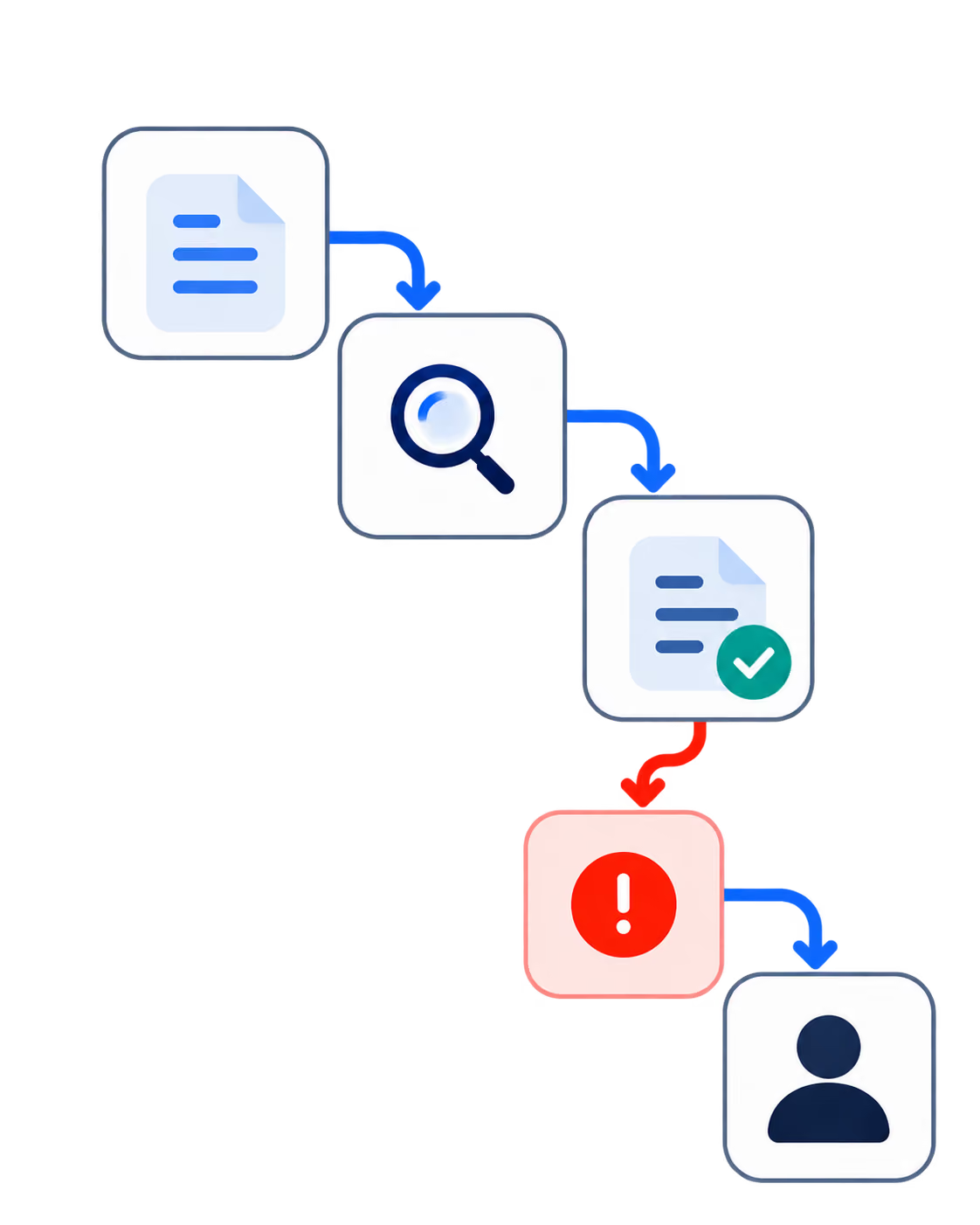
Partners read a realization report to learn what happened last month. A monitoring agent checks the inputs to realization every day and flags an engagement while your team can still change the outcome.
The agent reads five data sets your firm already holds: time entries, engagement budgets, WIP balances, billing history and past write-downs. It compares each open engagement with its budget, staffing plan and billing milestones, then sends the engagement lead a flag with the signal and the numbers behind it.
In an accounting firm, a flag might read: this audit has used 72% of its fieldwork budget with 48% of procedures signed off, and staff hours are running 30% above plan. In a law firm: this matter has used most of its discovery budget, and its oldest unbilled time is 45 days old.
People make every pricing and write-down decision. The agent finds the engagement and lays out the evidence, and the partner makes the call. It connects to the practice management and billing systems you run today, so your team keeps its current workflow.
Codebridge builds the WIP & Realization Monitoring Agent around your firm's budgets, rate structure and review cadence. We scope each build as a fixed-price engagement, and your firm owns the code.
To see where realization loss starts in your own engagements, book a 15 to 20 minute call with our team. We'll walk through how your budget and WIP data flows today and which early-warning signals it can support.
Frequently Asked Questions
















Heading 1
Heading 2
Heading 3
Heading 4
Heading 5
Heading 6
Lorem ipsum dolor sit amet, consectetur adipiscing elit, sed do eiusmod tempor incididunt ut labore et dolore magna aliqua. Ut enim ad minim veniam, quis nostrud exercitation ullamco laboris nisi ut aliquip ex ea commodo consequat. Duis aute irure dolor in reprehenderit in voluptate velit esse cillum dolore eu fugiat nulla pariatur.
Block quote
Ordered list
- Item 1
- Item 2
- Item 3
Unordered list
- Item A
- Item B
- Item C
Bold text
Emphasis
Superscript
Subscript