Supply chains test agentic AI harder than most enterprise domains. The workflows are structured but exception-heavy. The data spans dozens of internal and external systems. Errors carry direct financial consequences: missed service levels, excess inventory, broken customer commitments. If an autonomous system can operate reliably here, it can probably operate anywhere.
The market reflects that. Gartner forecasts that spending on supply chain management software with agentic AI will reach $53 billion by 2030. That figure signals where enterprise budgets are moving, and it means your competitors, suppliers, and logistics partners are evaluating the same technology.
The question for technical leaders is whether a given deployment will succeed or fail. For teams evaluating agentic AI development for supply chain use cases, the answer depends less on model selection and more on data infrastructure, governance design, and where you start.
This article breaks down where agentic AI delivers measurable results in supply chain operations, where it introduces new risks, and what technical and governance conditions you need before scaling beyond a pilot.
What Agentic AI in Supply Chain Actually Means
Most supply chain software that gets labeled "AI-powered" falls into one of two categories. The first is traditional automation: rule-based logic that executes predefined steps in stable, repeatable workflows. It works well for structured tasks but breaks when inputs shift or exceptions pile up, which in global supply chains happens constantly. The second is the AI assistant or copilot: a model that answers questions or summarizes data on demand but has no role in the workflow itself. It waits to be asked.
Agentic systems are different, as they control their own process. Instead of following a hardcoded sequence or responding to a prompt, an agent evaluates context, selects tools, and determines its next action based on the task it was given. That shift from "execute this path" to "figure out how to accomplish this goal" is what separates agentic behavior from everything that came before it.
In a supply chain context, a system qualifies as agentic when it can do four things together:
- Monitor operational signals across internal systems (ERP, WMS, TMS) and external sources (supplier feeds, logistics carriers, market data) without waiting for a human to pull a report.
- Reason about trade-offs given company-specific constraints. For example, deciding which customers to prioritize during a capacity bottleneck based on margin contribution, contractual obligations, or strategic importance.
- Take or recommend bounded actions, such as triggering a replenishment order, rerouting a shipment, or drafting a supplier communication, within clearly defined authority limits.
- Escalate when confidence drops. When the situation falls outside the agent's training data, policy boundaries, or confidence thresholds, it surfaces the decision to a human rather than guessing.
If a system cannot do all four, it is either an automation script or a chatbot with better branding. The distinction matters because the governance, integration, and failure modes for agentic systems are fundamentally different from those of both.
Where Agentic AI Creates Real Value Across the Supply Chain
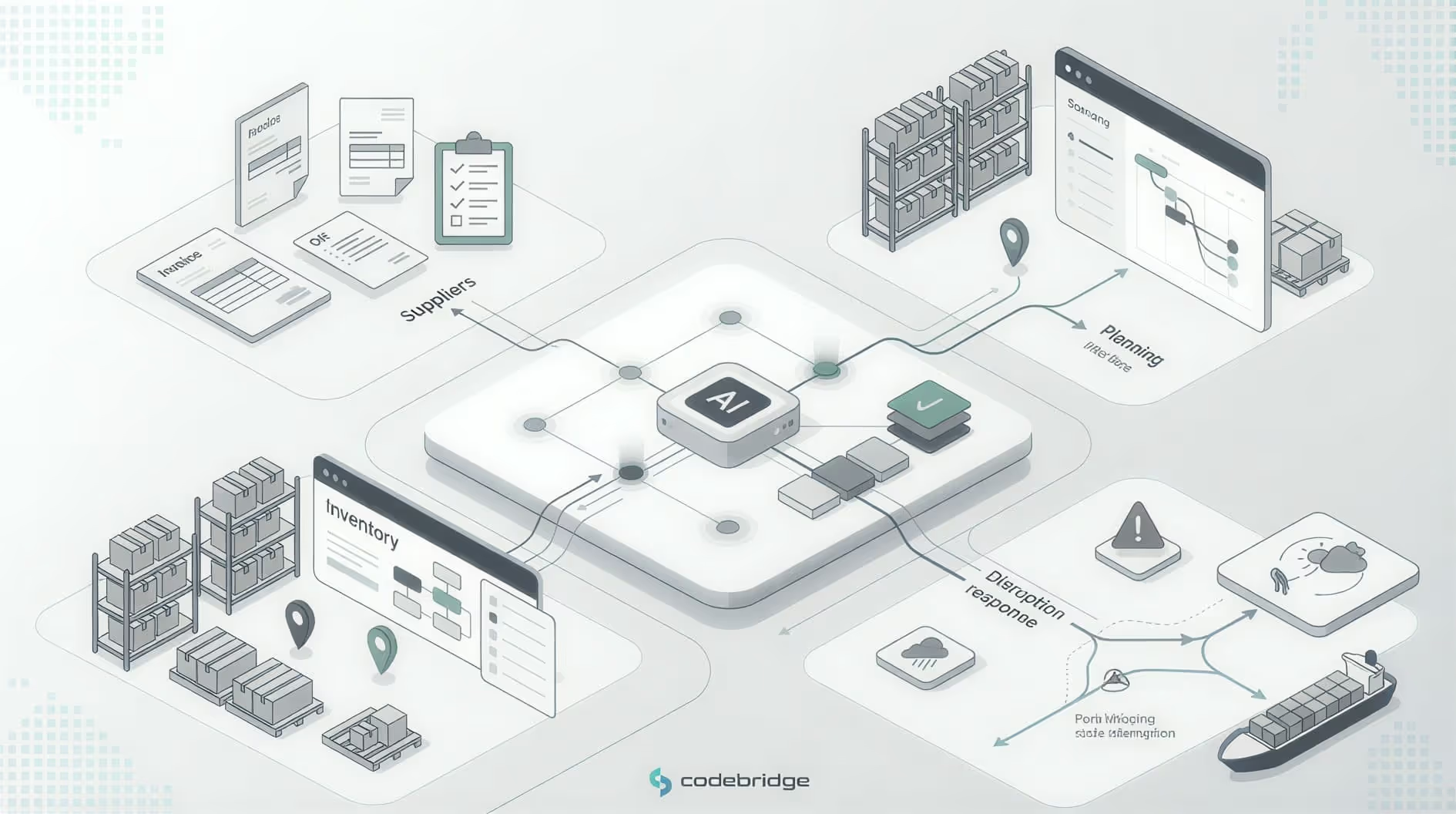
Agentic AI pays off in workflows that share three properties. They are exception-heavy, they require coordination across multiple systems or teams, and delays in them carry direct financial cost. Generic automation handles the steady state. Agents earn their complexity budget when the steady state breaks.
IBM’s recent survey supports this, saying that organizations with higher AI investment in supply chain operations see revenue growth 61% greater than their peers. That number reflects AI investment broadly, not agentic systems alone, but it establishes the financial ceiling for what supply chain AI can drive when the implementation is right.
Procurement and Supplier Coordination
Document handling still consumes 10–20% of a logistics coordinator's workload. Invoices arrive through multiple channels in inconsistent formats and need to be extracted, normalized, and matched against purchase orders and receipts. Specialized agents can now perform this matching with 100% numerical accuracy, which eliminates one of the most time-intensive manual reconciliation tasks in procurement.
But the more interesting application is upstream. When your team onboards a new supplier, an agent can evaluate that manufacturer against your risk profiles, compliance requirements, and existing supplier mix before a human reviewer gets involved. The agent doesn't replace the sourcing decision. It compresses the evaluation cycle so your procurement team spends time on negotiation and strategy rather than data gathering.
Inventory and Replenishment Exceptions
Inventory management is shifting from static rules to dynamic optimization based on real-time signals. Multi-agent systems can now determine optimal ordering policies and adapt to diverse supply chain scenarios, such as sudden demand surges or transportation lead-time shifts.
By leveraging historical transaction data via similarity matching, these agents can coordinate across tiers to mitigate the "bullwhip effect," in which small demand fluctuations at the retail level lead to massive upstream inventory imbalances. Early implementations, such as multi-agent space solvers, already use computer vision and reasoning to forecast spare-part storage needs and proactively mitigate stockout risks.
Planning and Re-planning Under Changing Conditions
Most supply chain planning still runs on a patchwork of tools: a demand planning system here, a capacity model there, spreadsheets bridging the gaps. Planners spend a significant share of their time translating between these systems rather than evaluating scenarios.
Agentic systems sit across these interfaces and let planners interact with the combined output through natural language. Instead of pulling data from three tools to answer "what happens if our Shenzhen supplier is two weeks late?", a planner can ask the question directly and get a scenario comparison that accounts for inventory positions, open orders, and downstream commitments. The value is in cycle time. Teams that can evaluate and act on a changed constraint in hours instead of days compound that advantage across every disruption they face.
Disruption Response
When a port closure, a geopolitical event, or a severe weather pattern threatens your supply network, the first bottleneck is usually information, not decision-making. Someone has to identify which suppliers are affected, trace the exposure through your multi-tier network, estimate the production impact, and surface alternatives. In most organizations, this analysis takes days.
Agentic architectures compress this to minutes. In one documented implementation, a framework of seven specialized agents performed end-to-end disruption exposure analysis, from monitoring unstructured news signals to mapping supplier-tier impact, in under four minutes. Each agent handled a distinct phase of the analysis (signal detection, supplier mapping, impact estimation, alternative sourcing), which made the system auditable and decomposable rather than a single black-box output. For a supply chain leader, the operational question is whether your team can respond to a disruption before your competitors do. That window is where agentic systems create separation.
Where It Breaks: The Trade-Offs, Risks, and Failure Modes
Supply chain operations punish architectural shortcuts faster than most domains. When you move from pilot to production with agentic systems, five failure modes recur.
Bad Data and Weak Context
An agent reasons over the data it can access. If your master data is inconsistent, your inventory levels lag reality, or your supplier records are stale, the agent will make confident decisions on wrong inputs. You get bad decisions faster, not better decisions. This is the most common failure mode and the least dramatic, which is why it gets underestimated.
Separately, these systems are expensive to run. High-parameter models consume significant GPU hours, and at scale, the inference cost can exceed the operational savings if you haven't scoped the cost model carefully.
Disconnected Legacy Systems
If your data lives in siloed systems with poor interoperability, the agent operates on partial truth. An agentic system needs a unified data estate, typically a supply chain data lake, to reason across the full set of real-world constraints. Without that, the agent cannot maintain a consistent picture of operational state and will fail to assess whether it's making progress toward its assigned task.
Autonomy Without Approval Logic
Every agentic system needs a clearly defined boundary between what it can recommend and what it can execute. Without bounded authority, stopping conditions, and iteration limits, you get an agent that takes self-directed actions outside the scope your team intended. This is an operational risk you introduce by design, not a bug. The fix is to define the agent's action space explicitly and tie each action tier (read, recommend, draft, execute) to an approval level before deployment.
Security and Cross-Tool Vulnerabilities
Once an agent acts across multiple tools, the attack surface changes. Four risks deserve specific attention.
- Agent Goal Hijacking: Hidden prompts turning agents into exfiltration engines.
- Tool Misuse: Agents bending legitimate operational tools into destructive outputs.
- Identity and Privilege Abuse: Leaked credentials allowing agents to operate beyond their intended scope.
- Supply Chain Vulnerabilities: Runtime components or third-party agent "skills" being poisoned by malicious actors.
Each of these requires a different mitigation, and standard application security frameworks don't cover them well yet.
What Technical and Governance Conditions Must Exist Before You Scale
A working demo is not evidence of production readiness. Most agentic supply chain pilots succeed in controlled conditions because the data is curated, the scope is narrow, and a human is compensating for gaps the system can't handle. Scaling exposes every gap the pilot obscured.
The timeline for that scaling is already here. In the same IBM survey, 70% of executives stated that by 2026, their employees would be drilling deeper into analytics as AI agents automate operational processes in procurement and dynamic sourcing. That expectation has now met its deadline. If you're planning to move agents into production workflows this year, the conditions below are not aspirational. They describe what your organization needs to have in place now.
Technical Conditions
Unified, fresh data access.
Your agent needs to read from ERP, WMS, TMS, and supplier systems as a single operational picture, not as separate queries stitched together in a pipeline. "Zero-copy" integration (where the agent queries live data rather than periodic exports) matters because agents act on what they see. Evaluate whether your current data infrastructure can serve a consumer who acts on data, not just one who displays it.
Event-Driven Signal Quality
Agents respond to events: a shipment delay notification, a supplier status change, a demand spike signal. If your systems emit events inconsistently, with missing fields, delayed timestamps, or duplicated messages, the agent's reasoning layer has no reliable foundation.
The bar here is higher than what a BI dashboard requires because the agent will take action based on these signals, not just surface them for a human to interpret.
Observability and Auditability.
You need to see what the agent did, what it considered, and why it chose a given action. This means logging the full chain: the input context, the planning steps, the tool calls, and the outcome. Without this, debugging a bad decision in production becomes guesswork.
Tiered Action Authority
Define what the agent can do at each level: read data, generate a recommendation, draft a communication, or execute a transaction. Tie each tier to a specific approval mechanism. An agent that can read inventory positions and recommend a reorder is a different risk profile than one that can place purchase orders against a supplier contract. Treat this like a permissions model, because it is one.
Infrastructure Boundaries
Decide where inference runs and where data stays. Many supply chain organizations handle sensitive supplier pricing, customer contracts, and demand forecasts that cannot leave their infrastructure.
A hybrid model, with on-premises data access and cloud-based inference, may be necessary, but it introduces latency and complexity you need to account for in your architecture.
Governance Conditions
Each governance area below maps to a specific class of failure that technical readiness alone won't prevent. Define these before your first production deployment, not after.
Choosing Your First Production Deployment
Start with a workflow that has three properties: the error rate is high enough to justify automation, the cost of a delayed response is measurable in dollars or SLA penalties, and a bad agent decision can be caught and reversed before it cascades. Document processing (invoice matching, PO reconciliation) fits well because the inputs are structured, accuracy is verifiable, and a mistake affects a single transaction. Exception resolution in warehouse operations works for similar reasons: high volume, clear success criteria, limited blast radius per error.
Avoid starting with workflows where the agent's decisions affect multiple downstream systems simultaneously or where reversal is expensive. Disruption response and logistics rerouting are high-value agentic use cases, but they're second-phase deployments. You want your team to build operational confidence with the system's behavior, its failure modes, and its observability tooling before you hand it decisions that propagate across your network.
Conclusion
The models are good enough. For most supply chain use cases where agentic AI applies, the bottleneck is not capability but readiness: whether your data infrastructure, governance structures, and operational workflows can support a system that acts on its own judgment within defined boundaries.
The companies that will extract value from agentic AI in the supply chain are the ones that treat it as an operational integration problem. They invest in unified data access, tiered authority models, and observability before they invest in more sophisticated agents. They start with high-exception, low-blast-radius workflows and expand only after their teams understand how the system behaves, how it fails, and how to correct it.
That discipline is the differentiator. Having an agent is straightforward. Knowing where to trust it, where to constrain it, and where to keep a human in the loop requires the kind of organizational and architectural work that no model can shortcut.














Heading 1
Heading 2
Heading 3
Heading 4
Heading 5
Heading 6
Lorem ipsum dolor sit amet, consectetur adipiscing elit, sed do eiusmod tempor incididunt ut labore et dolore magna aliqua. Ut enim ad minim veniam, quis nostrud exercitation ullamco laboris nisi ut aliquip ex ea commodo consequat. Duis aute irure dolor in reprehenderit in voluptate velit esse cillum dolore eu fugiat nulla pariatur.
Block quote
Ordered list
- Item 1
- Item 2
- Item 3
Unordered list
- Item A
- Item B
- Item C
Bold text
Emphasis
Superscript
Subscript