The Ticking Clock Nobody Wants on Their Roadmap
An indie AI developer scaled fast in early 2026, more users, more usage, more attention. Then came the gut punch: every new signup made the unit economics worse, not better. As one builder put it bluntly on Dev.to, "If growth makes your margins worse, you don't have a startup, you have a ticking clock." If you're shipping AI-adjacent product right now, that line probably stuck somewhere uncomfortable. We've watched it happen to design-tooling teams, internal-platform crews, and "AI feature" squads inside larger orgs. The compute got cheaper. The math didn't.
KEY TAKEAWAYS
The bottleneck has moved from writing code to validating it. Engineers who keep their use in 2026 are the ones defining what "correct" looks like, not the ones typing fastest.
Leader hesitation, not employee resistance, is the real AI adoption blocker. McKinsey's 2025 research flips the common narrative on its head.
Niche specialization is beating scale, a team of one focused on a vertical can out-execute a generic Silicon Valley competitor in 2026.
Unit economics are now a product design concern, not a finance afterthought. Compute is cheaper, not free.
Hype timelines and adoption timelines are not the same calendar. Regulated enterprises lag the trade press by years.
The Hidden Problem: Everyone's Reading the Same Headlines, Few Are Reading the Margin Sheet
The headline numbers are real. McKinsey pegs the long-term productivity opportunity from corporate AI use cases at $4.4 trillion, calling AI's arrival in the workplace as transformative as the steam engine. Deloitte's 2025 technology industry outlook describes a sector poised for growth on the back of IT spending and AI investment heading into 2026. Good news, broadly.
$4.4Tlong-term productivity opportunity from corporate AI use cases (McKinsey, 2025)
Here's the part the keynote slides skip. The same McKinsey research surfaces a counter-intuitive finding: the biggest barrier to scaling AI in the workplace isn't employees dragging their feet, it's leaders not steering fast enough. Meanwhile, on the technical side, scaling AI still bumps into stubborn realities around data labeling and supervised learning that McKinsey flagged years ago and that haven't gone away. Translation: the opportunity is enormous, the friction is real, and the people closest to the work usually feel both at once.
Real Stories From the Trench
Three stories from 2026 that map the terrain better than any market forecast. Consider the comparison below before we walk through them:
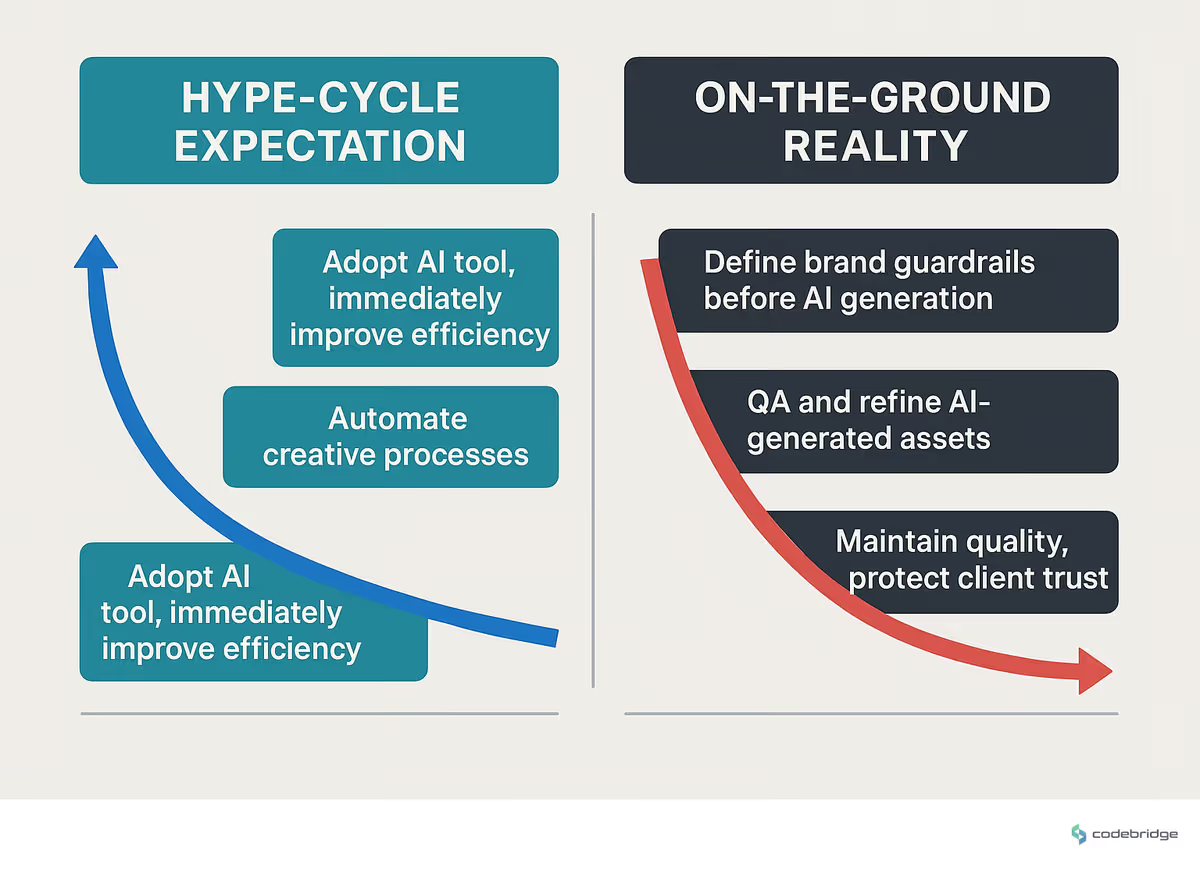
Hype-cycle expectation vs on-the-ground reality across indie AI builders, regional B2B teams, and regulated enterprises
Story one, the indie AI builder who scaled into a trap. A solo developer shipped an AI productivity tool in early 2026, riding the wave of cheaper inference. Three months in, growth was up and gross margin was down. The team's blog post on Dev.to dissected the autopsy: over-automating judgment-heavy steps destroyed user trust the moment the model misfired, and refunds plus support load swallowed the new revenue. The lesson the author landed on: in 2026 AI products, unit economics belongs in the product spec, not the spreadsheet.
"If growth makes your margins worse, you don't have a startup, you have a ticking clock." Compute is cheaper but not free, and over-automating judgment destroys trust the moment it breaks.
Jaideep Parashar, indie AI developer, writing on Dev.to
Story two, the regional team that won by getting smaller. A two-person indie shop in the Gulf South spent 2024-2025 trying to ship generic productivity apps against Silicon Valley incumbents. They lost. In late 2025 they pivoted hard into vertical B2B tooling for energy operators, regional logistics, and tourism. Six months later they were profitable. The author's framing on Dev.to is worth quoting: "A team of one can out-execute a large, generic competitor in these specific regional niches." In 2026 tooling, niche specialization is no longer a fallback strategy, it's the strategy.
Story three, the senior engineer who shed the keyboard. A senior engineer working alongside AI coding agents on production projects realized writing implementations was no longer the bottleneck. Validation and governance were. He repositioned himself as the architect-of-record for an agent fleet, building strict governance docs and review gates instead of typing functions. As shown in the workflow below, the value migration is structural, not cosmetic:
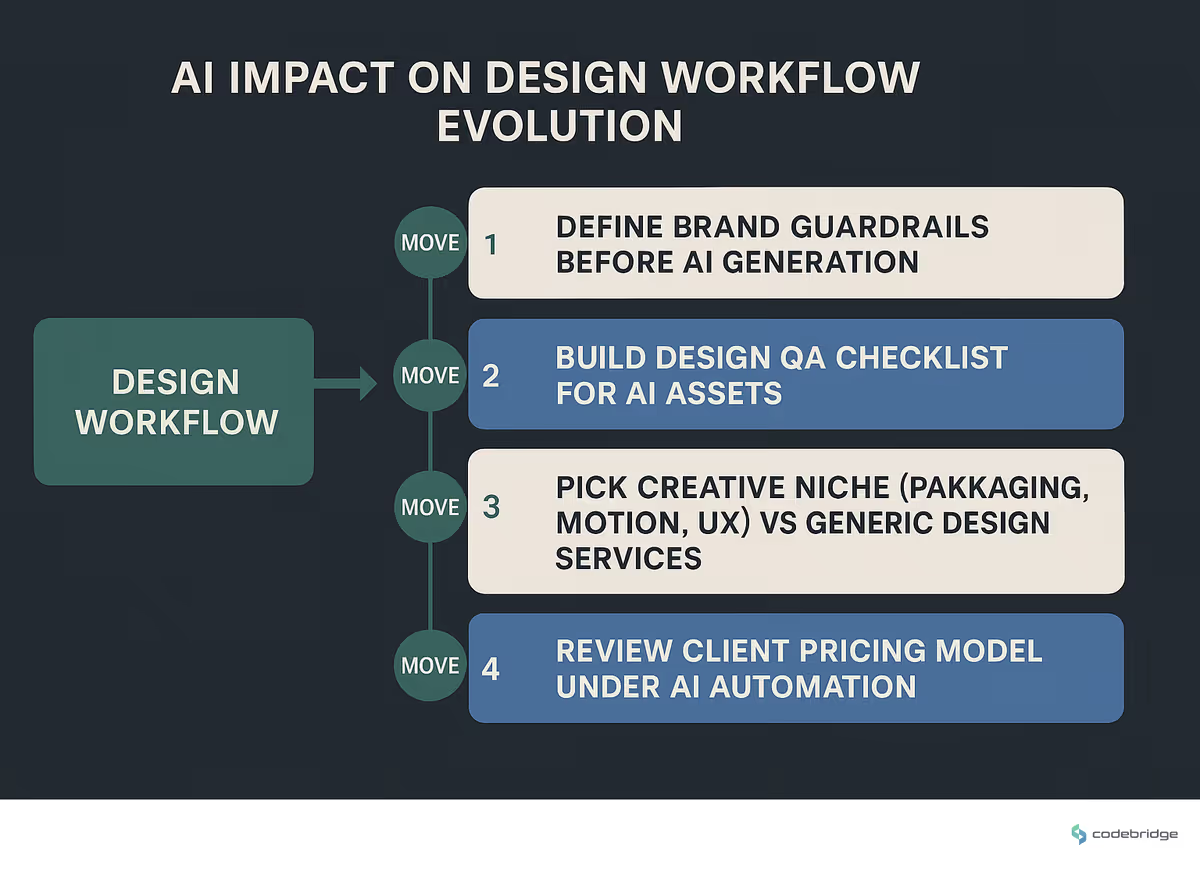
Developer value migration in 2026, from writing implementations to defining correctness, building validation, and governing agent output
"I have already personally shifted to more of an 'architect' position, I build strict governance documentation and lead a team of one or more agents through the development process."
Senior engineer, AWS community contributor on Dev.to
And then the counter-weight to all of this. A Fortune 500 engineer from the same Dev.to thread noted that friends in regulated industries only got Copilot access in the last three months. "The adoption tail is longer across regulated industries." Procurement, compliance review, security sign-off, all of it stretches the calendar by years. The hype cycle and the rollout cycle are not the same calendar.
The Pattern: What the Teams Holding Their Margins Are Doing Differently
Looking across the stories and the research, a pattern shows up. The teams keeping unit economics intact in 2026 treat AI as use on a narrow, expensive problem, not as a feature to bolt on broadly. They specialize before they scale. They invest in validation harnesses before they invest in agent fleets. And they read the adoption curve of their actual customer, not the keynote curve.
This tracks with what McKinsey Global Institute has flagged repeatedly: top-quartile analytics users in technology achieve meaningfully higher revenue growth, and the gap is widening as analytics prowess becomes the basis of industry competition. The compounding doesn't come from more tooling. It comes from sharper definition of what good looks like, and the discipline to measure against it.
From our work with technology teams: We've seen this pattern play out dozens of times in 2025-2026. The teams that hold their margins through an AI rollout aren't the ones with the biggest model budget. They're the ones who decided, before shipping, what counts as a correct output, what counts as a regression, and who owns the call when an agent gets it wrong. The ones who skipped that step are usually the ones now writing post-mortems.
One uncomfortable truth we've learned: Visual and design output suffers the same fate. When a creative pipeline over-automates judgment, brand decisions, layout calls, accessibility tradeoffs, trust collapses the first time something ships wrong. The fix is the same as engineering's: define correctness up front, gate the agent, and keep the human on the judgment-heavy steps.
Actionable Framework: Five Moves for the Rest of 2026
- Put unit economics in the product spec. Before adding an AI feature, write down the cost-per-successful-action and the breakeven volume. If growth makes that number worse, redesign the feature, don't just hope scale fixes it. (Source: Dev.to indie builder post-mortem.)
- Pick a vertical and go narrow. A focused B2B niche with five painful problems beats a generic horizontal tool with fifty shallow ones. The Gulf South case study is one data point; McKinsey's CMAC work with technology firms is another, analytics-driven niche focus correlates with above-market growth.
- Invest in validation before agent count. Write the governance doc, the eval suite, and the review gates before scaling from one agent to many. The senior engineer in the AWS community post moved from coder to architect because that's where the use went.
- Read your customer's adoption curve, not the keynote's. If your buyers are in regulated industries, finance, healthcare, energy, assume procurement and compliance add 12-24 months on top of the technical timeline. Price and plan accordingly.
- Push the leadership conversation, not the employee one. McKinsey's 2025 finding is unambiguous: employees are ready, leaders are the throttle. If you're a senior IC or engineering lead, the highest-use meeting this quarter is probably with your exec team about steering speed.
If you can't articulate what "correct output" looks like for your AI feature in one paragraph, you're not ready to ship it, and you're definitely not ready to scale it across an agent fleet.
Closing the Loop
Back to the indie builder watching their margins erode while their MRR climbed. The ticking clock wasn't the AI, it was the absence of a clear definition of when the AI was allowed to act, and what it cost when it did. That's the same clock ticking quietly inside a lot of 2026 roadmaps right now, including some that look healthy on the dashboard. The good news: it's a design problem, not a destiny. Pick the vertical. Define correct. Gate the agent. Then scale.
Wondering whether your AI rollout is on a growth curve or a ticking clock?
Talk to our team about pressure-testing the unit economics and governance model before you scale.
Diagnostic Checklist: Is Your AI Initiative on a Ticking Clock?
Your gross margin per active user has gotten worse, not better, over the last two release cycles
You cannot articulate, in one paragraph, what a "correct" output from your AI feature looks like
You have no automated eval suite gating model or prompt changes before they hit production
Your roadmap assumes regulated-industry buyers will adopt on the same timeline as the trade-press hype cycle
Leadership is waiting for "more employee readiness" before steering harder on AI, when employees are already ahead
Your product is generic-horizontal in a market where a focused vertical competitor could out-execute you with a team of one
Engineers on your team still measure their value by lines shipped, not by validation and governance authored
REFERENCES
Deloitte Insights: 2025 Technology Industry Outlook
McKinsey Global Institute: The Age of Analytics, Competing in a data-driven world
McKinsey: Driving impact at scale from automation and AI
McKinsey: Big Data, Analytics, and the Future of Marketing & Sales













Heading 1
Heading 2
Heading 3
Heading 4
Heading 5
Heading 6
Lorem ipsum dolor sit amet, consectetur adipiscing elit, sed do eiusmod tempor incididunt ut labore et dolore magna aliqua. Ut enim ad minim veniam, quis nostrud exercitation ullamco laboris nisi ut aliquip ex ea commodo consequat. Duis aute irure dolor in reprehenderit in voluptate velit esse cillum dolore eu fugiat nulla pariatur.
Block quote
Ordered list
- Item 1
- Item 2
- Item 3
Unordered list
- Item A
- Item B
- Item C
Bold text
Emphasis
Superscript
Subscript