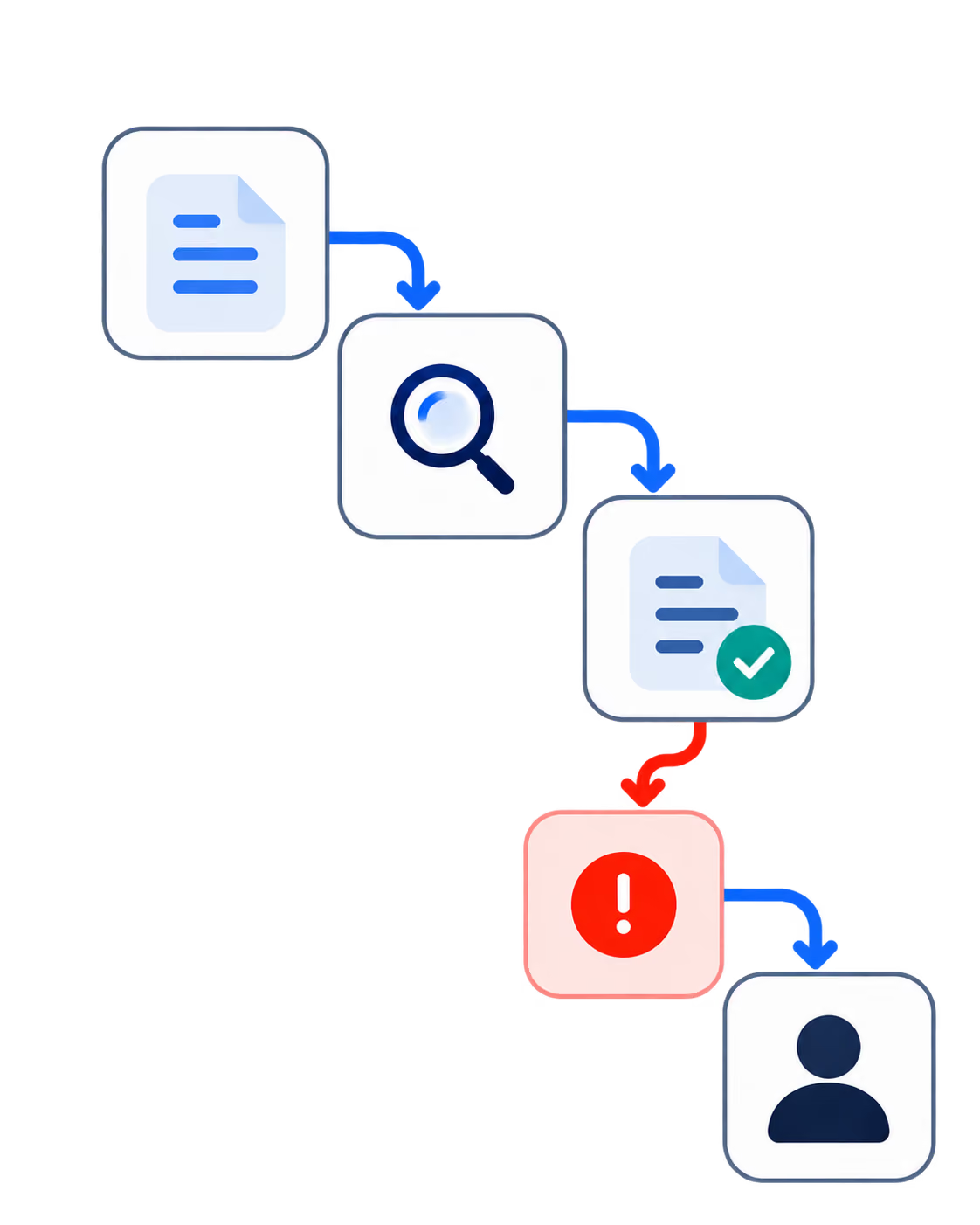
Building AI products in or for Europe without a compliance plan is no longer a strategic risk, it becomes a legal liability. The EU AI Act, which entered into force in August 2024, establishes the first comprehensive legal framework governing the development, deployment, and operation of artificial intelligence.
For most organizations, the critical date is August 2, 2026, when the Act’s core obligations become enforceable for most AI systems. However, parts of the regulation are already active. Obligations for General-Purpose AI (GPAI) models, including large language models and other foundational systems, have been in effect since August 2, 2025. Additional provisions, such as bans on certain high-risk AI practices and requirements related to employee AI literacy, became active on February 2, 2025.
EU AI Act timelines change the operational context of AI development. Compliance is no longer limited to legal interpretation or policy documents. Now, organizations building AI systems must demonstrate how models are governed, monitored, and released into production.
For CTOs and engineering leaders, this shifts EU AI Act compliance into the domain of software architecture and operational control. Evidence generation, system ownership, and release governance must become integrated components of the software development lifecycle.
What the EU AI Act Actually Is
The EU AI Act is a regulation that establishes legal requirements for the development, deployment, and use of artificial intelligence systems within the European Union.
The EU AI Act does not regulate artificial intelligence as a single category. Instead, it categorizes AI systems based on their potential to cause harm to health, safety, or fundamental rights, scaling the regulatory burden to match the assessed risk level.
To determine the appropriate level of oversight, the Act classifies AI systems into four risk categories. The higher the potential impact on safety, rights, or critical services, the more stringent the regulatory obligations.
- Unacceptable Risk: These systems pose a clear threat to fundamental rights and are banned outright. Prohibited practices include practices such as cognitive behavioral manipulation, government or corporate social scoring, and certain forms of real-time biometric identification in public spaces.
- High Risk: This category represents the core of the regulation. It includes AI systems used in areas such as critical infrastructure, medical devices, recruitment, education, and access to essential services. These systems must satisfy strict obligations related to data governance, documentation, human oversight, and monitoring before they can be placed on the market.
- Limited Risk: These systems mainly create transparency risks. The primary obligation is to ensure users are informed that they are interacting with an AI system, such as a chatbot, or encountering AI-generated synthetic media.
- Minimal or No Risk: The vast majority of everyday AI applications, such as spam filters or AI-powered video games, fall into this category. These systems face virtually no mandatory obligations under the Act, although voluntary compliance guidelines may apply.
General-Purpose AI (GPAI) models, such as GPT-5 or Claude, are regulated independently from the applications built on top of them. Providers must maintain detailed technical documentation, publish summaries of training data, and implement policies to comply with EU copyright law. Models exceeding certain compute thresholds (above 10²⁵ FLOPs) are classified as posing systemic risk.
Who This Affects and Why You Can't Opt Out
A common misconception among non-European technology companies is that the EU AI Act applies only to companies physically located within the European Union. In reality, the regulation has extraterritorial scope. Similar to the approach established under the GDPR, the Act applies based on where an AI system is used and where its impact occurs, not where the vendor is headquartered.
In practical terms, this means the regulation affects any organization that develops, deploys, or provides AI systems used within the EU, even if the company itself operates outside the region.
The regulation applies directly to:
- EU-based companies: Any organization developing or deploying AI systems within the Union.
- Non-EU companies: Providers placing AI systems or GPAI models on the EU market, regardless of their geographical location.
- Providers and users in third countries: Organizations based in the US, UK, or elsewhere must comply if the output produced by their AI system is utilized within the Union.
- Importers and distributors: Any entity making AI systems available on the European market.
If the AI system’s output touches the European market, even if the processing occurs on servers in California or Tel Aviv, this regulation applies.
What the EU AI Act Means for Businesses
The EU AI Act changes how organizations must treat AI systems, because compliance is no longer limited to legal reviews or occasional audits. Now, companies must manage AI systems through continuous governance across the entire system lifecycle, from development and testing to deployment and monitoring.
AI Becomes a Governed Product Category
Under the Act, many AI systems must be treated as regulated products. This means companies must maintain verifiable evidence showing how systems are designed, tested, and operated.
For systems classified as high risk, providers must maintain extensive documentation. This includes technical descriptions of system architecture, risk management records, performance evaluations, and operational logs. The purpose of this documentation is to allow regulators to verify that the system meets the requirements of the Act before and during its deployment.
Financial and Operational Consequences
The EU AI Act introduces significant penalties for non-compliance, structured similarly to the GDPR.
Beyond these financial penalties, regulators possess the authority to order the immediate withdrawal of non-compliant AI systems from the market. For companies operating in Europe, such a withdrawal results in immediate revenue loss, significant reputational damage, and the potential loss of access to the EU market of 450 million people.
A New Category of Operational Risk
The regulation also changes how liability can arise. Companies that integrate third-party AI systems are not automatically shielded from responsibility. If a business substantially modifies a system or places it on the market under its own brand, it may legally become the provider of that system under the Act.
This means organizations must examine their AI supply chains, internal controls, and development processes to ensure that regulatory obligations are met. Without these controls, AI systems can quickly become a source of legal and operational risk rather than a driver of innovation.
The EU AI Act Compliance Checklist
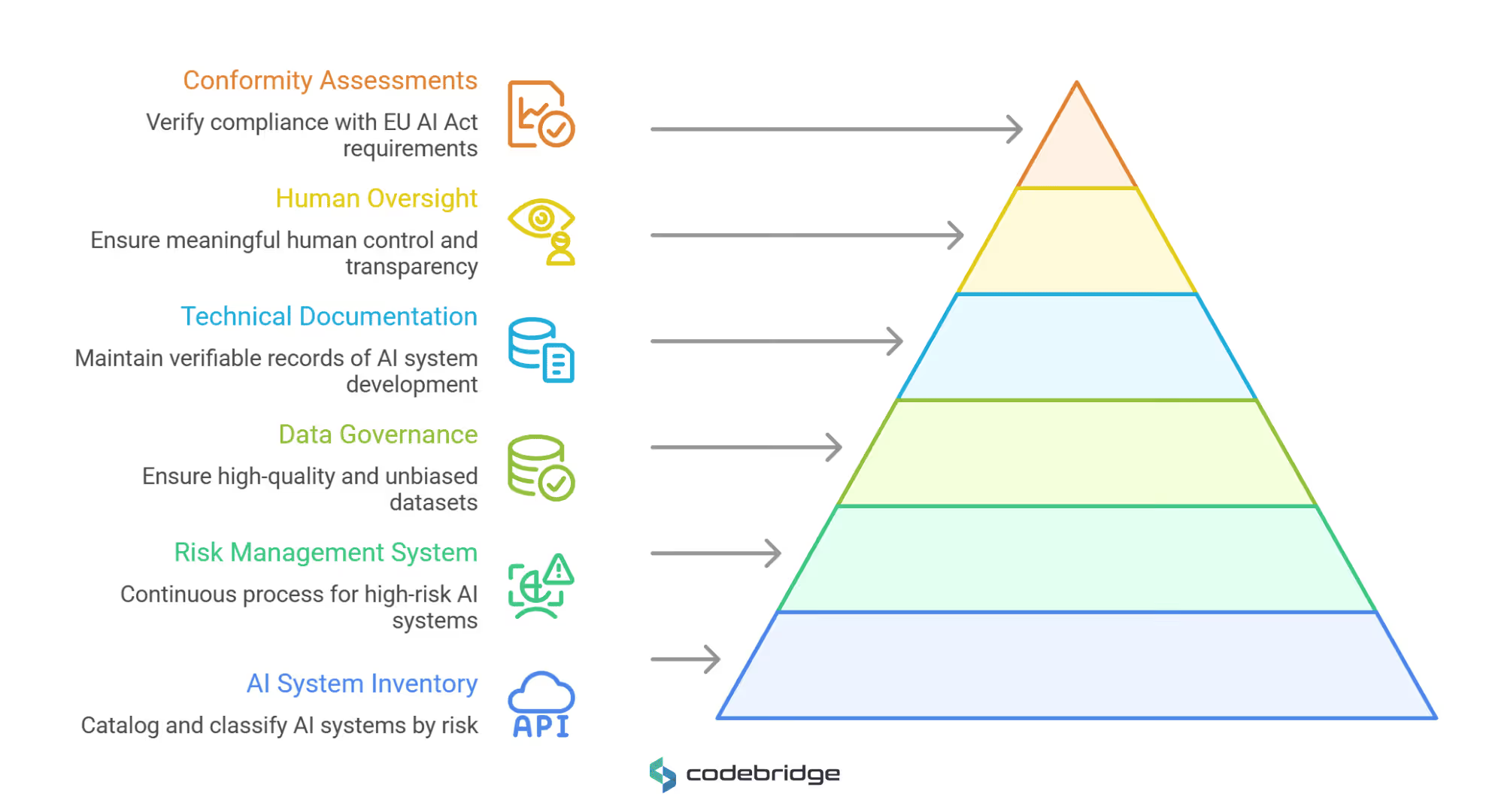
Compliance with the EU AI Act cannot remain a legal abstraction. It must be translated into technical artifacts, operational controls, and governed product processes as regulators will not assess intent or internal policies alone. They will evaluate whether organizations can demonstrate compliance through documented systems and operational controls.
The following checklist outlines the practical requirements organizations must implement to ensure their AI systems are prepared for full enforcement.
1. Create an AI System Inventory and Classify Risk
The foundation of compliance is a comprehensive understanding of the organization's AI footprint to determine regulatory scope and associated obligations.
- Create a System Inventory: Catalog every AI system currently in use, under development, or procured from third-party vendors, including embedded AI and cloud-based services.
- Document Intended Purpose: For each system, record a clear description of its intended use, including the context, conditions of use, and the specific decisions it informs or makes.
- Map Against Risk Tiers: Classify each system into one of the four risk categories defined by the Act: Unacceptable Risk (prohibited), High-Risk, Limited Risk (transparency obligations), or Minimal Risk.
- Identify Annex III Use Cases: Pay specific attention to systems used in critical infrastructure, education, employment, essential services, law enforcement, and migration, as these are explicitly listed as high-risk.
- Document Non-High-Risk Decisions: If an AI system falls under an Annex III category but is deemed not high-risk (e.g., performing only preparatory tasks), the provider must document this assessment thoroughly before the system is placed on the market.
Once the organization’s AI systems have been inventoried and classified, the next step is to operationalize governance for those systems that fall within the Act’s regulatory scope.
2. Implement a Continuous Risk Management System (RMS)
For high-risk AI systems, the risk management system (RMS) must operate as a continuous process throughout the system’s lifecycle. Risk identification, evaluation, and mitigation must occur during design, development, deployment, and ongoing operation to ensure that emerging risks are detected and addressed.
- Identify and Analyze Risks: Establish a structured process to identify known risks to health, safety, and fundamental rights arising from the system’s intended use, as well as from reasonably foreseeable misuse.
- Implement Mitigation Measures: Follow a strict mitigation hierarchy: first, eliminate or reduce risks through system design; second, implement technical protection for residual risks; and third, provide adequate information and training to users.
- Establish a Testing Regime: Test systems against defined metrics to ensure they remain within acceptable risk thresholds under real-world conditions.
- Iterate Post-Market: Continuously update the risk management process based on data collected from post-market monitoring systems and incident reports.
3. Rigorous Data Governance
High-risk systems must be developed using high-quality datasets to ensure accuracy and minimize the risk of discriminatory outcomes.
- Enforce Data Quality Standards: Ensure that training, validation, and testing datasets are relevant, representative, and as complete and accurate as possible. High-quality data is essential for producing reliable outputs and reducing the likelihood of harmful or misleading system behavior.
- Verify Statistical Properties: Confirm that datasets possess appropriate statistical properties regarding the persons or groups of persons the system is intended to be used on. Without this verification, models may produce systematically inaccurate results when applied in real-world contexts.
- Monitor for Bias: Implement active measures to detect, prevent, and mitigate potential biases that could lead to prohibited discrimination under Union law. This is particularly important when AI systems are used in areas such as hiring, lending, or access to essential services, where biased outputs can violate fundamental rights.
- Document Data Lineage: Maintain detailed records of data sourcing, collection, preparation (e.g., labeling, cleaning), and any assumptions made regarding what the data is intended to measure. This transparency allows organizations to demonstrate that datasets were selected and prepared responsibly.
However, data quality alone does not demonstrate compliance. Regulators must also be able to verify how a system was designed and operated. This requires formal documentation and traceable system records.
4. Technical Documentation and Logging Capabilities
To meet EU AI Act requirements, organizations must maintain a verifiable record of how their AI systems are developed. Documentation and logging create the evidence needed to demonstrate compliance during audits or regulatory reviews.
- Maintain Technical Dossiers: Prepare detailed documentation (Annex IV) describing the system's architecture, algorithmic logic, training data summaries, and performance metrics.
- Enable Automated Event Logging: Design high-risk systems to automatically generate logs throughout their operational lifetime. Logging ensures that decisions, outputs, and system behavior can be traced and reviewed when questions or incidents arise.
- Adhere to Retention Requirements: For deployers, ensure system-generated logs are retained for at least six months (or longer if required by other laws). These records support investigations into system failures or unexpected outcomes.
- Update Documentation on Changes: Ensure technical documentation is kept current and reflects any substantial modifications made to the system after deployment.
The EU AI Act also requires organizations to ensure that automated decisions remain subject to meaningful human control. Therefore, compliance extends beyond technical records to the design of systems that allow humans to understand and intervene when necessary.
5. Human Oversight and Transparency
The EU AI Act obligates organizations to ensure that automated systems do not operate without meaningful human control and that individuals interacting with AI are clearly informed about its use.
- Design for Interpretability: Ensure the system’s capacities and limitations are fully understandable to human overseers, enabling them to monitor operations effectively.
- Implement "Stop Button" Mechanisms: Provide technical means for human overseers to override outputs or safely shut down the system in the event of an anomaly or risk.
For instance, an AI service deployed behind an API gateway can include an administrative control that instantly disables the model endpoint or routes requests to a safe fallback response (returning a standard message or switching to manual processing)
- Supply User Instructions: Provide deployers with clear, comprehensive instructions for safe use, including expected levels of accuracy, robustness, and cybersecurity.
- Enforce Transparency Disclosures: Ensure systems intended to interact directly with humans (e.g., chatbots) or generate synthetic media (e.g., deepfakes) inform users they are interacting with an AI system.
6. Conformity Assessments and Post-Market Monitoring
Before a high-risk AI system can be placed on the European market, providers must verify that it meets the technical and safety requirements defined by the EU AI Act.
- Complete Conformity Assessments: Depending on the system's category, perform either an internal self-assessment (Module A) or a third-party assessment (Module B+C) by an accredited Notified Body.
- Issue Declaration of Conformity: Draw up a formal EU Declaration of Conformity and affix the mandatory CE marking to indicate the system complies with all requirements.
- Establish Incident Reporting Pipelines: Set up mechanisms to notify market surveillance authorities of serious incidents or malfunctions within 15 days (or 10 days in the event of a death) of becoming aware of the event.
- Register in the EU Database: Providers of Annex III high-risk systems must register themselves and their systems in the centralized EU database before placement on the market.
- Conduct FRIAs where Required: Certain deployers — including public authorities and financial institutions assessing credit or insurance — must complete a Fundamental Rights Impact Assessment before deploying a high-risk system.
By implementing this checklist, organizations establish a complete operational compliance framework for AI systems under the EU AI Act. This includes a clear inventory of AI systems, structured risk management processes, governed datasets, verifiable documentation, human oversight mechanisms, and validated market approval procedures.
In practice, this framework protects organizations from regulatory penalties and ensures their AI products can legally remain on the European market.
Executive Responsibilities: Ownership, Evidence, and Release Control
Moving from one-off compliance efforts to continuous governance requires clear executive responsibilities in three areas: ownership, evidence, and release control.
A. Ownership
Effective governance requires clear accountability. Organizations should assign responsibility for AI compliance to a named lead or a cross-functional governance group involving engineering, legal, and product leadership. This ownership includes maintaining the live AI inventory and ensuring every system has a clear accountability structure.
Leaders must also understand how regulatory roles can shift. An organization that integrates a third-party high-risk AI system and makes a substantial modification, or places it on the market under its own brand, may legally become the provider of that system. In such cases, the organization inherits the full set of regulatory obligations defined by the EU AI Act.
B. Evidence
Regulatory compliance depends on verifiable evidence. For this reason, technical documentation, system logs, and operational records should be treated as primary engineering artifacts.
Organizations must maintain documentation describing system architecture, training data summaries, model behavior, and performance characteristics. Logging systems should capture relevant operational events so that system behavior can be reconstructed and reviewed if incidents occur.
When using third-party AI systems, such as integrating large language models through APIs, organizations must also obtain sufficient documentation from vendors. The EU AI Act requires a contractual exchange of information between providers and organizations integrating their components to ensure that compliance obligations can be fulfilled. For deployments relying on GPAI, businesses must verify that their contracts align with transparency and copyright requirements that are already in force.
C. Release Control
Compliance must be a hard gate within the product release process. AI features should not be deployed unless risk classification has been completed and the required documentation is available.
Release governance must also address substantial modifications. If a deployed system is changed in ways not anticipated in its original technical documentation, the modification may require renewed conformity assessment before the system can remain on the market.
For systems that continue learning after deployment, organizations should define in advance which types of updates are expected and documented. Changes outside those boundaries should trigger a release pause and a new compliance evaluation.
Post-market monitoring processes must also be integrated into system operations. They must include mechanisms for users to contest AI-driven decisions, and version control must extend to models and their specific configurations to ensure traceability.
Conclusion
AI regulation in Europe has moved from policy discussion to an operational requirement. Organizations building or deploying AI systems must now demonstrate compliance through documented processes and verifiable technical controls.
Companies that integrate these controls into their engineering workflows early avoid the disruption and technical debt associated with late-stage compliance retrofits. Practices such as technical documentation, data lineage tracking, and system traceability are no longer optional. Now, they are fundamental components of reliable system engineering.
For engineering leadership, compliance infrastructure is increasingly indistinguishable from good engineering discipline. At the executive level, AI governance has become a strategic issue that affects enterprise partnerships, investment decisions, and long-term access to the European market.














Heading 1
Heading 2
Heading 3
Heading 4
Heading 5
Heading 6
Lorem ipsum dolor sit amet, consectetur adipiscing elit, sed do eiusmod tempor incididunt ut labore et dolore magna aliqua. Ut enim ad minim veniam, quis nostrud exercitation ullamco laboris nisi ut aliquip ex ea commodo consequat. Duis aute irure dolor in reprehenderit in voluptate velit esse cillum dolore eu fugiat nulla pariatur.
Block quote
Ordered list
- Item 1
- Item 2
- Item 3
Unordered list
- Item A
- Item B
- Item C
Bold text
Emphasis
Superscript
Subscript