The healthcare industry is navigating a paradigm shift comparable to the introduction of electronic health records, but at a significantly higher velocity. What once unfolded over years is now compressing into quarters, as artificial intelligence moves rapidly from experimentation into clinical and administrative reality. Industry analyses suggest that by 2026, clinical-grade AI will move from experimental tooling to an operational layer embedded in daily workflows, supporting documentation, care coordination, and clinical communication.
This shift matters because AI is no longer being evaluated as a pilot project or optional innovation. It is increasingly viewed as infrastructure, meaning it shapes how care is delivered, how systems communicate, and how organizations manage risk. When AI becomes embedded at the workflow level, it directly affects operational efficiency, clinician capacity, compliance posture, and ultimately patient outcomes.
For healthcare decision-makers, the strategic question is therefore no longer whether AI will be adopted, but how it can be deployed through secure, enterprise-grade architectures that address systemic inefficiencies while maintaining regulatory compliance. The organizations that treat AI as regulated infrastructure – rather than as isolated tools – will be positioned to capture both operational gains and long-term strategic advantage.
The sections that follow outline why this transition is accelerating, where measurable value is emerging first, and what governance structures determine whether AI reduces risk or amplifies it.
The Crisis of Administrative Overload
If AI is becoming infrastructure, the real question is: what structural problem is it solving?
The urgency around AI integration is not driven by hype, but by a long-standing administrative burden within healthcare that predates the current wave of generative tools but has intensified as compliance requirements and payer complexity have grown.
The U.S. healthcare system spends approximately $496 billion annually on administrative tasks, with nearly $248 billion considered excessive overhead, according to an analysis by the Center for American Progress, 2025. This is not marginal waste at the edges of the system. It represents a structural inefficiency embedded in billing, documentation, insurance coordination, and reporting workflows.
At the clinician level, the impact is even more visible. Physicians spend an estimated 30–50% of their clinical time on non-patient-facing work such as documentation, billing, and insurance coordination, as reported by the American Medical Association, 2024. In practice, this means that highly trained specialists devote nearly half of their working hours to administrative tasks rather than direct patient care.
This burden leads to so-called “pajama time” – EHR documentation completed after clinic hours, which is consistently linked to physician burnout. In 2024, 43.2% of physicians reported burnout symptoms (American Medical Association, 2024). The connection is causal, not coincidental: as documentation demands rise, cognitive load increases, workdays extend, and professional satisfaction declines.
Therefore, the financial consequence of burnout compounds the operational inefficiency. Administrative overload does not simply reduce morale; it increases turnover and adds measurable cost back into the system.
This structural pressure explains why early AI adoption is concentrating on documentation and workflow automation rather than diagnostic replacement. Before AI can transform clinical decision-making, it must first relieve the administrative weight that constrains physician time and institutional throughput. The next section examines one of the most acute examples of this friction: prior authorization.
Prior Authorization as a Systemic Bottleneck
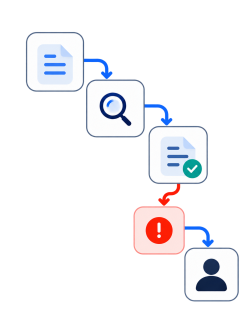
Even when coverage exists on paper, patients often face a different obstacle in practice: time. Prior authorization (PA) places an administrative step between diagnosis and treatment, effectively inserting insurer approval into the care pathway. While designed to limit low-value care, its widespread use often creates a gap between clinical urgency and administrative timelines.
In practice, prior authorization acts as a bottleneck. After a clinician determines the appropriate course of treatment, care can pause while documentation is submitted, reviewed, or appealed. That delay is not neutral. It disrupts clinical momentum at a critical moment and can influence decisions – not because the medical evidence changed, but because the approval process did. In some cases, patients are directed toward options that are easier to authorize rather than those best suited to their condition.
The link between administrative delay and clinical harm is not merely theoretical. According to the American Medical Association’s 2024 survey, 93% of physicians report that prior authorization negatively affects patient outcomes, and 24% say it has led to a serious adverse event, including hospitalization. These figures clarify the causal chain: when treatment is postponed, conditions can worsen, escalate, or require higher-intensity care.
Prior authorization is a constraint placed at the point where care begins. When approval delays occur early in the treatment pathway, the consequences surface later as higher acuity, emergency interventions, or avoidable hospitalizations. And what could have been managed proactively becomes reactive and more expensive. So, framing PA as a structural bottleneck rather than an isolated administrative task is critical. It directly affects clinical outcomes, system capacity, and total cost of care.
The Infrastructure Shift: From AI Tools to AI Systems
To move past isolated bottlenecks like prior authorization, healthcare is undergoing an important shift in how technology is deployed. In 2026, we are moving from the era of "AI tools", fragmented applications that solve a single, disconnected task, to "AI systems," which function as integrated infrastructure.
One of the reasons for this transition was the launch of OpenAI for Healthcare in early 2026. This initiative signaled a strategic pivot away from generic, consumer-grade assistants toward regulated infrastructure specifically engineered for clinical and administrative environments. By providing a secure, enterprise-grade foundation, these systems allow healthcare organizations to move away from informal or “shadow” AI use to standardized platforms that support large-scale, high-quality services while maintaining strict data protections
This change is driven by one practical requirement: interoperability. Healthcare systems must be able to exchange and use data reliably across platforms. Instead of evaluating isolated features, decision-makers are prioritizing custom solutions that connect directly to existing Electronic Health Records (EHRs), payer systems, and compliance frameworks. When integration is built in from the start, AI becomes part of the daily workflow, not a separate tool that requires manual data entry or forces clinicians to switch between portals.
By treating AI as regulated infrastructure, organizations can ensure that technological gains are sustainable and compliant. This systematic approach allows institutions to move beyond experimentation and begin capturing measurable value. The following section explains the three high-impact areas where this custom system-level development is currently delivering the most significant returns.
Where Custom Development Creates Real Value
Understanding the theoretical shift from isolated tools to integrated systems is foundational, but the strategic priority for 2026 is identifying exactly where these systems generate the highest measurable returns. And enterprise healthcare AI initiatives typically focus on three high-impact areas:
1. Ambient Clinical Documentation
The most immediate driver of value is the transition to ambient clinical documentation – technology that uses an AI-assisted documentation system to passively capture patient-provider conversations and convert them into structured medical notes in real-time. These systems can reduce daily charting time depending on daily visit volume and adoption rate, which can translate to ~30–60 minutes/day for typical users. Unlike generic transcription tools, these custom solutions are fine-tuned for over 50 specialties, ensuring that the final notes reflect the specific clinical nuances required for accurate billing and care continuity.
2. Automated Prior Authorization
While documentation saves time daily, automated prior authorization removes the single largest systemic bottleneck in the care cycle. By deploying specialized AI agents that can autonomously gather clinical rationale and validate information against specific payer requirements, organizations can reduce authorization cycles from several days to minutes. This custom orchestration eliminates the manual follow-ups and faxes and improves patient access to time-sensitive treatments like specialty medications or urgent diagnostic imaging
3. Evidence-Based Clinical Decision Support
The third area of impact is evidence-based clinical decision support, which solves the problem of knowledge fragmentation. Now, instead of generating opaque “black box” answers, modern AI systems are built to reference peer-reviewed studies and institutional guidelines, with clear, clickable citations. It helps clinicians to see where information comes from and verify it.
In this model, AI acts as a high-speed research assistant. It supports clinical reasoning without replacing professional judgment. Because these outputs are verifiable, they mitigate the risks of "hallucinations" (clinically invalid responses) that often plague consumer-grade AI models
Table: Administrative Impact of AI-Enabled Workflows
By focusing on these three pillars, healthcare leaders can move beyond experimental pilots and begin capturing tangible operational gains. However, achieving these efficiencies requires more than just technical deployment; it necessitates a rigorous focus on the guardrails that protect patient information. The following section analyzes the governance frameworks essential for managing these high-impact systems.
Security, Compliance, and Governance
As adoption accelerates, healthcare organizations face rising risks from "Shadow AI" – the unauthorized use of consumer-grade AI tools by clinicians and staff seeking immediate efficiency gains. Because 88% of health systems report using AI internally, but only 18% have a formal governance structure, a significant gap exists between actual use and institutional oversight. Without formal controls, these ad-hoc implementations increase exposure to data privacy violations and even clinical safety risks.
To move past this "shadow" era, regulated AI infrastructure in 2026 must be built on four technical and legal pillars:
- HIPAA-Compliant Business Associate Agreements (BAAs): Contractual frameworks that legally extend privacy requirements to the AI provider, ensuring Protected Health Information (PHI) is handled according to federal standards.
- Data Residency and Encryption: Advanced controls that allow organizations to determine where data is stored geographically and manage their own encryption keys to maintain data sovereignty.
- Enterprise Access Management: The use of standardized protocols, such as SAML, SCIM, and Role-Based Access Control (RBAC), to ensure that AI system access is governed by the same centralized security policies as the rest of the clinical environment.
- Explicit Restrictions on Model Training: Mandatory clauses ensuring that an institution’s patient data is never used to train foundational AI models, preserving both patient confidentiality and the organization’s proprietary insights.
Establishing this secure foundation is not merely a defensive measure; it is the operational baseline required to measure the success of any technological deployment. By ensuring that AI systems are compliant, transparent, and auditable, healthcare leaders can move to the final stage of strategic evaluation: calculating the tangible return on investment (ROI).
Measuring Return on Investment
The most immediate metric for healthcare leaders is the direct financial yield relative to initial costs. Organizations implementing custom AI-supported clinical documentation currently report a 5.8% increase in weekly RVUs and a 2.8% increase in encounters, translating to roughly $3,000 in additional annual revenue per physician under Medicare rates. Because these systems integrate directly into existing data pipelines rather than requiring manual oversight, payback periods have shortened. This rapid recovery of capital is largely driven by a significant shift in clinician time allocation: by reducing administrative load, practices are increasing their patient capacity.
By grounding technology in these measurable outcomes, healthcare organizations can finally move past the era of experimentation. As we have seen throughout this analysis, the shift toward custom, clinician-validated AI infrastructure is not merely a technical upgrade; it is a fundamental realignment of healthcare operations.
Conclusion: From Experimentation to Infrastructure
The HealthCare industry is moving beyond scattered pilots and isolated experimentation toward regulated enterprise-wide systems. And it is no longer just a technology upgrade.
Healthcare leaders are recognizing that AI is not meant to replace clinicians. Its role is to remove manual work and administrative friction that distracts from clinical judgment. By automating documentation, prior authorization, and other repetitive tasks, AI addresses one of the core drivers of burnout and workforce instability – a problem that costs the U.S. healthcare system an estimated $4.6 billion annually.
When AI systems are implemented as integrated infrastructure rather than disconnected tools, the results are measurable. Organizations report returns exceeding three times their initial investment and payback periods of three to six months.
In this new model, AI becomes a stable operational layer, one that strengthens the workforce, improves system performance, and allows clinicians to focus on care rather than administration.














Heading 1
Heading 2
Heading 3
Heading 4
Heading 5
Heading 6
Lorem ipsum dolor sit amet, consectetur adipiscing elit, sed do eiusmod tempor incididunt ut labore et dolore magna aliqua. Ut enim ad minim veniam, quis nostrud exercitation ullamco laboris nisi ut aliquip ex ea commodo consequat. Duis aute irure dolor in reprehenderit in voluptate velit esse cillum dolore eu fugiat nulla pariatur.
Block quote
Ordered list
- Item 1
- Item 2
- Item 3
Unordered list
- Item A
- Item B
- Item C
Bold text
Emphasis
Superscript
Subscript