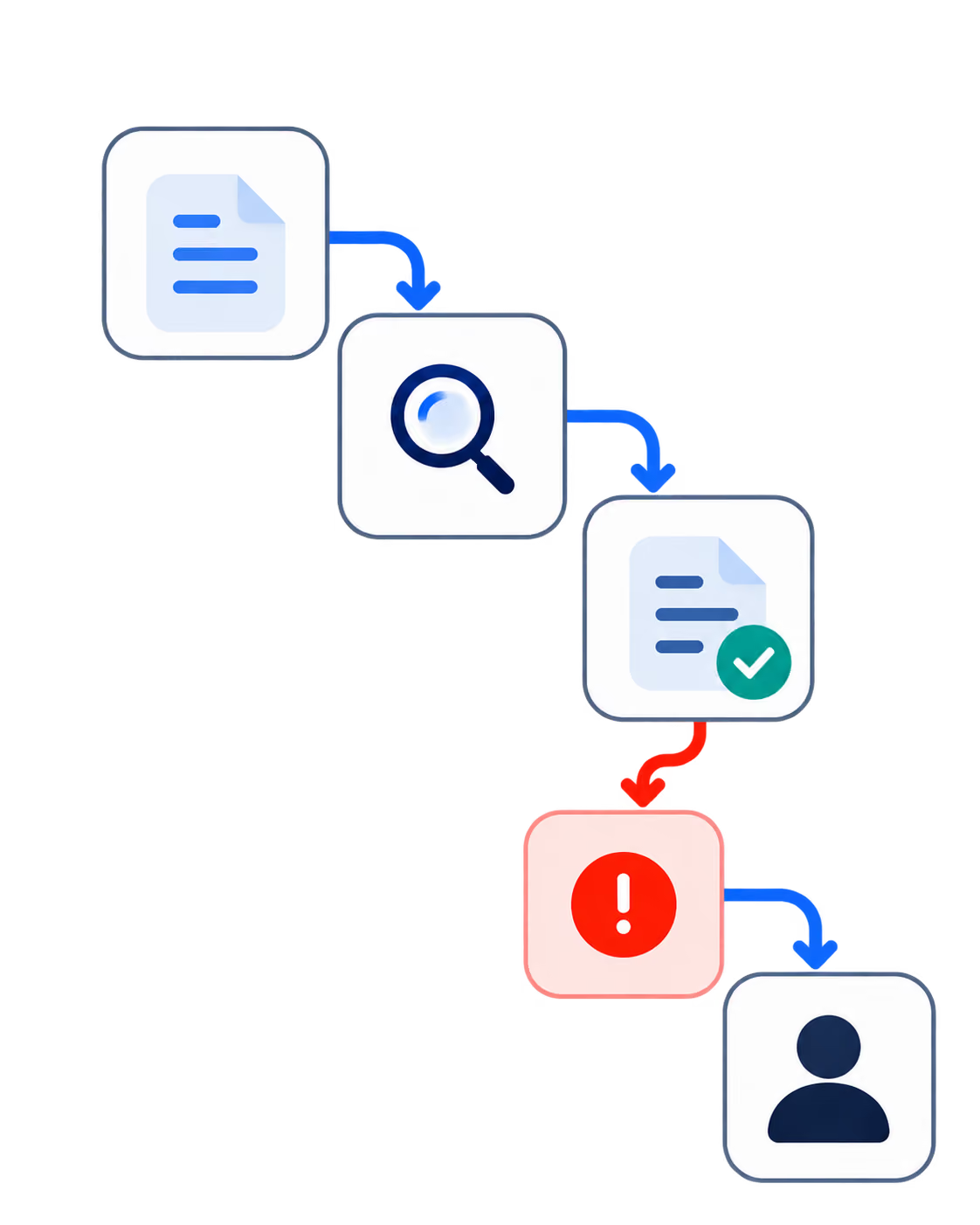
Over the past two years, large language models have moved beyond generating text into something more operational. Instead of simply answering questions, AI agents can now plan tasks, make decisions, and interact with external systems. In enterprise environments, they are beginning to execute workflows across repositories, browsers, APIs, and internal tools.
But moving from prototype to production has proven far more difficult than early demos suggested. While roughly 62% of organizations report experimenting with AI agents, far fewer have successfully scaled them into stable, scalable systems. The real challenge is to achieve repeatable reliability under production conditions.
This gap is primarily about evaluation. Many teams measure whether an agent completes a task once, under ideal conditions. Far fewer assess whether it can do so repeatedly, under constraints, without introducing security exposure, instability, or fluctuating cost.
For tech leaders, the question is no longer whether an agent can achieve an outcome in a demo. Now, the real question is whether it can operate dependably inside production systems. Without structured testing, scaling introduces financial, security, and reliability exposure.
What is AI Agent Evaluation?
AI agent evaluation is the systematic process of measuring and validating the performance, reliability, and alignment of autonomous systems across three core dimensions: technical ability, autonomy, and business impact.
Unlike standard LLM model assessment, which usually tests how well a model responds to a single prompt, agent evaluation looks at an ongoing process.
An AI agent must maintain context over time, interact with external tools and APIs, and handle unexpected errors or changing conditions. Evaluating that kind of system requires more than checking whether one answer is correct — it requires understanding how the system behaves across an entire workflow.
Industry Examples
In practice, agent evaluation looks very different depending on the domain. What counts as good performance in one environment can be unacceptable in another.
- Customer Support
In customer support teams, look at resolution rates, whether the agent can fully handle an issue without human escalation, and whether responses stay within approved policy and compliance boundaries. A failed evaluation here might identify an agent that provides confident but illegal advice, such as misinforming customers about regulatory rights. In this context, evaluation must include policy adherence checks and scenario-based testing, not just conversational quality.
- Coding Assistants
For coding agents, evaluation typically includes passing unit tests, successful builds, and regression checks. However, the more serious risks emerge when an agent completes the requested task but introduces hidden problems — such as weakening authentication logic, exposing secrets, or modifying production configurations despite explicit constraints. Teams often discover that a successful code generation in isolation can create downstream instability. Therefore, robust evaluation includes security scanning, diff reviews, and constraint validation.
- Financial & Corporate Services:
In financial operations, procurement, or internal corporate workflows, the tolerance for error is extremely low. Agents are mainly evaluated on data accuracy, audit trails, traceability of decisions, and strict role-based access controls. A small improvement in task speed or even accuracy is not meaningful if it increases API costs unpredictably or creates the possibility of sensitive data exposure. In these environments, reliability and governance outweigh marginal performance gains.
Across all three domains, evaluation is not about whether the agent can perform a task once. It is about whether it can operate safely, predictably, and economically within real operational constraints.
Prototype vs Production Evaluation
Why Evaluate an AI Agent?
One of the main reasons organizations invest in AI agents is productivity. In one recent industry report, approximately 80% of practitioners said their main objective was measurable efficiency gains, while 72% pointed to reducing human task-hours as a key driver. Agents are expected to lower operational overhead and accelerate workflows.
However, without rigorous evaluation, these gains are often erased by the reality that an agent might succeed on its first try but fail three out of four times in production.
Building and Maintaining Trust
Another critical reason to evaluate AI agents is trust. When a system operates with limited human oversight, trust is built through evidence, not just through claims.
Structured evaluation surfaces variance spikes, tool misfires, overconfident decisions, and cost volatility before they reach customers. It tests whether it behaves predictably across repeated runs, ambiguous inputs, and tool interactions. Without that level of scrutiny, confidence in the system erodes quickly, especially after the first visible mistake.
Resource and Cost Management
AI agents consume significantly more computational resources than traditional models through iterative reasoning loops and expanding context windows. Evaluation allows teams to identify inefficiencies in reasoning chains, optimize token usage, and manage the "communication tax" that increases both latency and cost.
For example, complex architectures like "Reflexion" can provide marginal accuracy gains while costing 5.12 times more than balanced alternatives, a diminishing return that only becomes visible through cost-normalized evaluation.
Enabling Rapid Iteration
Unlike single-response models, agents often run in loops. They plan, reflect, use tools, re-check results, and sometimes repeat the process multiple times before producing an outcome. Each step consumes tokens, API calls, and compute time. And as workflows become more complex, context windows expand, and latency increases.
Data-driven evaluation enables teams to compare model variations, test architectural changes, and accelerate development cycles by reducing guesswork. Furthermore, as more powerful models are released, teams with established evaluation suites can upgrade in days, while those without evals face weeks of manual verification to ensure new models haven't broken existing workflows.
Beyond Accuracy: The Reliability Gap
A critical discrepancy has emerged between laboratory performance and production readiness. High accuracy on standard benchmarks does not imply reliability. Borrowing from safety-critical engineering, reliability should be broken into four dimensions: consistency, robustness, predictability, and safety.
1. Consistency: Managing the Variance Liability
Consistency measures whether an agent behaves identically when faced with the same request multiple times. Because LLM-based agents rely on probabilistic sampling, variance is unavoidable. But in enterprise settings, high variance becomes an operational liability. An agent that succeeds once but fails under identical conditions the next time cannot be audited, forecasted, or safely automated.
Research shows a meaningful consistency gap: systems that achieve 60% success in a single run may deliver only 25% full consistency across repeated trials.
In practice, teams evaluate consistency across three levels:
- Outcome consistency: Does the agent reach the same final decision? A refund should not be approved on one run and denied on the next identical request.
- Trajectory consistency: Does it follow a stable reasoning path? Many agents select appropriate tools but vary execution order, introducing planning instability.
- Resource consistency: Does it consume predictable resources? Identical requests that trigger 50x swings in token usage or API calls create cost volatility and rate-limit exposure.
For mission-critical deployments, practitioners increasingly rely on pass^k (all trials succeed) rather than pass@k (at least one succeeds), as in production, users expect success every time, not occasionally.
2. Robustness: Stability Under Perturbation
Robustness evaluates an agent's ability to maintain performance levels when faced with variations in input or environment. In production, agents rarely operate under the ideal conditions found in training sets.
Robustness is assessed across three primary categories:
- Fault robustness: How the agent handles infrastructure issues such as tool crashes or malformed responses. A mature system retries, escalates, or falls back. An immature one hallucinates or fails.
- Environment robustness: Stability when interface details change — renamed parameters, altered date formats, or modified field ordering. Overreliance on surface conventions often exposes shallow tool understanding.
- Prompt robustness: Sensitivity to semantically equivalent rephrasing. Studies show accuracy drops of 11–19% when instructions are merely rewritten, revealing how fragile many agents remain.
3. Predictability: Characterizing Failure Modes
Predictability measures whether an agent can recognize likely failure and avoid acting incorrectly. A system that fails in known, expected ways is often preferable to one that fails rarely but unpredictably.
In many enterprise contexts, a system that declines to act is preferable to one that acts confidently and incorrectly. The key is calibration — the alignment between reported confidence and actual performance.
The measurement of predictability involves:
- Calibration: The alignment between the agent's reported confidence and its actual empirical success rate. If an agent reports 90% confidence but is correct only 55% of the time, it is systematically overconfident, rendering automated decision thresholds (like auto-blocking merges in a CI pipeline) useless.
- Discrimination: The ability of confidence scores to distinguish between successful and failed tasks on an individual basis. An agent may be well-calibrated on average but fail to flag the specific individual tasks that will trip it up.
- Brier Score: A holistic metric that jointly penalizes miscalibration and poor discrimination, offering a single view of predictive quality.
While calibration has improved in recent model generations, discrimination remains inconsistent across benchmarks, meaning agents are better at estimating their overall success but no better at identifying their specific imminent failures.
4. Safety: Bounding Error Severity
Safety differs from accuracy because not all errors are equal. A formatting mistake and a destructive system action should not be treated as equivalent. Safety evaluation focuses on the frequency and severity of violations of operational or ethical constraints.
Safety metrics include:
- Compliance: The percentage of runs that avoid policy violations, such as unauthorized data access or unintended system changes.
- Harm Severity: The weighted impact of failures. Deleting production documents is categorically different from misplacing a file.
For companies, safety issues are tail risks. An agent that behaves safely 99% of the time but causes catastrophic harm in 1% of cases is often an unacceptable risk. Therefore, safety metrics should be reported as hard constraints rather than continuous averages to be traded off against other dimensions.
5. Infrastructure & Cost Stability: Protecting the ROI
Measuring consistency, robustness, predictability, and safety is only the first step. In production systems, these properties are shaped not just by the model, but by the surrounding infrastructure. Orchestration policies, such as how many model calls are allowed, when tools are invoked, whether verification loops are triggered, directly influence variance and cost behavior.
In other words, reliability depends on orchestration limits, tool policies, retries, monitoring, and cost controls — not just the model.
Trace-First Observability
To evaluate and improve reliability, teams need visibility into how agents actually operate. The foundation of this visibility is the trace: a complete record of a single run, including intermediate reasoning steps, tool calls, retries, and environmental feedback.
In agentic systems, much of the practical logic lives inside these traces rather than in static code. Observability platforms such as LangSmith, AgentOps, or MLflow allow teams to analyze not only hard failures, but also cases where the agent technically succeeds yet follows an inefficient or risky trajectory. Without trace-level visibility, issues like resource inconsistency or hidden robustness gaps remain invisible until costs spike or incidents occur.
Protecting the Unit Economics
Infrastructure discipline is also essential for protecting ROI.
An agent’s business value must be evaluated against its full operational cost: model usage, tool calls, latency penalties, human oversight, and remediation when failures occur. Mature teams shift from measuring cost per message to cost per successful outcome. This outcome-based costing model exposes situations where the agent consumes extensive intermediate reasoning without meaningfully advancing the task.
Infrastructure Best Practices
To minimize risk while maximizing ROI, organizations should adopt:
- Sandboxing: Running agents in isolated environments prevents destructive actions — such as file deletion or code execution — from impacting production systems directly.
- Circuit breakers: Automated thresholds that halt repetitive or harmful action loops protect against runaway behavior.
- Role-Based Access Control (RBAC): Agents should operate with the same permission boundaries as the human user they represent, preventing privilege escalation and unauthorized access.
These controls operationalize the safety and robustness principles discussed earlier. They ensure that when agents fail, the consequences are contained.
Practical Framework: How to Evaluate the Agent Right
For Founders and CTOs, the transition from a functioning prototype to a scalable agent is not a linear scaling of compute, but a transition to rigorous reliability engineering. Successful deployment requires a multi-layered evaluation framework that moves beyond vibe-based testing into a structured, data-driven discipline.
1. Strategic Dataset Composition
Evaluation begins with scope definition. Before metrics, graders, or automation pipelines are introduced, organizations must define what failure actually looks like in their operating context. A test suite should not be a random collection of prompts, but a deliberate representation of the system’s real-world risk surface.
To meaningfully assess consistency, robustness, predictability, and safety, the evaluation dataset must span both common workflows and high-impact edge conditions. A balanced test architecture typically includes:
- Golden Dataset (20%): Representative scenarios reflecting typical user behavior and expected “happy path” outcomes. These validate baseline functionality and business value.
- Edge Cases (30%): Boundary conditions and rare inputs — such as unusually long messages, ambiguous instructions, or partial data — that expose brittleness in reasoning and tool orchestration.
- Adversarial Tests (20%): Intentionally malicious or stress-inducing inputs designed to trigger hallucinations, bypass safety controls, or execute prompt injections.
- Regression Tests (30%): A living archive of previously identified failures, ensuring that resolved defects do not silently reappear after prompt, model, or infrastructure updates.
Together, these categories ensure that evaluation reflects operational reality rather than idealized scenarios. However, defining what to test is only the start. The next step is determining how each scenario will be verified, and not all outcomes can be judged the same way.
2. Layered Verification: Choosing the Right Graders
Once the evaluation dataset is defined, the next step is determining how outcomes will be verified. Each category of test case — golden paths, adversarial inputs, or regression failures — requires an appropriate grading mechanism. Without reliable graders, even a well-constructed dataset cannot produce actionable signals.
Effective verification requires layering different methods so that failures slipping through one layer are caught by another.
- Deterministic Code-Based Graders: These should be the default for objective criteria. They verify state changes (e.g., "was the record updated in the DB?"), syntax validity, and tool-call schema adherence. They are cheap, fast, and reproducible, but lack the nuance to judge subjective qualities.
- Model-Based Graders (Agent-as-a-Judge): For subjective dimensions like tone, empathy, or clarity, use specialized LLM judges. Advanced "Agent-as-a-Judge" (AaaJ) frameworks can proactively gather evidence by opening files or running scripts to verify the agent's work, achieving alignment with humans at rates up to 90%. This method reduces evaluation costs by over 97% compared to human expert panels.
- Human-in-the-Loop (HITL): Human review remains the "gold standard" for high-stakes, ethically sensitive, or ambiguous tasks. Experts provide the ground truth needed to calibrate automated judges and identify edge cases that machines might overlook. In production, humans should act as "Approvers" for high-risk operations, such as financial transactions or data deletions.
3. The 70/30 Resource Allocation
With datasets and grading mechanisms in place, the next question becomes how to allocate engineering effort. Not all evaluation layers deserve equal investment.
A critical strategic decision is how to distribute evaluation efforts between holistic and granular testing.
- End-to-End (E2E) Evaluation (70%): The majority of effort must focus on validating overall business value and real-world reliability. E2E testing confirms whether the "model + scaffold + tools" triad successfully reaches the desired outcome in the environment. This is the primary gate for production readiness.
- Component-Level Evaluation (30%): Granular testing is used to optimize specific subsystems. This includes measuring the classification accuracy of routers, the retrieval precision of RAG systems, and the parameter extraction quality of tool interfaces. Component tests answer why a system is failing, while E2E tests confirm that it is failing.
4. Phased Implementation Roadmap
The structural components above — datasets, graders, and E2E prioritization — should not be built all at once. Their implementation must evolve alongside system maturity.
30-Day Quick Start (Visibility):
- Establish basic logging for all model calls, error codes, and tool invocations.
- Build an initial golden dataset (as the first subset of the broader evaluation suite) of 10–20 high-value scenarios derived from early user feedback or manual testing.
- Set baseline metrics for latency and success rates to create an "early warning system" for regressions.
60-Day Foundation (Automation):
- Deploy automated testing pipelines that run on every code commit.
- Introduce component-level evaluation to isolate performance bottlenecks in the LLM, retriever, and tool interfaces.
- Implement A/B testing frameworks to compare different prompt strategies or model versions in controlled environments.
90-Day Maturity (Continuous Optimization):
- Move to continuous evaluation using live production data.
- Integrate full observability platforms to analyze reasoning traces and identify "soft failures" where the agent succeeds through an inefficient or risky path.
- Automate feedback loops that convert production failures into new test cases for the regression suite.
5. Operational Discipline: Traces as Code
As evaluation moves from project to institutional practice, observability and isolation become non-negotiable infrastructure requirements.
In agent engineering, the logic of the application is documented in execution "traces," not just in the code. CTOs must mandate trace-first observability as a core infrastructure requirement.
Every trial must be isolated in a clean environment — such as a sandboxed VM or container — to prevent shared state from skewing results or creating security vulnerabilities. Finally, evaluation suites must be treated as versioned artifacts, with periodic temporal re-evaluation to ensure that the agent's reliability is maintained as underlying APIs, data schemas, and model behaviors silently drift in the real world.
In practice, evaluating an AI agent follows a disciplined loop. Define scenarios, assign graders, run repeated E2E trials, diagnose failures, convert them into regression tests, and promote only after reliability thresholds are met.
This cycle does not end at deployment — it continues in production through continuous monitoring and drift detection.
Conclusion
AI agent evaluation has become a core discipline of reliability engineering for organizations deploying autonomous systems in production.
High-performing model backbones — whether language or vision-language — are only one component of the picture. On their own, they do not provide the grounding, stability, or error-recovery mechanisms required for dependable digital operations. The gap between an impressive demo and a production-ready agent is actually closed by system-level discipline.
Organizations that embed evaluation directly into engineering workflows, avoid the prototype trap that has stalled many agent initiatives. More importantly, they build systems that operate consistently, recover gracefully, and align with business constraints. In that shift from experimentation to engineering lies the difference between short-lived pilots and durable, enterprise-grade value.















Heading 1
Heading 2
Heading 3
Heading 4
Heading 5
Heading 6
Lorem ipsum dolor sit amet, consectetur adipiscing elit, sed do eiusmod tempor incididunt ut labore et dolore magna aliqua. Ut enim ad minim veniam, quis nostrud exercitation ullamco laboris nisi ut aliquip ex ea commodo consequat. Duis aute irure dolor in reprehenderit in voluptate velit esse cillum dolore eu fugiat nulla pariatur.
Block quote
Ordered list
- Item 1
- Item 2
- Item 3
Unordered list
- Item A
- Item B
- Item C
Bold text
Emphasis
Superscript
Subscript