Most AI agent pilots look useful until the agent needs to touch the actual business. In a sandbox, an agent can summarize a lead, draft a response, classify a support ticket, or analyze a medical document. In production, that same agent has to know which system it can read from, which action it is allowed to take, when to stop, who approves the next step, what happens if the data is wrong, and how the company will prove later why it made the decision it made.
That is where most agent projects break.
Agentic orchestration is the architecture that coordinates AI agents, tools, data, permissions, workflows, and human decision points so that autonomous systems can perform multi-step business tasks reliably in production. IBM describes AI agents as systems that can autonomously perform tasks by designing workflows with available tools; orchestration is the layer that makes that workflow safe in an enterprise environment.
The number of agents a company runs is the wrong metric. The right one is what those agents are allowed to do when they encounter real permissions, real exceptions, and real consequences.
At Codebridge, we treat this as a software architecture question before it becomes an AI question. The agent is one component. The harder work is designing the environment in which it can act safely, with human control where the risk demands it, and with enough telemetry to explain its decisions afterward.
What Is Agentic Orchestration?
Agentic orchestration is the coordination layer for AI agents. It manages how an agent receives a task, breaks it into steps, calls tools, shares context, writes back to business systems, escalates to a human, and recovers when something fails. The point is to move from "AI can help with this task" to "AI can safely participate in this workflow."
Single-agent automation vs. agentic orchestration
A single AI agent helps with one task: summarize a document, draft a reply, or classify a record. It is useful, but bounded.
Agentic orchestration coordinates a workflow that crosses multiple steps, systems, and roles. In a typical revenue workflow, one agent researches the account, another checks CRM history, a third drafts a personalized message, a fourth verifies it against compliance rules, and a human approves. After the action, another agent updates the CRM and queues the follow-up.
None of this is impressive in isolation. The orchestration layer is what makes the sequence reliable and recoverable when a step fails.
Multi-agent orchestration is not just more agents
Businesses that strive for innovation need to understand that adding agents without orchestration is not a transformation. It is distributed confusion with API access.Multi-agent orchestration helps agents, assistants, and data sources work as one system instead of in silos.
Microsoft's Azure AI Foundry takes a similar position in its connected-agents model: enterprise agent systems should be designed as coordinated production workflows, not isolated prompt experiments. Most modern business workflows do not fit a single prompt. They need a stateful layer for context, retries, approvals, and rollback. Orchestration is what holds that layer together.
Why AI Agents Fail Without an Execution Architecture
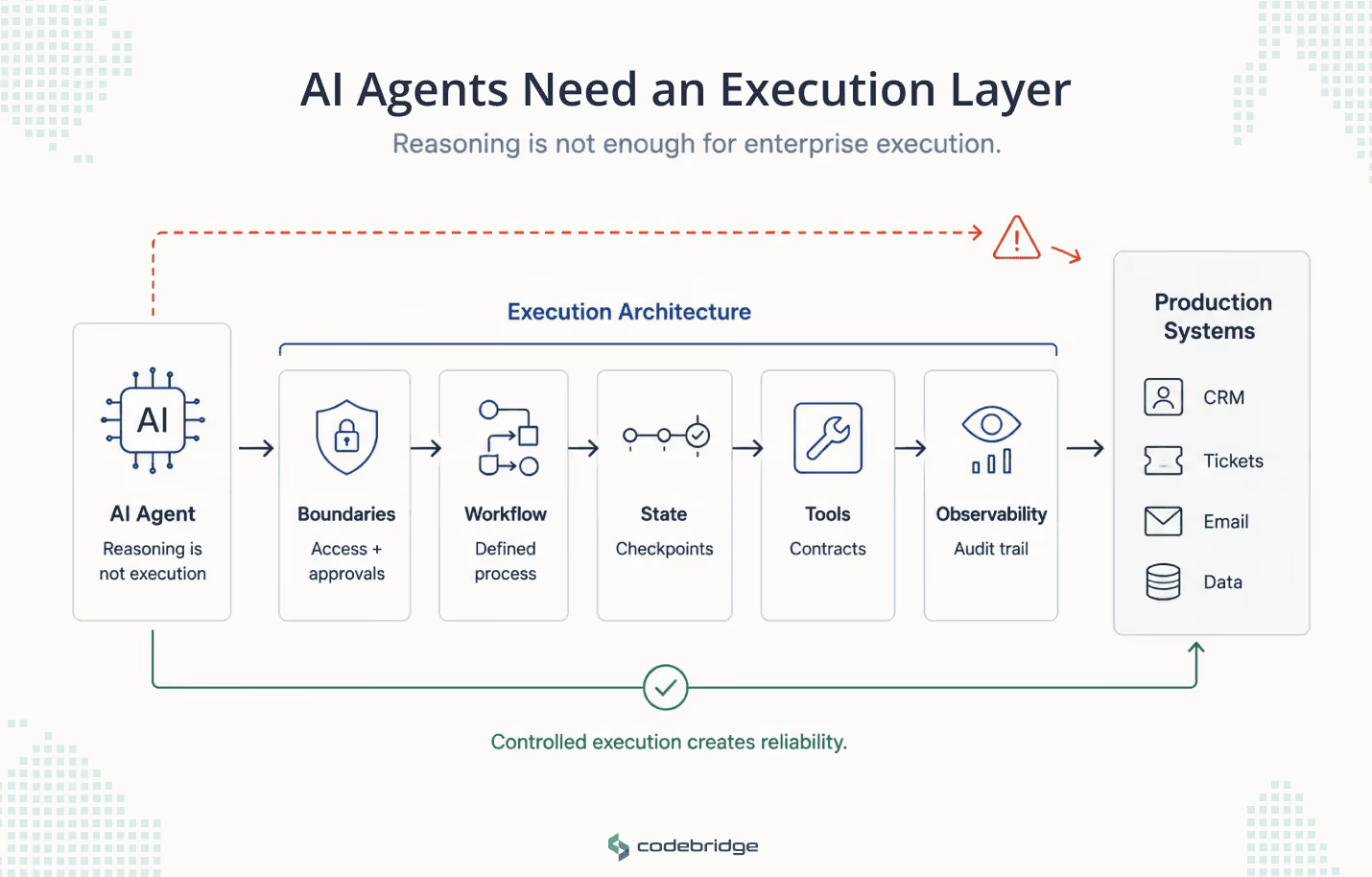
AI agents fail when companies confuse what an agent can do in a demo with what an enterprise system can absorb in production. The reasoning is often fine, but the surrounding architecture is not.
Failure mode 1: Agents get access before the company defines boundaries
The moment an agent can update CRM records, move tickets, or send customer messages, it stops being a productivity toy and becomes operational infrastructure. If permissions are not designed before access is granted, a small reasoning error becomes a business action with consequences. Two design rules limit the blast radius.
- Agents should not be allowed to do more than the human or role they represent
- Sensitive actions should require approval checkpoints
Both are obvious in retrospect and skipped during pilots, which is why pilots often pass, and production rollouts fail.
Failure mode 2: The workflow is not stable enough to automate
Many companies want agents to automate a process that is not actually a process. It is a chain of Slack messages, spreadsheet corrections, tribal knowledge, and one senior person who "just knows." If nobody can explain how the workflow runs without calling three people and opening five spreadsheets, the first AI agent will expose that the workflow was never designed.
This is one of the most common patterns we see at Codebridge, and it usually surfaces before any AI is involved. Fragile architecture and underestimated integrations are the same problem in different clothing.
Failure mode 3: Agents cannot manage state across a real process
Enterprise workflows are multi-step and often long-running. They need memory of what happened, what was approved, which data was used, which step is pending, and which action is complete. A standard LLM's conversation memory is not enough.
Without explicit state management, agents repeat work, overwrite records, or produce inconsistent outcomes. Long-running tasks need checkpoints. Failed steps need retry and rollback logic. State is a feature of the architecture, not of the prompt.
Failure mode 4: Tool use is treated as a prompt problem
Tool calling is where AI leaves language and enters execution. The system has to define what tools are available, what each tool can do, when the agent can call it, what arguments are valid, what outputs can be trusted, and what happens when the tool fails.
In production, "the agent called the wrong tool" is not a funny demo bug; it can be a corrupted record, a bad customer message, or a compliance incident. Tool contracts belong in the orchestration layer, not in the system prompt.
Failure mode 5: There is no observability for agent behavior
Executives should not only ask whether the agent completed the task. They should be able to answer what it did, why it did it, which data it used, where humans intervened, how often it failed, and how much each workflow costs.
NIST's Generative AI Profile frames AI risk management around this kind of operational measurement rather than abstract principles. Without telemetry at this level, agentic systems become a category of software with no audit trail.
The Real Job of Agentic Orchestration
Agentic orchestration is not one feature. It is a system of controls that turns agent activity into managed business execution. Five jobs sit inside it.
1. Task decomposition and routing
The orchestration layer decides what the business goal is, which subtasks are needed, who owns each one, what order the work runs in, and what data is needed at each step. In a SalesTech workflow, a lead qualification task may be split into company research, ICP fit scoring, CRM history review, buying-signal detection, message drafting, and human approval. The split itself is the design work. The framework choice is downstream.
2. Tool and API coordination
Agents need access to tools: CRMs, EHR systems, ticketing platforms, document repositories, payment systems, calendars, internal databases. The orchestration layer defines tool contracts so that access is not random. Each contract should specify API boundaries, rate limits, valid arguments, allowed actions, logging requirements, and fallback behavior. Tool use without contracts is the fastest way to turn an agent into an outage.
3. Permission and policy enforcement
This is the layer that makes agentic orchestration enterprise-ready. RBAC, ABAC, or policy-based controls should define what each agent can read, write, modify, send, or delete. Permission mirroring is one of the more practical patterns: an agent performs only the actions the human or role it represents is already authorized to perform. Sensitive actions require explicit approval. Regulated workflows need policy enforcement that is logged, not just configured.
4. Human-in-the-loop design
Human review should be designed by risk level, not added randomly. A useful mapping:
Each workflow has a risk class, and the orchestration layer should make the corresponding human role explicit.
5. Observability, auditability, and recovery
A production agentic system has to answer practical questions: what happened, which agent acted, which tool was called, which data was used, which human approved it, what failed, what was retried, what needs rollback. This is normal engineering, and it is where agent projects move from interesting to credible. The architectural maturity of an agentic system shows up in how well this layer is built, not in which model it uses.
What an Execution Architecture for AI Agents Should Include
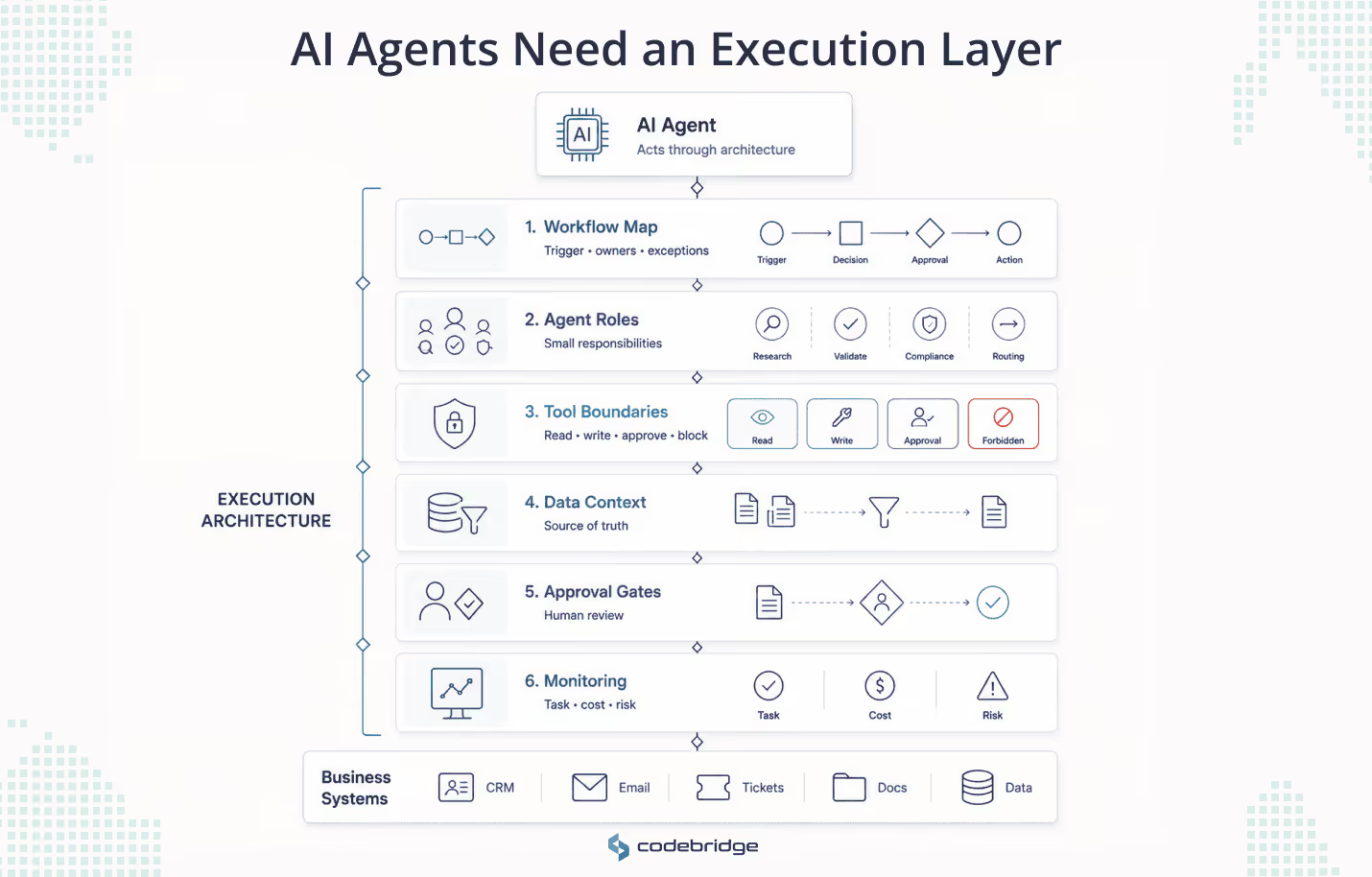
A useful agentic architecture does not start with the question "how many agents do we need?" It starts with a less exciting one: "what must be true for an agent to act inside this business without creating hidden risk?" Six layers usually answer that question.
Layer 1: Business workflow map
Before agents are designed, the workflow has to be mapped. The map records the trigger event, the input data, the decision points, the systems involved, the owners, the exception paths, the approvals, and the success metric.
For SalesTech, that workflow is not "send better emails." It is: identify accounts, enrich data, score fit, detect timing, generate a message, route for approval, send, track response, update the CRM, trigger the next action. Skipping the map is the single most common reason pilots fail to scale.
Layer 2: Agent roles and responsibilities
Agents should be designed by responsibility, not by department. A "Sales Agent" is not a design. An account research agent, a CRM validation agent, a compliance-check agent, a follow-up scheduling agent, and a human-review routing agent is a design. Smaller responsibilities make each agent easier to evaluate, debug, and replace.
Layer 3: Tool access and system boundaries
Each agent has read-only tools, write-capable tools, approval-required tools, and forbidden tools. Sandbox and production access are separated by policy, not by hope. A centralized tool gateway is usually the right place to enforce rate limits and access rules, because once these checks are scattered across agents, they are no longer checks.
Layer 4: Data and context layer
Agents need clean access to relevant context, and not unlimited context. The data layer defines which source-of-truth systems are reachable, what the retrieval boundaries are, how fresh the data has to be, which sensitive fields are filtered out, and what audit metadata is attached to each retrieval.
Deloitte's recent agentic AI research notes that searchability and reusability of data remain top blockers, with close to half of surveyed organizations citing those issues. Agents inherit whatever data discipline the company already has.
Layer 5: Control and approval layer
The control layer defines which actions require human approval before execution. Examples: sending external emails, changing account status, modifying pricing, escalating medical or legal recommendations, deleting records, updating financial data, contacting customers. Irreversible actions should be gated. Reversible actions can be logged and audited after the fact.
Layer 6: Monitoring and evaluation layer
The monitoring layer measures the system across both technical and business dimensions.
Most teams measure the technical metrics and forget the business and risk metrics. Business metrics justify the project. Risk metrics keep it alive.
Where Agentic Orchestration Creates Business Value
Agentic orchestration creates value when work crosses systems, departments, decisions, and exceptions. It is less valuable for simple single-step tasks.
A recent Codebridge project for a B2B professional services firm illustrates the pattern. The firm ran outbound sales across more than 100 LinkedIn and email accounts. Lead context was scattered, response times were slow, and off-the-shelf automation produced messages that were easily flagged as automated. A single AI agent would not solve any of that. The work needed an orchestration layer.
The system maps onto the layers described earlier:
The agent acts autonomously inside a narrow band: routine outreach and early qualification. Anything outside that band routes to a human. Permission mirroring is the principle; the confidence threshold is the lever.
The outcomes track with what coordination delivers, not with what a better prompt would deliver:
- Response time: from 24 hours to under 2 minutes
- Qualified meetings: +30%
- Time to first meeting: from 1-2 weeks to 2-3 days
- Pipeline velocity in early stages: +30%
- Operating volume: more than 500,000 messages per month
None of these came from a smarter email-writing model. They came from research, CRM context, follow-up scheduling, intent detection, and human escalation operating as one workflow.
When Agentic Orchestration Is Not Worth Building Yet
Some companies should not build agentic orchestration yet. They should first fix workflow clarity, data quality, integration readiness, and ownership.
Low-volume workflows. If a task happens rarely, orchestration is overengineering. Run a script.
Unclear process ownership. If no one in the leadership team owns the workflow, an agentic system will not produce an owner. It will add a new layer of complexity to an unowned process.
Poor data quality. If CRM, product, clinical, or operational data is unreliable, agents make confident decisions on weak input. Bad data gets amplified, not corrected.
No tolerance for errors and no approval design. High-risk workflows can still use agents, but only with strong human-in-the-loop controls, auditability, and fallback paths. Without those, the right move is to wait.
"We need AI" is the reason. That is not a business case. It is usually a symptom that no one has defined the operational bottleneck clearly. The architectural question comes first; the technology question is downstream.
How CEOs and CTOs Should Evaluate an Agentic Orchestration Opportunity
Most agentic AI conversations get stuck on framework choice. The earlier and harder question is whether the workflow itself is ready for autonomous execution. A short executive filter helps:
Deloitte's recent agentic AI work argues that businesses will need to reimagine workflows as concrete modules defined by criticality, dependencies, task predictability, and resilience. The checklist above is one way to start that mapping without buying a framework first.
At Codebridge, this is how we approach discovery. We do not start from which framework looks exciting. We start from the workflow, the system dependencies, the business metric, the approval points, and the production constraints.
Build vs. Buy vs. Customize
The real implementation question is not which framework wins between LangGraph, CrewAI, AutoGen, OpenAI Agents SDK, or Azure AI Foundry. It is how much of the orchestration layer needs to be owned by the business.
Buy when the workflow is standard. Simple internal support routing, standard document summarization, basic customer service triage, low-risk productivity tasks. Off-the-shelf platforms move faster, and vendor lock-in is acceptable because the workflow is not a differentiator.
Customize when the workflow is business-specific. Proprietary sales qualification, regulated HealthTech workflows, complex SaaS operational processes, multi-system knowledge workflows, and anything where permissions, auditability, or integration depth are the actual hard parts. A hybrid stack usually wins here: commercial agent platform, custom orchestration glue, self-hosted policy and observability.
Build when orchestration becomes part of the product. AI-native SaaS products, domain-specific agent platforms, high-volume operational systems, regulated workflow automation, customer-facing AI workflows where UX is part of the value. Owning the orchestration layer is the only way to control the differentiated experience.
The general principle: the more the agentic workflow touches core business logic, regulated data, or customer experience, the more dangerous it becomes to treat orchestration as a generic plug-in. Codebridge sits on the customize-and-build side of this line because that is where architecture, integration, and ownership are most decisive.
The Codebridge View: Agentic Orchestration Is a Production Architecture Problem
Our position on agentic orchestration is straightforward. It is a production architecture problem first and an AI problem second. The interesting question is not which model or framework to use. The harder one is how the workflow should behave when agents touch real systems, sensitive data, customer-facing actions, and business-critical decisions. That is where system architecture, integration depth, UX for human review, DevOps maturity, and product ownership become more important than the demo.
This is where the work we have done across more than 700 projects, including large-scale SaaS, complex integrations, high-load systems, and regulated-domain platforms, is most directly relevant. Agentic systems do not need a different kind of engineering. They need the kind of engineering enterprise software has always needed, applied to a new class of components that act on their own.
Conclusion
Agentic orchestration will not matter because companies want more AI agents. It will matter because companies need a controlled way for AI to participate in real work.
The next stage of enterprise AI will not be won by the organization with the most agents. It will be won by the organization that knows which agents should act, what they can touch, when humans should step in, and how the system recovers when something goes wrong. That is an architecture problem. The companies that approach it as one will be the ones whose agentic systems are still running a year after launch.












Heading 1
Heading 2
Heading 3
Heading 4
Heading 5
Heading 6
Lorem ipsum dolor sit amet, consectetur adipiscing elit, sed do eiusmod tempor incididunt ut labore et dolore magna aliqua. Ut enim ad minim veniam, quis nostrud exercitation ullamco laboris nisi ut aliquip ex ea commodo consequat. Duis aute irure dolor in reprehenderit in voluptate velit esse cillum dolore eu fugiat nulla pariatur.
Block quote
Ordered list
- Item 1
- Item 2
- Item 3
Unordered list
- Item A
- Item B
- Item C
Bold text
Emphasis
Superscript
Subscript