The explosion of large language model capabilities has created a new class of enterprise software: autonomous AI agents that promise to handle complex business tasks with minimal human intervention. Yet while vendor pricing pages tout pennies-per-thousand-tokens, organizations deploying these systems in production are discovering a harsh reality – the relationship between AI agent price and AI agent cost is far more complex than a simple API invoice.
This article will not provide “the exact cost” of building or running an AI agent. There is no universal number. Costs vary dramatically by use case, regulatory environment, success rate, and operational maturity. Instead, we focus on the metric that actually determines economic viability in 2026: Cost per Successful Task.
By reframing the analysis around cost per successfully completed business outcome, not cost per token or per API call, we eliminate the noise that wastes executive time. This approach provides a more accurate view of financial impact, operational burden, and ROI. It also forces visibility into the hidden drivers that determine whether an AI deployment creates leverage or quietly erodes margin.
Why "Cost per Successful Task" Replaces "AI Agent Price"
From Token Rates to Business Outcomes
When evaluating AI agent economics, the instinct is to start with vendor pricing: $0.002 per thousand input tokens, $20 per seat per month, or perhaps $1,200 per user annually for enterprise-grade solutions. These figures appear on procurement spreadsheets and inform budget requests. But they tell executives almost nothing about what matters.
The fundamental issue is that token pricing measures activity, not outcome. An AI agent that attempts a task is not the same as an AI agent that completes a task correctly. The gap between these two states, between an API call and a resolved business problem, contains the bulk of real-world costs that organizations encounter in production.
Consider a customer support scenario. A naive calculation might estimate: 10,000 tokens per support ticket × $0.00003 per token = $0.30 per ticket. But this ignores several realities. What happens when the agent produces an incorrect answer and a human must intervene? What about the orchestration layer that manages conversation state, retrieves relevant documentation, and validates outputs? What about the 15% of cases where the agent escalates to a human agent, who then spends 8 minutes resolving the issue?
The shift from token-based thinking to outcome-based economics is not academic. Now, it's the difference between projecting $50,000 in annual AI costs and discovering you're spending $380,000 when you account for integration overhead, human review labor, retry waste, and compliance infrastructure.
Defining Success in 2026
For this analysis, an "autonomous LLM agent" refers to software that combines a large language model with the ability to use tools, maintain conversation context, make multi-step decisions, and interact with business systems (databases, CRMs, ERPs, APIs) to accomplish tasks with limited or no human intervention per task. This excludes simple chatbots that return canned responses, and it excludes pure copilot tools where humans drive every decision.
A "successful task" is defined by business KPI achievement: a support ticket resolved to customer satisfaction without escalation, a qualified sales lead with CRM data accurately updated, a contract clause reviewed with accurate risk summary and suggested redlines, or a clinical question answered with proper citations and audit trail. The key criterion is that the output requires no human rework and achieves the business objective.
In production, autonomous resolution rates vary widely by use case and maturity. Early or conservatively scoped deployments often see around 50% deflection or resolution, with the remainder requiring human involvement. As systems mature through prompt refinement, better retrieval, and workflow optimization, some teams report 70-80% autonomous handling of routine inquiries. However, the remaining the 20% that fail consume disproportionate resources, often requiring expensive senior staff to untangle what the AI attempted.
The Unit Economics Equation
What Is “Cost per Successful Task”?
A successful task is not an API call, a model response, or a conversation turn. It is a business outcome completed correctly without requiring human rework. For instance, a customer support ticket was resolved to satisfaction without escalation, a sales lead was qualified and correctly entered into CRM, etc.
However, if a human must step in to correct, complete, or redo the work, the task was not autonomously successful. The resources consumed during that attempt still count toward the total cost. This distinction is what makes the metric operationally honest, and for executive decision-making, cost per successful task allows a direct comparison of the AI workflow vs. the human workflow. Without this denominator, cost projections are incomplete and often misleading.
Cost per Successful Task Equation
The true cost per successful task can be expressed as:
Cost per Successful Task = (Total Run Cost + Human Cost + Overhead + Amortized Build Cost) / Number of Successful Tasks
Breaking Down the Equation: Every Cost Constant
This equation forces visibility into every cost driver:
Total Run Cost
Total Run Cost includes all technical expenses incurred each time the agent executes a task: API inference fees, GPU or cloud compute, vector database usage, embedding generation, and external tool/API calls. For example, a support agent may trigger multiple LLM calls (planning, retrieval, validation) plus database queries, multiplying what looks like a single request into several billable events. This category belongs in the equation because every attempted task consumes these resources, successful or not.
Human Cost
Human Cost captures the labor required to review, correct, or complete AI-generated work. This includes escalation handling, sampling-based quality review, exception processing, and debugging failed outputs. For example, if 20% of tasks escalate and require 8 minutes of a $40/hour employee’s time, that labor materially alters unit economics. It is in the equation because AI rarely operates at 100% autonomy; human intervention directly determines the true cost per successful outcome.
Overhead
Overhead includes the operational infrastructure required to deploy AI agents safely and at scale: compliance systems, monitoring tools, security controls, audit logging, legal review, and governance processes. In healthcare or financial services, this may include HIPAA controls, SOC 2 compliance, encryption standards, and model risk documentation. They belong in the equation because without them, the system cannot operate legally, securely, or sustainably.
Amortized Build Cost
Amortized Build Cost represents the upfront engineering investment required to move from prototype to production: integration with CRMs or ERPs, workflow design, evaluation harnesses, testing, and production hardening. For example, building a contracts agent may require months of integration work, validation logic, and edge-case testing before it can operate reliably. They are included because AI agents are not just model calls; they are engineered systems whose development investment directly impacts per-task economics.
For organizations without in-house ML infrastructure, this is precisely where AI agents development services from a specialized partner reduce build cost and timeline, without cutting corners on the governance layer.
Successful tasks are the crucial adjustment. If your agent attempts 10,000 tasks but only successfully completes 7,000 without human intervention, your per-success costs must account for the 3,000 partial attempts that still consumed resources.
AI Agent Price vs. AI Agent Cost: The Visible vs. Real Spend
This equation only works if leadership clearly distinguishes between AI agent price and AI agent cost, because vendor pricing represents only a fraction of what it takes to deliver a successful outcome in production.
Price is what appears on an invoice, like token rates, subscriptions, or per-seat licenses. Cost reflects the fully loaded economic reality, including failures, human oversight, compliance, and infrastructure, the factors that ultimately determine financial impact.
What Procurement Sees
The "AI agent price" visible to procurement teams typically includes API token pricing:
Table: API Token Pricing Summary (vendor-published pricing)
These prices are real, but they represent perhaps 20-40% of the total cost in typical deployments. The common trap is optimizing this visible spend while ignoring the failure rate and oversight requirements that determine actual cost per successful outcome.
The Seven Cost Buckets That Shape AI Agent Costs in 2026
The real cost of an AI agent extends beyond model inference or API fees. In production, economics are shaped by a broader set of cost drivers, including build, runtime, oversight, compliance, and long-term maintenance. Understanding these buckets is essential for businesses to evaluate whether an agent deployment is financially sustainable at scale or not.
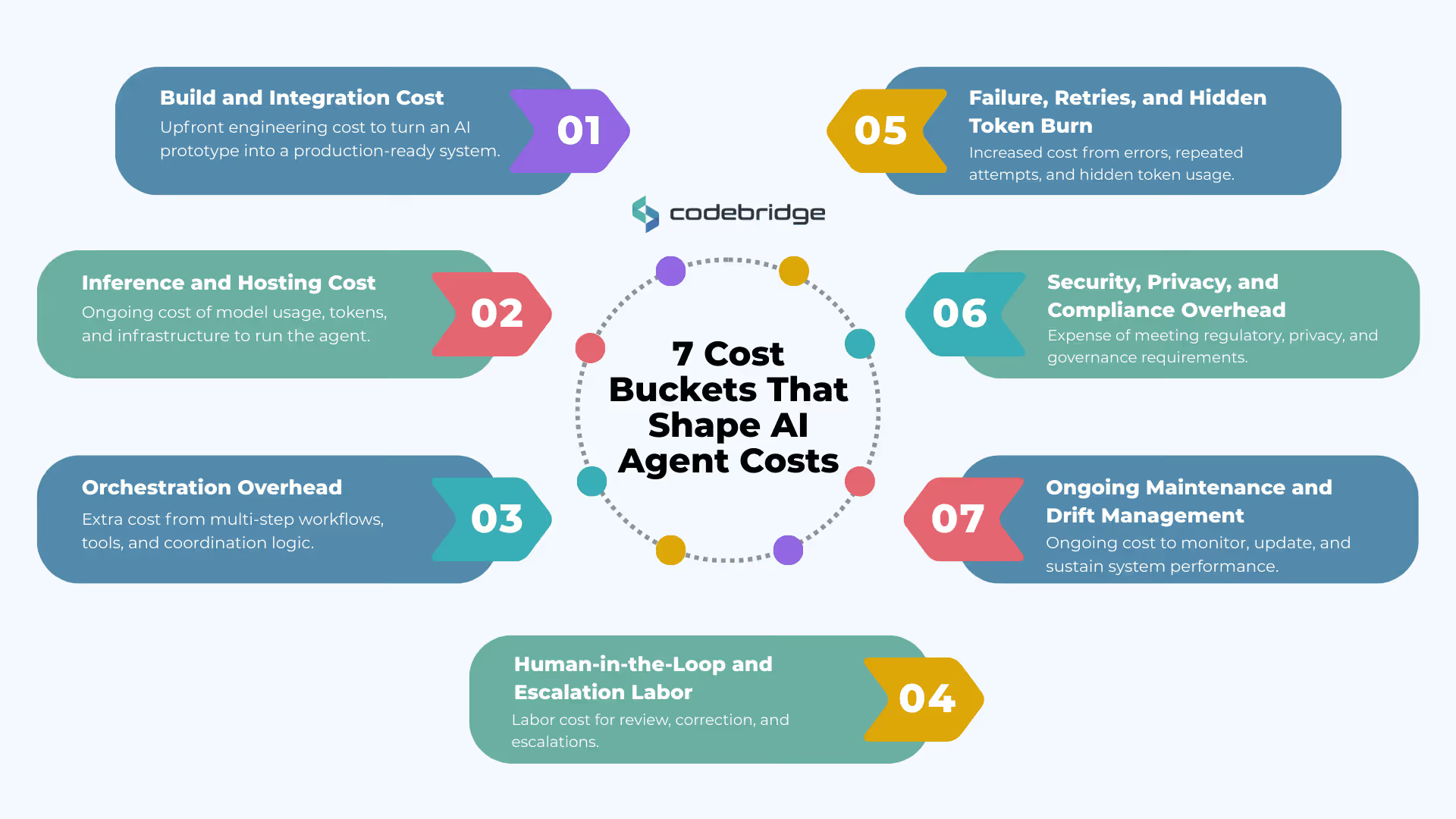
1. Build and Integration Cost (Amortized)
Bringing an AI agent from proof-of-concept to production requires significant engineering investment. This isn't about training models from scratch – most organizations use pre-trained LLMs via API or fine-tune existing models. Rather, it's the productization work: building interfaces between the LLM and business systems, mapping workflows, creating evaluation harnesses, implementing safety controls, and iterating through pilot testing.
McKinsey data provides useful benchmarks. Integrating an off-the-shelf coding assistant for a development organization: approximately $500,000, requiring a team of 6 engineers for 3-4 months. Building a general-purpose customer service chatbot with custom integrations: roughly $2 million, with a team of 8 working for 9 months.
These figures reflect a realistic scope: connecting to CRM systems, implementing data validation, building retry logic, creating dashboards for monitoring, establishing escalation workflows, and conducting extensive testing across edge cases. Organizations that budget only for "prompt engineering" consistently underestimate by 5-10 times.
This is why custom AI agent development requires upfront scoping across all seven cost buckets — not just model costs and prompt design.
2. Inference and Hosting Cost
Direct model inference costs, the actual API charges, or GPU expenses, are the most visible operational expense. Current 2026 pricing for enterprise-grade models shows wide variance:
For a typical autonomous agent handling a customer support ticket (roughly 8,000 input tokens, including context, and 2,000 output tokens):
- GPT-4.5 Mini: ~$0.006 per ticket (inference only)
- GPT-5.2: ~$0.042 per ticket (inference only)
- Claude 3.5 Sonnet via AWS Bedrock: ~$0.108 per ticket (inference only)
These per-call costs appear trivial, which is precisely why organizations get surprised when monthly bills arrive. Several factors drive actual consumption far above these baseline numbers:
Context size variability: Agents dealing with long documents or extensive conversation histories can consume 50,000-100,000 tokens per request. At $6 per million input tokens (Claude pricing), a 100,000-token context costs $0.60 just for the input – already 100 times higher than the simple example above.
Verbosity and reasoning overhead: Some models generate more verbose outputs than others for the same question. More critically, certain reasoning approaches, chain-of-thought, self-critique, planning, can multiply token generation.
Hidden reasoning tokens: Some newer model features use additional tokens internally that don't appear in outputs but are billed. Providers implementing extended reasoning modes may consume 10,000-50,000 hidden tokens per complex request, turning what appears to be a $0.01 call into a $0.30+ charge.
Organizations running millions of queries monthly on ChatGPT-5‑class models report annual inference costs of $200,000 to $2 million, depending on use case complexity and volume. At scale, inference is not negligible.
3. Orchestration Overhead
Modern AI agents are workflows, not single API calls. Production systems typically implement:
Vector databases for retrieval-augmented generation (RAG): Storing millions of document embeddings and enabling semantic search requires dedicated infrastructure. Managed services charge $2,000-10,000 monthly, depending on corpus size and query volume.
Embedding generation: Each query must be embedded for similarity search. While embedding APIs are cheap per call ($0.0001 per query), at 10 million monthly queries, this becomes $1,000.
Multi-step reasoning patterns: Agents using ReAct, reflection, or planning frameworks often call the LLM multiple times per task. A planning agent might generate a plan (call 1), execute it (calls 2-4 for different tools), then critique and revise (call 5). Each call multiplies cost.
Tool integration costs: Agents that query databases, call external APIs, or manipulate business systems incur those third-party costs. While often minor per task, high-frequency operations accumulate. More importantly, tool calls that fail require retry logic, error handling, and sometimes human escalation, adding operational complexity.
The canonical disaster story from 2025 illustrates the risk: a LangChain multi-agent system entered an infinite conversation loop between two agents, running for 11 days and generating $47,000 in API charges before anyone noticed. While extreme, this highlights that orchestration complexity creates failure modes that can instantly destroy cost assumptions. Even without catastrophic failures, loose retry logic or overly complex agent interactions routinely double or triple per-task costs.
4. Human-in-the-Loop and Escalation Labor
Despite "autonomous" branding, most production AI agents have humans involved at critical junctures – either reviewing outputs, handling exceptions, or taking over when the AI fails.
The cost model differs dramatically by industry and risk tolerance:
Sampling-based review: Lower-stakes applications might review 5-10% of outputs. If escalations require 5 minutes of a $30/hour worker's time, and 8% of tasks are reviewed, that adds roughly $0.20 per task on average ($30/60 × 5 × 0.08).
Risk-tiered review: Many organizations route low-confidence or high-stakes outputs to humans. For example, a contracts agent might auto-approve standard NDAs but flag merger agreements for attorney review. This keeps human costs concentrated on truly valuable work, but requires reliable confidence scoring from the AI.
Universal professional review: Legal, healthcare, and financial services often mandate 100% expert review of AI outputs initially. When a $200/hour attorney spends 15 minutes checking an AI-drafted document, that's $50 of labor on top of minimal AI costs. In these domains, AI functions as a productivity multiplier for humans rather than a replacement, and cost models must reflect blended human-AI economics.
Escalation handling: When agents fail mid-task and escalate to humans, costs multiply. The human must understand what the agent attempted, where it failed, and how to complete the work – often taking longer than if they'd started from scratch.
The escalation rate is the single most important parameter in determining cost per success. An agent with 90% autonomous resolution and 10% escalation has very different economics than one with 70% autonomous resolution.
5. Failure, Retries, and Hidden Token Burn
The reliability equation fundamentally shapes costs: Cost per successful task = (Cost per attempt) ÷ (Success rate).
A model that costs $0.01 per attempt but succeeds only 50% of the time effectively costs $0.02 per success. A model that costs $0.05 per attempt but succeeds 95% of the time costs $0.053 per success. This counterintuitive math explains why organizations often choose more expensive models; they're cheaper per desired outcome.
Retry overhead: When initial outputs fail validation (wrong format, missing fields, incorrect information), systems typically retry with modified prompts. Each retry consumes more tokens. An agent attempting a task three times before succeeding has tripled its token costs for that success.
Hidden Token Consumption
Some newer model features use additional tokens internally that don't appear in outputs but are billed. Providers implementing extended reasoning modes may consume 10,000-50,000 hidden tokens per complex request, turning what appears to be a $0.01 call into a $0.30+ charge.
Prompt escalation and bloat: To improve reliability, engineers often expand prompts with additional instructions, examples, and constraints. A prompt that started at 100 tokens might grow to 500 tokens through iterative refinement. This 5 times increase in prompt size persists across every subsequent API call, permanently raising costs unless actively managed.
Validation and judge patterns: Some teams use a second LLM call to validate or score the first LLM's output, accepting the doubled inference cost in exchange for higher success rates. This is cost-effective when it prevents expensive human escalation, but it requires careful measurement to ensure the quality gain justifies the cost.
Development and debugging time: Failed agent outputs require engineering investigation. Time spent debugging prompt issues, tuning retrieval parameters, or fixing integration bugs is a labor cost that should be amortized into the cost per task during the scaling phase. Organizations that budget only for successful steady-state operation miss this.
We summarized the failure‑cost dynamic: "A $0.002 model that needs three retries, your engineers' fifth prompt revision, and a manual fix is far more expensive than a $0.02 model that works the first time.
6. Security, Privacy, and Compliance Overhead
In regulated industries, such as healthcare, financial services, legal, and government, compliance infrastructure can exceed runtime inference costs by an order of magnitude.
HIPAA compliance in healthcare: Any AI agent handling protected health information requires rigorous controls. Organizations must implement:
- Business Associate Agreements (BAAs) with all LLM providers
- De-identification pipelines to strip patient identifiers before LLM processing
- Audit logging of every data access and model interaction
- Encrypted storage and transmission
- Regular security assessments
Regional Medical Center, attempting to build clinical AI without early compliance planning, spent $2.8 million across failed projects due to data quality and governance gaps, including heavy consulting and infrastructure costs, before achieving success.
Financial services and SOC 2: Banks deploying AI agents must satisfy internal model risk management frameworks and external audits. Achieving SOC 2 certification, implementing proper access controls, and establishing model governance processes can require thousands in certification costs plus months of engineering effort.
GDPR in European operations: Organizations processing EU citizen data must implement data minimization, user consent mechanisms, and the right to explanation for automated decisions. This often requires significant modifications to agent architectures and additional legal review.
7. Ongoing Maintenance and Drift Management
Production AI agents require continuous care:
MLOps and monitoring: Running production systems requires dedicated engineering. McKinsey suggests budgeting approximately 10% of initial development cost annually for maintenance. For a $2 million build, that's $200,000 per year. Larger deployments may require 3-5 engineers full-time to monitor performance, maintain integrations, update prompts as models evolve, and handle incident response – implying $1-4 million annual staffing cost.
Model updates and re-training: When underlying LLM providers release new model versions, teams must test compatibility and potentially refactor prompts or workflows. Organizations using fine-tuned models may need to retrain periodically as business data evolves, each retraining run costing $100,000+ in compute and engineering time.
Regression testing and evaluation: As systems evolve, rigorous testing ensures quality doesn't degrade. Building and maintaining evaluation harnesses, gold-standard test sets, and automated quality checks requires ongoing investment.
For an agent handling 1 million tasks annually, $500,000 in annual maintenance translates to $0.50 per task overhead. For a niche agent handling 10,000 tasks, that same $500,000 means $50 per task, potentially making the agent economically unviable despite low inference costs.
How to Cut AI Agent Costs Without Losing Quality
To prevent hidden costs from eroding ROI, organizations must manage AI agents as production systems, not experimental tools. Cutting costs does not mean reducing quality; it means controlling failure rates, routing intelligently, and eliminating structural inefficiencies. So, the objective is not cheaper model calls, but lower cost per successful outcome without increasing risk.
1. Route by Complexity (Multi-Model Routing)
Rather than using a single model for all tasks, successful organizations deploy portfolios and dynamically route based on complexity:
- Simple FAQ queries → lightweight, inexpensive models
- Complex troubleshooting → premium models with higher reasoning capability
- High-stakes or legally sensitive → most capable models plus human review
This requires a classification layer - either a small model that scores query complexity, or business logic that detects patterns (keywords, conversation length, sentiment). One organization implementing complexity-based routing reduced costs 65% with minimal quality impact by reserving expensive GPT-4 calls for only the 20% of queries that truly needed that capability.
The key is empirical measurement. Teams should continuously benchmark multiple models against their specific tasks, as capabilities and pricing evolve monthly. A model too weak last quarter may be viable now. A model you're overpaying for may have been surpassed by a cheaper alternative.
2. Reduce Tokens Structurally
Prompt minimization: Regularly audit system prompts and remove redundant instructions. Tiktokenizer, in one of its articles, shows how a 650-token prompt can be transformed into a 280-token prompt without quality loss, cutting costs 57% on that component.
Output constraints: Explicitly constrain response length when possible. "Provide a 2-sentence summary" is cheaper than "summarize this document," which might produce 500 words.
Conversation history management: In multi-turn conversations, summarize older turns rather than sending the full history with each new message. This prevents exponential token growth.
3. Caching and Semantic Reuse
Many real-world workloads exhibit repetition. Common questions get asked repeatedly. Standard operating procedures are referenced frequently. Caching exploits this:
Provider-level caching: OpenAI and other providers offer substantial discounts (50-90%) for repeated prompts. Structure prompts to maximize cache hits.
Application-level caching: Store frequent query-answer pairs and intercept similar requests before hitting the LLM.
Semantic caching: More systems use embedding similarity to determine if an incoming query is semantically similar to a previous one. If similarity exceeds a threshold, return the cached answer without calling the LLM.
4. Fine-Tuning and Distillation for High-Volume Task Families
When task volume justifies upfront investment, training specialized, smaller models can dramatically reduce per-task inference costs:
Distillation using large model outputs: Generate a high-quality training dataset using GPT-5, then train a smaller "student" model on that data. This allows the student to approximate GPT-5 quality at significantly lower runtime cost.
Volume thresholds: Fine-tuning makes economic sense when you'll run millions of similar queries. A $200,000 fine-tuning investment paid back through $0.01 per query savings requires 20 million queries to break even, achievable for high-volume customer service but not for specialized internal tools.
5. Implementing Guardrails and Monitoring to Prevent Waste
Loop detection and recursion limits: Prevent agents from calling the LLM more than N times per task. Set absolute token budgets per task. This contains rare but expensive failure modes.
Real-time monitoring: Track token usage patterns, unusual spikes, and anomalous behavior. Alert on thresholds to catch bugs before they rack up massive bills.
Prompt versioning and canary testing: Treat prompts like production code. A/B test changes on small traffic samples. If cost-per-task or success rate degrades, automatically roll back. This prevents well-intentioned optimizations from accidentally doubling costs.
SLOs for agents: Define service level objectives for latency and cost-per-task. Use automated policies to keep agents within budget constraints.
Robust observability often pays for itself within weeks by identifying token leaks, inefficient retrieval, or unnecessary escalations.
6. Humans in the Loop – Optimized, Not Eliminated
Risk-tiered review: Reserve expensive human review for high-stakes outputs. Auto-approve low-risk tasks. This can reduce review burden while maintaining quality where it matters.
Statistical sampling: Review 10% of outputs randomly. If quality remains high, let the other 90% operate autonomously. If errors appear, tighten oversight or retrain.
Confidence-based routing: When the AI's confidence score is high, proceed autonomously. When low, involve a human. Calibrating this threshold is critical – too conservative forfeits savings, too aggressive increases error rates.
Junior review tiers: Use lower-cost staff for initial review, escalating only exceptions to senior specialists. This reduces average review cost per task while maintaining quality.
A Decision-Maker's Checklist
Before scaling an AI agent deployment, executives should demand clear answers to:
Performance metrics:
- What is the current autonomous success rate?
- What percentage of tasks escalate to humans, and why?
- What is the measured cost per successful task, fully loaded?
- How does this compare to the cost of the current human-driven process?
Operational readiness:
- Do we have monitoring in place to detect cost spikes, quality degradation, or security issues?
- Have we established SLOs for latency, accuracy, and cost?
- Can we roll back changes quickly if performance degrades?
Compliance and risk:
- For regulated workloads, have we satisfied all legal, privacy, and security requirements before scaling?
- Do we have appropriate human oversight for high-stakes decisions?
- Have we quantified the potential cost of errors or compliance failures?
Economic sustainability:
- Can we articulate the business case: cost per task × task volume × cost reduction versus the current process?
- Have we amortized build costs realistically across expected volume?
- Do we have a plan to reduce the cost per task as we scale through fine-tuning, caching, or routing optimization?
The right question is never "What's the AI agent price?" The right question is "What's our AI agent cost per resolved outcome, and is that competitive with alternatives?"
The 2026 Reality
Organizations succeeding with AI agents in 2026 share common characteristics. They treat agents as production systems requiring engineering rigor, not experiments. They measure cost per successful outcome, not cost per API call. They invest in compliance and quality infrastructure upfront rather than retrofitting it later. They accept that full autonomy is rare and design human-AI collaboration workflows intentionally.
Those failing typically underestimate the gap between prototype and production. They focus on minimizing visible AI spend while hidden costs, retries, escalations, compliance remediation, and organizational friction accumulate uncounted.
The technology is real. The business value is achievable. But neither comes cheap, and both require treating AI agents with the operational discipline we apply to any mission-critical software system. Organizations that internalize this reality, that success is built on infrastructure, governance, and relentless focus on cost per business outcome, will extract enormous value. Those chasing the illusion of effortless, near-zero-cost automation will join the rest still searching for ROI.














Heading 1
Heading 2
Heading 3
Heading 4
Heading 5
Heading 6
Lorem ipsum dolor sit amet, consectetur adipiscing elit, sed do eiusmod tempor incididunt ut labore et dolore magna aliqua. Ut enim ad minim veniam, quis nostrud exercitation ullamco laboris nisi ut aliquip ex ea commodo consequat. Duis aute irure dolor in reprehenderit in voluptate velit esse cillum dolore eu fugiat nulla pariatur.
Block quote
Ordered list
- Item 1
- Item 2
- Item 3
Unordered list
- Item A
- Item B
- Item C
Bold text
Emphasis
Superscript
Subscript