In October 2025, the long-standing narrative of cloud invincibility broke down when Microsoft Azure experienced an eight-hour outage that affected every global region simultaneously. The failure originated in Azure Front Door, Microsoft’s global load-balancing and security service. A configuration cascade disabled Microsoft 365, Entra Identity, and Azure Kubernetes Service, disrupting millions of users and critical enterprise workloads worldwide.
Just days earlier, AWS suffered a 15-hour disruption in US-EAST-1, with cascading failures across multiple services impacting more than 17 million users, according to Downdetector. These incidents were not isolated. In June, a Google Cloud outage disabled 76 services at once, and in November, a Cloudflare disruption took X, ChatGPT, Discord, and Spotify offline.
The Azure outage cost the global economy an estimated $4.8 billion and $16 billion, using Gartner's benchmark of $5,600 per minute of IT downtime. The real damage wasn't just financial. The infrastructure designed for global resilience had become a single point of failure.
From Cost Center to Product Differentiator
Until 2023, infrastructure was an afterthought. Teams picked AWS because they knew it, chased vendor discounts, and built products first – then figured out deployment later.
However, by 2026, this relationship has reversed. Infrastructure choices now directly shape business models, and today, product releases are often delayed not by engineering challenges, but by rules about where data must be stored and processed. For example, a company cannot expand into the EU or healthcare markets without GDPR- or HIPAA-compliant regional infrastructure, which may require providers beyond its primary cloud vendor.
Reliability has also become a competitive differentiator. In commoditized SaaS markets, uptime guarantees increasingly separate competitors, while downtime penalties in enterprise contracts can erase an entire month’s margin. Unit economics are likewise determined by infrastructure strategy: egress fees can invalidate pricing models, and provider lock-in restricts future pricing flexibility.
Gartner projects that 90% of enterprises will adopt hybrid cloud by 2027, because companies want pricing power and specialized tools like Google's BigQuery for analytics, Azure for OpenAI access, and not just commodity compute. When a roadmap includes launching in multiple regions by a specific quarter, infrastructure is no longer a DevOps detail – it is a core product architecture requirement.
What the 2025 Outages Actually Revealed
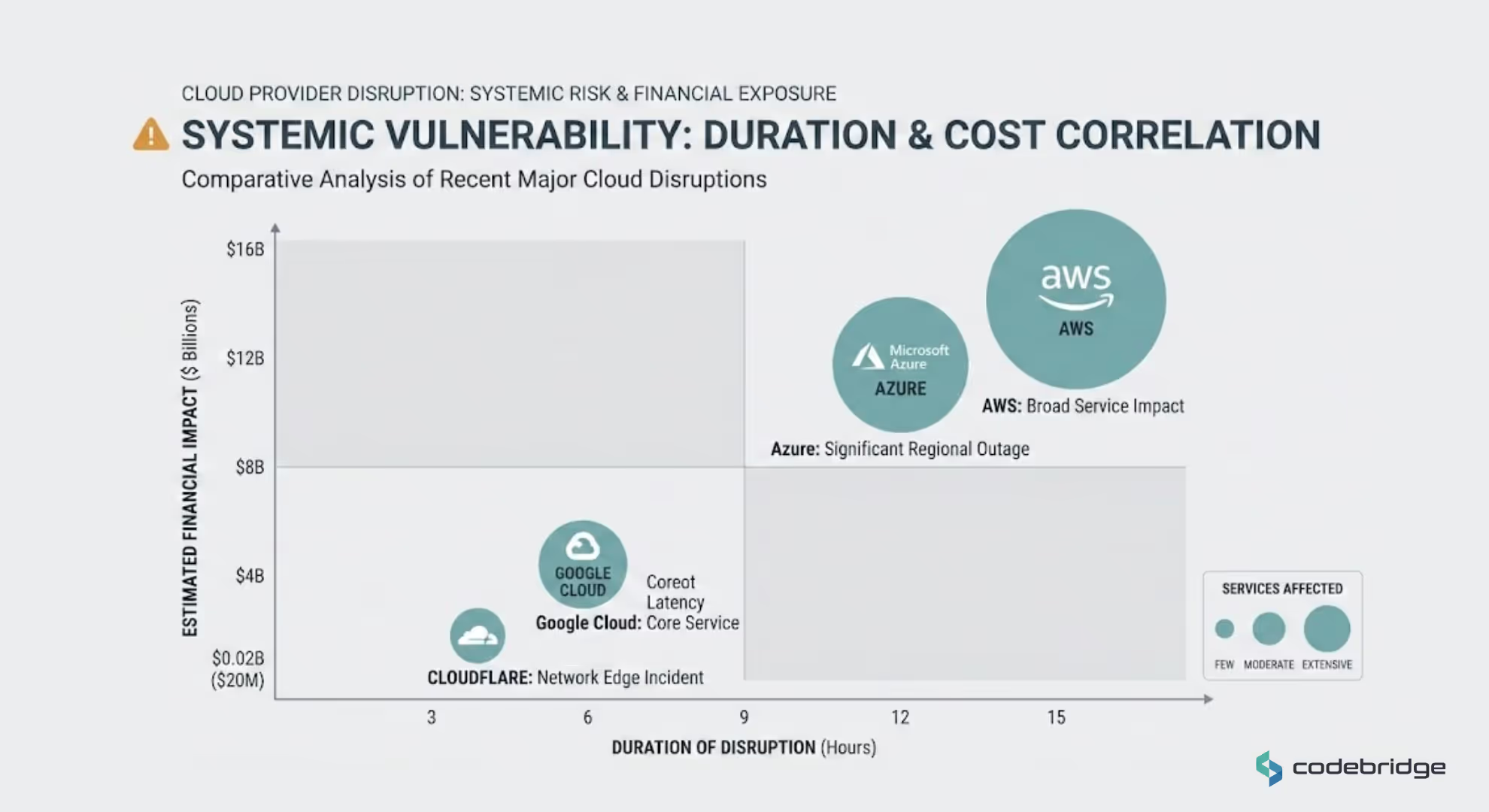
The failures of 2025 exposed a fundamental architectural reality: hyperscalers have transitioned from hardware redundancy to software-defined abstraction. This shift created a new failure mode known as “abstraction collapse.”
2025 Major Hyperscaler Outages
None of these incidents was caused by a hardware failure. All were triggered by software. Hyperscalers use shared control planes to manage resources globally. When that layer breaks, everything breaks everywhere. Therefore, a single configuration change can propagate worldwide in minutes, disabling thousands of unrelated applications simultaneously.
It's the same mistake IT made decades ago: don't put all your servers in one data center. Now, companies put all their workloads under one cloud provider's control.
For e-commerce, an AWS outage during Black Friday can cost $75 million per hour. For SaaS, an eight-hour Azure outage can invalidate SLAs for an entire month, triggering contractual credits and reputational damage.
The Regulatory Earthquake Ending Lock-In Economics
For years, hyperscaler lock-in was sustained by egress fees, typically $0.05 to $0.085 per GB. Migrating 50TB of data could cost up to $7,000 in transfer fees alone, creating a financial barrier to switching providers.
This model is now being dismantled by regulation. The European Union’s Data Act directly targets egress fees by requiring cloud providers to make data portable and affordable to move between platforms. Beginning in 2025, providers must reduce transfer charges to cost-based levels, and by 2027, they must eliminate them.
- Phase 1 (Sept 2025 – Jan 2027): Egress fees are capped at “at-cost” levels.
- Phase 2 (from Jan 2027): Egress fees are prohibited entirely.
The main goal of the European Union’s Data Act is to remove these artificial barriers to switching vendors and restore competition based on service quality rather than exit penalties.
Similar actions are emerging elsewhere. The UK Competition and Markets Authority found that AWS and Azure control up to 80% of the market through anti-competitive licensing and egress fees. In the US, the FTC is investigating bundled licensing as a potential antitrust violation. Anticipating this shift, Google waived egress fees for EU and UK customers in late 2025.
By 2027, strategic lock-in will no longer be a viable business model. Products built entirely on proprietary services such as AWS Lambda or Aurora, without portability plans, are operating on an economic model that is expiring.
The Cost Opacity Crisis and the FinOps Requirement
Multi-cloud improves resilience but introduces a “cost multiplication effect.” In 2025, 69% of organizations routinely exceed their infrastructure budgets due to poor visibility. This volatility reflects a governance gap, where infrastructure complexity is growing faster than financial control.
Unfortunately, hidden costs extend beyond compute. For instance, they include $72 per month control plane fees for each cluster, GPU idle time, and cross-region transfer charges.
Ironically, most enterprises adopt multi-cloud to cut costs, but only 25% will hit ROI by 2028, predicts Gartner. Why? Because seeing costs isn't the same as controlling them – and most companies lack the governance to act on what they learn. Managing multiple clouds effectively, therefore, requires FinOps, a practice that ties infrastructure spending to business goals.
- Accountability and Ownership: 70% of companies cannot accurately attribute cloud costs to teams, while 84% identify spend management as their top challenge. However, FinOps connects engineering decisions with financial consequences.
- Granular Cost Allocation: Without unified dashboards spanning AWS, Azure, and GCP, inefficiencies remain invisible. FinOps enables showback and chargeback models tied to specific teams, products, or features.
- Optimizing the Variable Cost Model: FinOps enables rightsizing, use of Spot Instances, and Reserved Instance management so organizations pay only for what they consume.
Multi-Cloud as Product Architecture
The legacy model – where product teams design features and DevOps later adapts the infrastructure – is no longer viable. In practice, this separation creates late-stage constraints: features are built without considering where data must live, how uptime is guaranteed, or which providers meet regulatory requirements. Modern organizations therefore adopt a product–infrastructure co-design approach, where technical architecture is defined alongside product functionality rather than after it.
Under this model, multi-cloud is not an operational afterthought but a set of product requirements driven by market access and pricing strategy.
Multi-Cloud as Product Requirements
- Global Expansion:
Launching in the EU requires GDPR-compliant regional infrastructure. Without providers that support data residency in specific geographies, product expansion is blocked regardless of feature readiness. - Enterprise SLAs:
No single provider guarantees 99.99% uptime. When enterprise contracts demand this level of availability, active-passive multi-cloud failover becomes a contractual necessity rather than an engineering preference. - Cost-Competitive Pricing:
Margin leadership depends on controlling unit economics. Automated workload placement across providers based on real-time pricing allows organizations to preserve margins without changing the product itself. - Compliance:
Healthcare and financial services require providers with specific HIPAA or SOC 2 certifications and localized controls. These constraints determine which markets a product can serve, independent of its feature set.
A product should move to multi-cloud when regulatory compliance requires specific geographies, or vendor lock-in limits pricing flexibility. Single-cloud should not be assumed “simpler” without accounting for the 40% re-architecture exit cost.
Four Strategic Imperatives for Decision-Makers
1. Audit Infrastructure Lock-In
Map proprietary dependencies such as Aurora, BigQuery, or Lambda. Calculate switching costs, including egress fees, re-architecture, and downtime. If exit costs exceed six months of revenue, architectural risk is existential.
2. Integrate Infrastructure into Product Planning
Infrastructure requirements – data residency, failover SLAs, compliance – must be defined alongside features. If DevOps uncovers them at launch, the planning process is broken.
3. Implement FinOps Discipline
Use centralized dashboards across providers. If next month’s bill cannot be predicted within a 10% margin, governance is insufficient. Tag resources so teams own feature margins.
4. Design for Multi-Cloud Resilience
Adopt distributed databases and IaC tools like Terraform. Test cross-cloud failover quarterly. If the product cannot survive a primary provider outage, it is not resilient.
Infrastructure Is Product Strategy
The events of 2025 showed that cloud reliability and portability are still open problems for many companies and that these three shifts are irreversible:
- Economic: When providers can no longer rely on egress fees to trap customers, they must compete more directly on performance and reliability.
- Operational: Downtime costs show that resilience cannot be outsourced to a single vendor.
- Strategic: Infrastructure determines market access and margin protection.
Infrastructure has moved from a background concern to a central part of product value. The organizations that lead beyond 2026 will treat portability and multi-region resilience as day-one requirements, turning infrastructure flexibility into a competitive advantage. The real challenge is building products that can survive outages while still delivering consistent performance to customers.











Heading 1
Heading 2
Heading 3
Heading 4
Heading 5
Heading 6
Lorem ipsum dolor sit amet, consectetur adipiscing elit, sed do eiusmod tempor incididunt ut labore et dolore magna aliqua. Ut enim ad minim veniam, quis nostrud exercitation ullamco laboris nisi ut aliquip ex ea commodo consequat. Duis aute irure dolor in reprehenderit in voluptate velit esse cillum dolore eu fugiat nulla pariatur.
Block quote
Ordered list
- Item 1
- Item 2
- Item 3
Unordered list
- Item A
- Item B
- Item C
Bold text
Emphasis
Superscript
Subscript