AI systems are now being deployed in operational environments where failures can have real-world consequences. In such high-stakes contexts, defense institutions, known for strict access controls and zero tolerance for compromise, are now using AI in production systems that support real operational decisions.
At the same time, most commercial enterprises remain stuck in a different phase of the AI lifecycle. Internal committees debate governance models, pilot programs accumulate without reaching production, and engineering teams struggle to transform experimental models into reliable infrastructure. Industry estimates suggest that nearly 95% of AI pilots never progress to production. This happens often due to missing data pipelines, unclear accountability, and insufficient operational controls.
Therefore, the recent wave of defense AI contracts represents more than procurement news. These deals reveal the architectural standards required before AI can operate in mission-critical environments.
For enterprise leaders, they offer a rare view into what production-grade AI security actually looks like in environments where system reliability is mandatory.
The Signal Behind the Headlines
To understand the current state of production-grade AI, organizations must analyze the specific infrastructure that defense entities are buying rather than the models themselves. Increasingly, these deals focus less on which model performs best in isolation and more on the conditions under which AI systems are permitted to operate.
The recent agreement between OpenAI and the U.S. Department of Defense illustrates this shift. The deployment architecture keeps OpenAI’s models inside controlled cloud environments connected to classified systems rather than pushing them to tactical edge deployments.
This structure allows the vendor to maintain continuous oversight of its safety mechanisms, including classifiers and monitoring systems that can be updated independently of the customer’s infrastructure. The arrangement reflects a broader architectural compromise: enabling operational use of AI while preserving enforceable safety controls and clearly defined restrictions on sensitive applications.
At the same time, OpenAI is reportedly exploring the deployment of its systems across NATO’s unclassified networks. While it is still under discussion, the potential agreement signals that AI systems are moving beyond isolated pilot projects toward institutional infrastructure shared across allied defense organizations.
Taken together, these developments indicate a shift in how advanced AI is being integrated into critical environments. Now, the focus has shifted from model capability to the operational safeguards required before AI can run inside sensitive systems.
What Defense Deployments Actually Enforce
Defense AI deployments reveal an important shift: AI is not treated as a feature, but as a semi-autonomous runtime governed by strict operational controls.
Across recent defense systems, four engineering patterns consistently appear.
Pattern 1: Strict Data Domains and Isolated Environments
Production AI in defense is almost always defined by strictly partitioned data domains. Rather than allowing models to access unrestricted enterprise data, defense deployments enforce strict separation between environments based on classification and risk.
Platforms such as the U.S. Department of Defense’s GenAI.mil provide access to AI capabilities only within environments certified for Controlled Unclassified Information (CUI) and Impact Level 5 (IL5). NATO infrastructure procurement similarly emphasizes sovereign and isolated deployments, including air-gapped configurations disconnected from the public internet.
For enterprise organizations, production AI cannot operate as a loosely governed sandbox. Data access, computation environments, and administrative privileges must align with explicit data classification policies.
Pattern 2: The AI Control Plane and Identity-First Execution
Model accuracy alone is insufficient for reliable AI systems. Organizations must be able to trace decisions, restrict system actions, and intervene an AI system safely when risk increases.
To To enforce these controls, advanced deployments introduce an AI Control Plane that governs how models interact with tools and APIs.
Within this architecture, every action passes through a policy enforcement point (PEP) that verifies whether a request is permitted and acts as a mandatory gate before any high-impact step.
In agentic and orchestration systems, there must be a dedicated, scoped identity, as shared API keys are insufficient when agents can mutate state. Instead, every tool invocation must be treated as a privileged service call.
This architecture ensures that each tool invocation becomes a controlled service request where the system verifies:
- Which agent is acting
- On whose behalf
- In which environment
- For what task
These constraints limit the potential impact of compromised prompts or manipulated model outputs.
Pattern 3: Governing Agentic Workflows and the "Lethal Trifecta"
As AI systems gain the ability to invoke tools, execute commands, or interact with external systems, the attack surface expands significantly.
A common failure mode appears when three conditions occur simultaneously:
- Untrusted Data: Attacker-controlled data enters the model via documents, emails, or websites.
- Access: The AI agent has access to sensitive internal systems or data.
- Ability to Send/Execute: The AI agent can initiate commands or send data to the outside world.
Security researchers sometimes describe this combination as the “lethal trifecta.”
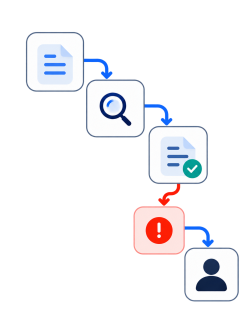
Defense architectures mitigate this risk by treating models as advisory systems rather than autonomous executors. One common pattern is two-phase execution:
- In the first phase, the model proposes a plan or recommended action.
- In the second phase, a control layer evaluates the proposal and executes it only after policy checks and, when required, human approval.
Autonomous Execution vs Controlled Agent Architecture
Pattern 4: Supply Chain Resilience and MLSecOps
Production AI systems must also address risks in the machine learning supply chain. If training data, model weights, or dependencies are compromised, the system’s behavior can change.
To manage this risk, defense programs extend traditional DevSecOps practices into Machine Learning Security Operations (MLSecOps). This includes maintaining an AI Bill of Materials (AIBOM) that inventories datasets, model components, and external dependencies.
Organizations also implement cryptographic verification of model artifacts to ensure that models deployed in production match the versions that were tested and approved. This creates a verifiable chain of trust across the AI lifecycle.
Mapping Defense Practices to Established Security Frameworks
The security patterns seen in defense AI deployments closely align with several widely recognized AI security frameworks. What appears as specialized military infrastructure often reflects the practical implementation of principles already outlined in frameworks such as the NIST AI Risk Management Framework, Google’s Secure AI Framework (SAIF), and the OWASP Top 10 for LLM and agentic applications.
Examining these deployments provides a concrete view of how high-level governance and security recommendations translate into enforceable operational controls.
1. NIST AI Risk Management Framework (AI RMF 1.0)
The NIST AI Risk Management Framework places governance at the center of AI security. It requires organizations to define who owns the risks associated with an AI system, how those risks are monitored, and how decisions are reviewed throughout the system’s lifecycle.
In defense environments, these governance principles translate into concrete operational rules. Responsibility for AI outcomes is explicitly assigned, and deployment conditions are defined before a system is introduced into a production environment. Teams document intended use cases, identify the limits of the model’s knowledge, and restrict how the system interacts with sensitive data.
The framework’s lifecycle functions – Map, Measure, and Manage — are reflected in how organizations structure AI environments.
Systems operate inside clearly defined data domains, such as the Impact Level 5 (IL5) environments used for controlled information within the U.S. Department of Defense’s GenAI.mil platform. Once deployed, these systems are continuously monitored for performance drift or adversarial signals that may require intervention.
The main takeaway is that secure AI deployment begins with governance and clearly defined accountability. Technical safeguards are effective only when they operate within a structured risk management process.
2. Google’s Secure AI Framework (SAIF)
Google’s Secure AI Framework (SAIF) provides guidance for building AI systems that remain secure throughout their lifecycle, from model development to deployment and ongoing operation. The framework emphasizes protecting AI infrastructure, controlling how models interact with external systems, and securing the ML supply chain.
Many organizations use SAIF as a reference for designing the technical security architecture around AI systems. This includes establishing dedicated control layers that govern how models access data and interact with internal services.
In practice, organizations treat AI systems as infrastructure governed by strict security boundaries. It also extends traditional security practices into the ML lifecycle by introducing measures such as model provenance verification, dependency tracking, and supply chain protection.
Several recent defense initiatives reflect these architectural principles. For instance, NATO’s procurement of Google Distributed Cloud infrastructure highlights the importance of environment isolation and sovereign deployment models. These systems are designed to operate within tightly controlled networks, including air-gapped configurations that separate sensitive workloads from the public internet.
Defense organizations also increasingly require machine-readable AI Bills of Materials (AIBOMs) to track model components and third-party artifacts that may introduce supply chain risk.
3. OWASP Top 10 for LLM and Agentic Applications
The OWASP Top 10 for LLM and Agentic Applications identifies the most common security risks introduced by generative AI systems. The framework focuses on risks that mainly arise from how models interpret instructions, interact with external tools, and process untrusted data. OWASP Top 10 highlights issues such as prompt injection, insecure output handling, excessive autonomy, and unintended data exposure.
Organizations use the OWASP guidance to evaluate how AI systems interact with internal infrastructure and external inputs. Security teams often apply it during application design and testing to identify situations where a model could be manipulated through crafted prompts or trigger unintended actions through connected tools and APIs.
Many companies mitigate these risks by introducing architectural controls around AI agents. Systems often enforce Least Model Privilege, limiting the actions a model can perform and treating its outputs as recommendations rather than executable commands.
Additional safeguards include tool gateways that validate model-initiated requests, output filtering layers, and human review for high-risk operations.
generative AI introduces security risks that originate from how models interpret instructions and interact with external systems. Managing these risks requires architectural controls around agent behavior, not only traditional application security measures.
Synthesis: Framework Alignment Mapping
The following table illustrates how defense-grade patterns are effectively the production enforcement of these frameworks:
The Enterprise AI Production Checklist
To transition from experimental pilots to production-grade infrastructure, engineering leaders must move beyond model evaluation and focus on system-level survivability. Defense-grade security reveals that if an AI system cannot answer how did it fail or how was it contained, it remains a prototype with unmanaged risk. The following checklist provides a technical and operational blueprint for establishing a production-ready AI environment.
1. Control and Identity: Establishing the Workload Perimeter
In production, AI agents must be treated as privileged service accounts rather than simple chat interfaces. Traditional credential management is insufficient when an agent possesses the autonomy to mutate system states.
- Dedicated Workload Identities: Every agent and orchestrator must be assigned a unique, scoped workload identity. Shared API keys or long-lived secrets are unacceptable for production execution as they create unbounded blast radiuses in the event of a prompt injection or credential theft.
- Two-Phase Execution Pattern: Architecture should explicitly decouple reasoning from execution.
- Phase one involves the model proposing a plan or dry run summary
- Phase two requires the control plane to gate that plan against policy enforcement points (PEP) before any state-changing action is triggered.
- Operation-Scoped Permissions: Permissions must be scoped to specific tasks (e.g., "create ticket") rather than broad tool access (e.g., "full Jira access"). This ensures that even if an agent is manipulated, its functional capability is restricted to the absolute minimum required for the transaction.
2. Infrastructure Isolation: Hardening the Runtime
AI workloads, particularly those capable of executing generated code, require stronger isolation than standard process-level containers.
- Advanced Sandboxing: Deploy untrusted AI-generated workloads within hardened sandbox environments that isolate execution from the host system and restrict system-level access. For multi-tenant environments or those requiring GPU passthrough, Kata Containers provide micro-VM isolation with a hardware virtualization boundary, making escapes fundamentally more difficult.
- Network Segmentation: Production AI must reside within private subnets (Private Google Access) to ensure compute resources reach necessary APIs over private networks, bypassing the public internet entirely.
3. Data Provenance and RAG Governance: Securing the "Truth"
Retrieval-Augmented Generation (RAG) is not just a quality feature; it is a critical security boundary where truth enters the system. If the retrieval layer is stale or poisoned, the model will faithfully execute a plan based on false premises.
- Provenance Tagging: Every retrieved data chunk must be labeled with its source, owner, classification level, and timestamp.
- Staleness Budgets: Organizations should define a staleness budget for retrieved information. If a runbook or data source is older than a defined threshold, the system must either alert the user or downgrade to a read-only mode to prevent reliance on outdated logic.
- Citation Requirements: For high-impact actions, the system architecture must require the agent to point to the specific, validated sources that justify the decision before the action is permitted to execute.
4. Runtime Security and Monitoring: Beyond Uptime
Standard observability (uptime and latency) is insufficient for AI, as systems can appear healthy while being confidently wrong. Production-grade security requires behavioral telemetry and centralized control mechanisms.
- Tool Gateways: Every agent interaction with external systems (Jira, payments, databases) must pass through a Tool Gateway that acts as a firewall, validating inputs, rate-limiting calls, and enforcing data constraints in real-time.
- AI-Driven SIEM Integration: Move beyond file-based signatures toward behavioral analytics. Telemetry should track "why" signals—such as classifier outputs, model drift, and agent tool invocation patterns—to identify anomalous sessions that deviate from established baselines.
- The Global Kill Switch: Maintain a centralized, instantaneous mechanism to disable tool execution across the entire agent fleet. During an active incident, the goal is to stop the system without requiring a full code redeployment.
By enforcing these engineering-first pillars, technology leaders can bridge the gap between pilot novelty and operational reality, ensuring AI serves as a resilient component of the intelligent enterprise rather than an unmanaged liability.
Conclusion
Artificial intelligence is entering environments where reliability, security, and accountability are mandatory. Recent agreements involving the Pentagon and the growing interest from NATO illustrate how seriously these institutions approach AI deployment. In these environments, models are introduced only after strict operational controls, governance mechanisms, and security architectures are in place.
The main challenge in production AI is no longer model capability. It is the ability to operate AI systems safely within complex organizational infrastructure. For this reason, systems must be designed with clear containment boundaries, traceable decision paths, and the ability to intervene when unexpected behavior emerges.
Organizations that recognize this shift early will treat AI as critical infrastructure. Organizations that build governance and monitoring capabilities today will scale AI more safely and efficiently. Others may find that early enthusiasm for AI deployment gives way to operational risk and costly redesigns.














Heading 1
Heading 2
Heading 3
Heading 4
Heading 5
Heading 6
Lorem ipsum dolor sit amet, consectetur adipiscing elit, sed do eiusmod tempor incididunt ut labore et dolore magna aliqua. Ut enim ad minim veniam, quis nostrud exercitation ullamco laboris nisi ut aliquip ex ea commodo consequat. Duis aute irure dolor in reprehenderit in voluptate velit esse cillum dolore eu fugiat nulla pariatur.
Block quote
Ordered list
- Item 1
- Item 2
- Item 3
Unordered list
- Item A
- Item B
- Item C
Bold text
Emphasis
Superscript
Subscript