The PR Queue That Ate Your Roadmap
It's a Tuesday morning. You open GitHub, and the queue of pull requests waiting on your review has thirty-seven items. Two are blocking the next quiz template ship. One is a HubSpot webhook fix your enterprise customer flagged on Slack at 11pm. Eleven are AI-assisted refactors you don't quite trust. The team is talented. The architecture is, by your own assessment, elegant. And yet, as one CTO advisor put it on LinkedIn, "despite having a talented team and a technically brilliant leader, they're behind on every timeline." If that sentence stung, you are the bottleneck.
"Despite having a talented team and a technically brilliant leader, they're behind on every timeline."
Matt Watson, The Hidden Scaling Crisis Every Startup CTO Must Overcome, LinkedIn
The Hidden Problem: You're Not Behind Because You're Slow
For a solo CTO scaling a quiz funnel platform, the bottleneck rarely shows up as a single failure. It shows up as drift. Deploys take a day longer. The integration roadmap slips by a sprint. The AI-assisted code that was supposed to give you 2x velocity quietly costs 1.5x in cleanup. DORA's annual research has been clear for years that elite-performing engineering teams deploy on demand while low performers ship weekly-to-monthly — and the difference correlates with where decisions are made, not how many people make them.
The consistent finding across DORA and Stack Overflow's 2024 developer survey: the strongest predictor of throughput is decision-flow design, not headcount. Adding a sixth engineer to a queue routed through one CTO produces a sixth source of waiting, not a 6x output.
KEY TAKEAWAYS
Solo-CTO bottlenecks compound non-linearly. One review-queue day-of-delay translates to two-to-three days of delivery slip, because work upstream blocks while waiting.
The default-to-build instinct burns measurable engineering capacity. Every integration you write to replace a $50/month vendor is engineering taken away from the quiz-builder UX that differentiates you.
AI velocity without ownership boundaries is debt. Mandating AI-everywhere shifts cleanup cost onto the engineers who didn't write the code.
Three CTO hats exist whether or not you split them. Strategic Vision, People Management, and Technical Leadership all happen on every solo CTO's calendar — usually all in the same hour, badly.
Real Stories From the Trenches
Stephan Schmidt, the CTO advisor behind amazingcto.com, describes a pattern he has watched in dozens of growing engineering orgs: shipping slows even as the team grows, meetings multiply, dependencies turn into blockers, and the best engineers leave. His phrase for it sticks:
"Explorers leave the ship and are replaced by villagers."
Stephan Schmidt, amazingcto.com
The mechanism is structural, not motivational. As headcount grows, every cross-team dependency becomes a coordination tax. The CTO either restructures for autonomy — clear team boundaries, fewer cross-team dependencies, owned services — or becomes the universal queue.
A different kind of pain shows up in the build-vs-buy posts. On dev.to, truongpx396 wrote what is, in our reading, the cleanest one-liner on the topic:
"A wrong 'buy' is reversible; a wrong 'build' sucks 5% of your team forever."
truongpx396, dev.to
For quiz funnel platforms specifically, the temptation to build is constant. Email deliverability, branching-logic editors, lead-scoring rules engines, GDPR consent receipts, webhook retry queues — every one of these has a vendor that solves 80% for $50-$500 a month. The 5% tax compounds when you build them all.
And then there is the AI angle. On r/cscareers, an engineer described a directive from their CTO that should sound familiar to anyone watching the vibe-coding wave:
"You guys will be the gate-keepers. If anyone from other teams pushes something and it breaks, just find the issue and fix it."
Anonymous engineer, r/cscareers
AI accelerates syntax. It does not accelerate understanding of data structures, shared state, auth flows, or maintainability. Mandating AI-everywhere without ownership boundaries doesn't multiply velocity — it shifts the cleanup cost onto the engineers who least signed up for it.
The Pattern: use Comes From What You Refuse to Touch
The MarTech founder-CTOs we see scale past the bottleneck have one thing in common, and it is not what most playbooks teach. They are aggressive about what they refuse to do personally. They refuse to be the only approver on integration code. They refuse to build what a vendor sells. They refuse to mandate tools without naming the owner of the cleanup. The diagram below shows where work flows in a solo-CTO bottleneck versus a three-hat-split organization:
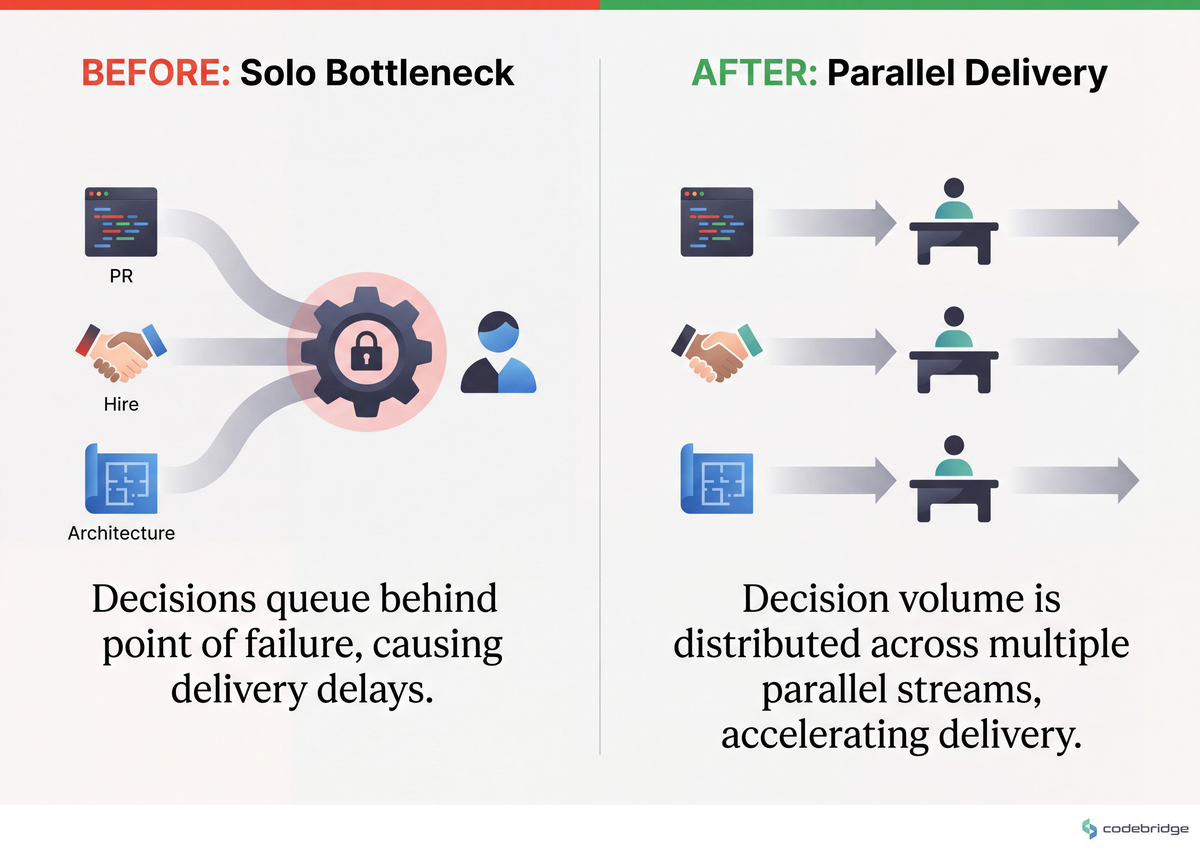
The pattern is not about hiring faster. It's about engineering your own removability from the critical path before each headcount increase.
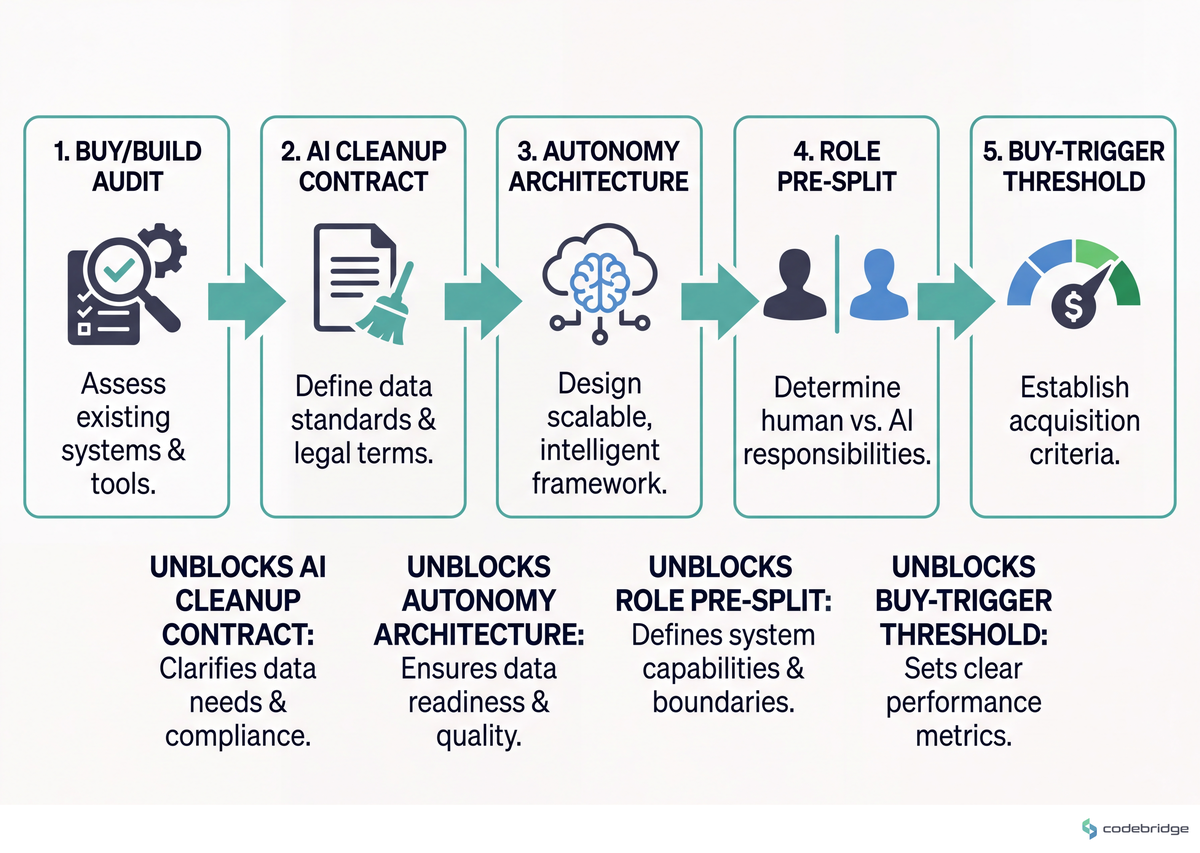
The Five-Step Engineering use Playbook
Each step is sequential. Skipping ahead is the most common failure mode — most solo CTOs try to fix the AI ownership problem before they have fixed the buy-vs-build problem, and end up with cleaner AI policies for code that shouldn't have been written in-house in the first place. The flow is depicted here:
Step 1: Run the buy-vs-build audit (this week)
What to do: List every component your platform depends on — auth, email delivery, payments, analytics, A/B testing, lead-scoring, CRM sync, GDPR consent, image hosting, search. Mark each as built, bought, or partnered. Calculate the engineering-week cost of the built ones over the last twelve months.
What good looks like: 80% bought, 20% built, with the 20% directly tied to the quiz-funnel value prop (branching logic, the funnel editor, scoring engines). Anything else marked "built" is suspect.
Common failure mode: Counting "we built it ourselves" as a cost saving. The cost shows up two years later when the original engineer has left and the integration falls behind a vendor's API change.
Step 2: Write the AI cleanup contract
What to do: Before mandating AI assistance in any team, write a one-page document that names: (a) which categories of code AI may auto-generate (boilerplate tests, CRUD endpoints, schema migrations), (b) which categories require human-first authorship (auth, billing, multi-tenant isolation, anything touching customer data), and (c) who owns cleanup when AI-generated code breaks production.
What good looks like: A merged PR with the contract committed to your engineering handbook, signed off by every engineer in writing.
Common failure mode: Naming "engineering" as the owner of cleanup. That is how you get the r/cscareers post. The owner of cleanup must be the team that pushed the code — engineering review is a check, not the cleanup crew.
Step 3: Architect for autonomy before ten engineers
What to do: Draw service boundaries that match team boundaries. For a quiz funnel platform, the natural seams are funnel-builder (editor and renderer), lead-pipeline (capture, scoring, dedup), integration-gateway (CRM, ESP, webhook delivery), and platform-core (auth, billing, multi-tenancy). Each gets one owner. Cross-seam changes require an interface change, not a Slack thread.
What good looks like: A new engineer can ship a change to the funnel-builder for two weeks straight without coordinating with anyone on the integration-gateway team.
Common failure mode: Drawing seams along technology lines (frontend, backend, devops) instead of business-domain lines. Tech-line seams force every customer-facing change through every team.
Step 4: Pre-split your role into three hats — even before you hire
What to do: On three different days of the week, you wear one hat: Strategic Vision (Monday), People Management (Wednesday), Technical Leadership (Friday). On the other days you actively block the other hats. Calendar the hat-days and protect them. The hat you are wearing today determines what you'll review and decide; everything else queues to its day.
What good looks like: When the team has a question, they know which day's queue to drop it into. The queue depth on any given day stays under one hour of CTO attention.
Common failure mode: Treating the three hats as time slices within a single day. The context-switch tax is what is killing you — separate days exist to absorb that tax.
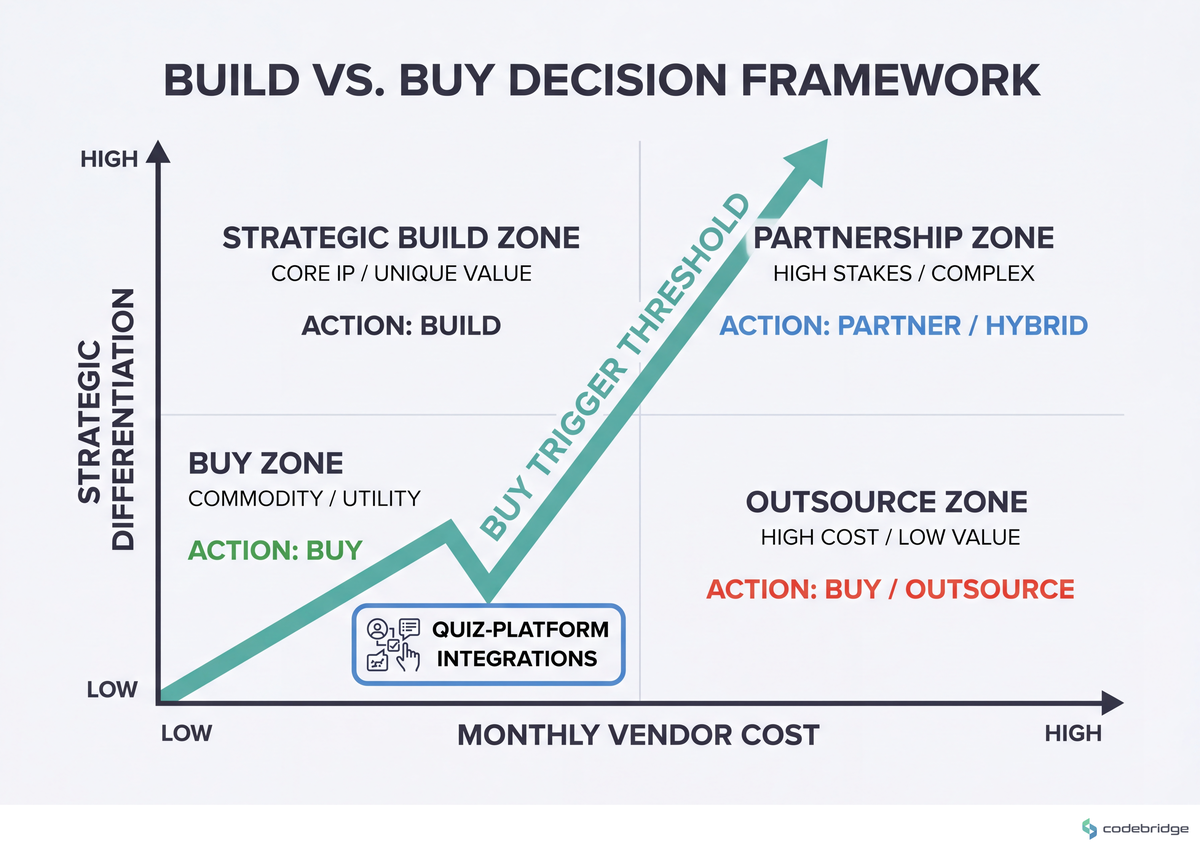
Step 5: Set the buy-trigger threshold
What to do: Pick a numeric threshold below which you always buy. A reasonable default for a quiz funnel platform under $5M ARR: if a vendor solves the need at under $1,000/month and pays back in under 18 months, you buy. Period. No design doc, no spike, no "let's see if we can build it cheaper." Above the threshold, you write a one-page memo with the build/partner/buy options.
What good looks like: The memo template lives in your engineering handbook. The threshold is the same number every time. Engineers stop pre-emptively building because the rule is unambiguous.
Common failure mode: Letting the threshold become a "starting point for discussion." A threshold that's debatable in every Slack thread is no threshold at all.
Consider the comparison below, mapping the threshold against the strategic-differentiation axis:
Close: Three Days, Three Concrete Moves
Matt Watson framed the bottleneck without giving you a Tuesday-morning move. Here is the Tuesday-morning move. Tomorrow morning, open a spreadsheet and run Step 1 — list every dependency, mark built/bought/partnered, and tally the engineering-weeks burned on the built ones. That single document will tell you whether your bottleneck is decision-flow or build-flow. Wednesday, draft Step 2's AI cleanup contract: one page, three sections, named owner. By Friday, calendar your three hat-days for next week and tell your team which day's queue holds which kind of decision.
If the spreadsheet from Tuesday shows more than 30% of your engineering capacity going to rebuilt vendors, you have already paid the cost of not running this audit a year ago. The thirty-minute artifact that earns its keep this week is that audit spreadsheet — everything else is downstream of it.
Need a second pair of eyes on your buy-vs-build audit?
Talk to our team about a one-week use diagnostic for your quiz funnel platform.
Pre-Flight Diagnostic: Are You the Bottleneck?
Score yourself. Higher-risk answers are worth three points; lower-risk answers are worth zero. Total at the end determines what to do this quarter.
In the last 7 days, was there a deploy that could not ship without your personal approval? Yes (3) / No (0)
Of your platform's integrations (CRM, ESP, payments, analytics), what percentage did you build in-house? Over 50% (3) / 30-50% (2) / Under 30% (0)
If you took a 14-day vacation starting tomorrow, how many decisions would queue up unresolved? 5+ (3) / 3-4 (2) / 0-2 (0)
Has AI-generated code broken production in the last 30 days without a clearly named owner of the fix? Yes (3) / No (0)
Do you have a written, merged document defining what AI may auto-generate vs what requires human-first authorship? No (3) / Yes (0)
Did your last cross-team change require coordination across more than two teams? Yes (3) / No (0)
In a typical week, how many cross-team coordination Slack threads do you personally moderate? 5+ (3) / 2-4 (2) / 0-1 (0)
0-7: Healthy use. Re-run this checklist quarterly. 8-14: use debt accumulating — run Steps 1 and 2 this month. 15-21: You are the bottleneck. Block your calendar for the full playbook this quarter.
REFERENCES










Heading 1
Heading 2
Heading 3
Heading 4
Heading 5
Heading 6
Lorem ipsum dolor sit amet, consectetur adipiscing elit, sed do eiusmod tempor incididunt ut labore et dolore magna aliqua. Ut enim ad minim veniam, quis nostrud exercitation ullamco laboris nisi ut aliquip ex ea commodo consequat. Duis aute irure dolor in reprehenderit in voluptate velit esse cillum dolore eu fugiat nulla pariatur.
Block quote
Ordered list
- Item 1
- Item 2
- Item 3
Unordered list
- Item A
- Item B
- Item C
Bold text
Emphasis
Superscript
Subscript