Last quarter, a designer on a tech team I was advising opened our call with: "Leadership wants me to ship three times faster using AI, but they also just hired a contractor for the brand refresh because they said I'm 'too production-focused.' What am I supposed to be?" That sentence — half exhausted, half frustrated — is the tax that 2026 is putting on graphic designers in technology. The role is being pulled in two opposite directions, and most teams haven't named the fork yet.
That call wasn't an outlier. We worked with a ~25-person SaaS infrastructure team on a 4-month engagement to rebuild their design operations after their sole in-house designer burned out. The before-state: one generalist designer covering brand, product UI, marketing site, sales decks, and event collateral. The after-state: a clearer split between an AI-orchestrating production lead and a fractional brand specialist on retainer. The single biggest unlock wasn't tooling — it was finally admitting that "graphic designer" had stopped being one job.
The Hidden Problem: One Title, Two Diverging Markets
The macro numbers look like a single rising tide. The graphic design market hit $62.9 billion in 2024 and is projected at $98.7 billion by 2034, and Spherical Insights forecasts an 8.25% CAGR through 2035. But underneath that average sits a bimodal split: AI-augmented production work is commodifying fast, while strategic brand and systems work is getting more scarce and more expensive.
KEY TAKEAWAYS
"Graphic designer in tech" is now two jobs. AI-orchestrating generalist vs. craft-deep specialist — and the middle is collapsing.
Market growth is real but bimodal. $62.9B → $98.7B by 2034 hides a split between commodifying production and scarce strategic work.
AI raised the floor, not the ceiling. Adoption climbed from 10% to 37% in four years; speed is now table stakes, not a differentiator.
The decision is positional, not technical. Pick a path before your next review cycle, or your manager will pick one for you.
The jump from 10% to 37% AI adoption between 2015 and 2019 is the inflection point that reshaped what "graphic designer" means inside a tech company. When your engineering manager can generate a passable hero image in 90 seconds, your value isn't producing the asset — it's deciding which asset matters and why.
Real Stories From the Fork in the Road
On Dev.to, a developer covering 2026 web predictions captured the broader mood of professionals stuck between adopting tools and waiting for standards to catch up:
"Baristas are taking coding courses so they can become developers while developers are dreaming of opening cafés and becoming baristas." The post argues that even with TypeScript at ~43.6% active developer usage in 2025 and ECMAScript still not adding native typing, betting on a "wait for the standard" strategy is a losing one — the de facto winner has already won.
Ingo Steinke, Dev.to, "2026 web design and tech predictions"
Read that as a designer, not a developer, and the parallel is uncomfortably tight. Adobe Firefly and Figma's AI features are the TypeScript of design — adopted faster than any standards body or design school can react. The thread doesn't tell us how Steinke thinks individual designers should respond, but the directional lesson is sharp: don't wait for the industry to declare which AI tools are "legitimate" before structuring your career around them.
A second story sharpens the strategic-work side of the fork. A Dev.to writer covering accessibility heading into 2026 surfaced a number that should be sitting on every tech-org designer's desk:
"The vast majority of websites and PDFs still fall short, creating both risks and openings for those willing to lead." Reports show 94.8%–96.3% of websites still fail basic WCAG criteria, averaging 51 accessibility errors per homepage; ~95% of public-facing PDFs are inaccessible.
SDET Tech, Dev.to, "Why web accessibility matters in 2026"
No AI tool ships a fix for that. Accessibility-aware design systems, screen-reader-tested components, color-token governance — that's craft-deep specialist work, and demand for it is rising while the supply of designers who can actually do it stays flat.
Imagine a mid-size cloud-tooling company rolling out a 2026 brand refresh while simultaneously shipping weekly product updates. The first quarter, the in-house designer tries to do both. By the second quarter, marketing screenshots are a week behind every release. By the third, the brand refresh has slipped twice and the CMO is quietly asking whether to outsource. This is the pattern the fork is meant to prevent: trying to be both paths at once, and being mediocre at each.
The Pattern: Two Paths, Diverging Fast
The teams that come out of 2026 with healthy design budgets and engaged designers have already made the call. They're not running one generic "graphic designer" headcount — they're running one of two clearly-shaped roles. The comparison below shows what those two paths actually look like inside a tech org:
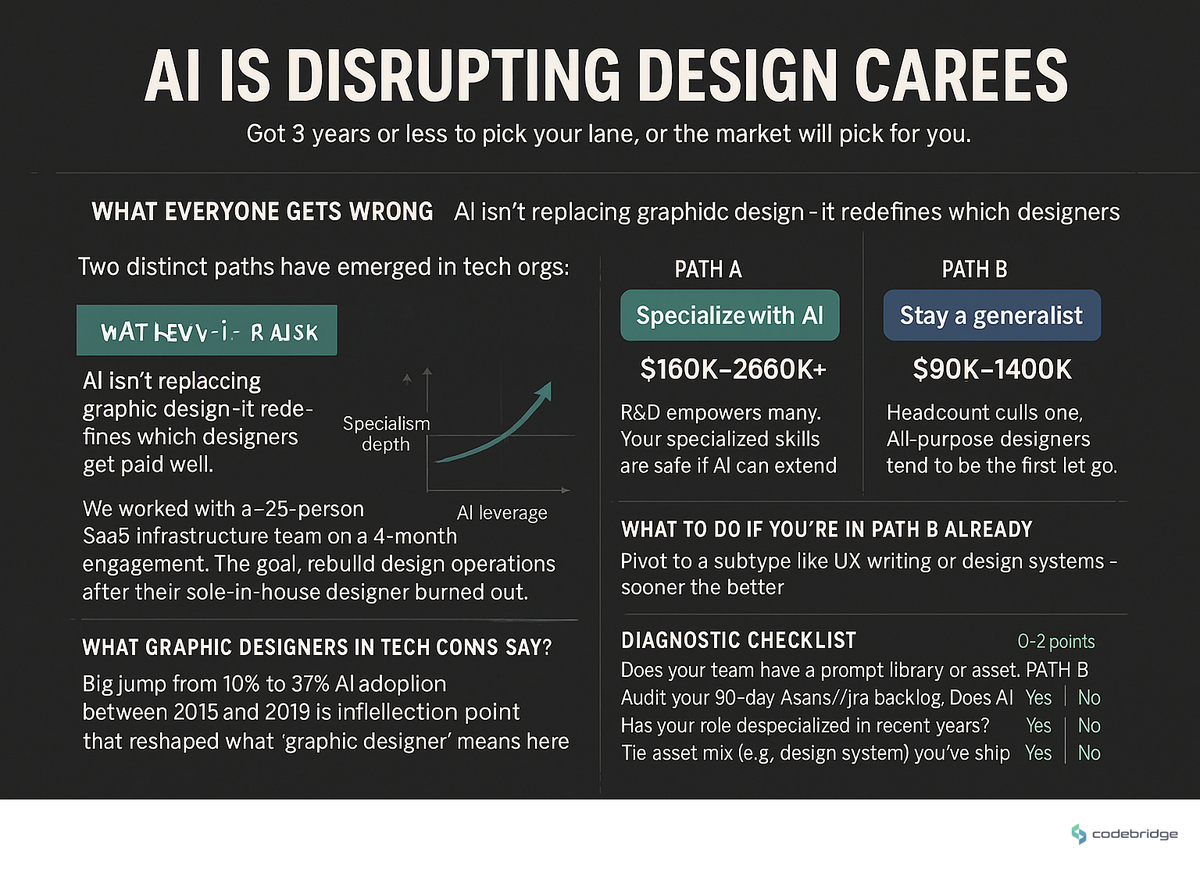
| Dimension | Path A: AI-Orchestrating Generalist | Path B: Craft-Deep Specialist |
|---|---|---|
| Primary value | Throughput, velocity, on-brand variation at scale | Systems, accessibility, brand IP, strategic narrative |
| Daily tools | Figma AI, Adobe Firefly, Midjourney, prompt libraries, automation | Design tokens, WCAG audits, motion systems, illustration craft |
| How you're measured | Assets shipped per sprint, response time, cross-team coverage | System adoption rate, accessibility score, brand consistency audits |
| Career risk | Commodification — your "speed" gap closes when juniors get the same tools | Scope risk — fewer roles, harder to fill, but deeper moat per role |
| Salary trajectory | Flat-to-modest growth, role-count expansion | Steeper growth, fewer seats, longer tenure |
The Figma 2025 study showing renewed designer demand isn't a tide lifting all boats. It's lifting the boats that already chose a hull shape. Generalist-in-the-middle is the role getting squeezed.
Actionable Framework: Choosing Your Path
Four decision criteria, each with a measurable signal you can apply this week:
1. Audit your current asset mix against the 70/30 rule
Pull your last 90 days of Figma/Jira/Asana tickets. Tag each as either production (variations, resizes, marketing collateral, decks) or systems (tokens, components, accessibility, brand). If production is >70%, your environment is pushing you to Path A whether you've named it or not. If systems is >30%, you have a credible foundation to claim Path B in your next review.
2. Quantify your AI use with a concrete formula
Track time-saved-per-asset for two weeks: (manual time estimate) − (AI-assisted actual time) per ticket. If your average is <20% time saved, you're using AI as a novelty, not a system. Path A requires >40% sustained use and a documented prompt library. Below that threshold, you're a generalist claiming AI capability without the receipts.
3. Pick one specialism and pressure-test it against a $-or-risk number
Path B requires a specialism that maps to a number leadership tracks. Accessibility maps to legal exposure (95% of PDFs failing WCAG = an open lawsuit surface). Design systems maps to engineering velocity (component reuse rate). Motion maps to landing-page conversion. If you can't connect your specialism to a metric the CFO would recognize within 60 seconds, pick a different one.
4. Rewrite your role description before someone else does
Your job title hasn't caught up to the fork; your self-description has to. Path A reads: "I scale on-brand visual production across product, marketing, and sales using an AI-orchestrated pipeline — output up 3x in [timeframe]." Path B reads: "I own [accessibility / design system / brand IP / motion language] for [product surface], measured by [metric]." If your current LinkedIn headline still says "graphic designer with experience in Adobe Suite," you've already lost the framing battle.
The Verdict: Pick Before Your Next Review Cycle
Back to the designer from the opening call — the one being told to ship 3x faster and being passed over for the brand refresh. The honest answer is that those two pieces of feedback aren't contradictory; they're the org telling them, in two different voices, that the middle role is gone. We helped them re-scope toward Path A (production lead, AI-orchestrated, with a documented pipeline that justified a hiring request for a fractional brand specialist alongside them). Six months in, the role is stable and the brand work has an owner. Both jobs exist; one designer covering both did not.
Pick Path A (AI-Orchestrating Generalist) if: your tech org ships weekly, marketing is your largest internal customer, your AI-use measurement is already >40%, and you energize on throughput and cross-team coverage.
Pick Path B (Craft-Deep Specialist) if: your org has a measurable craft gap (accessibility debt, fragmented design system, weak brand language), you can name a specialism that ties to a CFO-legible metric, and you'd rather own one surface deeply than touch ten lightly.
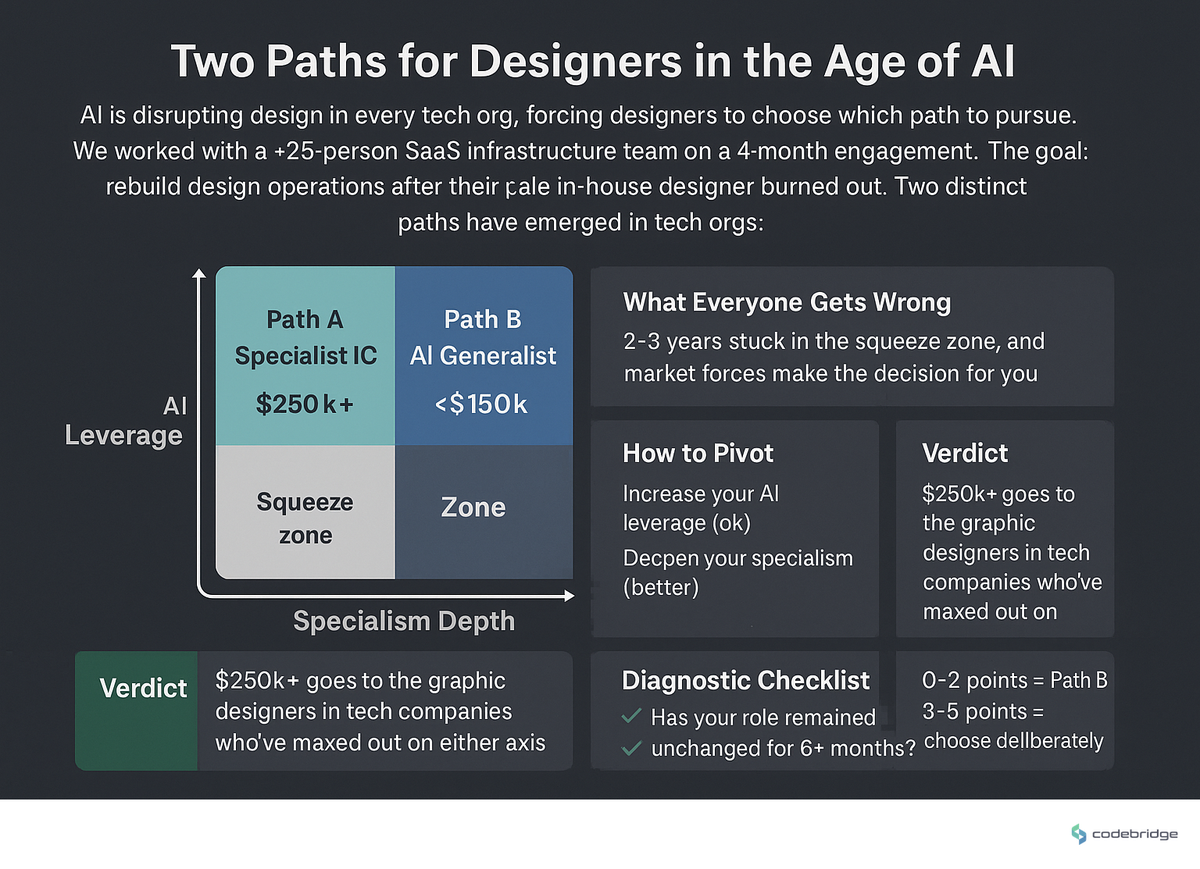
Pick neither — and reconsider the role itself — if: your audit shows a 50/50 split with no AI use and no specialism, your role description hasn't changed since 2023, and your last two reviews used the word "versatile" as a compliment. That's the squeeze zone, and waiting it out is the most expensive option.
The default for technology Members of a Graphic Design Department in 2026 is usually Path A — most tech orgs need throughput before they need craft depth, and AI orchestration is the more defensible career bet inside fast-moving product teams. But "usually" isn't "always," and the wrong default for your specific org is worse than the harder right path.
Not sure which side of the fork you're on?
Talk to our team about auditing your design role against the 70/30 production-vs-systems split.
Diagnostic Checklist: Which Path Is Actually Open to You?
Run these against your current role, not your aspirational one. Score one point per "Yes."
In the last 90 days, did more than 70% of your tickets fall into production work (variations, resizes, decks, marketing collateral)? Yes / No
Can you produce, on demand, a measured time-saved-per-asset number from your AI workflow that exceeds 40%? Yes / No
Does your team have a documented prompt library or AI-asset pipeline that someone else could run if you were out for two weeks? Yes / No
Can you name a specialism (accessibility, design system, motion, illustration, brand IP) you've shipped against in the last 6 months and tie it to a metric leadership tracks? Yes / No
Has your role description, LinkedIn headline, or self-introduction in standups changed in the last 12 months to reflect either AI orchestration or a specialism? Yes / No
In your last review, did the feedback cluster around one identifiable strength rather than the word "versatile" or "wears many hats"? Yes / No
If a contractor was hired tomorrow for "the strategic stuff," would your remaining workload still be visibly valuable to leadership six months later? Yes / No
Scoring: 5-7 Yes = your path is already chosen and visible; double down. 3-4 Yes = you've started but the framing hasn't caught up; rewrite your role description this month. 0-2 Yes = you're in the squeeze zone — pick a path before your next review, because your manager will pick for you.
REFERENCES










Heading 1
Heading 2
Heading 3
Heading 4
Heading 5
Heading 6
Lorem ipsum dolor sit amet, consectetur adipiscing elit, sed do eiusmod tempor incididunt ut labore et dolore magna aliqua. Ut enim ad minim veniam, quis nostrud exercitation ullamco laboris nisi ut aliquip ex ea commodo consequat. Duis aute irure dolor in reprehenderit in voluptate velit esse cillum dolore eu fugiat nulla pariatur.
Block quote
Ordered list
- Item 1
- Item 2
- Item 3
Unordered list
- Item A
- Item B
- Item C
Bold text
Emphasis
Superscript
Subscript