The Funnel Is Lying to You
A senior cybersecurity engineer ran a six-month experiment on the senior-tech hiring funnel. He applied to 50 roles ranging from Mid-Senior to Director. Most never replied. The few that did rejected him after a recruiter skim. His diagnosis was direct:
, anonymous senior practitioner
If you're a Chief Technology Officer hiring senior data analytics engineers right now, that quote is a mirror, not a horror story. The funnel that's losing him is the same funnel that's losing your senior data analytics candidates. The market isn't empty — your filter is broken.
KEY TAKEAWAYS
Senior tech roles take 62 days to fill on average — 40% longer than non-tech roles, but most of that delay sits in intake and screening, not in market scarcity.
Companies using analytics-driven recruiting see 30% faster fills and 2.5x higher quality of hire; the win comes from measurement loops, not from posting more jobs.
Mid-sized tech firms close senior data roles 20% faster than tech giants when they use specialized networks and tighter intake processes.
Referral networks and cultural fit predict 3x better retention than salary, so the optimization target for senior CTO-direct reports is fit signal, not comp band.
The Hidden Problem: Sourcing Gap, Not Skill Gap
The headline numbers point to scarcity. McKinsey's Future of Work After COVID-19 projects 85 million unfilled tech jobs globally by 2030. Gartner's 2023 Tech Talent Trends reports 85% of tech leaders struggle to hire senior engineers. LinkedIn's 2024 Global Talent Trends pegs senior tech time-to-hire at 62 days — 40% longer than non-tech roles.
Read those three together and the natural conclusion is: there aren't enough senior data engineers. That conclusion is half wrong. The pipelines are leaking long before they reach scarcity.
On r/ghosteddevs, an engineer with 5-12 years of experience described the same pattern from the inside:
, senior engineer thread
The thread doesn't tell us how individual posters resolved it. What it tells us is that the top of the funnel — keyword filters, ATS parsing, ten-second screens — is rejecting senior candidates for reasons that have nothing to do with the work. That's not a market problem. That's a process problem you own.
!
If your senior data analytics req has been open more than 60 days, the bottleneck is almost certainly upstream of the candidate pool — intake, sourcing, or screening logic.
Real Stories from the Funnel
An in-house TA professional on r/recruitinghell described the failure mode that explodes time-to-hire from the company side:
, in-house TA practitioner
That's the 62-day delay in one sentence. A req opens. The recruiter doesn't have a sharp picture of the role. The hiring manager — often a CTO or VP — is unavailable for the calibration call. The recruiter sources broadly to look productive. The hiring manager rejects everyone for reasons they couldn't articulate up front. The candidates churn. The req drags. Sixty-two days later, you're still hiring.
A separate r/codingbootcamp thread surfaced the requirements-bloat side of the same problem, attributed to an agency recruiter watching client behavior:
, agency recruiter
For a senior data analytics engineer, "5+ years of Snowflake" or "experience in fintech specifically" rarely predicts on-the-job performance. They predict prior company logos. They shrink your funnel without raising the quality bar.
The pattern below shows where senior tech requisitions actually leak. The diagram below maps the leak points across the typical 62-day cycle:
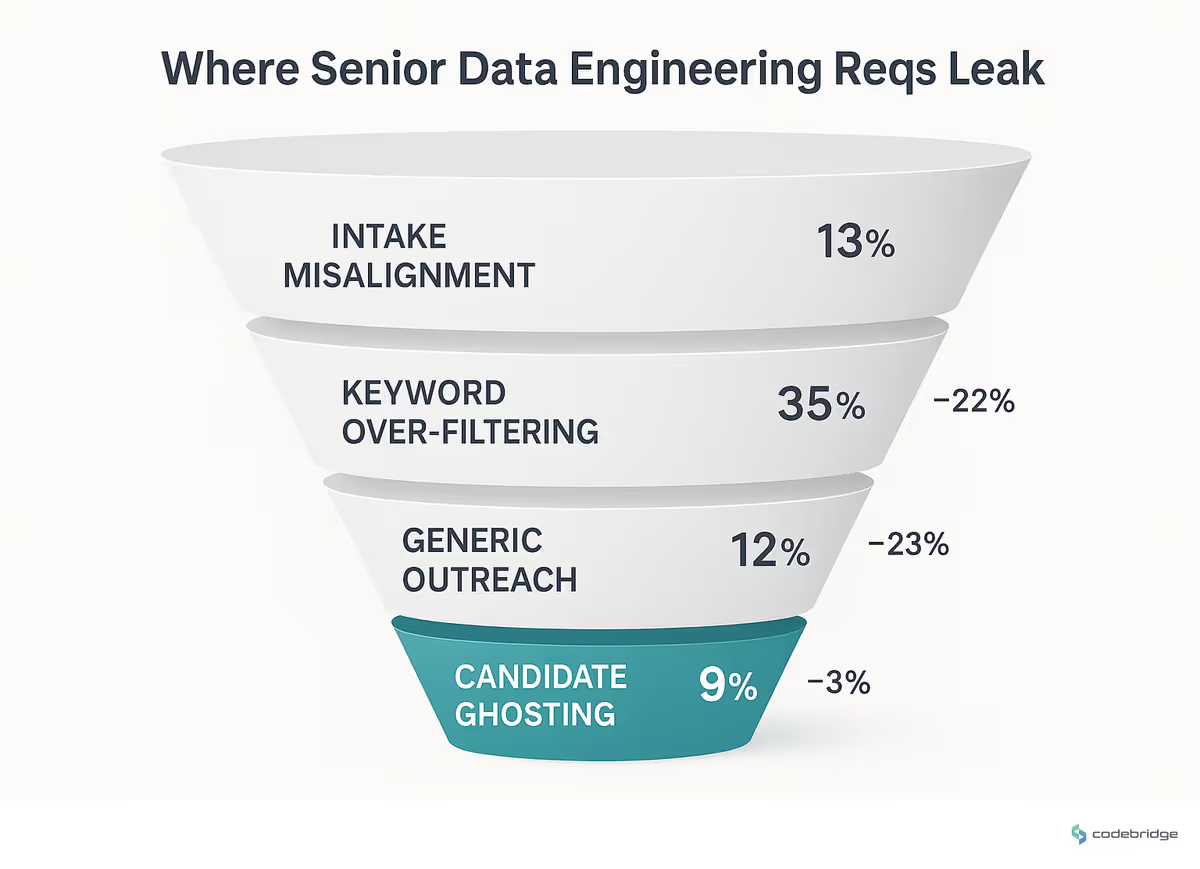
Where senior data engineering reqs leak — intake misalignment in week 1, keyword over-filtering in weeks 2-3, generic outreach in weeks 3-5, and candidate ghosting mid-process in weeks 5-8
A third pattern shows up in r/Recruitment, in a 2026 retrospective from an agency recruiter:
, agency recruiter, 2026 market thread
Three independent voices, three different angles, one shared diagnosis: senior tech hiring is breaking at intake, screening, and outreach — long before the candidate market becomes the limiting factor.
The Pattern: Treat the Pipeline Like a Product
Look at what the operators who hire well actually do. Netflix's engineering blog describes data-driven sourcing and predictive analytics for candidate pipelines, with reported time-to-hire reductions for senior data roles. Stripe's engineering recruiting writeup describes automated sourcing pipelines and internal referral analytics for specialized infrastructure engineers. The common thread is not the brand. It's the instrumentation.
The data backs the pattern. Deloitte's 2024 Global Human Capital Trends reports a 30% reduction in time-to-fill for engineering roles among companies using AI in talent acquisition. Forrester's ROI of Talent Analytics reports 2.5x higher quality of hire for CTO-direct reports at firms using analytics-driven recruitment. Accenture's 2024 Technology Vision reports 45% lower attrition for engineering leaders using targeted acquisition strategies.
Read against the funnel diagnosis above, our reading is that those numbers are not really about smarter sourcing tools. They are about closing the loop between intake, sourcing, and outcome measurement so the system can learn. The teams that win don't have better candidates. They have a tighter feedback loop.
2.5xhigher quality of hire for CTO-direct reports at firms using analytics-driven recruitment (Forrester)
From our work with technology engineering teams: The CTOs who close senior data analytics roles fastest are not the ones with the biggest comp bands or the strongest employer brand. They are the ones who treat each open req like a sprint with explicit acceptance criteria. They write a one-page intake spec before the recruiter sources a single candidate. They look at rejection patterns weekly. They cut nice-to-have requirements when the funnel narrows for reasons that don't predict performance. The recruiter becomes a product manager for the pipeline, and the CTO becomes the product owner. That single reframe — pipeline as product — produces more wins than any single tool we have seen.
There is a useful counterpoint in the data here. Forrester's mid-sized tech hiring analysis reports that mid-sized tech firms fill senior data roles 20% faster than tech giants via specialized networks. Interpreted in this article's framework, that says the lever is process tightness, not headcount or brand. If you're a Chief Technology Officer at a 200-person scaleup, you can outpace a 50,000-person tech giant on senior data hires — provided your intake-to-offer loop is shorter than theirs.
The Playbook: A One-Week Reset for Stuck Senior Reqs
If you have a senior data analytics req open past 45 days, run this in the next five business days. Each step has a clear "what good looks like" signal and a common failure mode to avoid.
Step 1 — Lock the intake spec (Monday)
What to do: a 60-minute working session with the recruiter and you (the CTO). Output is a one-page document with three sections: must-have signals (3 max), deal-breakers (2 max), comp band with a concrete ceiling.
What good looks like: the recruiter can describe the role to a candidate in 90 seconds without notes.
Common failure: a 12-bullet "ideal candidate" list that conflates must-haves with nice-to-haves. If your list has more than 5 must-haves, you are describing a unicorn, not a hire.
Step 2 — Audit the rejection log (Tuesday)
What to do: pull the last 100 rejections on the req. Tag each by stage (resume screen, recruiter call, hiring-manager call, panel) and reason. Look for the stage with the highest dropout.
What good looks like: you can name the leakiest stage and the top three rejection reasons in plain English.
Common failure: skipping this because "the recruiter has a feel for it." A feel is not a measurement. The 30% reduction Deloitte reports comes from teams that measure.
The diagram below contrasts the two screening models you are choosing between. Look at the second column to see why human review at the top of the funnel pays off for 5+ YOE candidates:
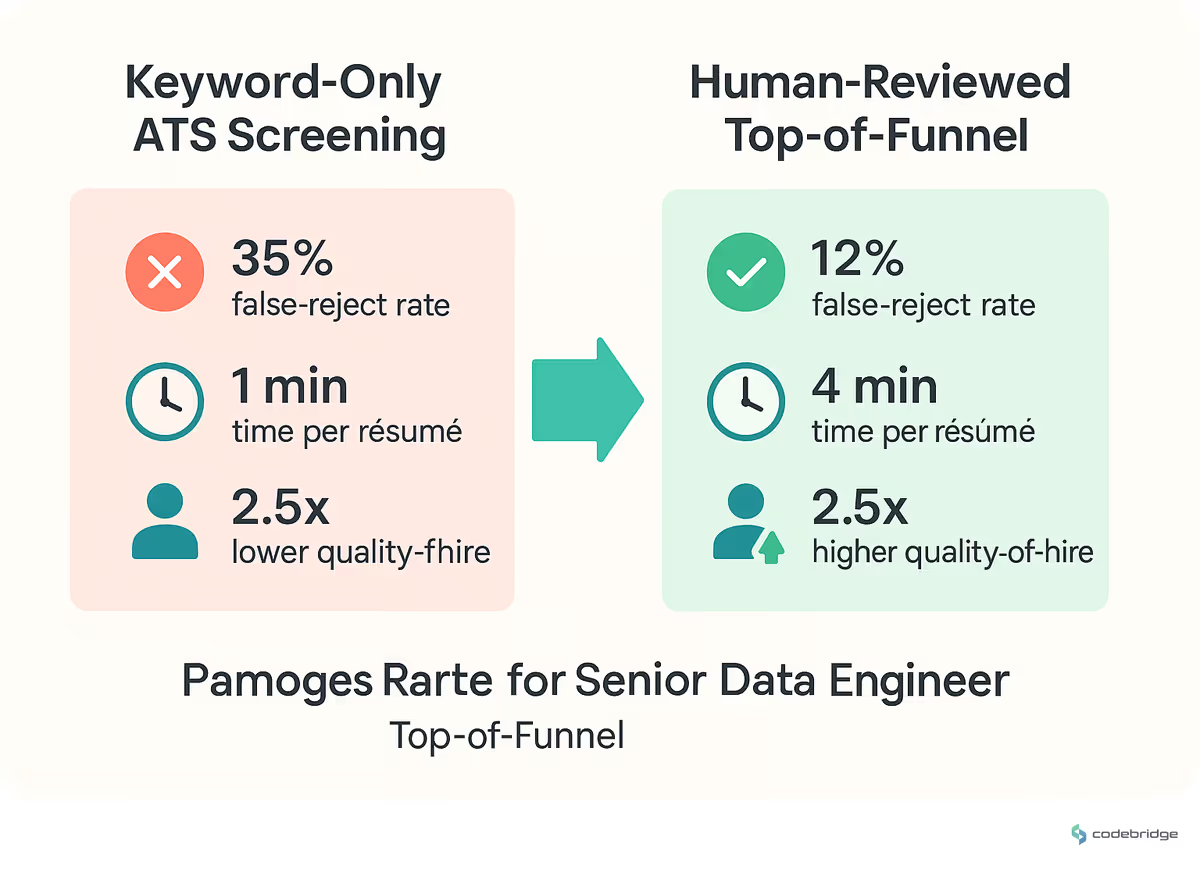
Keyword-only ATS screening vs human-reviewed top-of-funnel for senior data engineers — false-reject rate, time-per-resume, downstream quality-of-hire
Step 3 — Cut signaling-have requirements from the JD (Wednesday morning)
What to do: open the JD. Cross out every requirement that is a proxy for a logo, a tool version, or an exact YOE number. Keep only the requirements tied to demonstrable on-the-job behavior.
What good looks like: the JD has no "5+ years" line. It has "has shipped a production analytics pipeline at scale and can speak to the trade-offs."
Common failure: leaving in "experience in our exact industry" — Forrester's mid-sized firm finding suggests this is the single requirement that most often shrinks the funnel without improving fit.
Step 4 — Replace generic outreach with role-specific messaging (Wednesday afternoon)
What to do: write three outreach templates, each anchored to a specific signal in the candidate's public work (a GitHub repo, a conference talk, a published post). The CTO writes the first one personally. The recruiter clones the structure for the next two.
What good looks like: response rate above 25% on the new templates. Generic copy-paste outreach in 2026 averages well below 10%.
Common failure: letting the recruiter send the same templated note to 50 senior engineers. The 2026 saturation is real — generic outreach to senior data engineers does not work.
Step 5 — Insert a human screen for 5+ YOE applicants (Thursday)
What to do: any applicant with 5+ years of experience bypasses keyword-only ATS screening and goes to a 5-minute human review of resume + one public artifact. The recruiter does the review.
What good looks like: at least 30% of 5+ YOE candidates that the ATS would have auto-rejected get advanced to a recruiter call.
Common failure: trusting the ATS to make this call. The r/ghosteddevs thread is what happens when you don't.
Step 6 — Set a weekly funnel review (Friday)
What to do: 30 minutes every Friday. CTO + recruiter look at four numbers: applications, recruiter screens passed, hiring-manager screens passed, offers extended. If any conversion rate dropped from last week, you investigate before next Monday.
What good looks like: you can predict your time-to-fill within ±5 days at any point in the cycle.
Common failure: treating this as the recruiter's meeting. The Forrester 2.5x quality-of-hire number requires the hiring decision-maker in the loop on the metrics, not just the outcome.
Step 7 — Differentiate the candidate experience through to offer (ongoing)
What to do: every senior candidate who reaches a panel gets (a) a written summary of the role's first 90 days, (b) direct access to the CTO for a 20-minute conversation before the offer, (c) a transparent timeline.
What good looks like: offer-acceptance rate above 70%. Candidate-side ghosting drops below 15%.
Common failure: assuming the offer letter does the selling. In a saturated market, the CTO conversation does.
The week-long sequence is laid out below. Notice that intake and rejection-log work happens before any sourcing change — fix the spec before optimizing the funnel:
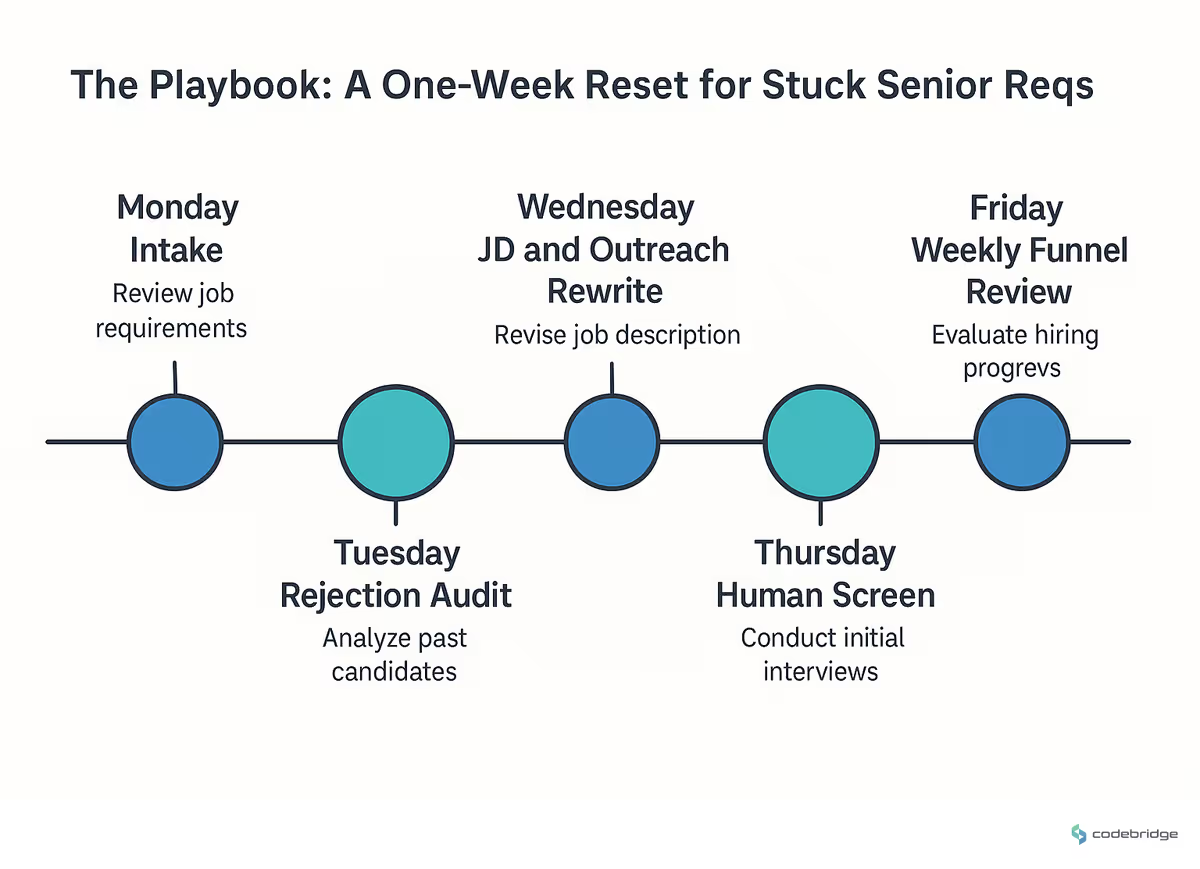
Five-day reset for stuck senior data engineering reqs — Monday intake, Tuesday rejection audit, Wednesday JD and outreach rewrite, Thursday human screen, Friday weekly funnel review
Closing the Loop
The cybersecurity engineer who ran the 50-applications experiment never told us how his search ended. The thread closes with him still ghosted. We don't get a redemption arc. What we do get is the diagnosis, and the diagnosis is the actionable part: the funnel is leaking before the market gets a chance to be scarce.
If you run this playbook on your most stuck senior data analytics req: tomorrow morning, you book the 60-minute intake working session. Wednesday, you cut the signaling-have requirements and rewrite three outreach templates personally. By Friday, you have your first weekly funnel review on the calendar with the recruiter, with four numbers and a comparison to last week.
The one artifact you can produce in the next 30 minutes: open your most-aged senior req, write down the three must-have signals, two deal-breakers, and the comp ceiling on a single page. If you can't fill that page in 30 minutes, that is your real answer for why the role is still open.
Stuck on a senior data analytics req past 60 days?
Talk to our team about auditing your hiring funnel and intake process.
Diagnostic Checklist: Is Your Senior-Tech Funnel Healthy?
Run these against your current senior data analytics req. Score one point per "yes."
Has the hiring manager spent less than 30 minutes with the recruiter in the past two weeks on this req? Yes / No
Does the JD list more than 5 must-have requirements, OR include a specific YOE number? Yes / No
Are 5+ YOE applicants being auto-rejected by the ATS without human review? Yes / No
Is your outreach response rate below 15%? Yes / No
Has the req been open more than 60 days without a clear leakiest-stage diagnosis? Yes / No
Is candidate-side ghosting (mid-process drop) above 20%? Yes / No
Do you lack a weekly review of the four funnel numbers (applications, recruiter pass, hiring-manager pass, offers)? Yes / No
Scoring: 0-2 yes = healthy funnel, hold your weekly cadence. 3-4 yes = the leak is likely intake or screening; run Steps 1-3 of the playbook this week. 5-7 yes = the funnel is the bottleneck, not the market; run the full five-day reset.
REFERENCES
McKinsey Global Institute — The Future of Work After COVID-19
Deloitte — 2024 Global Human Capital Trends
Accenture — 2024 Technology Vision Report
Netflix Tech Blog — Talent Acquisition at Netflix
r/cybersecurity — 50 Jobs in Six Months
r/ghosteddevs — Why Good Engineers Get No Callbacks (5–12 YOE)
r/recruitinghell — In-House TA Pain Thread










Heading 1
Heading 2
Heading 3
Heading 4
Heading 5
Heading 6
Lorem ipsum dolor sit amet, consectetur adipiscing elit, sed do eiusmod tempor incididunt ut labore et dolore magna aliqua. Ut enim ad minim veniam, quis nostrud exercitation ullamco laboris nisi ut aliquip ex ea commodo consequat. Duis aute irure dolor in reprehenderit in voluptate velit esse cillum dolore eu fugiat nulla pariatur.
Block quote
Ordered list
- Item 1
- Item 2
- Item 3
Unordered list
- Item A
- Item B
- Item C
Bold text
Emphasis
Superscript
Subscript