"Moving from CTO to CEO doesn't change what you know, it changes the weight of what you carry." Ludovic Fleury wrote that on Dev.to during his own founder transition, and if you're a Founder-CTO running a Practice Management Software company past the first ten engineers, you already feel the weight he's describing. Except for you it's worse — nobody is taking the CTO chair off your hands. You're carrying both seats, and the calendar shows it: the matter-billing bug review at 9:15, the partner demo at 10, the architectural decision on multi-tenant data isolation at 11, the comp conversation at 11:30, and somewhere in there the sales team is waiting for you to approve a custom workflow for a 40-attorney firm.
KEY TAKEAWAYS
The founder bottleneck appears in the calendar before it appears in any product metric. Teams queue for your attention, and queue depth is invisible in dashboards.
Most founder-CTOs are strong on strategy and technical leadership, weak on people management. That's a structural gap to hire around, not a character flaw to fix in yourself.
Decision-rights matrices with dollar and risk thresholds reduce founder load faster than coaching the founder to "delegate better."
Onboarding infrastructure must exist before the next engineer joins. Hiring without it converts "bad hire" into a self-fulfilling prophecy.
A two-meeting operating cadence (weekly execution standup + monthly operating review) replaces most of the ad-hoc pings that consume founder time.
The Hidden Problem: You Outgrow Your Calendar Before You Outgrow Your Skills
The pattern is well-documented and the diagnosis is consistent: founders become the bottleneck not because they get worse, but because the company outgrows the routing logic that worked when there were five people. A 2026 Forbes Business Council piece on founder bottlenecks frames the failure mode bluntly:
Forbes Business Council, March 2026
In Practice Management Software specifically, the bottleneck has sharp teeth. Your buyers are professional services firms — partners, principals, practice managers — and they pattern-match on responsiveness during sales. So the founder gets pulled into deals. Your product spans clinical/legal/financial workflows that have real compliance edges (HIPAA, attorney work-product, trust accounting), so the founder gets pulled into architecture review. Your churn signal is twelve months out, so by the time the team's judgment has decayed, you've already lost the renewal cycle.
!
If your engineering managers are sending you Slack DMs to approve routine decisions a Director-level person should be making, you are paying twice: once in your own time, once in the manager's atrophying authority.
Real Stories: What the Pattern Looks Like in the Wild
The pattern doesn't only show up in late-night journaling. It shows up in candid conversations among technical founders who've already lived it.
On r/startups, a poster behind The Technical Co-Founder Paradox thread didn't hedge:
The point wasn't that technical founders are inadequate — it was that the skill that built the product (deep technical focus, fast individual execution) is structurally different from the skill that scales the team (delegation, calibration, hiring loops, performance management).
, "The Technical Co-Founder Paradox"
Matt Watson, who's been on the founder-CTO seat at multiple companies, wrote a LinkedIn piece called "The Hidden Scaling Crisis Every Startup CTO Must Overcome" that names the three pillars (Strategic Vision, People Management, Technical Leadership). His read:
, multiple-time founder-CTO, LinkedIn
The "actually okay" is the line that matters. The solution to a people-management gap isn't a six-month leadership coaching engagement to retrofit yourself. It's an engineering manager or VP of Engineering whose primary job is the second pillar, while you stay on pillars one and three.
From our work with Practice Management Software teams: We worked with a ~22-person legal-tech PMS team on a six-month engineering enablement engagement. Before-state: the founder-CTO was in 38+ hours of meetings a week and personally reviewing roughly 70% of PRs. After installing a decision-rights matrix and a weekly execution standup, founder meeting load dropped to ~18 hours/week and PR-review-by-founder fell to ~15% (architectural and security-sensitive paths only). The team's deploy frequency didn't change. The founder's sleep did.
The Pattern: System Before Headcount, Cadence Before Coaching
The teams that escape the bottleneck don't out-discipline their way through it. They install infrastructure that lets routine decisions live below the founder. That infrastructure has three parts: a decision-rights matrix (who decides what, under what thresholds), an operating cadence (when do we sync, when do we report, in what format), and an onboarding system that turns new hires into contributors without founder hand-holding.
The diagram below illustrates the difference between a founder-routed organization and a system-routed one:
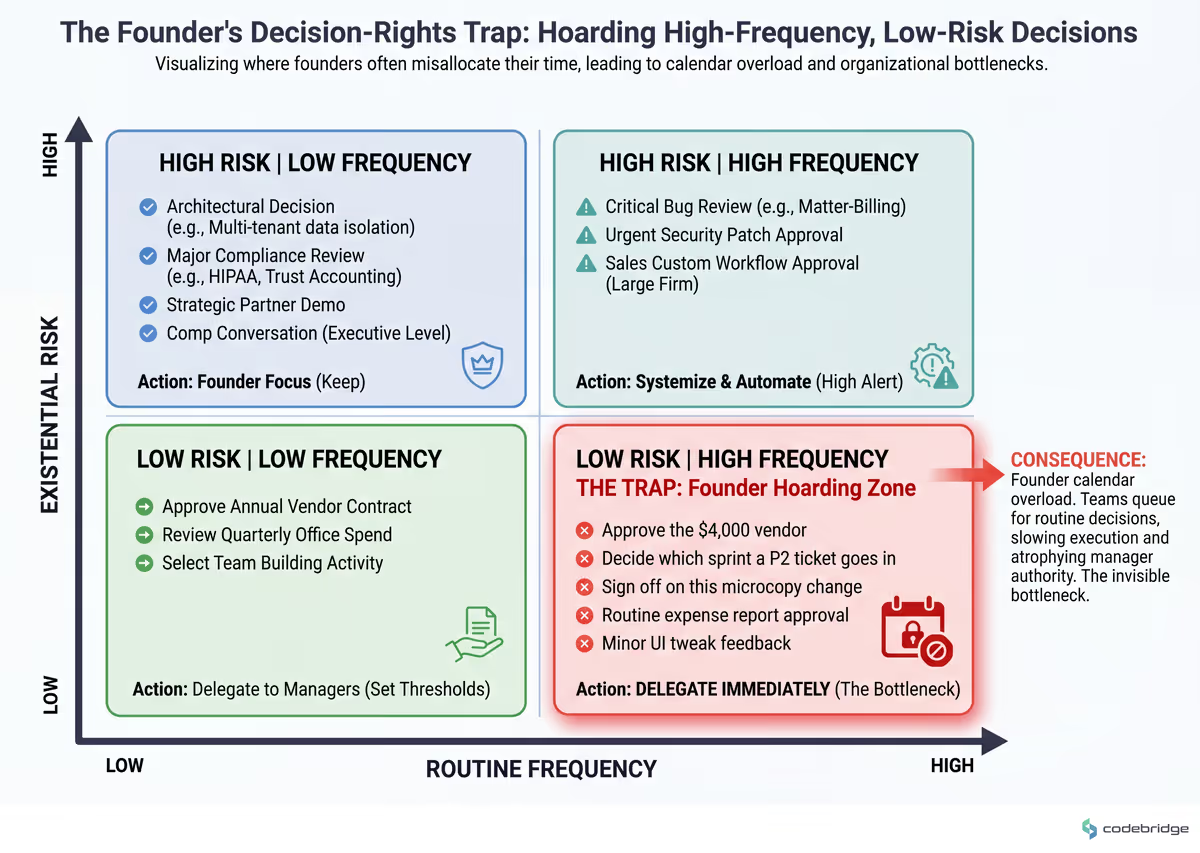
Decision-rights quadrant — existential risk (high/low) versus routine frequency (high/low). The bottom-right (low risk, high frequency) is where the founder is most likely to be hoarding decisions that should be delegated.
Notice that the trap is the bottom-right cell. High-frequency, low-risk decisions ("approve the $4,000 vendor", "decide which sprint a P2 ticket goes in", "sign off on this microcopy change") feel small individually. Aggregated, they're the calendar.
Fleury's Dev.to essay on the engineer-to-CEO transition describes the same trap from inside: relentless context-switching in a flat organization with no buffer between micro and macro operations. Our reading is that the absence of buffer isn't a personality issue — it's an architecture issue. The buffer is supposed to be a layer of people with defined authority. If that layer doesn't exist, every micro decision climbs the stack to the macro seat.
The Playbook: Five Steps to Install the System
Step 1: Build the decision-rights matrix
What to do: List every recurring decision in your engineering org. For each, name (a) who decides, (b) who must be informed, (c) the threshold above which it escalates. Use dollar thresholds for spend, severity thresholds for incidents, and customer-tier thresholds for support/custom-work decisions.
What good looks like: A VP of Engineering can approve a vendor up to $10K and a new hire's offer up to band-3. Anything above goes to you. Anything below is theirs, with no Slack DM required.
Common failure mode: Mismatched authority — you let an EM hire a $180K engineer without sign-off but require approval for a $5K observability tool. That signals you don't actually trust the rules, which signals nobody else should either.
Step 2: Install the two-meeting operating cadence
What to do: Weekly engineering execution standup (45 minutes, leads only, format: what shipped, what's blocked, what's at risk) and monthly operating review (90 minutes, you + functional leads, format: scorecard against quarterly objectives, top 3 risks, hiring pipeline).
What good looks like: Between meetings, there's nothing the founder must attend. Status updates live in a written scorecard, not in your DMs.
Common failure mode: Adding the cadence without removing the ad-hoc pings. If you keep answering Slack DMs about status, the new cadence is theater.
The diagram below visualizes the weekly rhythm we install with most PMS clients:
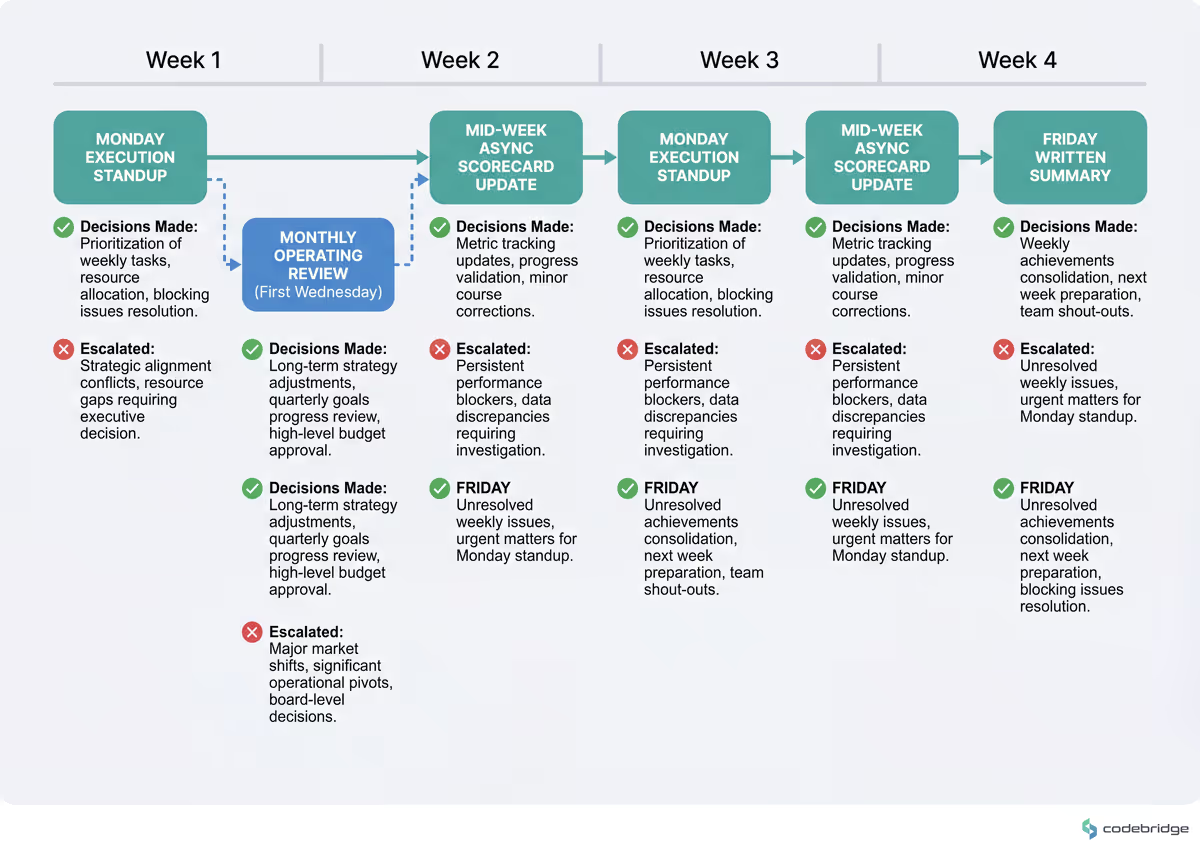
Weekly operating cadence — Monday execution standup, mid-week async scorecard update, Friday written summary, monthly operating review on the first Wednesday. Each block notes which decisions are made there versus escalated.
Step 3: Codify onboarding before the next hire
What to do: Before posting the next engineering req, write the 30/60/90 plan for that role. First commit by day 5. First on-call shadow by day 14. First feature owned by day 45. Pair them with a peer for the first 30 days who is explicitly tasked with their ramp, with time budget for it.
What good looks like: A new senior engineer produces their first non-trivial PR before the end of week one, without you or another founder in the loop.
Common failure mode: The "hand them a laptop and hope" pattern. Three months in, the hire underperforms; you conclude bad hire; you re-hire; same outcome. The cycle is the system, not the candidate.
Step 4: Replace founder pings with an async status surface
What to do: Move three categories off your calendar entirely — task assignments to the project tracker, status updates to a shared weekly scorecard, customer-success escalations to a CRM workflow with named owners and SLAs. Make the surfaces public to the org, not DM-based.
What good looks like: When a partner-tier customer at a 50-attorney firm escalates a billing-engine bug, the path to resolution doesn't run through your inbox. There's a named owner, a documented SLA, and the resolution shows up in the weekly scorecard.
Common failure mode: Building the surfaces but not enforcing the rule that DMs to the founder bounce. If you keep answering, the surfaces are decoration.
Step 5: Hire the complementary leader, or commit to growing one
What to do: If your honest self-assessment matches Matt Watson's pattern (strong on strategy and technical, weak on people management), start the VP of Engineering or strong Engineering Manager search before the team hits 15 engineers. If you can't afford that hire, pick the strongest existing senior engineer and explicitly transition them into management, with coaching budget attached.
What good looks like: Within two quarters, 1:1s, performance reviews, hiring loops, and PIP conversations all live with the EM/VPE. You spend your people-leadership time on the EM/VPE themselves, not on the eight engineers below them.
Common failure mode: Hiring a "Director of Engineering" who is really a senior IC with a fancier title. If they're still writing 60% of their week in code, they're not absorbing the people-management pillar — they're another engineer.
The comparison below shows how the load distributes between the two operating models:
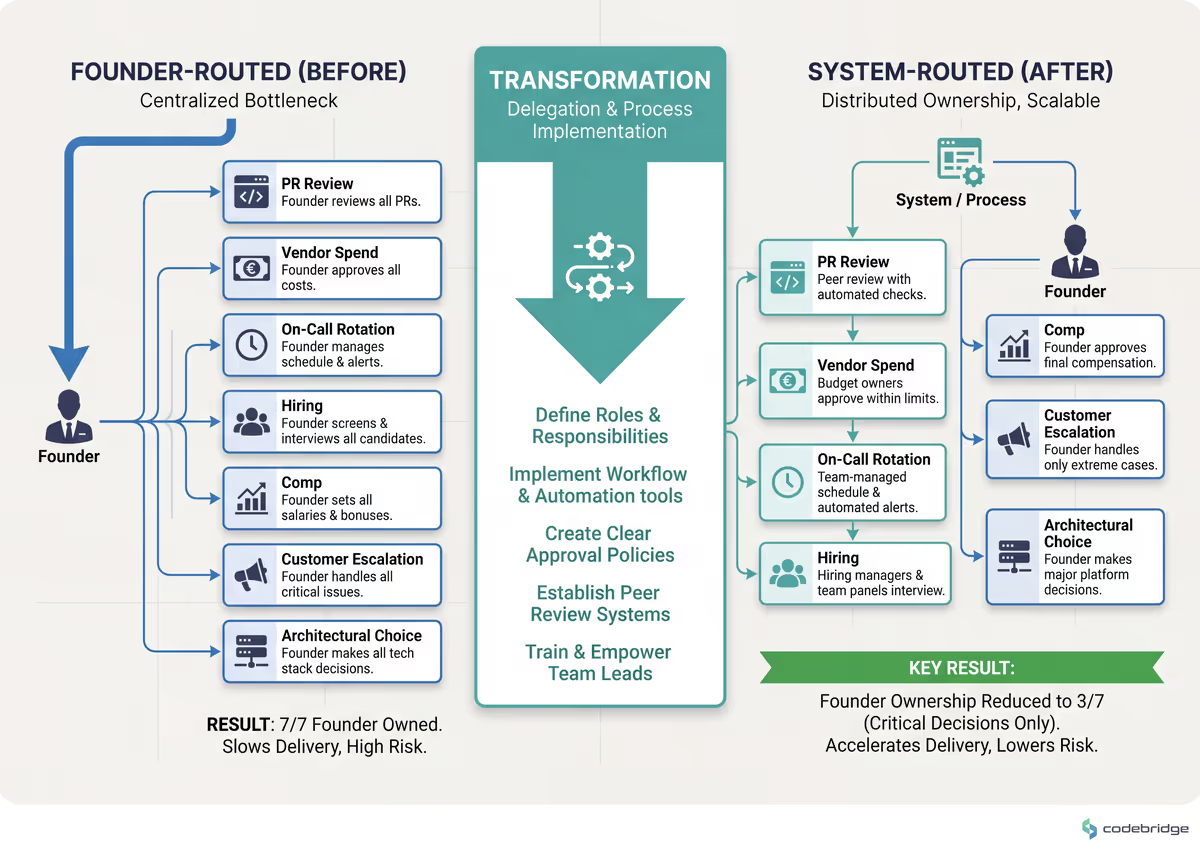
Founder-routed versus system-routed engineering org — for each of seven recurring decision types (PR review, vendor spend, on-call rotation, hiring, comp, customer escalation, architectural choice), shows who owns it in each model. The right column reveals the insight: in the system-routed model, the founder owns three of seven, not seven of seven.
Close: Three Days to a Working Version
Ludovic Fleury's framing — that the weight changes, not the knowledge — is the thing to come back to. The fix isn't learning to be a different kind of leader. The fix is building the layer between you and the routine decisions, so the weight you actually carry is the macro one you're paid to carry.
You can ship v1 of this system in three working days, without coaching, without a leadership offsite:
Tomorrow morning, open your calendar and your Slack DMs for the last 14 days and list every decision someone routed through you. Tag each with (a) dollar amount or risk severity, (b) frequency, (c) whether it really required you. That list is your raw material.
Wednesday, classify the list into the four quadrants (existential/routine × high/low frequency) and draft a one-page decision-rights matrix. Name an owner and a threshold for each of the bottom-right cells — the routine, high-frequency stuff that's eating your week.
By Friday, share the matrix with your engineering leads, agree on the two-meeting cadence, and announce one rule to the team: routine decisions that fall inside someone's published authority do not need to ping the founder. Pin it in #engineering. Re-pin it in 30 days.
That's a 30-minute artifact you can produce this week: the decision audit. Everything else follows from it.
Diagnostic Checklist: Run This Against Your Own Org
Score one point for each YES. 0-2 yes: you're in good shape. 3-4 yes: the bottleneck is forming — install the matrix this quarter. 5+ yes: you're already the bottleneck; the team's judgment is decaying in real time.
In the last 14 days, did any engineering manager DM you for approval on a sub-$5K spend or a P2 ticket prioritization? Yes / No
Does the path from a Tier-1 customer escalation to a resolution currently route through your inbox before reaching a named owner? Yes / No
Is your average weekly meeting load above 30 hours, with more than half of it being status-update-shaped rather than decision-shaped? Yes / No
Did your last engineering hire reach their first non-trivial merged PR after day 10, without a written 30/60/90 plan handed to them on day one? Yes / No
In your authority rules, can a VP-level person hire a $180K+ engineer without your sign-off but cannot approve a $5K vendor without it? Yes / No
If you took a fully-disconnected two-week vacation tomorrow, would more than three routine decisions stall waiting for you? Yes / No
Is your most senior people-leader in engineering still writing production code more than 50% of their week? Yes / No
Bottlenecked on yourself?
Talk to our team about auditing your engineering operating cadence and decision-rights matrix.
REFERENCES
Forbes Business Council — Founders Can Be the Biggest Bottleneck to Their Own Growth (March 2026)
Matt Watson — The Hidden Scaling Crisis Every Startup CTO Must Overcome (LinkedIn)
Ludovic Fleury — From Software Engineer to Startup CEO: What Really Changes (Dev.to)










Heading 1
Heading 2
Heading 3
Heading 4
Heading 5
Heading 6
Lorem ipsum dolor sit amet, consectetur adipiscing elit, sed do eiusmod tempor incididunt ut labore et dolore magna aliqua. Ut enim ad minim veniam, quis nostrud exercitation ullamco laboris nisi ut aliquip ex ea commodo consequat. Duis aute irure dolor in reprehenderit in voluptate velit esse cillum dolore eu fugiat nulla pariatur.
Block quote
Ordered list
- Item 1
- Item 2
- Item 3
Unordered list
- Item A
- Item B
- Item C
Bold text
Emphasis
Superscript
Subscript