Imagine your second week as the new CTO of a social trading platform. The board wants a roadmap by Friday. Your VP of Engineering wants headcount approval by Monday. Compliance just dropped a 40-page FCA letter on your desk. And at 11:47 PM on a Tuesday, copy-trading latency would spike to 4.2 seconds, ten thousand mirrored trades would queue, and your phone would start vibrating before you'd finished reading the letter. That hypothetical Tuesday is the one most new fintech CTOs think they're inheriting infrastructure for — and it's the one that exposes whether the first 90 days were spent building features or building a foundation.
If you've ever walked into a CTO seat at a social trading platform and felt the gap between what the deck promised and what the codebase actually does, you already know the rest of this article. The question is what you do about it in the next 12 weeks.
KEY TAKEAWAYS
Reliability investments yield ~3x more revenue stability than parallel feature work in fintech, per McKinsey's analysis of operator outcomes — yet most new CTOs allocate the inverse ratio in their first 90 days.
Hiring before a process audit tends to amplify attrition — process-first sequencing is what the recoveries have in common.
Cybersecurity incidents in fintech continued to climb through 2024, with API surface area being the dominant attack vector for social trading platforms specifically.
Cloud-native architecture migrations show strong multi-year ROI in published analyses, but only when sequenced after a reliability baseline — migrations on top of unmeasured systems amplify the existing chaos.
The Hidden Problem: First 90 Days Are Mostly Spent Solving the Wrong Problem
The dominant first-90-day playbook in fintech is roughly: meet the team, ship a "quick win" feature, hire aggressively, present a 12-month roadmap. It's the playbook you'd find in any general engineering-leadership book. It's also the playbook that, in social trading specifically, predicts which CTOs will be replaced in 18 months.
The data behind this is unambiguous. McKinsey's fintech growth analysis reports that 72% of fintech firms (social trading included) had adopted AI for fraud detection and personalization by 2024 — but the firms that achieved durable revenue growth were the ones that had first invested in reliability infrastructure. Per McKinsey's tech-at-the-edge brief, reliability investments yield roughly 3x the revenue stability of equivalent feature investment in this segment.
The root cause of the wrong-problem trap is structural: boards and founders measure CTOs on visible output in their first quarter, and visible output means features. Reliability work is invisible until it isn't — and when it isn't, you're already in the postmortem.
Real Stories From the Wild
From our work with social trading and FinTech teams: We worked with a ~50-engineer social trading platform on a 6-month engagement that began as a "scale our copy-trading engine" project and within three weeks turned into a reliability rebuild. Before-state: peak-hour signal-distribution latency around 1.8 seconds with a 12% trade-execution failure rate during volatility events. After-state, four months in: latency under 220 ms p95, failure rate under 1%. The single biggest unlock wasn't the rewrite — it was that we spent the first three weeks doing nothing but instrumenting the existing system. The team had been guessing at where the latency lived for over a year.
The pattern in the public record is similar. Robinhood, following the 2020 outages and the leadership transition that came after, prioritized SRE practices and multi-region failover in the months that followed. eToro's 2021 migration to Kubernetes-based microservices with AI-driven load balancing took the platform from ~80% peak-hour availability to four-nines, documented in their engineering writeup. ZuluTrade's edge-compute deployment with AWS Global Accelerator dropped trade-copy latency to under 50 ms and pushed execution success to 99.5% (per their engineering blog).
The common factor across these examples: none of them led with a feature. All of them led with an audit, then a foundation move, then features.
The Pattern: Audit-First, Sequenced
The successful 90-day windows in social trading look almost boringly similar. They follow a sequence — reliability baseline before compliance map, compliance map before architecture inventory, architecture inventory before process audit, process audit before any hiring blitz, and only then strategic bets. The diagram below shows where the use lives in each phase:
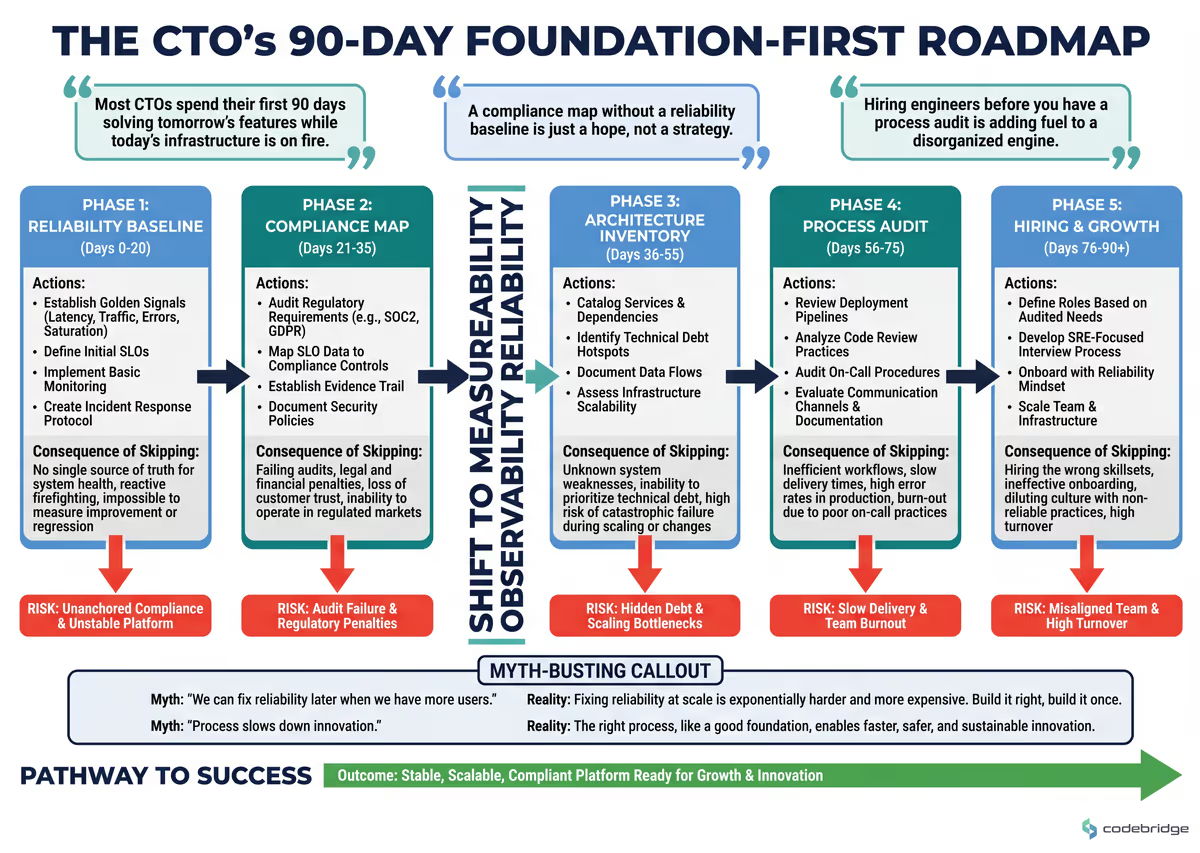
Each phase compounds the next — skipping reliability baseline makes the compliance map unanchorable; skipping process audit makes hiring counterproductive.
The compounding matters. Skip the reliability baseline and your compliance audit has no SLO data to anchor against. Skip the architecture inventory and your hiring plan optimizes for the wrong skills. Skip the process audit and the engineers you hire are likely to churn within 12 months — hiring before optimizing existing process tends to amplify attrition costs rather than relieve capacity pressure.
!
Most CTOs treat the 90-day window as parallel workstreams. It's a serial dependency chain. Each phase produces the inputs the next phase needs.
The Playbook: Six Steps Across 90 Days
Step 1 (Days 1-7): Establish a reliability baseline
What to do: Pull the last 12 months of incident reports. Compute MTTR, MTBF, and incident-cost-per-hour for each Tier-1 service (trade execution, copy-trading signal, KYC, payments, login). Stand up a single dashboard with three SLOs: availability, p99 latency, and execution success rate. Do not make any architectural recommendations this week.
What good looks like: By Friday of week 1, you can name the three services most likely to cause an outage in the next 90 days, and you have a number for what each minute of downtime costs in lost trade volume.
Common failure mode: Treating week 1 as "meet the team." You will meet the team. You will also have a baseline. Both, not either.
Measurable signal you need this: If your team cannot produce MTTR for the last quarter within 24 hours of you asking, you are flying blind on reliability.
Step 2 (Days 8-21): Compliance and security inventory
What to do: Map every regulatory regime that touches your platform — FCA, SEC, MiCA if you have EU users, state-level money-transmitter rules. For each, enumerate the technical controls that prove compliance (data retention timestamps, audit logs, KYC flow versions). Then run an API surface audit against the OWASP API Top 10. Per Forrester's 2026 payments-and-lending trends, zero-trust architecture is becoming the regulatory default for social trading APIs after the 2024 breach wave.
What good looks like: A two-page document mapping each regulator to specific code paths and data stores. Anything that "we think" is compliant is flagged red.
Common failure mode: Outsourcing the inventory to compliance. The compliance team can describe what's required; only engineering can describe what the system actually does.
Threshold: If more than three Tier-1 controls require manual evidence collection at audit time, this is your single highest-use rebuild.
Step 3 (Days 22-45): Architecture inventory and single-points-of-failure map
What to do: Document every service, queue, database, and external dependency on a single page. Mark the single points of failure in red. For each red item, estimate the dollar cost of a 1-hour outage during peak trading. Compare your monolith-vs-microservices boundaries against the trading-volume reality — eToro's documented Kubernetes migration is the canonical reference for what "microservices done right" looks like at social-trading scale. The diagram below sketches the comparison most teams need to make:
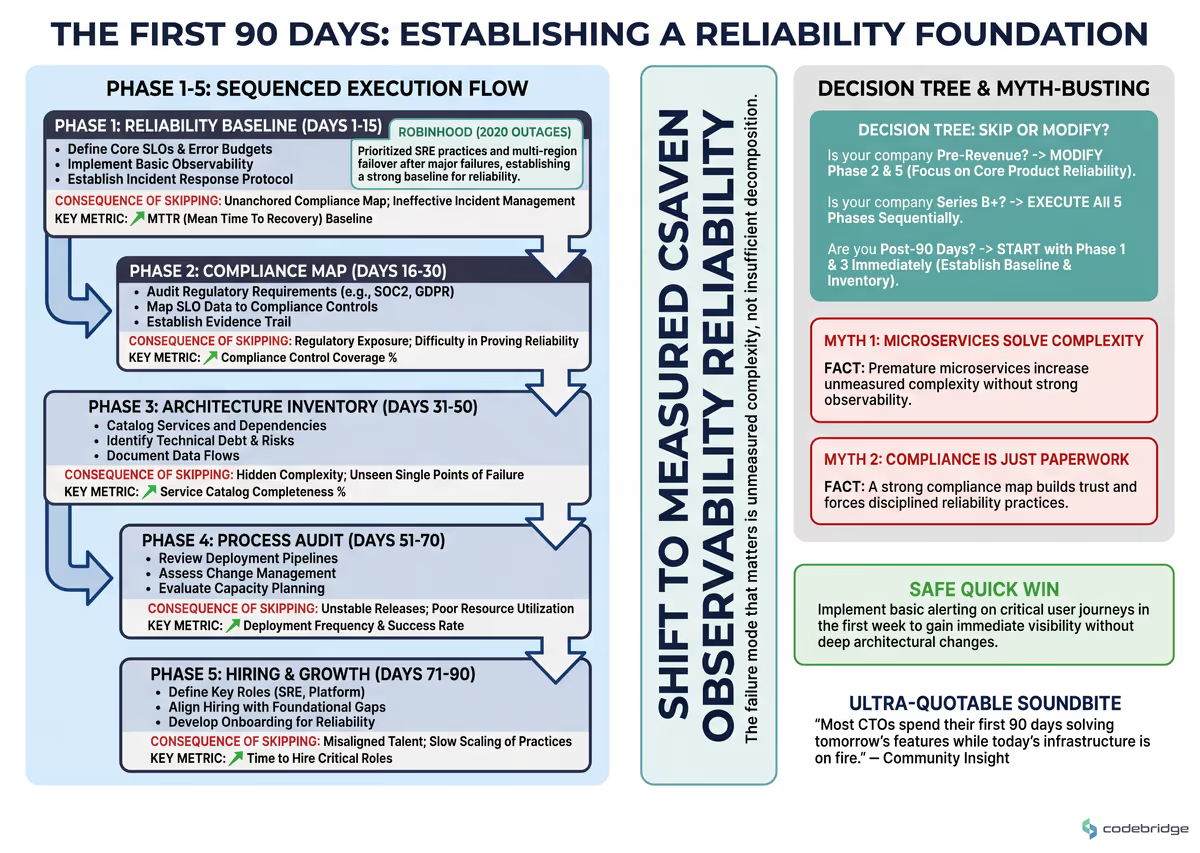
Monolith with strong observability often beats premature microservices — the failure mode that matters is unmeasured complexity, not insufficient decomposition.
What good looks like: A diagram on one wall of your office that any senior engineer can update in under 15 minutes. The red items have named owners.
Common failure mode: Recommending a microservices migration before the monolith is instrumented. Published cloud-migration ROI numbers are typically measured on migrations done after a reliability baseline, not on top of one.
Step 4 (Days 46-60): Process audit before any hiring
What to do: Measure cycle time from first commit to production deploy. Measure how many people sign off on a routine deploy. Measure how long a new engineer takes to land their first one-line change. If any of these is broken, hiring 10 more engineers makes it worse, not better.
What good looks like: Cycle time under 48 hours for routine changes. Single-owner deploys for 80%+ of services. New engineers landing first commit by end of week 1.
Common failure mode: Approving the headcount plan you inherited because "we already promised the board." The board will accept "we're optimizing process before we hire" if you frame it as a 6-month NPV calculation. Skipping this step correlates with shorter CTO tenures and higher engineering attrition.
Worked example: If your average engineer cost is $180K loaded and your current cycle time is 7 days, hiring 5 engineers without fixing process delivers ~5×($180K)/7-day-cycles = $128K/week of capacity. Cutting cycle time to 2 days first delivers the same capacity from your existing team — and the new hires then compound.
Step 5 (Days 61-75): Pick two to three strategic bets — no more
What to do: Of the gaps your audits surfaced, pick two or three to invest in over the next 12 months. The 2026 anchors most worth considering: embedded AI for trade-signal personalization (Gartner projects ~30% retention lift from real-time AI recommendations), zero-trust API architecture, and decentralized identity for KYC under MiCA. Pick the bets that compound with your existing strengths, not the ones that fix every weakness.
What good looks like: Each bet has a named executive sponsor, a measurable 12-month outcome, and a kill criterion you'll honor at the 6-month review.
Common failure mode: Picking five bets to satisfy five stakeholders. You will deliver none of them.
Step 6 (Days 76-90): Communicate the roadmap and the foundations underneath it
What to do: Present the 12-month roadmap with two layers: the visible features (what the board will see) and the foundation work (why the features will actually ship on time). Tie every foundation investment to a specific incident, regulatory deadline, or scaling threshold from your audits.
What good looks like: Your CFO can repeat the rationale for the foundation budget back to you in their own words. Your engineers can name which two bets they're contributing to.
Common failure mode: Presenting only the features and treating foundation work as "engineering hygiene we'll do in the background." The hygiene becomes the first thing cut when the next quarter's revenue target slips.
Close: What You Do This Week
Recall the hypothetical Tuesday at 11:47 PM — copy-trading latency spiking, ten thousand mirrored trades queued, your phone vibrating. The version of you that worked the playbook above doesn't get that call, because the version of you that worked the playbook spent week 1 instrumenting the signal-distribution path and caught the queue-saturation pattern in week 3.
Tomorrow morning (Monday, May 11), pull the last 12 months of incident reports and ask your senior on-call engineer to walk you through the three worst ones. By Wednesday, May 13, have a single dashboard with availability, p99 latency, and execution success rate for your top five services. By the end of this week (Friday, May 15), write a one-page document naming the three services most likely to cause an outage in the next 90 days, with dollar-per-minute cost estimates. That document is your 30-minute artifact — it becomes the anchor for every audit, hire, and bet that follows.
Mid-way through your first 90 days and the audits are surfacing more than you expected?
Talk to our team about a reliability and architecture review tuned to social trading scale.
Diagnostic Checklist: Run This Against Your Platform This Week
Use this to score where you are. Each item is verifiable from your own systems within an hour.
Can your team produce MTTR and MTBF for each Tier-1 service for the last quarter within 24 hours of asking? Yes / No
Can your compliance team produce the full audit trail for any specific user trade in under 10 minutes? Yes / No
What percentage of your services have a single named owner who can deploy without external sign-off? <70% / 70-90% / >90%
When did you last execute a multi-region failover in production (not in drill)? Never / >12 months / <12 months
How many production deploys in the last month required manual sign-off from someone outside engineering? 0-2 = healthy / 3-5 = friction / >5 = bottleneck
Can a new engineer ship a one-line change to production by the end of their first week? Yes / No
For each regulatory regime you operate under, can you point to specific code paths and data stores that prove compliance? Yes / No / Partially
Scoring: 6+ healthy answers — your foundation is solid; spend the 90 days on strategic bets. 4-5 healthy — sequence Steps 1-4 of the playbook before any feature work. 0-3 healthy — your first 90 days are an audit and rebuild, not a roadmap presentation, regardless of what the board expected.
REFERENCES
McKinsey — Fintechs: A New Paradigm of Growth
Forrester — Payments and Lending Trends 2026
PwC — Global Fintech Report 2024










Heading 1
Heading 2
Heading 3
Heading 4
Heading 5
Heading 6
Lorem ipsum dolor sit amet, consectetur adipiscing elit, sed do eiusmod tempor incididunt ut labore et dolore magna aliqua. Ut enim ad minim veniam, quis nostrud exercitation ullamco laboris nisi ut aliquip ex ea commodo consequat. Duis aute irure dolor in reprehenderit in voluptate velit esse cillum dolore eu fugiat nulla pariatur.
Block quote
Ordered list
- Item 1
- Item 2
- Item 3
Unordered list
- Item A
- Item B
- Item C
Bold text
Emphasis
Superscript
Subscript