The Catalog Page That Stopped Converting
Imagine you're the Strategy & Execution Lead at a mid-size analytical instruments company in 2026. The mass spec line would be solid. The application engineers would be seasoned. The website would have a beautiful catalog, a polished "Resources" tab, and a "Leadership" page with three executives in matching navy backgrounds. And yet — the inbound would have gone quiet. The last three serious pricing conversations would have started not from the contact form, but from a LinkedIn comment a customer left under a preprint that cited your instrument. You'd open analytics on a Monday morning and the pattern would be unmistakable: application notes still pull traffic, the leadership page barely registers, and the bounce rate on your "Why Choose Us" tile would be embarrassing in a way you wouldn't want to circulate to the board.
If that scenario lands too close to home, you're in the same place most strategy leads in this category are in right now. The buyer of an analytical instrument is a scientist, a lab manager, or a principal investigator — and they don't read your "Why Choose Us" page because they're not your peer audience. They're a technical audience surveying a noisy market for proof that someone they recognize is already running your gear and getting publishable data out of it. A brochure-shaped website cannot deliver that proof.
KEY TAKEAWAYS
Scientists trust other scientists more than they trust corporate sites. Edelman's 2024 Trust Barometer puts "scientists" near the top of trusted institutions; "the company itself" sits well below.
Awareness sites in this category fail on freshness, not design. A homepage hero that hasn't changed in 90 days reads as either a museum or a dormant company.
Personal stories outperform credential lists for technical buyers. A scientist's name, lab, and method on a page produces more qualified inbound than a polished "About" deck.
News velocity is a buying signal. Buyers read recent posts as evidence the vendor is still active in the field, not just selling into it.
The site is infrastructure, not a campaign. A weekly cadence of scientist story + field news + method note compounds; quarterly campaigns don't.
The Hidden Problem: Buyers Trust Peers, Not Brands
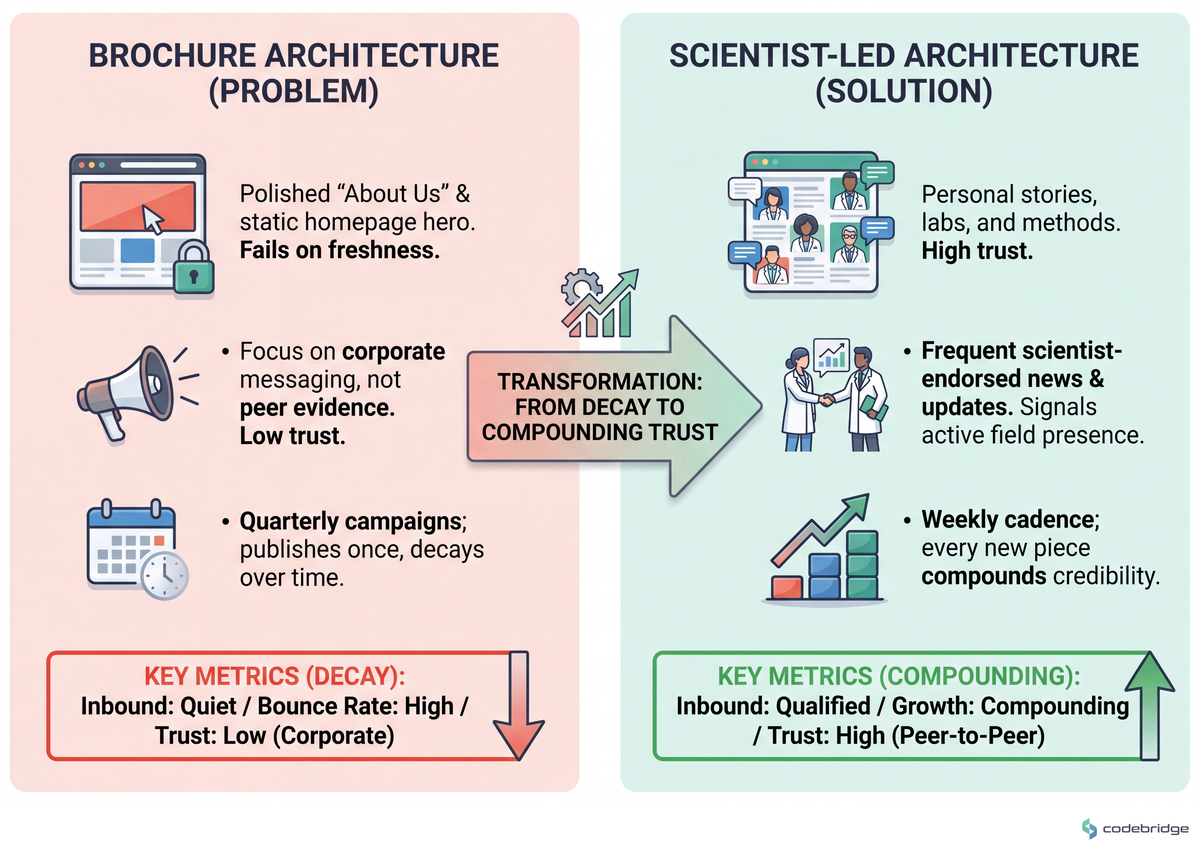
The instinct of a strategy team that hasn't worked in a technical-buyer category before is to apply consumer marketing logic: invest in brand language, polish the value proposition, A/B test the hero copy. In Life Sciences / Analytical Instruments that effort lands flat because the audience indexes on a different signal. Edelman's Trust Barometer has documented for several years running that scientists and technical experts are among the most trusted voices, while corporate communications functions sit closer to the bottom of the list. The implication for an awareness site is concrete: every minute a visitor spends reading copy that you wrote about yourself is a minute they are not reading evidence that another scientist endorses you.
The diagram below contrasts the two architectural choices that strategy leads in this category typically face:
Tier 3 community blogs in the life sciences space are unanimous on the felt experience of this gap, even when they aren't speaking from primary research. One agency working with biotech clients put it this way:
"Humans are hard-wired for stories." Stories can also influence our decisions by tugging on our heartstrings and connecting emotionally. They are essential for communicating your identity, brand, and values to customers.
Arttia Creative, Arttia.co.uk Blog
That sentiment maps directly onto what the Trust Barometer measures at the institutional level. A buyer is not deciding whether to trust your brand in the abstract; they're deciding whether to trust the people on your site enough to write you into a grant proposal.
Patterns From the Field
Consider a hypothetical proteomics tools company about to launch a new sample-prep kit. The brochure-shaped instinct would be a product page with specs, a hero video, and a downloadable spec sheet behind a form gate. The scientist-led instinct would be a launch page that opens with a named research group running the kit on a real sample type, links to their preprint, and includes a one-paragraph note from the bench scientist explaining the workflow change. The first version reads as a vendor announcement. The second reads as field news. A buyer surveying both versions would treat them differently — the first becomes a tab to "read later," the second becomes a forwarded link.
Trainees and early-career scientists who have built personal scientific websites describe the same pattern from the other side of the keyboard. As one mentor in that community framed it:
"A valuable personal website should be an organic growth of your scientific journey," populated with content that reflects your evolution as a scientist.
Unnamed mentor, SciTales Blog
Read that quote as a reader, not a writer. The scientist on your customer side is internalizing the same expectation — they read your awareness site looking for the same evolution-of-a-journey shape they'd want on their own page. A static "Founded in 2008" page fails that expectation in the first paragraph.
The Pattern: What Works for Awareness in This Category
The strategy leads who get the awareness site right in Life Sciences / Analytical Instruments aren't the ones who hire the best brand agency. They're the ones who reorganize the site around two assets the brand team is rarely incentivized to produce on cadence: named scientist stories and news pulses tied to the field, not to the company. Everything else — the catalog, the spec sheets, the contact forms — is plumbing. The plumbing matters, but it doesn't generate awareness on its own.
Social proof on a technical site has a specific shape that consumer-side patterns don't capture. A pure logo wall doesn't work — every competitor has the same logos. Quoting a customer with no name and no affiliation reads as fabricated. The pattern that works is named, specific, and verifiable. As one B2B content team observed:
"Providing social proof is a fundamental aspect of any effective marketing strategy." When you infuse your testimonials with real names, titles, and even the friendly faces of satisfied customers, you're creating a powerful connection.
Up There Everywhere, UpThereEverywhere Blog
The point isn't that this is a counterintuitive insight — it's the dominant view. The point is that almost no awareness site in this category actually executes on it, because executing requires getting customers to consent to be named, photographed, and quoted with their actual lab and method. That consent loop is operational work, not creative work, and it's where most teams quietly fail.
The Playbook: Six Steps to Run This Quarter
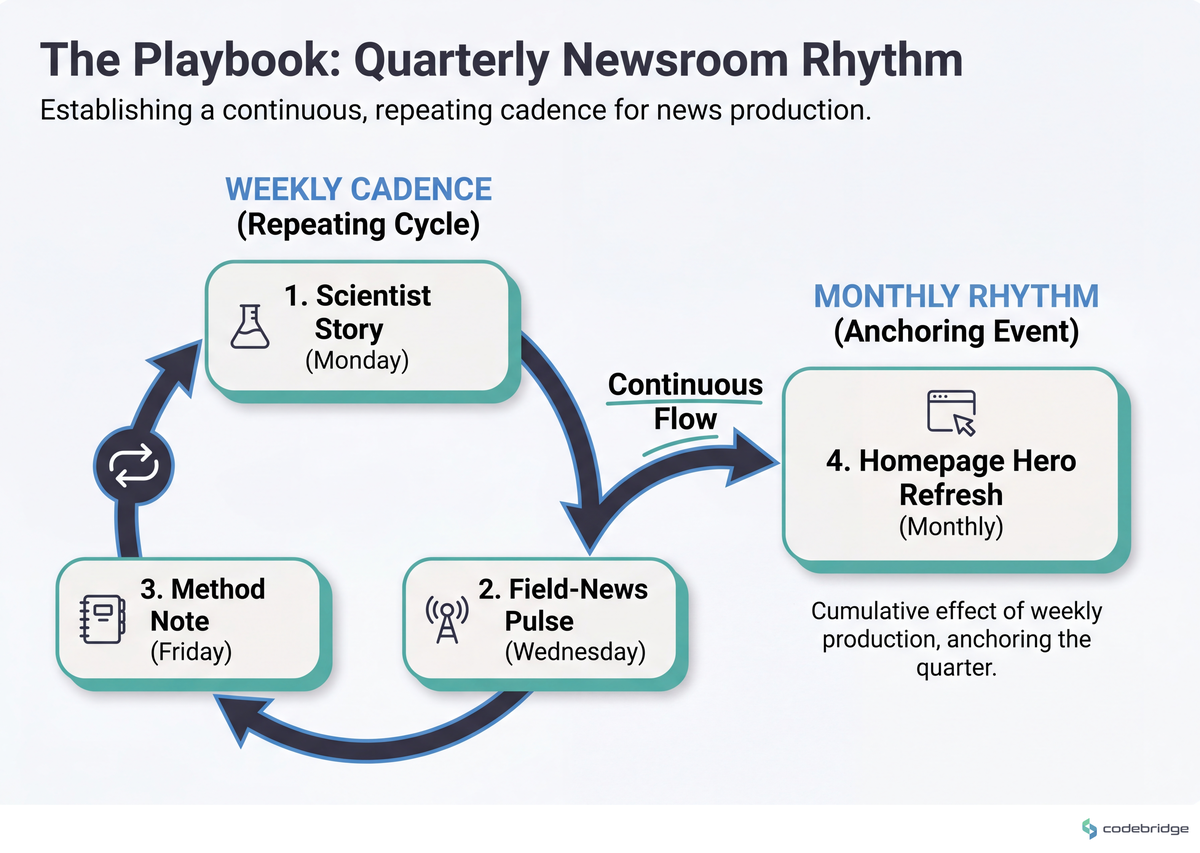
This is the part to send to whoever owns the website on your team. Each step has a concrete signal of done — not "improve" or "refresh," but a binary you can show the executive team in your next review. The flow is depicted below:
Step 1 — Audit your scientist signal (Day 1)
What to do: Open your homepage and three top-trafficked subpages. Count the number of named, real, non-employee scientists who appear above the fold across all four pages.
What good looks like: Three or more named external scientists, each with their institution and at least a one-line method or finding attributed to them.
Common failure mode: Counting your own employees, executive team, or "Dr. [name], Chief Scientific Officer" as the signal. They aren't peers to the visitor; they're you.
Step 2 — Replace the case studies page with scientist profile pages (Week 1)
What to do: Take your three best customer stories and rebuild each as a profile of the scientist, not the deal. Lead with their face, their lab, their question. The instrument is the supporting actor.
What good looks like: A reader on the page can name what the scientist is studying within ten seconds, before they encounter your product.
Common failure mode: The page reads "Customer X uses Product Y to achieve Z." That's a deal narrative. The scientist narrative reads "Dr. X is studying Z; here's how she got past the bottleneck of W."
Step 3 — Establish the 1+1+1 weekly cadence (Week 2 onward)
What to do: Commit to publishing one scientist story per week, one field-news item per week (a preprint citing your instrument, a regulatory update, a methods paper), and one short method note per week. Three pieces, every week, for a quarter minimum.
What good looks like: A homepage "This Week" rail that genuinely turns over every seven days, dated, with the most recent piece visible without scrolling.
Common failure mode: Front-loading the quarter (six pieces in week one, silence in week eight). Consistency is the signal, not volume.
Step 4 — Wire news to a real source feed (Week 3)
What to do: Set up a recurring search on PubMed, bioRxiv, or your relevant preprint server for citations of your instrument, kit, or core method. Surface those citations on the site as a live "In the literature" rail with linked DOIs.
What good looks like: A scientist visiting your site can see, in under five seconds, that real labs have published using your tools in the last quarter. The rail updates automatically; no marketing approval needed for each citation.
Common failure mode: Treating this as a manual quarterly newsletter. The cost of staff curation collapses the cadence within two months.
Step 5 — Rewrite the About page as a story, not a credentials list (Week 4)
What to do: The About page should answer one question: "Why does this company exist for the science it's serving?" Lead with the founding scientist's question, not the funding round or the office locations.
What good looks like: A reader who only reads the About page can summarize, in one sentence, what scientific problem the company is trying to make easier.
Common failure mode: A timeline of corporate milestones (founding, Series B, ISO certification). None of those answer the scientist's actual question.
Step 6 — Track trust-side metrics, not just funnel metrics (Month 2)
What to do: Add two metrics to your weekly review: number of named external scientists currently visible on the homepage, and median age in days of the most recent visible content. Report both alongside the usual sessions and conversions.
What good looks like: Both numbers are visible on a slide your CEO sees monthly. When the named-scientist count drops below three, or the median age exceeds 14 days, an alert fires.
Common failure mode: Reporting only sessions and form fills. Both metrics are lagging indicators; the trust-side metrics are leading.
Closing the Loop on the Catalog Page
Return to the synthetic Strategy & Execution Lead from the opening. If they ran this playbook, the version of their site at the end of the quarter would look different in two specific places. The leadership page would no longer be the second-most-visited internal page; that slot would belong to the scientist profile rail. The catalog pages would still convert, but the path in would have shifted from search to story — buyers would arrive having already read a Dr. So-and-So profile and would scroll the catalog with intent rather than evaluation. The three quiet weeks of inbound would not return, because the homepage would now be a publicly visible signal that the company is alive in the field, not just in the catalog.
Tomorrow morning, do Step 1 — audit the scientist signal on your top four pages and write down the count. Wednesday, draft Step 2 with whoever owns content. By the end of next week, the 1+1+1 cadence should be on a shared editorial calendar with the first week's three pieces named. If you want a 30-minute artifact to do today: open your homepage, screenshot the hero, and write down the publish date of every piece of content visible above the fold across the top three pages. If the median date is older than two weeks, you have already proven to yourself that this is the work.
The most overlooked operational dependency in this playbook is customer consent for naming and quoting. Build the consent template into your sales contracts now, not after the first scientist profile is drafted.
Diagnostic Checklist: Score Your Awareness Site
Run these against your current site. One point per "Yes." Three or below: brochure mode, rebuild the cadence. Four to five: structurally healthy, strengthen the freshness signal. Six or seven: the site is doing its job; protect the cadence and don't let a brand refresh interrupt it.
Can a first-time visitor name at least three external scientists who appear above the fold across your top four pages? Yes / No
Is the most recent piece of content on your homepage dated within the last 14 days? Yes / No
Does your "About" page open with a scientific question rather than a founding date or a funding round? Yes / No
If your CEO asked "how many named, non-employee scientists are visible on our site this week," could whoever owns the site answer in under a minute? Yes / No
Does at least one page on your site auto-pull citations of your instrument or method from a real source feed (PubMed, bioRxiv, or equivalent)? Yes / No
Is there a documented consent template that a sales rep can attach to a contract to name and quote a customer scientist on the site? Yes / No
Are at least two trust-side metrics (named-scientist count, median content age) reported alongside conversion metrics in your monthly review? Yes / No
Not sure where to start?
Talk to our team about auditing your awareness site against this playbook.











Heading 1
Heading 2
Heading 3
Heading 4
Heading 5
Heading 6
Lorem ipsum dolor sit amet, consectetur adipiscing elit, sed do eiusmod tempor incididunt ut labore et dolore magna aliqua. Ut enim ad minim veniam, quis nostrud exercitation ullamco laboris nisi ut aliquip ex ea commodo consequat. Duis aute irure dolor in reprehenderit in voluptate velit esse cillum dolore eu fugiat nulla pariatur.
Block quote
Ordered list
- Item 1
- Item 2
- Item 3
Unordered list
- Item A
- Item B
- Item C
Bold text
Emphasis
Superscript
Subscript