The Tuesday Before Christmas Eve, Your Lead Dev Pings You: "Merge Conflicts in the Hero Section, Again"
You signed the rebrand SOW in October. The client wanted the new site live "before holiday traffic." Your team picked up AI-assisted coding to compress the build. Now it's 9pm on December 22nd, and the lead dev is staring at a pull request that touches roughly 5,000 lines because an LLM helpfully refactored half the theme. On r/webdevelopment, one developer summed up the exact moment many of us recognize:
"Merge conflicts with like 5000 lines of AI-gen code changes — it's brutal."
Reddit r/webdevelopment
If you run a WordPress-heavy agency and you've ever shipped a rebrand against a fixed holiday date, you don't need a research deck to feel this. You've lived it.
KEY TAKEAWAYS
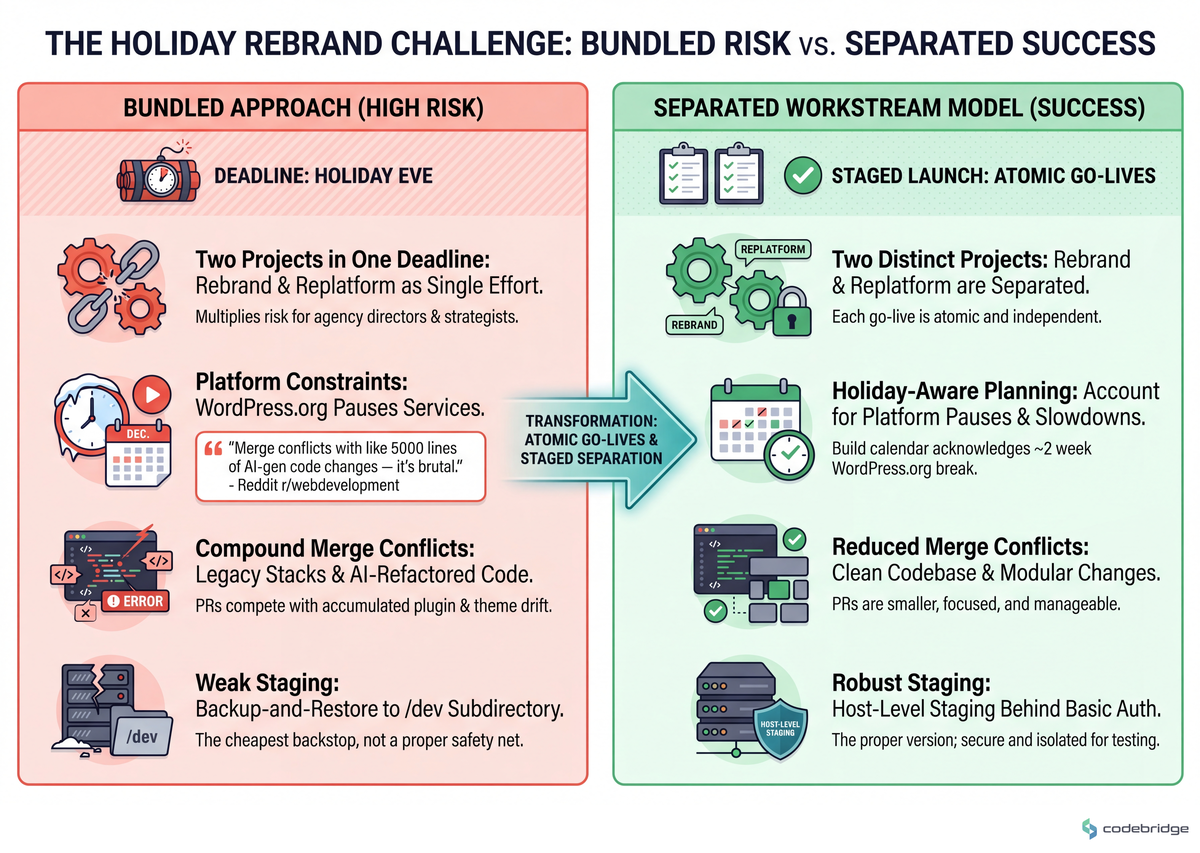
Rebrands and replatforms are two projects, not one. Bundling them into a single pre-holiday deadline multiplies risk for any agency director or strategist.
WordPress.org itself pauses services around the holidays. The platform you build on slows down for roughly two weeks; your build calendar should account for that.
Merge conflicts compound on legacy stacks. On sites older than four or five years, every redesign PR competes with accumulated plugin and theme drift.
Staging is the floor, not the ceiling. The cheapest backstop is a backup-and-restore into a /dev subdirectory; the proper version is host-level staging behind basic auth.
Holiday rebrands fail at the kickoff stage, not the deploy stage. The checklist at the bottom of this article catches the kickoff failures.
The Hidden Problem: You Negotiated One Deadline for Two Projects
When a marketing director signs a holiday-rebrand SOW, they're typically buying three things at once: a new visual identity, a redesigned WordPress front end, and — uncomfortably often — an implicit platform decision ("should we move off WordPress while we're in here anyway?"). All three are due before Black Friday, or the early-January launch announcement, or whichever fixed date the client's calendar dictates.
The WordPress ecosystem itself doesn't run at full capacity in those weeks. The platform team has been transparent about that:
"We're going to be pausing a few of the free services currently offered..." New account registrations on WordPress.org, new plugin directory submissions, new plugin reviews, new theme directory submissions, new photo directory submissions.
WordPress.org Team, WordPress.org News — Holiday Break
That's the platform you depend on telling you, in writing, that core services slow down for roughly two weeks. If your launch window straddles that period, you've inherited a quieter support surface at the exact moment your team needs the most help. Anchor every milestone to that calendar, not to a wishful client schedule.
Real Stories from Agencies That Hit the Wall
The merge-conflict problem isn't new — it's just been amplified by AI tooling and aging codebases. One developer on r/webdev described the exact bottleneck that turns rebrand sprints into weekend death-marches:
"Recently had to code a rebranded/redesigned frontend on top of a 5+ year old stack — merges only went through when there were no conflicts at all."
Reddit r/webdev
The thread doesn't tell us how that engagement shipped. What it does tell us is the pattern: when the underlying codebase is ancient and the rebrand touches the surface layer, every merge becomes a negotiation with five years of accumulated decisions you didn't make.
Meanwhile, marketing-led teams keep asking a different — but related — question. From r/cms:
"Our current site is on WordPress — is it actually worth replatforming during a rebrand, or are we just inviting chaos?"
Reddit r/cms
The honest answer for almost every agency director: yes, you are inviting chaos. Treat the replatform as a separate engagement with its own go-live date. Lead-gen sites that lose pipeline during a botched migration don't get the lost months back, and "we were also rebranding" is not a defense the CMO accepts in the QBR.
The third pattern is the staging question. On Quora, a recurring answer for agencies without proper hosting tooling:
"The easiest way is to back up the current site with a plugin and restore it into a /dev subdirectory until the redesign is ready."
Quora
The diagram below contrasts the bundled approach with the separated workstream model that survives holiday pressure.
The Pattern: Successful Agencies Cut the Scope, Not the Hours
Across the rebrand engagements we see go sideways in November and December, the single most reliable predictor of failure is scope bundling. The kickoff meeting promises "a fresh look and a modernized stack and a holiday launch." Three of those promises are real; one is a fiction the client wants to believe.
The directors who deliver clean holiday rebrands aren't the ones who hire more contractors in week two. They're the ones who, in the kickoff meeting, push back on a single line of the SOW — the one that says "and we'll evaluate moving off WordPress as part of this." That sentence is where the project's risk doubles. Cut it. Schedule the replatform conversation for Q1, with its own discovery phase, its own budget, and its own launch date.
The second pattern that separates clean launches from messy ones: explicit feature freezes. On any legacy WordPress site, the moment the rebrand sprint starts, new feature work on the live site must stop. Every merge into main that isn't part of the rebrand is a future conflict you're funding with your weekend.
The Six-Step Holiday Rebrand Playbook
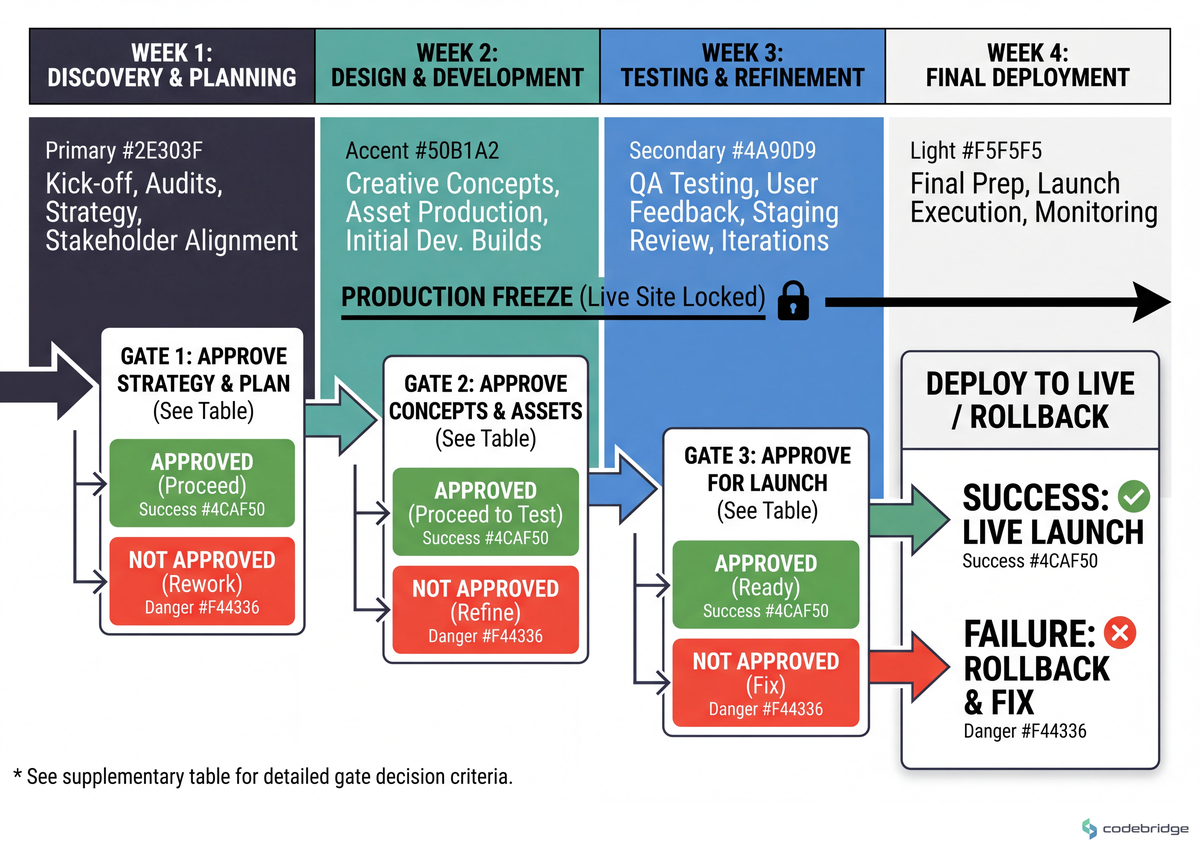
What follows is the sequence we run. It assumes a four-week window before the launch date and a WordPress site older than three years. The timeline below shows how the gates align against a typical pre-holiday calendar.
Step 1 — Split the SOW into two documents before kickoff
What to do: Separate "rebrand + redesign" from "replatform / CMS swap / major plugin migration." Two SOWs, two launch dates, two budgets. If sales pushes back, point them at the r/cms thread above.
What good looks like: The rebrand SOW lists exactly which templates, components, and pages are in scope. The replatform conversation has a separate discovery date in Q1.
Common failure mode: Sales bundles them to close the deal. By week three of the build, the replatform "exploration" has eaten 40% of the design hours.
Step 2 — Freeze the production codebase on Day 1
What to do: Announce a written feature freeze covering the live site. No new plugins, no new ACF fields, no theme tweaks until launch. Put it in the client portal. Get the freeze acknowledged by the marketing lead, not just the dev contact.
What good looks like: Any content change during the sprint is achievable through the CMS interface — no deploys, no merges.
Common failure mode: The client's in-house marketer publishes a homepage hero swap on December 10 because "the campaign needed it." Your rebrand branch is now three commits behind in a place it can't easily rebase.
Step 3 — Stand up real staging in week one, not week three
What to do: If the host offers staging (Kinsta, WP Engine, Pressable), use it. If not, the Quora pattern works: backup plugin → restore into /dev subdirectory protected by basic auth. Either way, staging exists before any design work merges.
What good looks like: Designers and content editors can preview the rebrand on staging by end of week one. Client stakeholders have credentials.
Common failure mode: Staging is promised "next week" for three weeks, and the team works directly off feature branches with no shared preview environment.
Step 4 — Cap AI-generated diffs at 400 lines per PR
What to do: If your team uses Copilot, Cursor, or Claude Code for theme work, enforce a hard PR size limit. The r/webdevelopment quote of "5,000-line AI-gen merge conflicts" is what happens when you don't.
What good looks like: Each PR touches one component or one template. Reviews take under 30 minutes. Conflicts resolve in single commits.
Common failure mode: A junior dev asks an LLM to "refactor the header" and accepts the entire diff. The PR now reformats every .php file it touched, and the senior reviewer needs four hours to understand what changed.
Step 5 — Build the holiday-content layer as configuration, not code
What to do: If the rebrand needs to ship with holiday-specific creative (logo variants, campaign banners, seasonal CTAs), use builder-native scheduling rather than custom theme code. Plugins listed in the WordPress.com holiday directory already do logo-on-schedule swaps.
What good looks like: The marketing team can swap a holiday hero on December 23 without filing a ticket and without your team touching main.
"Change your logo on a schedule by saving different versions for holidays and special events." Set the dates and this plugin will switch them out.
WordPress.com Plugins — Holiday category
Common failure mode: Holiday creative gets hard-coded into the theme. Removing it in January requires a deploy that no one wants to do during the campaign-debrief week.
Step 6 — Lock the deploy window before WordPress.org slows down
What to do: Plan the production cutover for at least three business days before December 20. After that, plugin support, theme directory submissions, and core community responsiveness drop measurably, as the WordPress.org Holiday Break announcement makes explicit.
What good looks like: Your launch lands on a Tuesday or Wednesday, with two full business days for hot-fixes before the platform itself enters its quieter window.
Common failure mode: A "soft launch" on December 22 turns into a hard support incident on December 23 with no community channel responding until the new year.
If the client insists on launching between December 21 and January 4, renegotiate the date, not the scope. A two-week shift right or left protects the build more than any technical heroics you can sell.
Close: Three Concrete Moves Before This Friday
Remember the 5,000-line AI-generated merge conflict that opened this article. The Reddit thread doesn't tell us how that team got the rebrand out the door — and that's exactly the point. The win condition isn't a heroic Sunday-night rescue. It's a kickoff meeting two months earlier where someone — almost certainly the agency director or strategist — pushed back on the bundled scope.
Tomorrow morning: open every active holiday-rebrand SOW and find the line that bundles "and we'll evaluate the platform." Email the client to schedule a separate Q1 discovery for that conversation. Wednesday: issue a written feature freeze on every legacy WordPress production site your team touches before December 20. By Friday: confirm staging environments exist for every active rebrand and that the client marketing lead has credentials.
The 30-minute artifact: run the checklist below against your single most at-risk rebrand. Each "Yes" is a kickoff decision you made that's going to cost you billable hours in week three.
Looking at a holiday rebrand that already feels overscoped?
Talk to our team about a one-hour scope review before week one slips.
Diagnostic Checklist: How Exposed Is Your Next Rebrand?
Score one point per "Yes." 0-2 = healthy; 3-4 = exposed, replan now; 5+ = the launch will slip — the only question is by how much.
Does the signed SOW bundle "rebrand" and any phrase like "evaluate replatforming" into a single deadline? Yes / No
Is the production WordPress site older than four years, with more than 20 active plugins? Yes / No
Is the planned go-live date between December 20 and January 5? Yes / No
Does staging still not exist by the end of week one of the engagement? Yes / No
Are AI-assisted PRs landing in the repo with no enforced size limit? Yes / No
Has any non-rebrand merge landed in production since the rebrand sprint started? Yes / No
Is holiday creative (logo variants, banners, seasonal CTAs) being implemented as theme code rather than scheduled configuration? Yes / No
REFERENCES










Heading 1
Heading 2
Heading 3
Heading 4
Heading 5
Heading 6
Lorem ipsum dolor sit amet, consectetur adipiscing elit, sed do eiusmod tempor incididunt ut labore et dolore magna aliqua. Ut enim ad minim veniam, quis nostrud exercitation ullamco laboris nisi ut aliquip ex ea commodo consequat. Duis aute irure dolor in reprehenderit in voluptate velit esse cillum dolore eu fugiat nulla pariatur.
Block quote
Ordered list
- Item 1
- Item 2
- Item 3
Unordered list
- Item A
- Item B
- Item C
Bold text
Emphasis
Superscript
Subscript