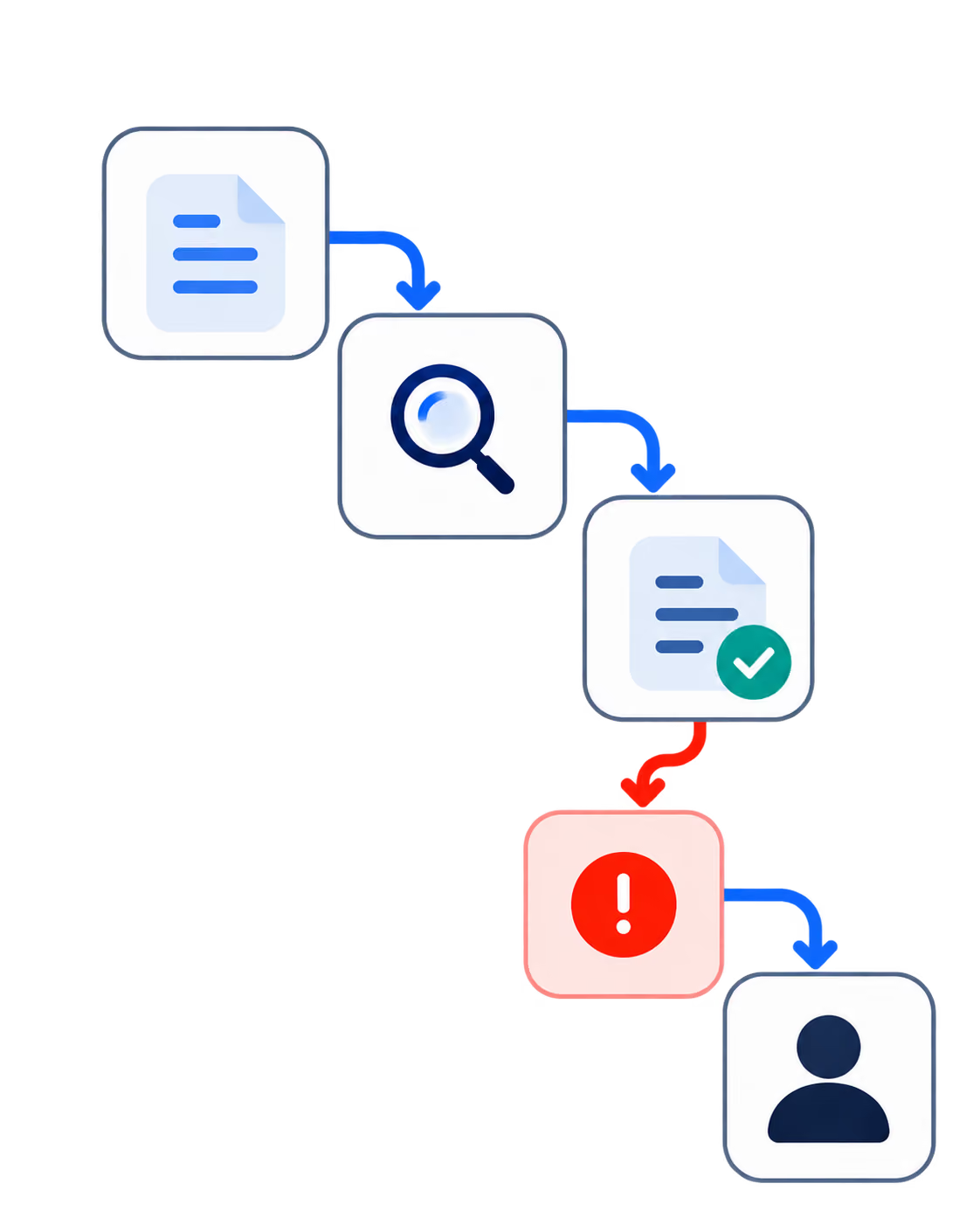
Last quarter, a mid-sized satellite operations team faced a familiar nightmare: their constellation was growing faster than their ability to process the data coming down. Ground station queues backed up. Analysts worked weekends. The obvious answer,hire ML engineers,ran into an equally familiar wall: six-month recruiting cycles, $300K+ compensation packages, and the uncomfortable reality that specialized AI talent doesn't want to join a 40-person space company when FAANG is calling.
So they did something different. They stopped trying to hire AI specialists and started enabling their existing engineers to use AI tooling directly. Within 90 days, their data processing latency dropped by nearly half. No new headcount. No massive infrastructure overhaul. Just a strategic shift in how they thought about AI adoption.
This isn't an isolated story. It's becoming the playbook for space-tech teams that can't,or won't,compete in the AI talent wars.
KEY TAKEAWAYS
The AI specialist hiring bottleneck is real, but leading space-tech teams are bypassing it entirely by upskilling domain experts.
AI reduces data processing latency by 40% for large satellite constellations,gains achievable without dedicated ML teams.
Predictive maintenance via ML cuts unexpected failures by 30%, and the implementation often comes from systems engineers, not data scientists.
23% of enterprises are already scaling agentic AI, with space-tech organizations among the early adopters in mission-critical applications.
The Hidden Problem: The AI Talent Gap Is Widening, Not Closing
Here's what the recruiting dashboards don't show you: the global AI adoption gap is accelerating. According to Microsoft's AI Economy Institute, the Global North's AI adoption grew almost twice as fast as the Global South in 2025, widening the gap to 10.6 percentage points. This isn't just a geographic problem,it's a talent distribution problem. The engineers who understand both AI and space systems are clustering in a handful of well-funded organizations.
The Technavio market analysis projects the AI in space exploration market will grow by USD 11.28 billion between 2025 and 2029. That's a 34.1% compound annual growth rate. But here's the uncomfortable math: the supply of AI specialists with aerospace domain knowledge isn't growing at 34%. It's not even close.
For CTOs and CISOs in this sector, the strategic question has shifted. It's no longer "How do we hire AI talent?" It's "How do we multiply our existing team's output using AI without becoming dependent on specialists we can't find or afford?"
What Successful Teams Actually Do
The organizations pulling ahead aren't waiting for perfect AI hires. They're taking a different approach,one that treats AI as an amplifier for domain expertise rather than a replacement for it.
Pattern 1: Embed AI Capabilities Into Existing Workflows
Capella Space's trajectory is instructive. When they secured $150 million in Series C funding in January 2025, the investment thesis wasn't about building an AI research lab. It was about enhanced on-board AI processing capabilities,pushing intelligence to the edge where their existing satellite engineers could use it directly.
The key insight: they didn't hire a separate AI team to build these capabilities. They invested in tooling that their systems engineers could configure, tune, and deploy. The AI became part of the satellite engineering workflow, not a separate discipline requiring handoffs and translation layers.
The most successful AI implementations in space-tech aren't built by AI specialists,they're configured by domain experts using increasingly accessible AI tooling.
Pattern 2: Start With Predictive Maintenance, Not Moonshots
Machine learning reduces unexpected satellite component failures by 30% via predictive maintenance and anomaly detection. This isn't theoretical,it's operational reality for teams that chose the right entry point.
The pattern here is consistent: successful teams don't start with ambitious autonomous systems. They start with predictive maintenance. Why? Because it's a bounded problem. Your systems engineers already understand the failure modes. They already have the telemetry. AI becomes a force multiplier for pattern recognition they're already doing manually.
One defense contractor's satellite operations team implemented anomaly detection using their existing MATLAB-trained engineers. No Python expertise required initially. No dedicated ML ops team. They used pre-built models, fine-tuned them on their historical telemetry data, and deployed within a single quarter. The result: a 30% reduction in unplanned maintenance events.
Pattern 3: use Agentic AI for Autonomous Operations
Lockheed Martin's $80 million NASA contract for lunar rover autonomous navigation demonstrates where this is heading. Their reinforcement learning system for real-time pathway self-correction wasn't built by a separate AI division,it was developed by their robotics and systems engineering teams using AI frameworks that abstract away the ML complexity.
According to McKinsey's 2025 State of AI survey, 23% of organizations are scaling agentic AI systems. In space-tech, this translates to autonomous navigation, real-time decision-making for orbital maneuvers, and intelligent resource allocation,all increasingly accessible to teams without dedicated AI specialists.
The Framework: Multiplying Output Without Multiplying Headcount
Based on the patterns emerging from successful implementations, here's the actionable framework space-tech engineering teams are using:
1. Identify Your "AI use Points"
Not every problem benefits equally from AI. The highest-use opportunities in space-tech share common characteristics:
- High data volume with known patterns: Telemetry analysis, Earth observation data processing, signal processing
- Repetitive expert judgment: Anomaly detection, quality assurance, mission planning optimization
- Real-time decision requirements: Orbital maneuvers, autonomous navigation, collision avoidance
AI optimizes satellite orbital paths, reducing propellant consumption by over 10% compared to traditional maneuvers. That's not a nice-to-have,it's satellite lifetime extension. And it's achievable by systems engineers using optimization frameworks, not ML PhDs.
2. Upskill Domain Experts, Don't Hire AI Generalists
The counterintuitive insight from St. Louis Fed research: nonwork AI adoption (48.7%) is outpacing work adoption (37.4%). Your engineers are already using generative AI at home. They're experimenting with it for personal projects. The gap isn't capability,it's permission and tooling.
Successful teams are:
- Providing access to enterprise-grade AI tools (not blocking them)
- Creating internal "AI champions" from existing engineering staff
- Running 2-week sprints where domain experts prototype AI solutions
- Investing in prompt engineering and AI integration training, not ML fundamentals
3. Build the Infrastructure for AI Enablement
North America is projected to contribute over 41% of incremental growth in the AI space exploration market, largely due to investments in autonomous systems infrastructure. The winning teams aren't just buying AI tools,they're building the data pipelines, governance frameworks, and integration layers that let domain experts use AI safely.
For CISOs, this means:
- Data classification systems that enable AI training without security violations
- Sandboxed environments for AI experimentation
- Clear policies on AI-generated code review and validation
- Audit trails for AI-assisted decisions in mission-critical systems
4. Start With Ground Systems, Then Move to Space
AI reduces data processing latency on the ground by 40% for large satellite constellation Earth observation data. Ground systems are the lowest-risk, highest-reward starting point. You can iterate quickly, fail safely, and build organizational confidence before pushing AI capabilities to space assets.
| Application Area | Risk Level | Typical Impact | Time to Value |
|---|---|---|---|
| Ground data processing | Low | 40% latency reduction | 1-3 months |
| Predictive maintenance | Medium | 30% failure reduction | 3-6 months |
| Orbital optimization | Medium | 10%+ propellant savings | 6-9 months |
| Autonomous navigation | High | Mission-enabling | 12-18 months |
5. Embrace Sovereign AI Considerations
The biggest trend in 2025-2026 is sovereign space,nations demanding sovereign access and data control. UAE's AI adoption rate of 64% of working-age population reflects this priority. For defense-adjacent space-tech, this means AI solutions must be deployable in air-gapped or sovereign cloud environments.
This constraint is actually an advantage: it forces teams to build AI capabilities that don't depend on external APIs or cloud-based ML services. The result is more solid, more secure, and more controllable AI implementations.
The Security Dimension: What CISOs Need to Consider
Enabling AI across engineering teams introduces security considerations that can't be afterthoughts:
Data exposure risks: When engineers use AI tools for code generation or data analysis, what's being sent to external services? Establish clear boundaries between AI tools that can touch sensitive data and those that can't.
Model integrity: If you're fine-tuning models on proprietary data, how do you ensure those models aren't exfiltrated or compromised? This is especially critical for defense-adjacent work.
AI-generated code validation: Code generated by AI assistants needs the same (or more rigorous) review as human-written code. Establish review protocols before AI tools are widely deployed.
Decision audit trails: For mission-critical systems, you need to demonstrate why an AI-assisted decision was made. Build logging and explainability into your AI implementations from day one.
The organizations that treat AI security as a blocker will fall behind. The organizations that treat it as an enablement challenge,something to solve, not avoid,will multiply their teams' output while maintaining security posture.
Looking Ahead: 2026 and Beyond
The trajectory is clear. AI isn't eliminating jobs in space-tech,it's transforming how work gets done. The teams that thrive will be those that figure out how to make their existing engineers 2x, 3x, or 5x more productive using AI tools, rather than waiting for AI specialists who may never arrive.
Remember that satellite operations team from the opening? They didn't solve their data processing bottleneck by hiring ML engineers. They solved it by giving their existing analysts access to AI-powered processing tools and the training to use them effectively. The 40% latency reduction wasn't magic,it was strategic enablement.
The question isn't whether your team will use AI. It's whether you'll lead that transformation intentionally or scramble to catch up when competitors pull ahead.
Ready to assess your team's AI enablement readiness?
Schedule a technical consultation to identify your highest-use AI opportunities.
Diagnostic Checklist: Is Your Team Ready to Multiply Output With AI?
Your engineers are using consumer AI tools at home but blocked from using them at work
Data processing backlogs are growing faster than your ability to hire analysts
You have no clear policy on AI-generated code review and validation
Your predictive maintenance is still primarily rule-based rather than ML-driven
AI initiatives are siloed in a separate team rather than embedded in engineering workflows
You lack data classification systems that would enable safe AI training on operational data
Your AI strategy depends on hiring specialists you've been unable to recruit for 6+ months
Ground system data processing latency exceeds industry benchmarks by more than 40%
REFERENCES











Heading 1
Heading 2
Heading 3
Heading 4
Heading 5
Heading 6
Lorem ipsum dolor sit amet, consectetur adipiscing elit, sed do eiusmod tempor incididunt ut labore et dolore magna aliqua. Ut enim ad minim veniam, quis nostrud exercitation ullamco laboris nisi ut aliquip ex ea commodo consequat. Duis aute irure dolor in reprehenderit in voluptate velit esse cillum dolore eu fugiat nulla pariatur.
Block quote
Ordered list
- Item 1
- Item 2
- Item 3
Unordered list
- Item A
- Item B
- Item C
Bold text
Emphasis
Superscript
Subscript