Last month, a CTO at a mid-sized commercial real estate firm told me something that stopped me cold: "We have six developers. We built our property management system in-house. And now I'm terrified of what happens when two of them leave." It wasn't a hypothetical fear,he'd already lost one senior engineer to a PropTech startup, and the remaining team was drowning in maintenance while competitors deployed AI-powered features quarterly.
This isn't a story about outsourcing. It's about a structural shift that's making "we have internal developers" an increasingly dangerous comfort blanket in real estate technology.
KEY TAKEAWAYS
The PropTech market is tripling by 2033, creating a talent war that internal teams can't win on compensation alone.
AI integration complexity is accelerating, with the market hitting $303B and demanding specialized skills your generalist team likely doesn't have.
"No immediate needs" is the most expensive phrase in technology planning,by the time needs become immediate, you're already 18 months behind.
Strategic partnerships aren't about replacing your team; they're about creating capacity for the rare, high-stakes projects that define market position.
The Hidden Problem: Your Developers Are Fighting Yesterday's War
Here's what the market data reveals about the pressure your internal team is under: the PropTech market is projected to reach $114.8 billion by 2033, growing at 13.25% annually. That's not incremental growth,it's a fundamental restructuring of how real estate operates. Every percentage point of that growth represents new capabilities your competitors are deploying while your team maintains legacy code.
$303.06BAI in Real Estate market size, growing at 34.4% annually
The AI integration challenge is particularly brutal. According to Research and Markets, the AI in Real Estate sector is valued at $303.06 billion with a 34.4% compound annual growth rate through 2029. Your internal developers,however talented,likely built their expertise on CRUD operations, API integrations, and database management. Now they're expected to implement machine learning models for property valuation, natural language processing for lease analysis, and predictive analytics for market timing.
The skills gap isn't a training problem. It's a physics problem. There aren't enough hours in the day for your team to maintain existing systems, ship new features, AND develop expertise in rapidly evolving AI frameworks.
The Commercial Complexity Multiplier
If you're in commercial real estate, the challenge compounds. Commercial properties represent 63% of the real estate software market specifically because operational requirements are exponentially more complex than residential. Multi-tenant billing, CAM reconciliation, lease abstraction, space planning optimization,each of these is a domain unto itself.
The following comparison illustrates why commercial PropTech demands a different approach than what worked five years ago:
Commercial vs. Residential PropTech Complexity, Feature depth, integration requirements, and AI use cases
Notice the divergence in AI application requirements. Residential tech can get away with relatively simple recommendation engines. Commercial demands sophisticated financial modeling, predictive maintenance algorithms, and tenant behavior analysis that requires genuine data science expertise,not just developers who've completed a machine learning MOOC.
The Pattern: What Future-Ready Teams Actually Do
The organizations navigating this transition successfully share a counterintuitive approach: they treat their internal development capacity as strategic rather than operational.
Here's what that means in practice. Internal teams focus on three things: proprietary business logic that creates competitive advantage, deep integration with core operational systems, and institutional knowledge preservation. Everything else,including the "rare" projects that require specialized expertise,gets structured for external partnership.
The phrase "potential for future rare projects" is a red flag. Rare projects are precisely the ones that benefit most from external expertise,your team lacks the pattern recognition that comes from doing similar work across multiple organizations.
Consider the real estate software market trajectory: $13.65 billion in 2025 growing to $34.1 billion by 2032 at 14% annually. That growth is being captured by organizations that can deploy new capabilities faster than their competitors. Speed-to-market on "rare" projects, AI implementations, mobile-first redesigns, IoT integrations,determines who captures market share.
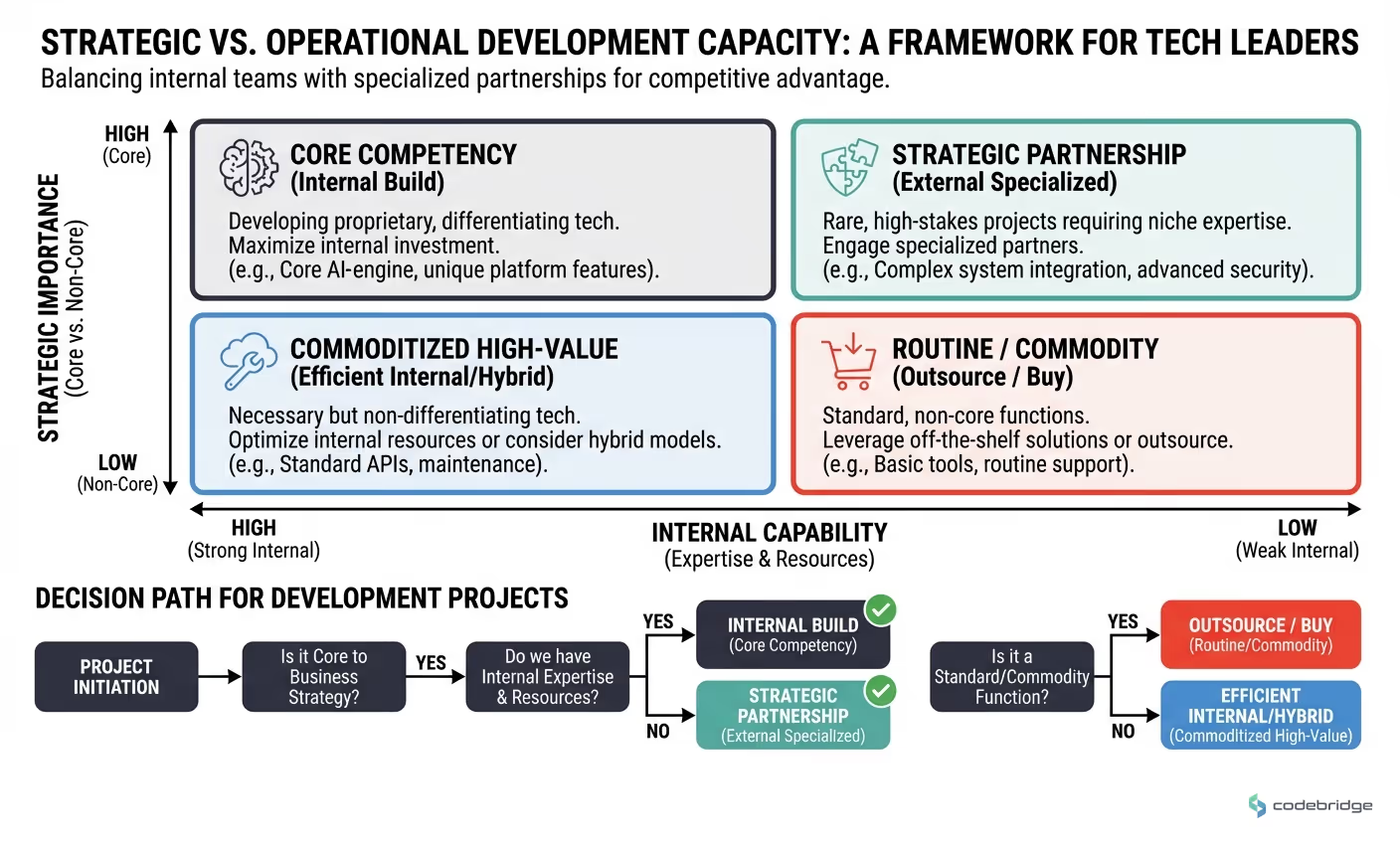
The diagram below shows how leading PropTech organizations structure their development capacity:
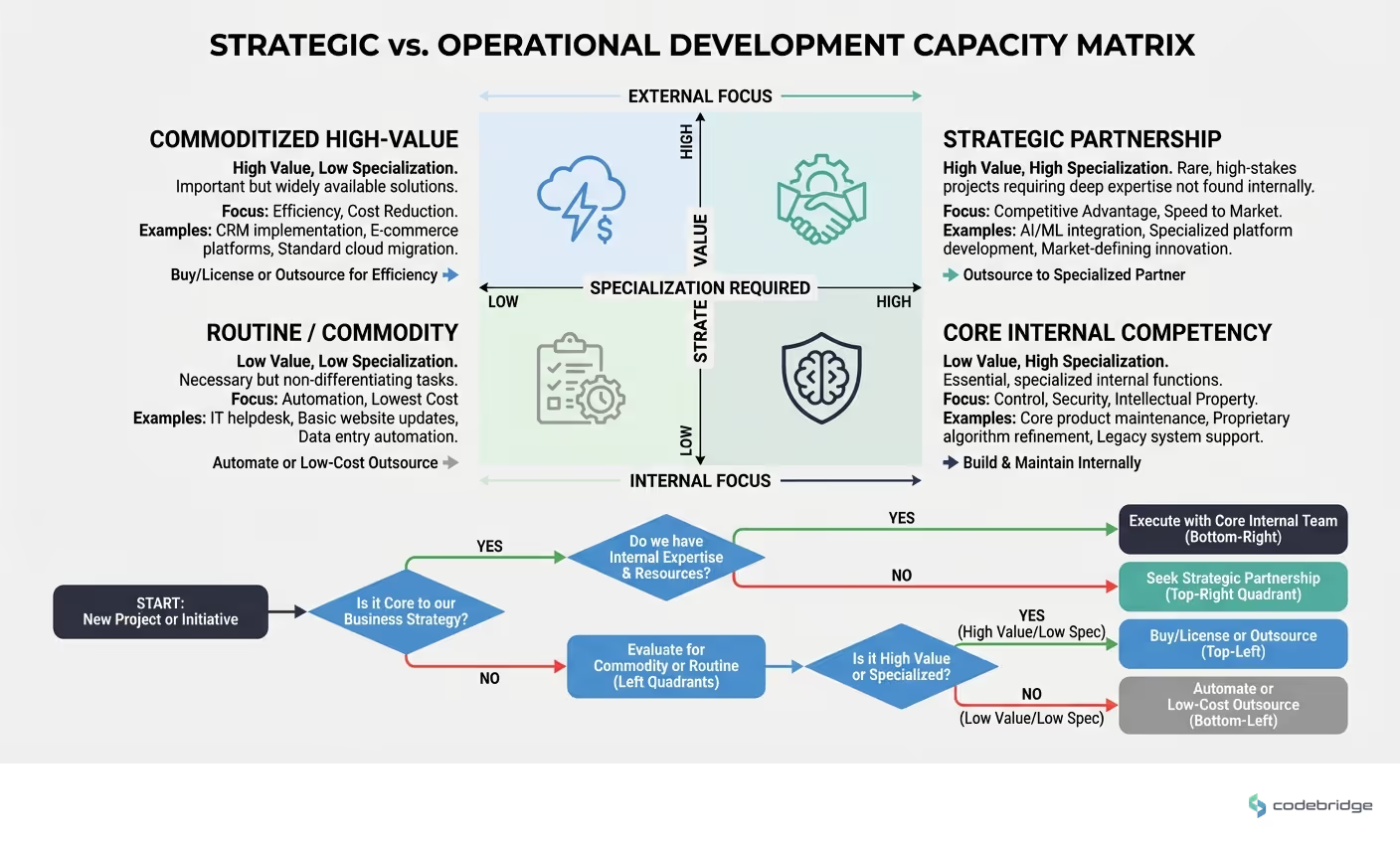
Development Capacity Matrix, Internal vs. External by Strategic Value and Specialization Required
The upper-right quadrant,high strategic value, high specialization,is where "rare projects" live. It's also where internal teams struggle most, because they lack both the specialized skills and the cross-industry pattern recognition that external partners develop through repeated exposure to similar challenges.
The Geographic Reality Check
If you're operating in North America, you're in the most competitive PropTech market on the planet. North America holds 63% of the global real estate software market. That concentration means your competitors have access to the same talent pools you do,and they're all competing for the same limited supply of developers with PropTech domain expertise.
Meanwhile, Asia Pacific is growing fastest at 22.9% market share, driven by urbanization. Global PropTech players are building distributed teams that can tap talent across regions. Your six-person internal team in Denver is competing against organizations with development capacity spanning three continents.
A Framework for Strategic Development Capacity
Here's how to think about development capacity in a market growing this fast:
1. Audit Your Team's Actual Expertise vs. Market Requirements
Map your developers' skills against the capabilities driving PropTech growth: AI/ML implementation, mobile-first development, IoT integration, data pipeline architecture, and real-time analytics. Be honest about gaps. A senior developer who's "interested in learning ML" is 18-24 months away from production-ready expertise.
2. Calculate Your True Maintenance Burden
Most internal teams spend 60-80% of their capacity on maintenance, bug fixes, and incremental improvements. That leaves 20-40% for new development,and "rare projects" require focused attention, not fragmented time between support tickets.
3. Define Your Strategic Core
What code, if a competitor had it, would eliminate your competitive advantage? That's your strategic core. Everything else is a candidate for partnership or external development.
4. Build Partnership Capacity Before You Need It
The worst time to find a development partner is when you have an urgent project. Relationships, security reviews, and workflow integration take time. Organizations that wait until needs become "immediate" pay premium rates and accept compromised timelines.
5. Structure for Knowledge Transfer, Not Dependency
External partnerships should increase your team's capabilities, not create black-box dependencies. Require documentation, code reviews with internal team members, and explicit knowledge transfer milestones.
The following process flow illustrates how to evaluate whether a project should be handled internally or through partnership:
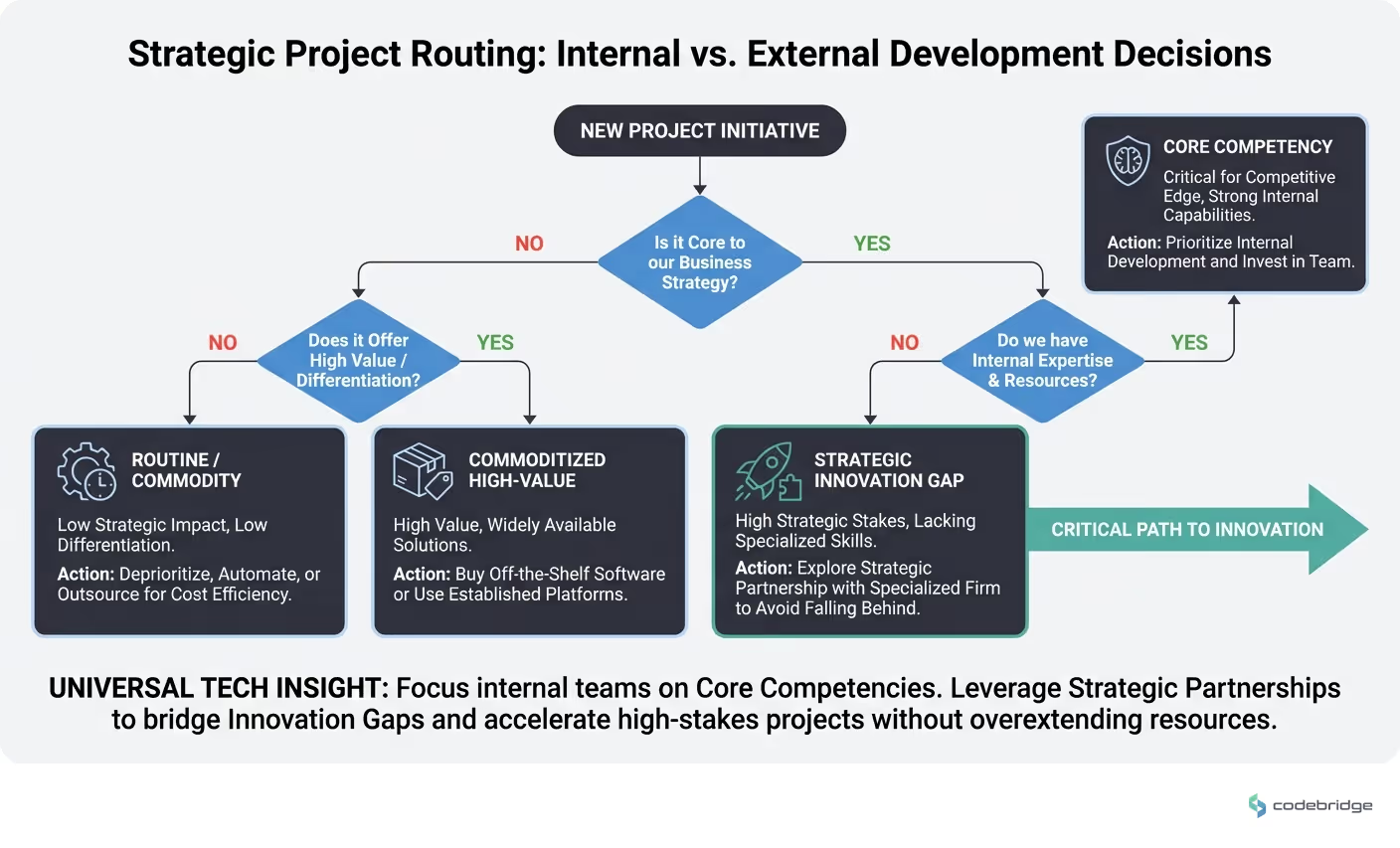
Project Routing Decision Tree, Internal Development vs. Strategic Partnership
The Real Cost of "No Immediate Needs"
Here's the uncomfortable math. The PropTech market will grow from $40.19 billion in 2025 to $104.57 billion by 2034. That's a 160% increase over nine years. Organizations that deploy AI-powered capabilities, mobile-first experiences, and IoT integrations in the next 24 months will capture disproportionate market share. Organizations that wait until needs become "immediate" will find themselves playing catch-up against competitors who moved earlier.
160%PropTech market growth projected over the next 9 years
"No immediate needs" is a statement about today. It says nothing about where the market is moving or what your competitors are building. The CTO I mentioned at the start? His "no immediate needs" posture lasted until a competitor launched an AI-powered lease analysis tool that reduced their clients' legal review costs by 40%. Suddenly, every enterprise prospect was asking why his platform couldn't do the same thing.
He had the developers. He didn't have the specialized expertise. And by the time he realized the gap, he was already two quarters behind.
Is Your Development Strategy Future-Proof?
Use this diagnostic to evaluate whether your current approach will serve you as the PropTech market triples over the next decade:
Your team spends more than 60% of their time on maintenance and support rather than new development
You have no developers with production experience in AI/ML frameworks (not just coursework or side projects)
Your mobile application was last updated more than 18 months ago
You've lost a developer to a PropTech startup or well-funded competitor in the past year
Your roadmap includes "AI features" without a clear implementation plan or assigned expertise
You have no established relationship with external development partners for specialized projects
Your competitors have launched capabilities in the past 12 months that your team couldn't replicate
If you checked three or more items, your development capacity strategy is likely misaligned with market trajectory. The question isn't whether you'll need specialized external expertise,it's whether you'll build that capacity proactively or scramble to find it when a competitor forces your hand.
Want to stress-test your PropTech development strategy?
Schedule a technical architecture review to identify where specialized expertise could accelerate your roadmap.
REFERENCES
AI in Real Estate Market Report 2025, Research and Markets
PropTech Market Size, Growth, Trends, and Report 2025-33, IMARC Group
Real Estate Software Market Size and Forecast, 2025-2032, Coherent Market Insights
PropTech Market Size, Share, Trends | Forecast Report, Fortune Business Insights












Heading 1
Heading 2
Heading 3
Heading 4
Heading 5
Heading 6
Lorem ipsum dolor sit amet, consectetur adipiscing elit, sed do eiusmod tempor incididunt ut labore et dolore magna aliqua. Ut enim ad minim veniam, quis nostrud exercitation ullamco laboris nisi ut aliquip ex ea commodo consequat. Duis aute irure dolor in reprehenderit in voluptate velit esse cillum dolore eu fugiat nulla pariatur.
Block quote
Ordered list
- Item 1
- Item 2
- Item 3
Unordered list
- Item A
- Item B
- Item C
Bold text
Emphasis
Superscript
Subscript