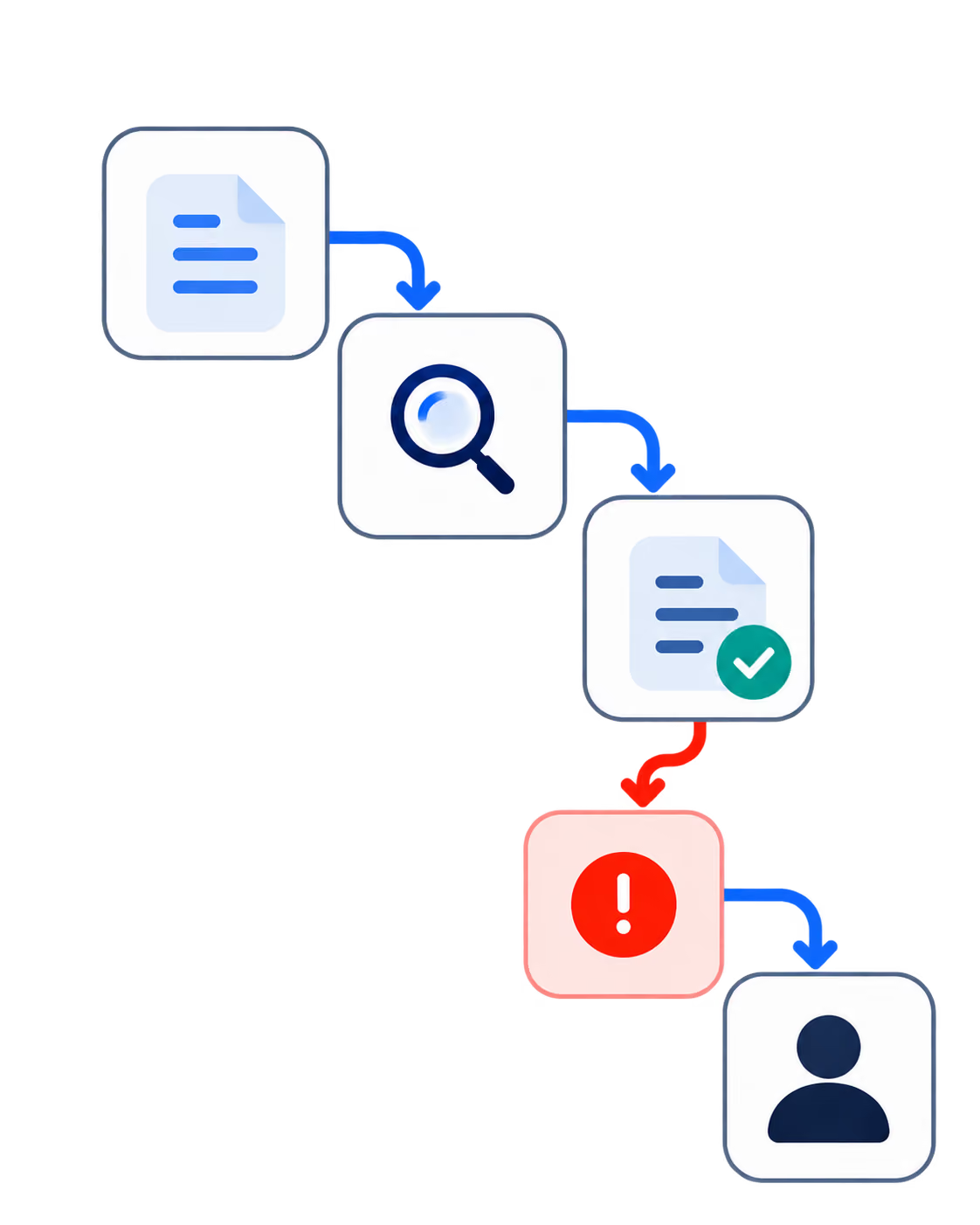
It's 2:47 AM, and your phone buzzes. The VP of Marketing needs to know how many players from the loyalty tier "Gold" visited the steakhouse last Tuesday after losing more than $500 at blackjack. She's prepping for a board meeting in six hours. Your database analyst is on vacation in Cancun. The backup analyst quit last month. You're staring at a ceiling fan, mentally writing the SQL query you'll have to build yourself,again.
This scenario plays out in casino IT departments constantly. The data exists. The business need is urgent. But the bridge between question and answer requires someone who speaks fluent SQL, understands your schema, and has the security clearance to touch player data. In an industry generating $66.5 billion in US commercial gaming revenue in 2023 alone, the bottleneck isn't data,it's access.
KEY TAKEAWAYS
Natural language to SQL isn't about replacing analysts,it's about freeing them from repetitive queries so they can focus on strategic work.
Security doesn't have to be sacrificed for accessibility,row-level permissions and query guardrails can coexist with conversational interfaces.
The 2026 regulatory environment demands audit trails, NL-to-SQL systems actually improve compliance when implemented correctly.
Adoption fails when IT treats this as a technology project,success requires treating it as a change management initiative.
The Data Democratization Paradox
Here's what nobody tells you about casino data: the more valuable it becomes, the fewer people can access it. Your player development team needs real-time insights on high-value guests. Your food and beverage managers want to correlate restaurant visits with gaming behavior. Your compliance team needs instant answers for regulatory inquiries. But every request funnels through the same three people who understand both the business context and the database architecture.
45%rise in US online fraud cases in 2023, driving tighter data access controls
The irony is brutal. The global online gambling market hit $93 billion in 2024, and the convergence of physical and digital platforms means your data is more complex than ever. You're tracking player behavior across slot machines, mobile apps, hotel bookings, restaurant POS systems, and loyalty programs. The schema complexity has exploded, but your analyst headcount hasn't.
Meanwhile, the security stakes have never been higher. A 45% rise in online fraud cases and €1.3 billion in EU gambling-related losses in 2023 have regulators watching closely. You can't just hand out database credentials to anyone who asks nicely.
What Natural Language to SQL Actually Looks Like in 2026
Let's be clear about what we're discussing. Natural language to SQL (NL-to-SQL) systems allow users to type questions in plain English,"Show me all players who visited more than three times this month but haven't redeemed any comps",and receive accurate SQL queries that execute against your databases.
The technology has matured dramatically. Early systems were glorified keyword matchers that broke on anything beyond simple SELECT statements. Today's implementations use large language models fine-tuned on your specific schema, trained to understand casino-specific terminology, and constrained by security policies that prevent unauthorized access.
The critical distinction: NL-to-SQL generates queries, not answers. The query still executes through your existing security layer, respecting all permissions and audit requirements.
This matters because it addresses the primary objection IT directors raise: "I can't let marketing query player data directly." You're not. You're letting marketing describe what they need, then the system generates a query that runs through the same permission checks as any analyst-written query. The human is removed from the translation step, not the security step.
The Security Architecture That Actually Works
The casino IT teams successfully deploying NL-to-SQL share a common architecture pattern. They don't treat it as a database tool,they treat it as a security-first interface layer.
Layer 1: Schema Abstraction
Users never see your actual table names or column structures. The NL-to-SQL system works with a semantic layer that maps business concepts ("high-value player," "comp redemption," "gaming session") to underlying database objects. This abstraction serves two purposes: it makes queries easier to write in natural language, and it prevents users from learning exploitable details about your data architecture.
Layer 2: Query Guardrails
Before any generated query executes, it passes through validation rules. Common guardrails include:
- No queries that would return individual player PII without explicit role authorization
- Automatic aggregation enforcement for certain data categories
- Row limits on result sets to prevent data exfiltration
- Blocked access to specific tables regardless of how the query is phrased
Layer 3: Row-Level Security Inheritance
The generated query executes with the permissions of the requesting user, not a service account. If your food and beverage manager can only see data from their property, the NL-to-SQL system inherits that restriction automatically. No special configuration required,it leverages your existing RBAC implementation.
Layer 4: Complete Audit Trail
Every natural language query, the SQL it generated, and the results returned are logged. This actually improves your compliance posture compared to analysts writing ad-hoc queries in management studio. You can answer "who accessed what data and why" with the actual business question they asked, not just the technical query they ran.
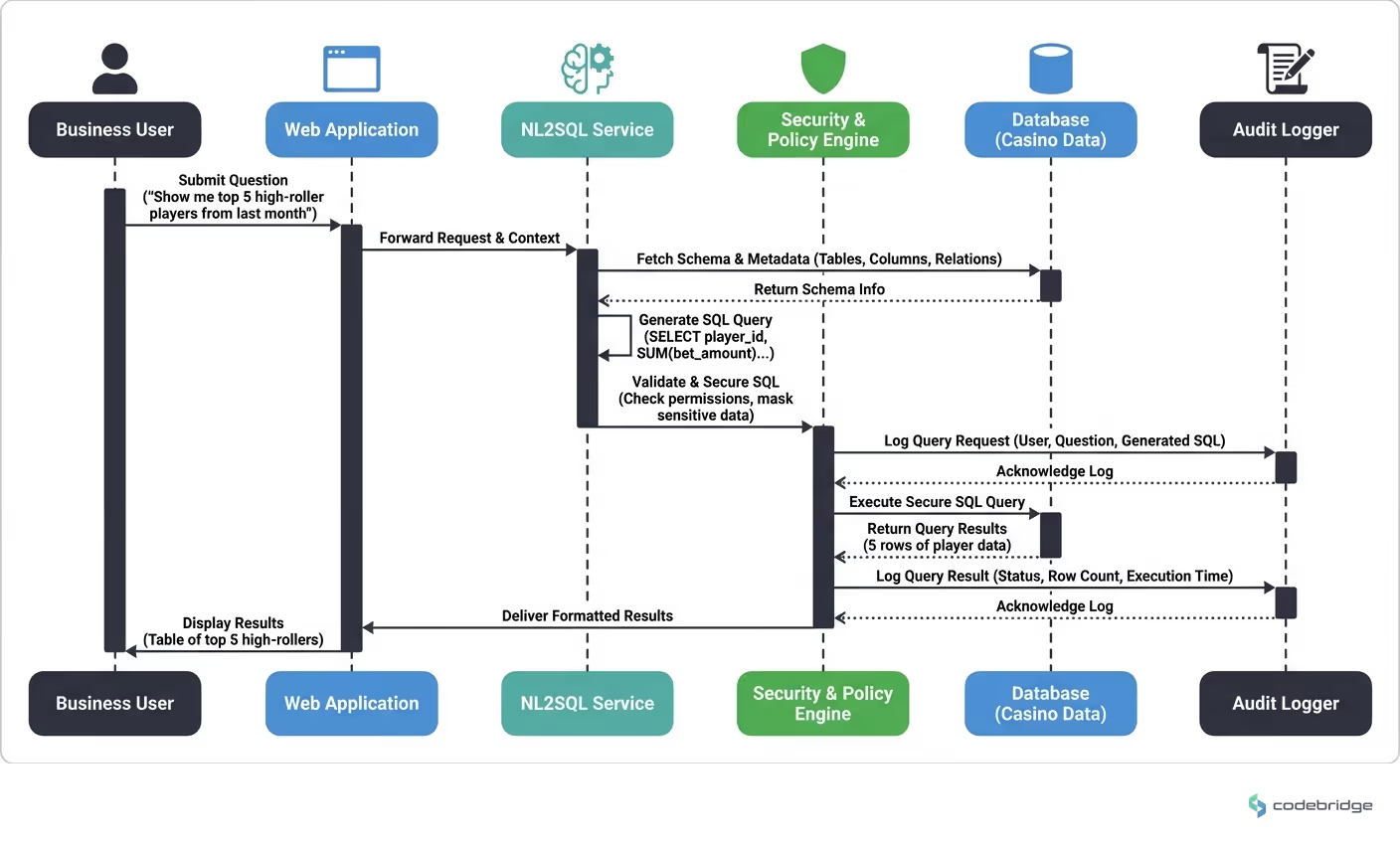
Query Flow: How a business user's natural language question transforms into secure SQL execution with audit logging
The Pattern: What Successful Teams Do Differently
After observing multiple casino IT organizations attempt NL-to-SQL implementations, a clear pattern emerges separating success from expensive failure.
They Start With High-Volume, Low-Risk Queries
The teams that succeed don't begin with sensitive player data. They start with operational questions: "How many covers did the buffet do last Saturday?" or "What was slot coin-in by denomination yesterday?" These queries have minimal security implications but massive time savings. They build confidence in the system before touching anything regulated.
31 of 35US gaming jurisdictions saw revenue increases in 2023, creating more data complexity
They Invest in Schema Documentation
NL-to-SQL systems are only as good as their understanding of your data. The teams that struggle have tribal knowledge locked in analysts' heads. The teams that succeed have documented their schema with business-friendly descriptions, common query patterns, and known data quality issues. This documentation serves double duty: it trains the NL-to-SQL system and reduces your bus factor.
They Treat Adoption as Change Management
The technology works. The failure mode is almost always organizational. Analysts feel threatened. Business users don't trust the results. IT leadership can't articulate the security model to compliance. Successful teams invest as much in training, communication, and process change as they do in the technical implementation.
"When we look at the map, there could be potentially two or three states that have some activity and get it across the finish line this year."
Chris Cylke, Senior Vice President at American Gaming Association
This regulatory expansion Cylke references means more data, more compliance requirements, and more pressure on already-stretched IT teams. The operators preparing now are building data access infrastructure that scales with regulatory complexity.
The Implementation Framework
If you're considering NL-to-SQL for your casino operation, here's the sequence that minimizes risk while building organizational capability.
Phase 1: Shadow Mode (Weeks 1-4)
Deploy the system in parallel with your existing analyst workflow. Business users submit questions through the NL-to-SQL interface, but results are validated by an analyst before delivery. You're testing query accuracy without any risk to operations or security. Track which queries the system handles well and which require human intervention.
Phase 2: Graduated Access (Weeks 5-12)
Open direct access for query categories with proven accuracy and low security sensitivity. Operational metrics, aggregate reports, and historical comparisons are good candidates. Maintain analyst review for anything touching player PII, financial data, or compliance-sensitive information.
Phase 3: Role-Based Expansion (Weeks 13-24)
Extend access to more sensitive data categories based on user role. Your player development team might gain direct access to loyalty tier analysis. Your compliance team might get self-service regulatory reporting. Each expansion follows the same pattern: shadow mode first, then graduated access.
Phase 4: Continuous Refinement (Ongoing)
Monitor query success rates, identify common failure patterns, and continuously improve the system's understanding of your business domain. The best implementations treat this as a living system that gets smarter over time, not a one-time deployment.
The casino operations seeing highest ROI from NL-to-SQL measure analyst time freed, not queries automated. The goal is strategic work, not headcount reduction.
The Compliance Conversation You Need to Have
Your compliance and legal teams will have concerns. Here's how to frame the conversation productively.
Concern: "This creates new data access pathways we can't control."
Reality: It creates new query generation pathways, but data access still flows through your existing security infrastructure. The permission model doesn't change,only the interface does.
Concern: "We can't audit natural language queries for regulatory purposes."
Reality: You can audit them better. Every query includes the business question asked, the SQL generated, the user who asked, and the results returned. This is more context than you get from raw SQL logs.
Concern: "What if the system generates a query that violates gaming regulations?"
Reality: The guardrail layer prevents this. You define what queries are permissible, and the system refuses to generate anything outside those boundaries. This is more reliable than hoping every analyst remembers every regulation.
The 2026 Reality Check
The casino industry is converging physical and digital operations faster than most IT organizations can adapt. With brick-and-mortar revenue growing 3.3% to $49.36 billion while iGaming grew 22.9%, you're managing data from increasingly diverse sources. Your analysts can't scale linearly with data complexity.
The IT directors who thrive in this environment aren't the ones who hoard data access as a power center. They're the ones who build secure, auditable systems that let the business move at the speed of decision-making while maintaining the control regulators require.
That 2:47 AM phone call? In the right architecture, your VP of Marketing could have answered her own question before you woke up. The query would have respected player privacy, logged for compliance, and delivered accurate results. You'd have slept through the night, and your analyst in Cancun wouldn't have a backlog waiting when she returns.
That's not a technology fantasy. That's what data democratization looks like when security is built into the foundation, not bolted on as an afterthought.
Not sure if your data architecture is ready for NL-to-SQL?
Request a technical assessment of your current schema documentation and security posture.
Diagnostic Checklist: Is Your Casino Ready for NL-to-SQL?
Use this checklist to assess whether your organization has the prerequisites for successful implementation:
Your analysts spend more than 40% of their time on repetitive report generation rather than strategic analysis
Business users wait more than 24 hours for answers to straightforward data questions
You have documented schema descriptions for at least 80% of your core business tables
Your row-level security policies are implemented in the database, not just application code
You can produce a complete audit trail of data access for regulatory inquiries within 4 hours
Your IT leadership can articulate the security model to non-technical compliance stakeholders
You have at least one analyst who could validate NL-to-SQL output during a shadow deployment phase
Your organization has successfully adopted at least one self-service BI tool in the past three years
If you checked fewer than five items, focus on foundational data governance before attempting NL-to-SQL. If you checked six or more, you have the organizational readiness for a pilot program.
REFERENCES
Casino Market Size, Share, Trends & Analysis, 2033, Market Data Forecast
Legal Sports Betting Hits Record Revenue in 2023, S&P Global / American Gaming Association
Online Gambling Market Size, Share, Growth Report 2033, IMARC Group
Global Casino and Online Gambling Industry Market Size 2012-2023, Statista
American Attitudes on Casino Gaming 2023, American Gaming Association












Heading 1
Heading 2
Heading 3
Heading 4
Heading 5
Heading 6
Lorem ipsum dolor sit amet, consectetur adipiscing elit, sed do eiusmod tempor incididunt ut labore et dolore magna aliqua. Ut enim ad minim veniam, quis nostrud exercitation ullamco laboris nisi ut aliquip ex ea commodo consequat. Duis aute irure dolor in reprehenderit in voluptate velit esse cillum dolore eu fugiat nulla pariatur.
Block quote
Ordered list
- Item 1
- Item 2
- Item 3
Unordered list
- Item A
- Item B
- Item C
Bold text
Emphasis
Superscript
Subscript