You stepped into the CTO role three weeks ago. The founders want a roadmap by Friday, the lead engineer just quit, and someone in your Slack DMs is asking why the staging environment costs $4,200 a month. You open a forum tab on your second monitor and read someone post: "I see people online saying they shipped full apps with Claude Code and no engineering background. How?? What am I missing??" You feel that — except your version is "How are other new CTOs running 8-person teams without melting down? What am I missing?"
That quote isn't hypothetical. It's from a working developer on r/ClaudeCode in late 2025, and the thread is full of replies from other experienced builders saying the same thing. The thread doesn't reveal how the original poster eventually got things working — the last comments are still mid-debug. The pain trigger is what matters: strong individual skill plus modern tooling does not equal shippable output without scaffolding underneath it. That's the foundation problem you've inherited.
KEY TAKEAWAYS
The first 90 days set the engineering floor, not the ceiling. What you make non-negotiable in the first quarter becomes culture; what you defer becomes permanent technical debt.
Lean is a constraint on tool count, not on rigor. Fewer tools, fewer dashboards, fewer meetings — but the ones that survive must be enforced and measured.
AI tooling amplifies scaffolding it doesn't replace it. Teams without clear requirement decomposition and review guardrails get faster broken code, not faster working code.
Throughput metrics alone hide morale debt. Engineers shifted from "solving" to "reviewing AI output" report lower engagement even when velocity rises.
Methodology adoption that requires top-down enforcement is failed adoption. If your engineers don't reach for the tool voluntarily within 4-6 weeks, the tool is wrong.
The Hidden Problem: Lean Gets Confused With Light
New CTOs hear "lean" and translate it to "fewer processes". That mistranslation is where most foundations crack within the first six months. Lean engineering, in its original Toyota Production System framing, is about eliminating waste while preserving the rigor that catches defects early. The waste is the meetings, the redundant tooling, the bureaucratic gates. The rigor is the testing, the observability, the postmortems. New CTOs often cut both, because both feel like overhead from inside week three.
The 2024 DORA Accelerate State of DevOps Report from Google Cloud's DevOps Research and Assessment team found that elite-performing teams aren't the ones with the fewest practices — they're the ones with the smallest set of consistently-enforced practices. The distribution matters more than the count.
If your "lean" foundation has zero CI gates, zero on-call rotation, and zero observability budget, you don't have a lean foundation — you have an unfunded one. Those are different problems with different fixes.
In the Wild: Three Patterns From New-CTO Postmortems
A systems engineering practitioner on r/systems_engineering spent 4-5 years pushing Model Based Systems Engineering (MBSE) across multiple programs before giving up on the discipline entirely:
"Modelers still aren't considered real design engineers, and I can't get anyone to say they've realized any actual benefit from working with a model."
u/[anonymized OP], Reddit r/systems_engineering
The thread doesn't tell us where the practitioner landed next — they signed off saying they were "done with the discipline." What's load-bearing for a new CTO: this is what failed methodology adoption looks like from inside. Years of effort, top-down mandates, and the engineers still didn't reach for the tool. If you mandate a heavyweight process in month two and your engineers are still avoiding it in month six, the right move is not "enforce harder". The right move is "kill it and pick a tool engineers reach for voluntarily".
A second forum signal is worth weaving in. A developer on r/ExperiencedDevs reflected on a multi-month rollout of AI coding tools across 500 developers at 4 organizations:
"Solving problems was the fun part, not reviewing and testing code."
u/[anonymized OP], Reddit r/ExperiencedDevs
The throughput numbers in side-project benchmarks didn't translate to workplace gains. The work itself got less enjoyable. For a new CTO this is a flashing yellow light: if you measure only commits-per-week and PR-cycle-time, you will hit your targets and bleed your seniors. The DORA report calls this out explicitly: team-level wellbeing predicts long-run delivery performance better than any single throughput metric.
The Pattern: What New CTOs Who Survived Year One Did Differently
Across the engagements we've watched up close, the new CTOs who built a foundation that held — versus the ones who rage-quit at month nine — share three behaviors. None of them are "pick the right stack". The stack barely matters.
First, they treated tool consolidation as the visible artifact of leadership, not a side project. Killing the second project tracker, the second CI system, the second observability vendor — these are the political acts that signal "we are running one playbook now". Second, they invested in requirement decomposition before AI tooling rollout, not after. Third, they protected unstructured problem-solving time on the senior engineers' calendars as if it were a SLA.
The dev.to writeup by Mark Nicol on applying Lean to engineering organizations captures the third behavior well:
"Focusing on flow can mean people are busy dealing with the urgent so good new ideas are never developed."
Mark Nicol, Dev.to
That's a Tier 3 voice naming an effect every veteran engineering leader has felt: teams run at full planned utilization produce fewer durable innovations than teams kept deliberately under that line. Lean does not mean 100% loaded.
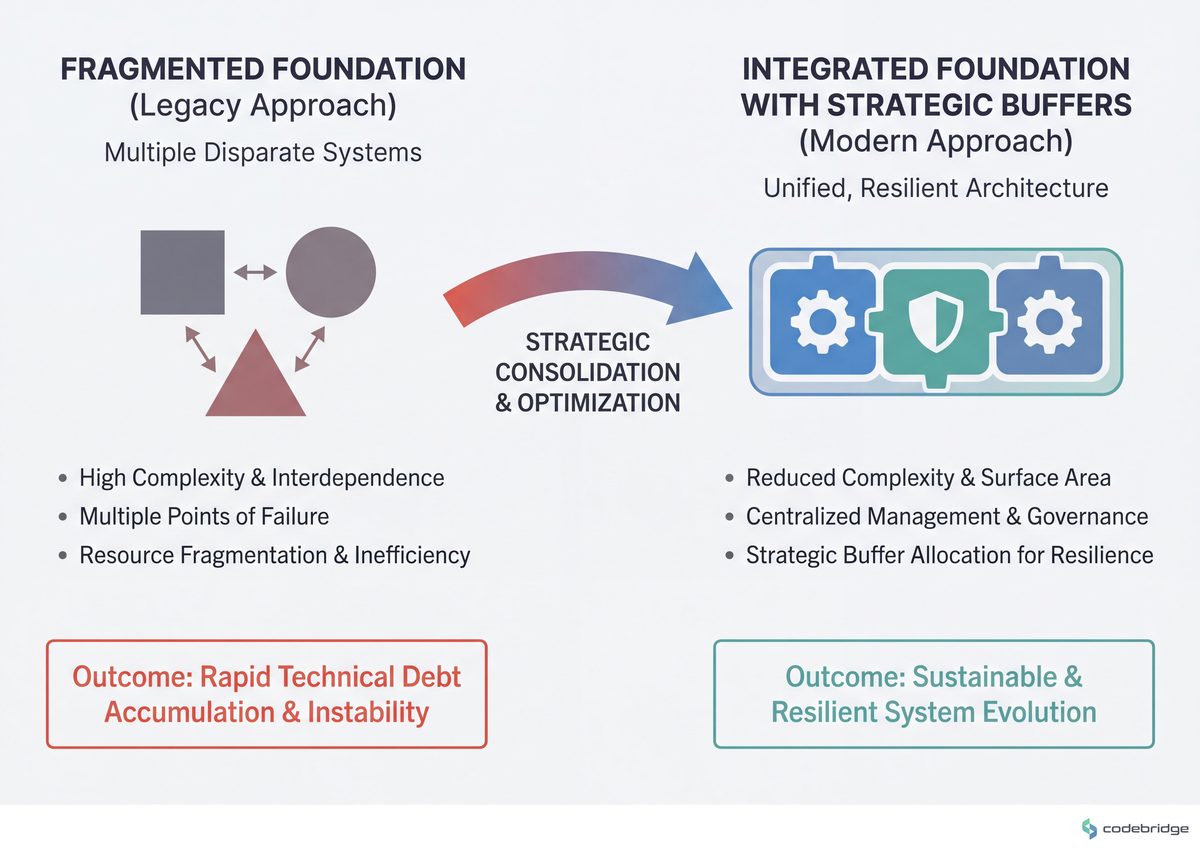
The comparison below shows the two foundations we typically see in month nine:
The 5-Step Playbook For Your First 90 Days
This is sequential. Don't reorder. Each step depends on the previous one being done well enough to lean on.
Step 1 (Week 1): Inventory every tool, dashboard, and recurring meeting
What to do: One spreadsheet. Columns: tool/meeting name, owner, monthly cost, last-used date, what would break if it disappeared tomorrow. Walk every engineer through it 1:1.
What good looks like: 30-50 rows. At least one third have an honest "nothing would break" in the last column.
Common failure mode: Doing this as a survey. Surveys produce the answer "we need everything". 1:1s produce the truth.
Step 2 (Week 2-3): Kill the bottom third
What to do: Cancel the contracts, archive the dashboards, end the meetings flagged in Step 1. Send one announcement, not a debate thread.
What good looks like: Monthly tool spend down 20-40% within the first month. At least one cancelled meeting frees up a recurring 90-minute block.
Common failure mode: Negotiating exceptions. Every "but we still need X for that one quarterly thing" is the foundation's first crack.
Step 3 (Week 4-6): Pick ONE source of truth per category
What to do: One CI system. One observability stack. One project tracker. One docs platform. Write it in a single-page "engineering operating system" doc and pin it.
What good looks like: If an engineer asks "where do I log this?", the answer takes under 10 seconds and is unambiguous.
Common failure mode: Picking the technically-best option over the option the team already uses voluntarily. Voluntary adoption beats technical superiority every time at this stage.
Step 4 (Week 6-9): Establish requirement-decomposition discipline before scaling AI tooling
What to do: Adopt a written template for any work over ~2 days of effort: problem statement, success criteria, non-goals, acceptance tests. Only then turn on team-wide AI coding tool access.
What good looks like: Every PR description references the template. Senior engineers report that AI-assisted PRs are reviewable in under 20 minutes rather than 60+.
Common failure mode: Rolling out the AI tooling first because vendors are pushing trials. The forum signal from the r/ClaudeCode thread is exactly this: strong individual skill plus AI minus scaffolding produces broken full output.
Step 5 (Week 9-12): Protect senior slack time as a tracked metric
What to do: Each senior engineer gets at least 20% of their week as unscheduled problem-solving time. Track it. Report it monthly to the founders alongside throughput metrics.
What good looks like: By week 12, you can point to one concrete experiment, prototype, or internal tool that came out of slack time.
Common failure mode: Treating slack time as "what's left after sprint commitments". It evaporates within two sprints. Schedule it explicitly.
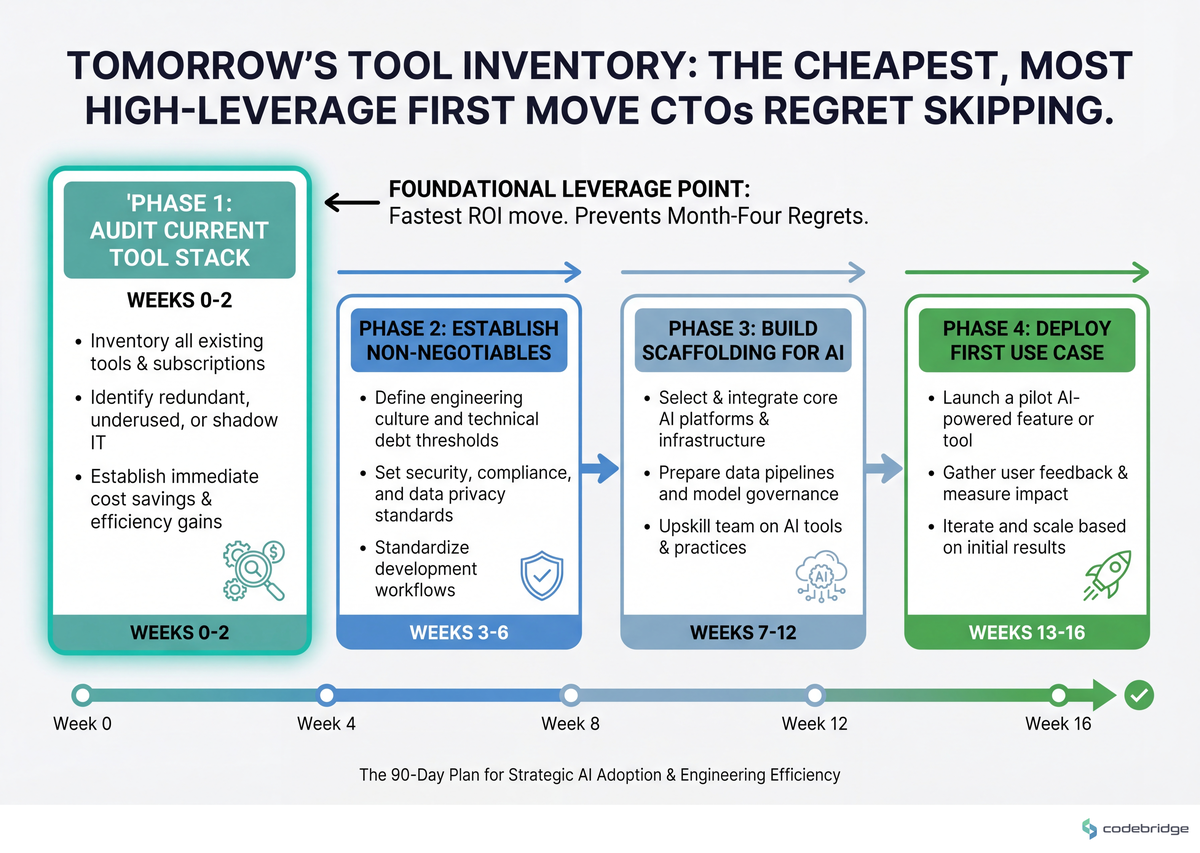
The flow below captures the 90-day arc:
Closing the Loop
Back to the developer in the r/ClaudeCode thread — the one staring at broken full output and asking what they were missing. We don't know how that thread ended; the last reply was someone still mid-debug. But the inherited lesson for you, the new CTO, is the actionable one: they were missing scaffolding. Not better tools. Not more talent. Scaffolding.
Tomorrow morning, open a blank spreadsheet and start Step 1: list every tool, dashboard, and recurring meeting. By Wednesday, identify the bottom third. By Friday, cancel three of them. You don't need to know what the right foundation looks like in week one. You need to know what the wrong foundation looks like — and you can see that within five business days if you're honest with the spreadsheet.
Inherited an engineering org and not sure which pieces are load-bearing?
Talk to our team about a 2-week foundation audit for new technical leadership.
Diagnostic Checklist: Run This Against Your Current Foundation
Score one point per "yes". 0-2 yes = healthy foundation. 3-4 yes = at risk, address within the quarter. 5+ yes = rebuild before adding any new initiative.
Do you have more than one active CI system, observability vendor, OR project tracker in production use? Yes / No
If an engineer joined this week, would the answer to "where do I log a production error?" take longer than 10 seconds to find? Yes / No
In the last 30 days, did any methodology or process you mandated require a follow-up reminder to get used? Yes / No
Is at least one of your senior engineers below 15% unscheduled problem-solving time per week (averaged over the last month)? Yes / No
Did your most recent AI-assisted PR take a senior engineer longer to review than it would have taken them to write from scratch? Yes / No
Can you name the monthly cost of every line item on your engineering tooling bill without opening a doc? Yes / No
Is there a recurring engineering meeting on the calendar that nobody has cancelled even though the original reason for it ended? Yes / No
REFERENCES










Heading 1
Heading 2
Heading 3
Heading 4
Heading 5
Heading 6
Lorem ipsum dolor sit amet, consectetur adipiscing elit, sed do eiusmod tempor incididunt ut labore et dolore magna aliqua. Ut enim ad minim veniam, quis nostrud exercitation ullamco laboris nisi ut aliquip ex ea commodo consequat. Duis aute irure dolor in reprehenderit in voluptate velit esse cillum dolore eu fugiat nulla pariatur.
Block quote
Ordered list
- Item 1
- Item 2
- Item 3
Unordered list
- Item A
- Item B
- Item C
Bold text
Emphasis
Superscript
Subscript