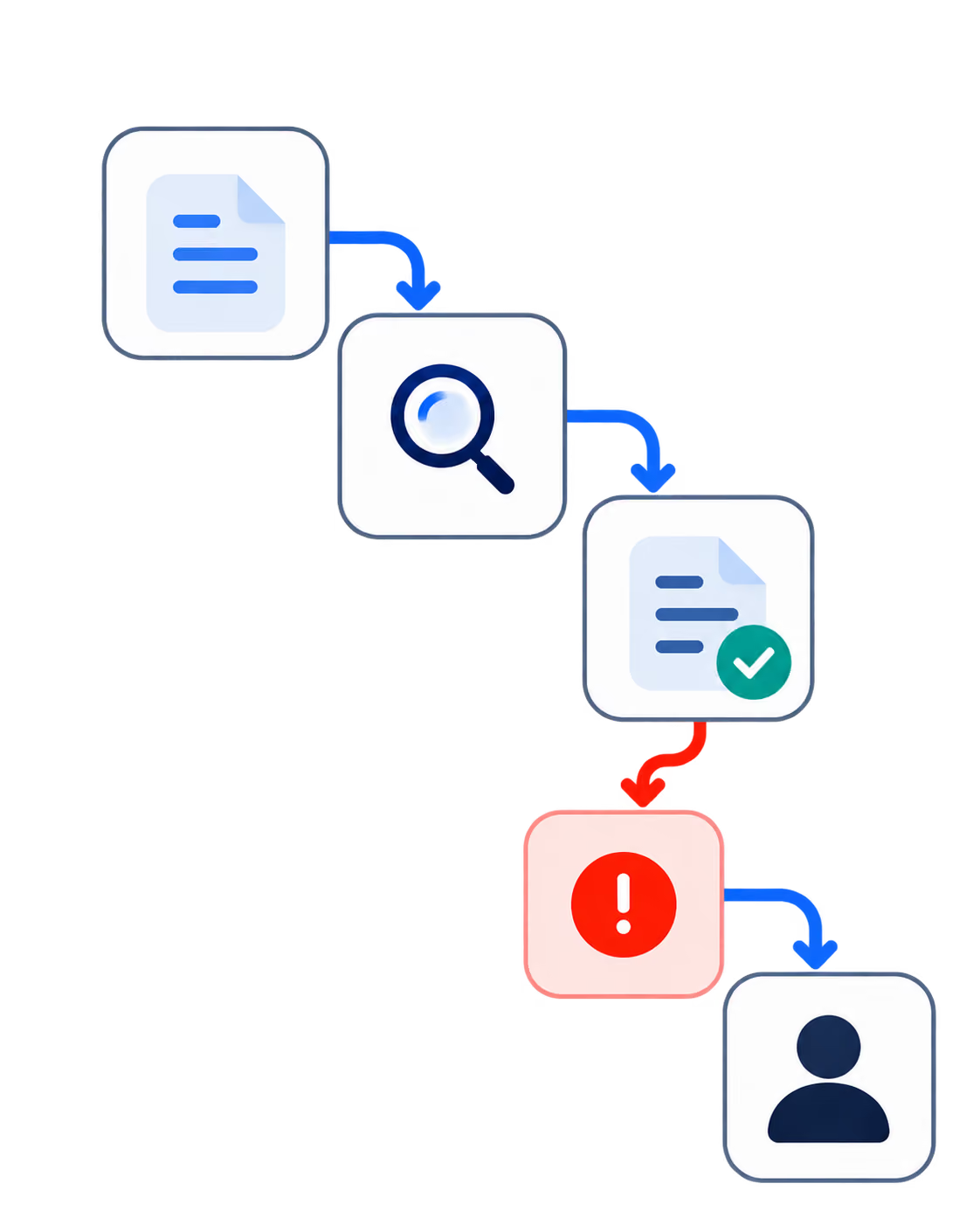
Last year, a mid-sized city's IT director watched their $3.2 million "smart traffic" initiative collapse. Not because the AI didn't work,it worked beautifully in the vendor demo. The collapse came six months post-deployment when their two-person technical team couldn't maintain the custom integrations, couldn't debug the proprietary algorithms, and couldn't afford the $180/hour consultant rates to keep it running. The traffic lights went back to their old timing patterns. The sensors kept collecting data nobody could use.
This story repeats across municipal IT departments every quarter. The promise of AI-powered city services crashes against a brutal reality: the talent market for AI engineers has priced out virtually every government budget in America.
KEY TAKEAWAYS
The $2M engineer myth is dead,leading cities deploy AI through data streaming platforms and open APIs, not elite engineering teams.
Integration beats innovation,only 17% of cities have integrated AI systems despite $124B annual spending on dashboards and sensors.
On-premises AI is the 2026 unlock,rising data security concerns are driving deployments that don't require cloud dependency or specialized talent.
The pattern is clear, San Francisco improved transit on-time performance from 72% to 94% using existing staff and platform-based approaches.
The $124 Billion Integration Gap
Here's the number that should make every CTO uncomfortable: cities worldwide spend $124 billion annually on AI dashboards and sensor infrastructure. Yet according to a 2024 UN-Habitat assessment, only 17% of surveyed cities have integrated AI systems with proper data-sharing standards.
17%of cities have integrated AI systems despite $124B annual spending
That's not a technology problem. That's an architecture problem. Cities are buying point solutions,a traffic AI here, a predictive maintenance system there, a public safety analytics platform somewhere else,and then discovering they've created a dozen data silos that can't talk to each other. The integration work requires exactly the kind of specialized engineering talent that commands $200K+ salaries in the private sector.
Over 50% of city leaders doubt the reliability of their own data, even after massive infrastructure investments. The sensors work. The AI models work. The connection between them? That's where everything falls apart.
What San Francisco Actually Did
San Francisco's transit system tells a different story. Their on-time performance jumped from 72% to 94% since 2022,not by hiring a team of machine learning PhDs, but by deploying AI across over 30,000 IoT sensors using a platform-based approach.
The key wasn't building custom algorithms. It was choosing infrastructure that let their existing IT staff connect systems without writing integration code from scratch. Real-time traffic signal adjustment and predictive maintenance now run on machine learning models that their team can monitor and tune,not rebuild.
San Francisco's success came from platform selection, not talent acquisition. Their existing team manages 30,000+ sensors because the integration layer doesn't require specialized AI engineering.
Dallas took a similar approach with public safety. Their sensor-laden smart neighborhoods feed into AI-powered Real-Time Crime Centers (RTCCs), and they're seeing sharp drops in crime rates. The technology stack relies on AI-powered video analytics that can reduce crime by up to 40% and cut emergency response times by 35%,but the implementation doesn't require a dedicated AI team.
The Pattern: Platforms Over People
A 2025 survey of urban leaders reveals the actual playbook. Over 60% report that real-time IoT data is reshaping their daily operations. But the successful deployments share common infrastructure choices:
- Data streaming platforms (52% adoption),These handle the real-time data flow between sensors and AI models without custom middleware.
- Open APIs (45% adoption),Standard interfaces let cities swap vendors and add capabilities without rewriting integrations.
- Low-code connection tools, Visual configuration replaces custom code for most integration scenarios.
The common belief that massive engineering teams are required for AI deployment doesn't match reality. Leading cities succeed by choosing infrastructure that abstracts away the complexity, not by out-hiring the private sector for talent.
The 2026 Shift: On-Premises AI
The next wave is already visible. Rising concerns about data security and the need for customization are driving cities toward on-premises AI deployment. This isn't a step backward,it's a recognition that cloud-dependent solutions create both security vulnerabilities and vendor lock-in.
UK smart city initiatives in energy and transportation are leading this shift. Asian Pacific cities with rapid urbanization are following. The projected impact: remarkable growth through 2034 as cities realize they can run AI workloads locally without the cloud dependency that often requires specialized DevOps talent to manage.
$460.47Bprojected AI in smart cities market by 2034, up from $50.63B in 2025
Singapore's approach to smart buildings illustrates the principle. They've adopted technologies like automated fire and leak sensors that slash energy use by up to 40%,targeting 80% green-certified buildings by 2030. The AI runs on-site. The maintenance is automated. The city's IT staff manages the system without needing to understand the underlying machine learning models.
The Framework: Deploying AI Without Elite Engineers
Based on what's working in cities that have cracked this problem, here's the practical approach:
1. Audit Your Integration Layer First
Before evaluating any AI solution, map how data currently flows between your existing systems. The cities stuck at 17% integration didn't fail at AI,they failed at plumbing. Your first investment should be a data streaming platform that can normalize inputs from multiple sensor types and legacy systems.
2. Demand Open APIs as a Procurement Requirement
Every RFP should require documented, standard APIs. This isn't a technical preference,it's insurance against the $180/hour consultant trap. When your vendor's proprietary integration breaks, you need the ability to fix it yourself or hire any qualified developer, not just the vendor's team.
3. Start with Machine Learning, Not "AI"
The largest market share in smart city applications belongs to machine learning,not generative AI, not autonomous systems. Traffic optimization, predictive maintenance, and waste management all run on ML models that are well-understood and don't require expertise to deploy and maintain.
4. use Government-Specific AI Platforms
2025 saw launches like ChatGPT Gov, designed specifically for secure government deployment. These platforms handle the compliance, security, and customization requirements that would otherwise require specialized engineering. U.S. government agencies are already adopting them.
5. Build for Monitoring, Not Building
Your team's job isn't to build AI models,it's to monitor AI systems and tune their parameters. This is a different skill set that your existing IT staff can develop. Invest in observability tools and training, not in competing with Google for ML engineers.
The 78% of organizations now using AI (up from 55% the previous year) aren't all hiring AI teams. Most are adopting platform-based approaches that let existing staff operate AI systems.
The Real Constraint Isn't Talent
The global AI in smart cities market hit $50.63 billion in 2025 and is projected to reach $64.71 billion this year. That growth isn't being driven by cities suddenly finding budget for $2M engineering teams. It's being driven by infrastructure that makes AI accessible to the IT departments cities already have.
Remember that IT director whose traffic initiative collapsed? The failure wasn't inevitable. It was architectural. They bought a solution that required specialized talent to maintain instead of a platform that their existing team could operate. The sensors still work. The AI models still work. The integration layer,the part that actually matters,was designed for a team they could never afford to hire.
The cities winning at AI deployment in 2026 aren't the ones with the biggest budgets or the most impressive engineering teams. They're the ones who understood that the real problem was never artificial intelligence. It was integration architecture.
Diagnostic: Is Your City Ready for Platform-Based AI?
Your current AI/IoT vendors require proprietary integrations with no documented APIs
You have more than three data systems that can't share information automatically
Vendor support costs exceed 20% of your original implementation budget annually
Your IT team spends more time on integration maintenance than system monitoring
You've delayed AI projects specifically due to concerns about finding qualified engineers
Your sensor data sits in dashboards that aren't connected to operational systems
You've experienced a "successful pilot" that failed to scale due to integration complexity
If you checked three or more items, your constraint isn't talent,it's architecture. The path forward starts with your integration layer, not your hiring plan.
REFERENCES
Precedence Research: AI in Smart Cities Market
Infrastructure Transparency Initiative: World Cities Day 2025
StartUs Insights: 10 Emerging Smart City Trends 2025-2026











Heading 1
Heading 2
Heading 3
Heading 4
Heading 5
Heading 6
Lorem ipsum dolor sit amet, consectetur adipiscing elit, sed do eiusmod tempor incididunt ut labore et dolore magna aliqua. Ut enim ad minim veniam, quis nostrud exercitation ullamco laboris nisi ut aliquip ex ea commodo consequat. Duis aute irure dolor in reprehenderit in voluptate velit esse cillum dolore eu fugiat nulla pariatur.
Block quote
Ordered list
- Item 1
- Item 2
- Item 3
Unordered list
- Item A
- Item B
- Item C
Bold text
Emphasis
Superscript
Subscript