A small-business owner posted to r/webdesign last month with a story that should make every climate-tech founder pause before signing a redesign contract. He'd bundled hosting, web design, and SEO with a single low-cost vendor. After paying upfront, the design came back unusable. There was no resolution path. Then the SEO invoices started arriving — for a website that didn't exist.
, Reddit r/webdesign
That $1,500 sounds small. Scale it up by 10x — or 50x — and you have the budget most sustainability-tech founders quietly burn on a redesign that never quite ships, never quite converts, and never quite matches the rigor of their actual climate work. The thread doesn't reveal how it ended, but it doesn't have to. The structural mistake was made the day the contract was signed.
KEY TAKEAWAYS
For climate-tech ventures, the website is regulator-grade infrastructure, not a marketing brochure — 64% of sustainability leaders now treat digital channels as their primary stakeholder communication.
Bundled contracts (hosting + design + SEO) hide the failure modes that hurt founders most: no acceptance gates, no escape hatch, no use when something goes wrong.
Code quality and accessibility deserve dedicated SOW clauses — only 29% of corporate ESG/sustainability pages pass basic accessibility checks, and most redesigns inherit that debt rather than fix it.
A vetting checklist is only useful if it's diagnostic, not aspirational — the questions you ask before signing decide whether the website becomes an asset or a 12-month tax on your engineering team.
The Hidden Problem: Your Website Is Now Part of Your ESG Disclosure
Climate-tech founders tend to underweight the website because they overweight the product. That made sense five years ago. It doesn't now. Institutional investors increasingly treat ESG risks as material to investment decisions, and a meaningful share will divest from companies not taking sufficient action. Sustainability leaders are also shifting toward digital channels — websites, interactive reports, dashboards — as their primary stakeholder communication channel, ahead of static PDFs.
Translate that for the founder writing an SOW: investors, regulators, and corporate buyers will judge your sustainability seriousness by your website before they ever see your product. A redesign vendor who doesn't understand the difference between a marketing site and a live sustainability report will deliver an artifact that under-serves all three audiences. And with Gartner projecting >30% CAGR for ESG and sustainability software through 2025, the digital front door has to scale with the regulatory load, not buckle under it.
Real Stories: When Vendor Vetting Fails Quietly
The Bluehost story above is the visible failure mode — money in, nothing out. The quieter failure mode is worse: a website that ships, looks fine, and silently traps you for years.
A non-technical solo founder on r/SaaS documented the pattern in painful detail. He hired an offshore agency at $35/hr through a referral, scoped 500 hours, paid $17,500, and got a working product. Then he tried to extend it.
, Reddit r/SaaS
The vendor delivered what the contract asked for. The contract didn't ask for maintainability, documented architecture, test coverage, or knowledge transfer. The founder discovered those gaps only when feature velocity collapsed and every new developer he interviewed declined the codebase. The thread ends with him pricing a rebuild.
Compare this with how seasoned climate-tech operators approach their digital infrastructure. BCG's writeup of Ørsted's transformation documents how the company rebuilt its public web presence around interactive project maps, decarbonization progress, and investor-grade transparency on its long-term climate strategy. The rebuild coincided with a >200% increase in market capitalization between 2016 and 2020 and repeated recognition as the world's most sustainable energy company by Corporate Knights, with digital communications cited as a key enabler of stakeholder trust. The reading from Ørsted's case is that the website wasn't downstream of the strategy — it was load-bearing for it.
Schneider Electric's redesign, per BCG, consolidated hundreds of legacy microsites into a unified platform with persona-based navigation (sustainability officers, facility managers) and integrated carbon footprint calculators. BCG and Schneider report that digital channels now drive ~70% of new leads in some segments, with 20-30% shorter sales cycles for certain digital offers. Our reading: those numbers aren't a marketing win, they're an operational win that started with a vendor brief written by someone who understood what the website had to do.
The Pattern: Vet Like You're Hiring a Compliance Partner, Not a Marketing Agency
The teams that come out of a redesign stronger share a single trait: they vetted the vendor with the same rigor they'd apply to a carbon accounting platform or an MRV system. The teams that come out weaker treated it as a procurement exercise driven by quote comparison.
Why does this matter more in climate-tech than in, say, e-commerce? Because the website carries claims that have to survive scrutiny. Corporate ESG and sustainability report pages frequently fail basic accessibility checks (alt text, heading structure, contrast). Many sustainability brands ship inaccessible digital experiences — exactly the gap an institutional investor's analyst will note in the diligence memo. Deloitte's 2023 consumer survey found 78% of UK consumers more likely to buy when environmental impact is clearly labeled, and McKinsey's experiments showed up to 33% higher conversion for products with clear low-carbon labels. The data is consistent: clarity converts, vagueness costs.
From our work with climate-tech and sustainability-software teams: the founders who run a structured vendor vetting process before signing — even a lightweight one — spend roughly half the post-launch engineering time fixing things compared to founders who picked the vendor on price and timeline. The expensive part of a redesign isn't the redesign. It's the 12 months after launch, when every regulatory change, every CSRD update, every new SASB-aligned metric needs to land on the site without a code release.
This is the architectural pattern most founders miss. Your vendor's discovery process predicts your post-launch maintenance burden. A vendor who leads with mockups will deliver a beautiful site that fights you every time the disclosure landscape shifts. A vendor who leads with user tasks, content architecture, and data pipelines will deliver a slower-looking site that absorbs change through configuration.
The diagram below shows the difference between the two vendor archetypes you'll encounter when shortlisting:
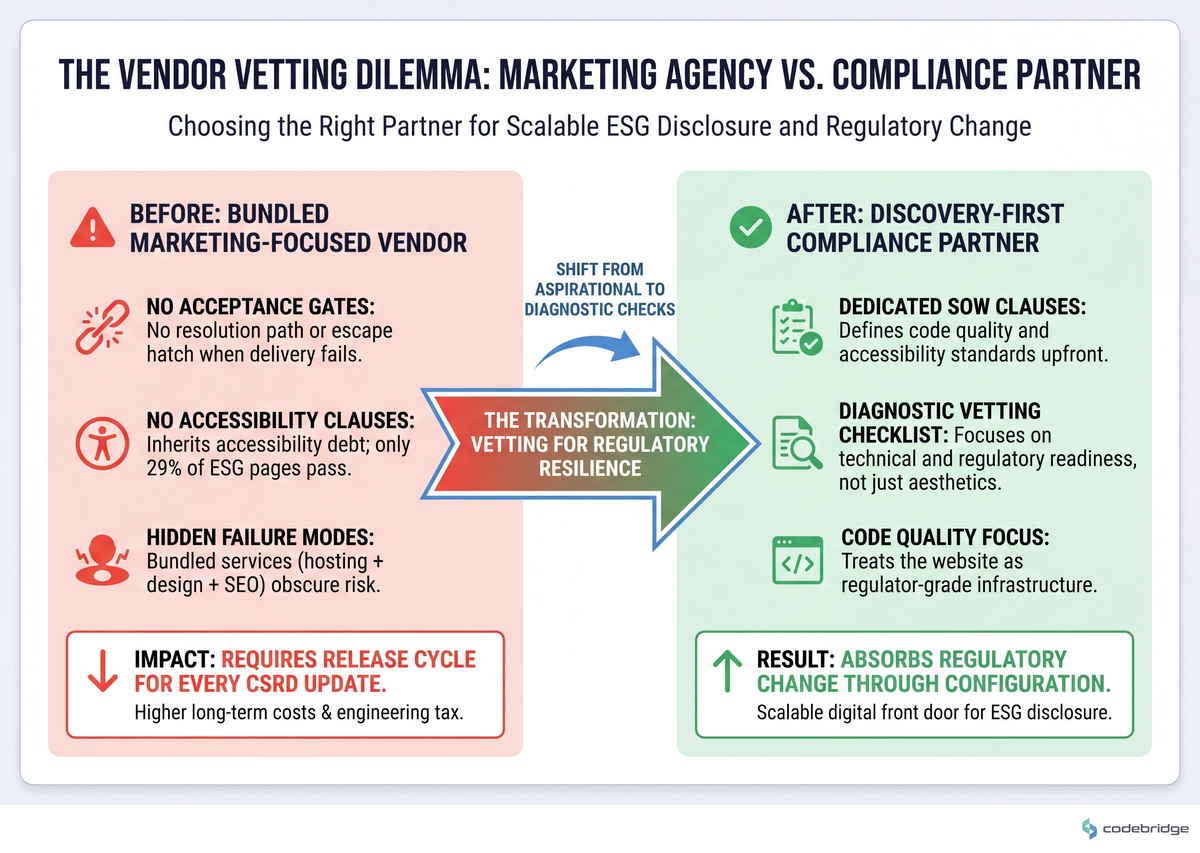
The right column shows why discovery-first vendors cost more upfront but absorb regulatory change through configuration — left-column vendors require a release cycle every time CSRD updates.
The Vetting Playbook: Six Steps Before You Sign
This is the order to run it in. Steps are sequential — skipping the early ones makes the later ones meaningless.
Step 1 — Force the vendor to describe their discovery process before showing portfolio
What to do: In the first 30-minute call, ask: "Walk me through the first three weeks of your engagement, before any design work." Refuse to look at portfolio screenshots until they answer.
What good looks like: They name stakeholder interviews, content audits, analytics review, competitor disclosure benchmarking, and a written discovery deliverable. They mention business goals before visual direction.
Common failure mode: The vendor pivots immediately to "let me show you some recent work we love." If visuals come up before user tasks and business goals, the redesign will inherit that ordering. Vetting checklists that skip this question end up shortlisting vendors who can't survive a regulatory shift.
Step 2 — Demand milestone-based payments with explicit acceptance criteria
What to do: Replace any "50% upfront, 50% on completion" structure with at least four milestones: discovery sign-off, information architecture sign-off, design system sign-off, and staged launch. Each milestone has written acceptance criteria you can verify yourself.
What good looks like: The vendor proposes acceptance criteria you didn't have to invent. They expect to be measured. They have a documented process for what happens if a milestone fails.
Common failure mode: Bundled contracts that cover hosting, design, and SEO under one upfront fee. The Reddit story above isn't an edge case — it's the predictable end-state of bundling. Once paid in full, the use to enforce delivery is gone.
Step 3 — Write code quality, accessibility, and documentation into the SOW as gates, not aspirations
What to do: Require WCAG 2.2 AA conformance (verified via an automated scan plus a manual audit), a documented architecture diagram, a README that lets a new developer get to local-dev in under 30 minutes, and a minimum test coverage threshold for any custom code.
What good looks like: The vendor pushes back on specifics ("we recommend WCAG 2.2 AA with documented AAA exceptions on these components") rather than agreeing to everything. Pushback signals they've shipped against these gates before.
Common failure mode: Accepting a Lighthouse score in lieu of a manual accessibility audit. Automated scans miss the kinds of failures that matter most for sustainability disclosures. If you don't gate it in the SOW, you'll inherit the debt.
Step 4 — Name a single client-side executive sponsor and put it in the SOW
What to do: Before kickoff, designate one person on your side with binding decision authority on scope, design direction, and content. Name them in the SOW. Define the escalation path when the sponsor is unavailable.
What good looks like: The vendor asks who the sponsor is in the first proposal and structures their cadence around that person's calendar. They have a written policy for what happens when a late-stage stakeholder (board member, new CMO) tries to reshape work mid-flight.
Common failure mode: Multi-headed approval ("the CEO, CMO, and VP Sustainability all need to sign off"). Project leads who arrive late and veto designs are how mid-flight rewrites happen. Vendors who don't insist on a single sponsor will absorb the chaos and bill you for it.
Step 5 — Stress-test scalability and the path to interactive ESG dashboards
What to do: Ask: "If our traffic 10x's in 18 months, what breaks first?" and "If we need to embed a live CSRD-aligned emissions dashboard in 12 months, what's the path?" Both answers should be specific, not directional.
What good looks like: The vendor names the CMS, the hosting tier, the cache strategy, and the API patterns that would support a dashboard integration. They distinguish between "we can build this on the current platform" and "this would require re-platforming."
Common failure mode: Sizing the platform for current users instead of projected growth. Gartner's >30% CAGR projection for sustainability software means today's load is the floor, not the ceiling. A platform chosen for today's traffic will become the bottleneck within the engagement's payback period.
Step 6 — Require source code ownership, knowledge transfer, and a documented exit path
What to do: Code lives in your Git org from day one, not the vendor's. The SOW includes a 30-day post-launch knowledge transfer with named recipients on your side. The exit path — what happens if you part ways at month 6 — is written, not assumed.
What good looks like: The vendor offers this proactively. They've done it before. They have a checklist for handoff.
Common failure mode: The r/SaaS pattern — a working artifact wrapped around an unmaintainable foundation. Once the vendor is the only entity that can extend the codebase, every future change is priced as ransom.
The timeline below shows how these six steps map to a realistic vetting calendar:
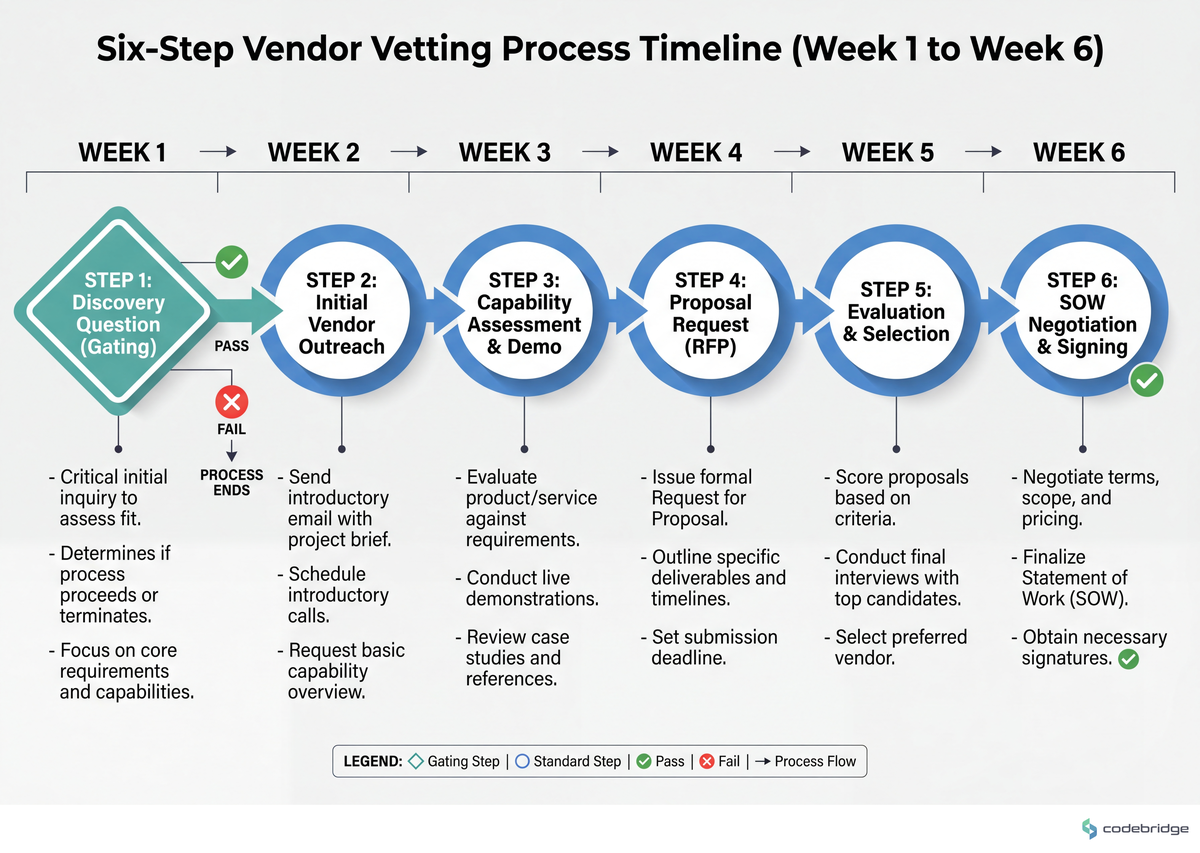
Six-step vetting calendar from initial vendor outreach to signed SOW — the discovery-process question (Step 1) gates everything that follows, so it sits in week one.
Close: What to Do This Week
Don't try to run all six steps at once. Run them in order, on a real calendar.
Tomorrow morning: Write a one-page vetting brief that names your single executive sponsor, the three regulatory frameworks your site has to align with (CSRD, SASB, TCFD, GRI — pick what applies), and the one business outcome the redesign has to move (investor inbound, B2B sales-qualified leads, or stakeholder trust signals). One page. Not ten.
Wednesday: Send that brief to three shortlisted vendors with one filter question — Step 1's discovery question. Read the responses. Two of the three will shift to portfolio. Eliminate them.
By Friday: Schedule the structured discovery interview with the remaining vendor (or run Step 1 against a fresh shortlist if all three failed). Bring the SOW gates from Steps 2, 3, and 6 to that conversation. The vendor's reaction to those gates — pushback with specifics, or agreement with vagueness — is your real signal.
The Reddit founder who lost $1,500 didn't need a bigger budget. He needed Step 2. The $18K founder didn't need a more expensive agency. He needed Step 6. The vetting checklist isn't about finding the perfect vendor. It's about making the predictable failures visible before they cost you a year.
!
If your shortlisted vendor cannot answer "what happens to our codebase if we part ways at month six?" with a written policy, you are not negotiating a partnership — you are negotiating future ransom.
Diagnostic Checklist: Run This Against Your Current Vendor Shortlist
Five or more "Yes" answers = high-risk vendor. Three to four = workable with SOW reinforcement. Zero to two = strong shortlist candidate.
Did the vendor show portfolio screenshots in the first call before describing their discovery process? Yes / No
Does the proposal bundle hosting, design, and SEO under a single upfront payment with fewer than three milestones? Yes / No
Does the SOW rely on a Lighthouse or PageSpeed score as the only accessibility/quality gate (no WCAG manual audit, no test coverage minimum)? Yes / No
When you asked "what happens if our traffic 10x's in 18 months?", was the answer directional ("we can scale that") rather than specific (named CMS tier, cache strategy, API patterns)? Yes / No
Is the source code repository owned by the vendor's GitHub/GitLab org rather than yours from day one? Yes / No
Does the proposal name multiple client-side approvers without designating a single executive sponsor with binding authority? Yes / No
Is the post-launch handoff described as "we'll be available for questions" rather than a scheduled 30-day knowledge-transfer with named recipients? Yes / No
Running this checklist and finding more than three "Yes" answers on your shortlist?
Talk to our team about a one-call vendor brief review before you sign.
REFERENCES
PwC — State of Climate Tech 2023
Deloitte — Shifting sands: Are consumers still embracing sustainability?
Gartner — Market Guide for ESG Management and Reporting Software
Reddit r/webdesign — small-business owner vendor failure thread











Heading 1
Heading 2
Heading 3
Heading 4
Heading 5
Heading 6
Lorem ipsum dolor sit amet, consectetur adipiscing elit, sed do eiusmod tempor incididunt ut labore et dolore magna aliqua. Ut enim ad minim veniam, quis nostrud exercitation ullamco laboris nisi ut aliquip ex ea commodo consequat. Duis aute irure dolor in reprehenderit in voluptate velit esse cillum dolore eu fugiat nulla pariatur.
Block quote
Ordered list
- Item 1
- Item 2
- Item 3
Unordered list
- Item A
- Item B
- Item C
Bold text
Emphasis
Superscript
Subscript