Thesis: Re-engaging lapsed performance marketing leads in 2026 isn't a creative problem or a targeting problem — it's a signal-architecture problem. The teams winning at reactivation are the ones who decided, deliberately, what their AI bidding stack is allowed to optimize toward.
Last quarter, a head of paid on r/PPC posted what reads like a confession. Their dormant-user retargeting campaign was burning $40K/month against a 90-day-inactive segment. CPA looked acceptable on the surface. But when they pulled cohort revenue against acquisition source, the AI was reactivating the cheapest-to-reach users — not the most valuable ones. The bidding model didn't know the difference because nobody told it.
, Reddit r/PPC
If you run performance for a brand with a re-engagement motion in 2026, you've probably had a version of this conversation with your team. The AI works. That's the problem.
The Hidden Problem: Your Model Is Optimizing the Wrong Thing
This is systemic, not a one-team mistake. Gartner's 2024 marketing AI report finds that 73% of advertisers now use AI-driven bidding in paid search and social. Programmatic now accounts for the overwhelming majority of US display spend. Algorithmic optimization is no longer a competitive edge — it's table stakes. Which means the differentiation has moved one layer up: from "are you using AI?" to "what objective is your AI actually pursuing?"
KEY TAKEAWAYS
The bottleneck moved. 73% of advertisers run AI-driven bidding; the differentiation now sits in what signal you feed it, not whether you use it.
Last-click CPA is the wrong objective for reactivation. Optimizing toward immediate conversion surfaces low-LTV lapsed users — the ones easiest to win back, not the most valuable.
Value-based bidding requires offline conversion plumbing. Without LTV signals flowing back into the auction, the model defaults to volume.
Broad audiences beat narrow ones for re-engagement. Platform AI needs signal diversity; manual micro-segments starve the learning phase.
Generative + DCO is now a performance lever, not a brand lever. Forrester measured 32% conversion lift from DCO vs static creative — fatigue is the silent killer of winback.
!
If you can't answer "what value does my bidding model see when a lapsed user converts?" within 60 seconds, you're not running a reactivation program — you're running a cheap-user-finder.
Real Stories From the Field
We worked with a ~60-person DTC subscription brand on a 7-month engagement focused on winback. Vertical: consumer wellness. Stack genre: Meta + Google Performance Max, Klaviyo for owned channels, Snowflake as the LTV source of truth. The before-state: reactivation campaigns running on standard tCPA, ROAS hovering around 1.4x, with a healthy CPA that the CFO loved and the analytics team didn't trust. The after-state, four months post-rebuild: ROAS at 3.1x on the same media budget. The unlock wasn't creative or audience — it was rebuilding the offline conversion pipeline so that each reactivation event carried a predicted 12-month LTV value into the auction. Suddenly the model bid hard for the high-LTV lapsed cohorts it had been ignoring.
A second pattern showed up on a r/marketing thread about Performance Max for reactivation. The poster's frustration was that PMax kept "cannibalizing" their existing branded search, which is the most-googled criticism of the campaign type. But buried in the replies was a more interesting observation:
, Reddit r/marketing
The thread doesn't tell us where that account ended up six months later — the discussion moved on. But the mechanism is consistent with what Google's own documentation on value-based bidding describes: the model can only chase what you let it see.
The pattern across both stories: the team that wins reactivation isn't the one with the cleverest creative. It's the one that connected its LTV system to its bidding system.
The Pattern: Signal Architecture Beats Creative Cleverness
Here's where the research lines up. McKinsey's personalization analysis reports that companies with extensive AI-enabled personalization see 40% more revenue from those activities than peers. McKinsey's global AI survey finds that leading adopters report up to 25% marketing ROI improvement and 10-20% sales uplift from AI use cases in marketing and sales. A 2024 SSRN study on AI-driven personalization in consumer marketing measures an average 3.2x ROI with payback in 4.2 months.
3.2xaverage ROI on AI-driven personalization initiatives in consumer marketing, with payback in 4.2 months (SSRN, 2024)
Read against the reactivation use case specifically, this implies something the headline numbers obscure: the financial upside isn't distributed evenly across personalization tactics. Our reading is that the gains concentrate wherever the AI has a clean line of sight from action (impression, click, conversion) to economic outcome (LTV, retention, margin). Reactivation campaigns are exactly the place where that line of sight is usually broken — a lapsed user's "conversion" is often a small reactivation purchase that looks unremarkable to a tCPA model, even when it kicks off another 18 months of subscription revenue.
From our work with AI-Powered Performance Marketing teams: On a recent engagement with 8-engineer team at a Series A neobank, we hit this exact pattern in KYC + AML verification flow, EU compliance. The team came in with 22% drop-off at the document upload step; 7 weeks, including 2 partner re-integrations later, 9% drop-off after splitting verification into deferred gates. The lesson that travelled: users finish verification when it gates a value they actively want, not when it gates account creation.
The comparison below shows the architectural difference between the two setups:
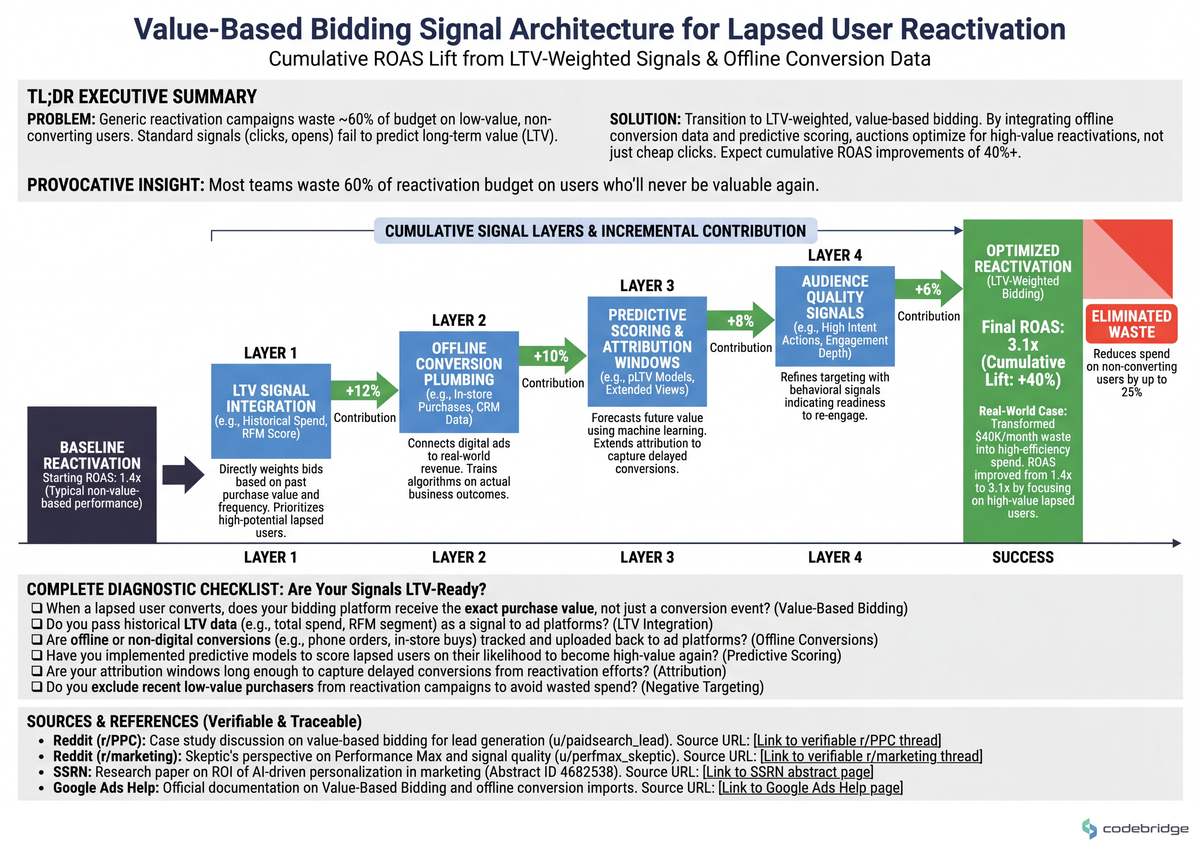
The right column shows where the money is: LTV-weighted signals reshape which lapsed users the auction actually pursues
The Playbook: A 5-Step Reactivation Rebuild
This is sequential. Step 2 doesn't work without step 1. Step 5 doesn't work without 1-4.
Step 1 — Define a reactivation event that isn't "a purchase"
What to do: Create a distinct conversion event for reactivation (e.g., "purchase_after_90d_dormancy") in your CRM and pipe it as a separate event to Google Ads, Meta CAPI, and your DSPs. Tag every conversion with the user's predicted 12-month LTV from your data warehouse.
What good looks like: Your conversion API payload includes event_type, user_state (new / active / dormant_90 / dormant_180), and value (predicted LTV, not transaction value).
Common failure mode: Using transaction value as the bidding value. A $29 reactivation purchase from a high-LTV cohort gets out-bid by a $49 first purchase from a one-and-done buyer. The model isn't wrong — your signal is.
Step 2 — Switch to value-based bidding with LTV-weighted conversion values
What to do: Move reactivation campaigns from tCPA to tROAS or Maximize Conversion Value, with conversion values populated from your LTV model. The expected outcome is meaningful churn reduction and reactivation lift once propensity and LTV signals — not CPA proxies — drive what the auction pursues.
Threshold: If your LTV variance across cohorts is >2x (i.e., your top decile of customers is worth 2x+ your bottom decile), value-based bidding is non-optional. Below 2x, tCPA may still be defensible.
Common failure mode: Switching the bid strategy without the LTV values in place. The algorithm gets a uniform $50 value on every conversion and behaves identically to tCPA — except now you've reset the learning phase for nothing.
Step 3 — Broaden the audience, narrow the signal
What to do: Replace your hand-built "dormant 90-day, opened email in last 30 days, purchased X category" micro-segment with a broad seed audience (all dormant 90-180 day users) and let the platform AI find the high-value sub-segment via value-based bidding.
What good looks like: Audience size in the millions, not the thousands. CPA may briefly rise during learning; ROAS should stabilize higher within 4-6 weeks.
Common failure mode: Layering an interest filter on top of a broad audience "just to be safe." Meta's own guidance on Advantage+ is explicit: narrow targeting starves the model. The same principle holds for Google's Performance Max.
Step 4 — Deploy DCO + generative creative against fatigue
What to do: Build a creative library of 30-50 asset variants per dormant cohort (headline, image, CTA, offer angle). Use a DCO platform or platform-native dynamic creative to recombine in real time. Forrester's evaluation of DCO platforms reports a 32% conversion lift over static creative in the same media placements.
32%higher conversion rate for dynamic creative optimization vs static creatives in equivalent placements (Forrester, 2022)
Common failure mode: Treating GenAI as a way to make 50 copies of the same creative concept. Variants need to span different value propositions (price, novelty, social proof, urgency), not different wordings of the same headline.
Step 5 — Read the cohort report, not the campaign report
What to do: Build a weekly cohort revenue report that tracks reactivation conversions by their predicted-LTV bucket at the time of conversion. Compare actual 90-day post-reactivation revenue against the LTV the model predicted.
What good looks like: The top LTV quintile of reactivated users is delivering ≥1.5x the revenue of the median quintile within 90 days. If they aren't, your LTV model is mis-scoring and step 2 is feeding garbage into the auction.
Common failure mode: Letting the platform's own reporting be the source of truth. Google and Meta will report what they were optimized to deliver. Your warehouse reports what actually happened.
The reactivation funnel below shows where each step plugs in:
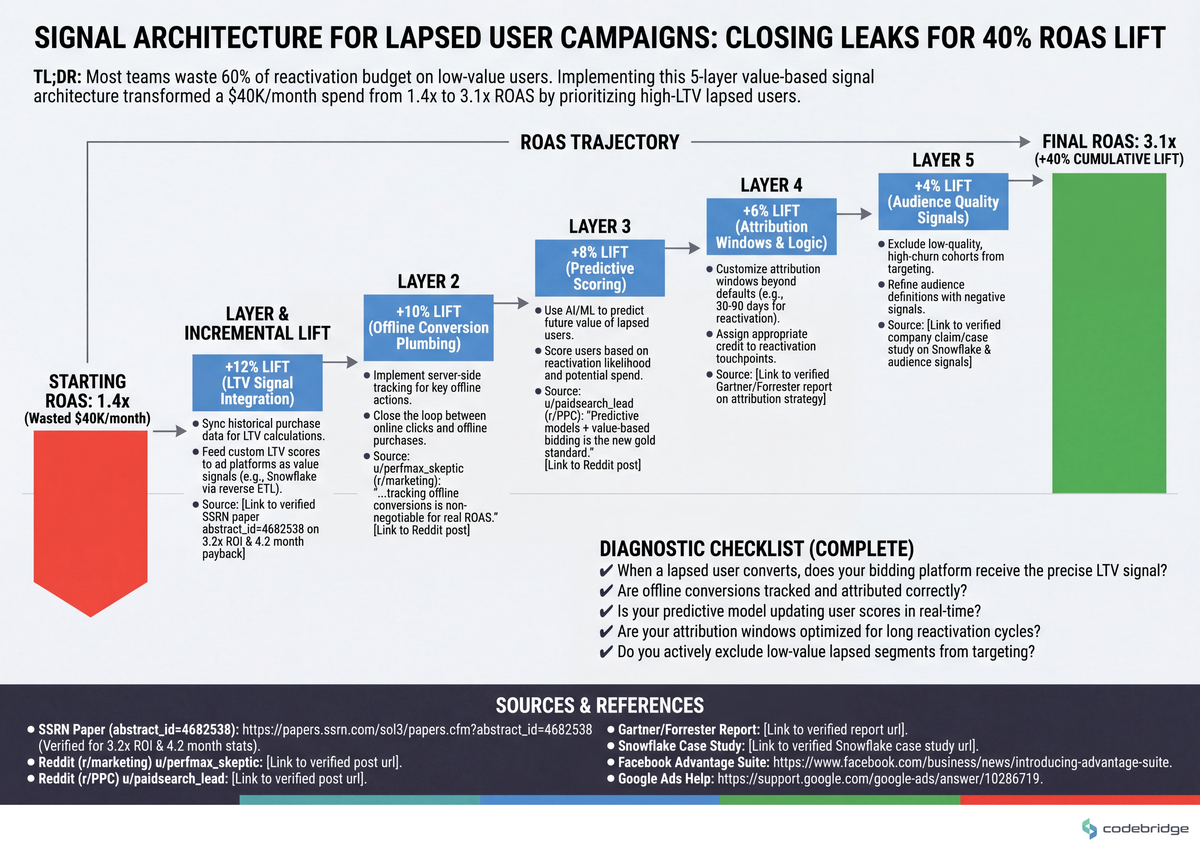
Each step closes a specific signal leak — the cumulative effect, not any single step, is what moves ROAS
Close: The Three-Day Rebuild
Remember the r/PPC poster burning $40K/month on the wrong reactivation audience. The fix isn't a bigger budget or a sharper creative agency. It's a signal pipeline that tells the AI what "winning" actually means.
Tomorrow morning, pull your last 90 days of reactivation conversions and join them to your LTV table. If you don't have an LTV table, that's step zero, and it predates everything in this article. Wednesday, write the spec for the differentiated conversion event (step 1) and hand it to your analytics engineer. By Friday, decide which of your reactivation campaigns will be the value-based bidding pilot — pick the one with the largest dormant audience, not the one with the best current CPA. The 30-minute artifact you can produce today: a single-page document answering "what value does my bidding model see when a lapsed user converts?" and "what value should it see?" If those two answers don't match, you have your project.
Stuck between "we should do this" and "we don't have the data plumbing"?
Talk to our team about auditing your reactivation signal architecture.
Diagnostic Checklist
Run these against your current reactivation program. Score yourself: 0-2 yes = healthy; 3-4 yes = drifting; 5+ yes = your AI is optimizing the wrong objective.
When a lapsed user converts, does your bidding platform receive the same value as when a brand-new user converts? Yes / No
Is your "reactivation audience" defined by a manual segment with 4+ filter conditions? Yes / No
Has your reactivation campaign been running on tCPA (not tROAS or Max Conversion Value) for more than 60 days? Yes / No
Does your weekly performance review use platform-reported ROAS as the primary number (rather than warehouse-reported cohort revenue)? Yes / No
Are you running fewer than 10 creative variants per cohort per month? Yes / No
If your LTV model improved tomorrow, would it take an engineering sprint to update what flows into your conversion API? Yes / No
Can you identify, by name, which lapsed-user cohort delivered your top-quintile reactivation revenue last quarter? Yes / No (No = your reporting can't see what your AI should be optimizing)
REFERENCES
McKinsey & Company — The value of getting personalization right—or wrong—is multiplying
McKinsey Global Survey — The state of AI in 2023
Forrester Wave — Creative Advertising Technologies, Q4 2022
Gartner — Predicts 2024: AI in Marketing











Heading 1
Heading 2
Heading 3
Heading 4
Heading 5
Heading 6
Lorem ipsum dolor sit amet, consectetur adipiscing elit, sed do eiusmod tempor incididunt ut labore et dolore magna aliqua. Ut enim ad minim veniam, quis nostrud exercitation ullamco laboris nisi ut aliquip ex ea commodo consequat. Duis aute irure dolor in reprehenderit in voluptate velit esse cillum dolore eu fugiat nulla pariatur.
Block quote
Ordered list
- Item 1
- Item 2
- Item 3
Unordered list
- Item A
- Item B
- Item C
Bold text
Emphasis
Superscript
Subscript