Over the past two years, enterprise IT leaders have found themselves caught between accelerating business demands and an increasingly constrained development capacity. What once felt like a tooling decision has now become a strategic inflection point: how to deliver software faster without eroding architectural integrity, security, or long-term scalability.
According to Gartner, by 2026, around 75% of all new applications will be built using low-code technologies. And by 2029, these platforms are projected to power 80% of mission-critical applications globally.
With these market changes, the question for modern executives is no longer whether low-code platforms are viable. It's how to strategically integrate them without compromising system integrity and security.
Closer Look at Market Realities
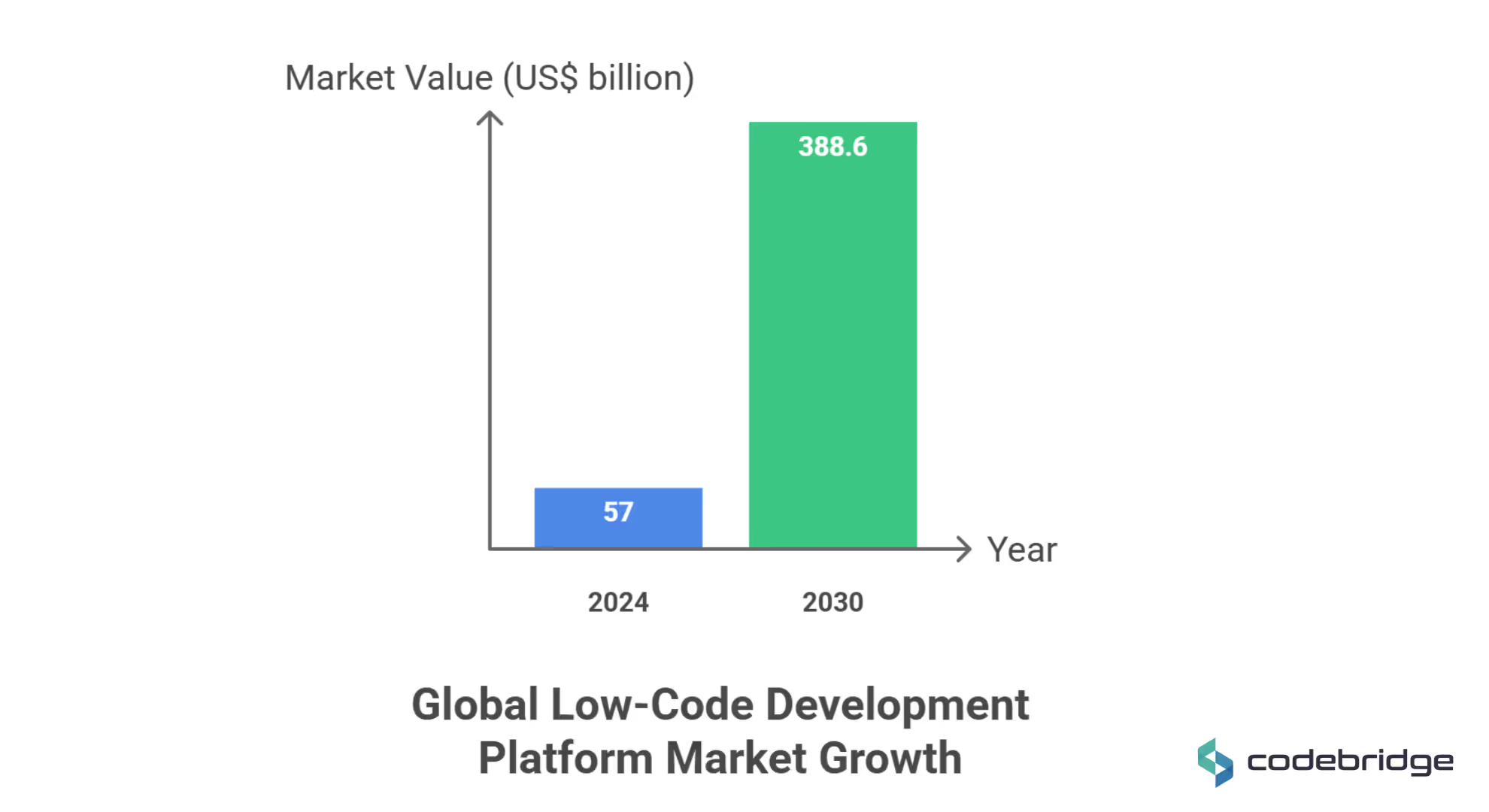
The case for adopting it is becoming stronger. The global market for Low-Code development platforms was valued at US$57 billion in 2024. It is projected to reach US$388.6 billion by 2030, growing at a CAGR of 37.7%. The obvious question is, why is this shift happening now?
This acceleration is not driven by a single factor, but by a recurring tension inside IT organizations. As demand for new applications grows, teams are simultaneously dealing with limited developer availability and the long-term drag of technical debt. Over time, this combination has become what many teams informally call an “impossible equation.”
Within that equation, the primary driver for Low-Code/No-Code (LCNC) adoption remains the global developer shortage. This talent gap has given rise to a new organizational reality, where "citizen developers" (business users creating apps) now outnumber professional developers by a 4-to-1 ratio at large enterprises.
This shift is not occurring in isolation from engineering teams. Far from rejecting these tools, professional developers are institutionalizing them. Recent data indicates that 87% of enterprise developers use low-code platforms for at least some of their work. By using these tools to handle routine UI and database operations, developers can focus on complex business logic. According to Forrester, this shift allows for a 70% reduction in costs.
The Strategic Risk of Shadow IT
While LCNC changes the IT market and empowers business units, it also introduces a significant risk of “Shadow IT,” where employees create applications without formal IT oversight.
According to KPMG research, 73% of organizations have not yet defined rules for citizen development and structured governance. In practice, this lack of oversight can lead to fragmented systems, unmanaged data flows, and security gaps. For that reason, each ungoverned application represents a potential vulnerability or compliance lapse under regulations such as GDPR or HIPAA.
Establishing a Low-Code Centre of Excellence (LCCoE)
Without clear governance, IT becomes a source of architectural complexity and operational risk. Enterprises can prevent this chaos by shifting from a restrictive IT mindset to one focused on business enablement – establishing a Low-Code Centre of Excellence (LCCoE) framework to streamline development and maintain control.
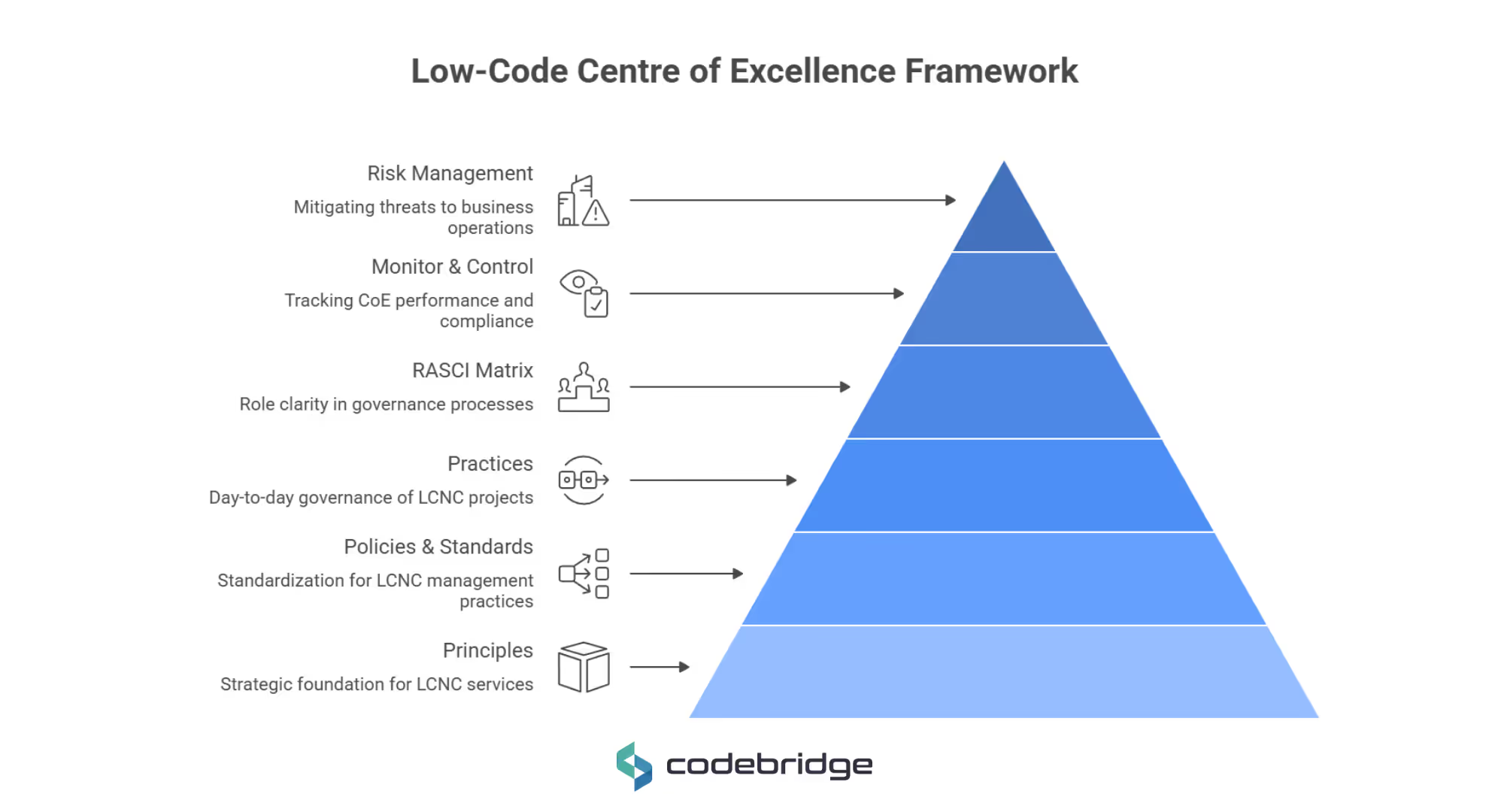
This governing body includes six core components:
1. Principles: Strategic Foundation
- Maintain comprehensive oversight that guides all LCNC services and projects, providing a foundation for their management.
2. Policies and Standards: Standardization
- Establish CoE services, LCNC guidelines for management practices, and KPIs. Standardization reduces dependency on individual efforts and promotes long-term maintainability.
3. Practices: Day-to-Day Governance
- Establish governance of development, management, and support of CoE services and LCNC projects, including the Power Platform.
4. RASCI Matrix: Role Clarity
- Define and communicate the roles of different individuals or groups in the execution of governance processes.
5. Monitor and Control: Performance Tracking
- Track CoE performance and ensure compliance with LCNC application and platform standards.
6. Risk Management: Threat Mitigation
- Mitigate potential threats to the business, such as cyber-attacks, data breaches, outages, and system vulnerabilities.
In reality, organizations rarely mature across all six dimensions at the same pace. However, in fact, role clarity and enforcement mechanisms typically lag behind tooling and standards, creating governance gaps even when formal frameworks exist.
For this reason, many teams start small by establishing clear ownership, decision rights, and basic governance controls, and then expand standards, monitoring, and risk management progressively as adoption and complexity increase.
Strategic Trade-offs: Evaluation and Selection
To really understand the value of a solution, decision-makers must move beyond feature lists and evaluate how it aligns with long-term roadmap priorities.
- Performance and Scalability: LCNC platforms are well-suited for MVPs and internal tools, but teams often encounter performance constraints as applications scale(>10,000 simultaneous sessions). When workflows become more complex, abstraction layers can introduce latency that is difficult to tune without deeper access to the underlying architecture.
- Database and Integration: LCNC tools frequently rely on auto-generated schemas that lack optimized indexing. This results in impaired performance for applications requiring complex joins or real-time reporting. Many platforms also impose API rate limits that can throttle high-volume enterprise processes.
- The "Exit Strategy": A critical risk is vendor lock-in. Most no-code platforms, such as Adalo, do not allow source code export, meaning applications are tethered to proprietary infrastructure. Strategic alternatives like FlutterFlow allow Pro users to export clean Flutter source code, providing a viable exit strategy should the business outgrow the platform.
Proven ROI: Success at Scale
Real-world implementations demonstrate the transformative potential of LCNC when managed correctly:
SN Aboitiz Power (SNAP)
Before adopting LCNC, SNAP struggled with fragmented legacy systems that were costly, slow, and required heavy manual intervention. For that reason, the company decided to launch a Citizen Developer Program, training non-technical employees to build applications on the low-code platform.
The team’s success was driven by the combination of a professional senior development team and the low-code software. And while the platform accelerated the development process, the senior team continued to support and expand applications over time, ensuring stability and security.
As a result, in six months, the team migrated over 95 processes and built 114 custom applications, eliminating $61,000 in annual infrastructure costs.
Ricoh
With accelerated market changes, Ricoh Singapore was struggling with disconnected systems and outdated applications, which made everyday tasks slow and error-prone. For instance, teams often had to reconcile data manually across multiple databases, creating frustration and delays.
To address these challenges, the company integrated modern interfaces and cloud services into its existing systems. The senior development team provided strategic guidance and handled complex integrations, while the low-code platform automated tasks like invoice approvals and report generation.
This approach quickly paid off. The initiative achieved a 253% ROI in seven months and generated $130,000 SGD in annual benefits.
The Hybrid Path Forward
The most resilient enterprise architectures in 2026 are adopting a Hybrid Development Strategy. This involves utilizing LCNC for front-end agility and rapid prototyping while maintaining core routing algorithms, complex database formats, and specialized integrations through traditional, custom-coded microservices.
The goal for decision-makers is not merely to "build an app." It's to architect a foundation that balances speed with the rigors of enterprise engineering. By implementing robust governance through an LCCoE and understanding exactly where platforms hit their performance ceilings, enterprises can harness the democratization of development to drive significant ROI without sacrificing security or scalability.












Heading 1
Heading 2
Heading 3
Heading 4
Heading 5
Heading 6
Lorem ipsum dolor sit amet, consectetur adipiscing elit, sed do eiusmod tempor incididunt ut labore et dolore magna aliqua. Ut enim ad minim veniam, quis nostrud exercitation ullamco laboris nisi ut aliquip ex ea commodo consequat. Duis aute irure dolor in reprehenderit in voluptate velit esse cillum dolore eu fugiat nulla pariatur.
Block quote
Ordered list
- Item 1
- Item 2
- Item 3
Unordered list
- Item A
- Item B
- Item C
Bold text
Emphasis
Superscript
Subscript