Picture this: Your internal development team has been humming along beautifully for eighteen months. They've built solid integrations, maintained your core systems, and shipped features on schedule. Then a client requests something that requires specialized PropTech expertise,maybe a smart building IoT integration or an AI-powered property valuation engine. Suddenly, your capable team is staring at a six-month learning curve while the opportunity window is measured in weeks.
This isn't a failure of planning. It's the new reality of real estate technology, where the market is expanding so rapidly that even well-staffed teams face capability gaps they couldn't have anticipated.
KEY TAKEAWAYS
The PropTech market is exploding at 16.4% CAGR, creating specialized demands that outpace internal team skill development.
Cloud-based solutions now dominate at 61% market share, requiring different architectural expertise than legacy systems.
Commercial real estate tech is growing faster than residential, despite residential's larger base,creating unexpected specialization needs.
Strategic capability mapping prevents reactive scrambling when rare but high-value projects emerge.
The Capability Gap You Can't See Coming
The numbers tell a story that most technology leaders haven't fully absorbed. The PropTech market reached $47.08 billion in 2025 and is projected to hit $185.31 billion by 2034. That's not gradual growth,it's a fundamental reshaping of what real estate technology means.
Here's what makes this particularly challenging for organizations with capable internal teams: the growth isn't uniform. Commercial real estate software now commands 63% of the market share, driven by increasingly complex operational requirements. Meanwhile, the AI segment is expanding at a staggering 34.4% CAGR, projected to reach $988.59 billion by 2029.
Your team might be excellent at what they do. But "what they do" is becoming a smaller slice of a rapidly expanding pie.
The Hidden Problem: Specialization Velocity
The conventional wisdom suggests that internal teams can upskill as needed. Hire smart people, give them learning time, and they'll adapt. This worked when technology evolved at a pace measured in years.
That assumption breaks down when you examine current market dynamics. Consider that RSoft Technologies launched RealtorsRobot in January 2025,an AI-powered CRM with SIM-based auto-dialing, WhatsApp automation, and over 1,500 integrations. The result? A 73% boost in call efficiency. This isn't incremental improvement. It's the kind of capability leap that takes years to develop internally but arrives in the market fully formed.
When specialized solutions can deliver 73% efficiency gains, the cost of "we'll figure it out internally" becomes a competitive disadvantage measured in market position, not just dollars.
The challenge isn't that your team lacks talent. It's that specialization velocity,the speed at which narrow expertise becomes essential,has outpaced traditional skill development models.
What Counter-Intuitive Patterns Reveal
Two market shifts challenge assumptions that many technology leaders still hold:
First, cloud has won decisively. Despite persistent beliefs that on-premises solutions offer superior control for property technology, cloud-based deployment now captures 61% market share. The accessibility advantages,data from anywhere, reduced infrastructure overhead, faster deployment,have proven more valuable than the theoretical control benefits of on-premises systems.
This matters for capability planning because cloud-native architecture requires different expertise than traditional deployment models. Teams skilled in one paradigm don't automatically transfer to the other.
The following comparison illustrates how deployment requirements have shifted:
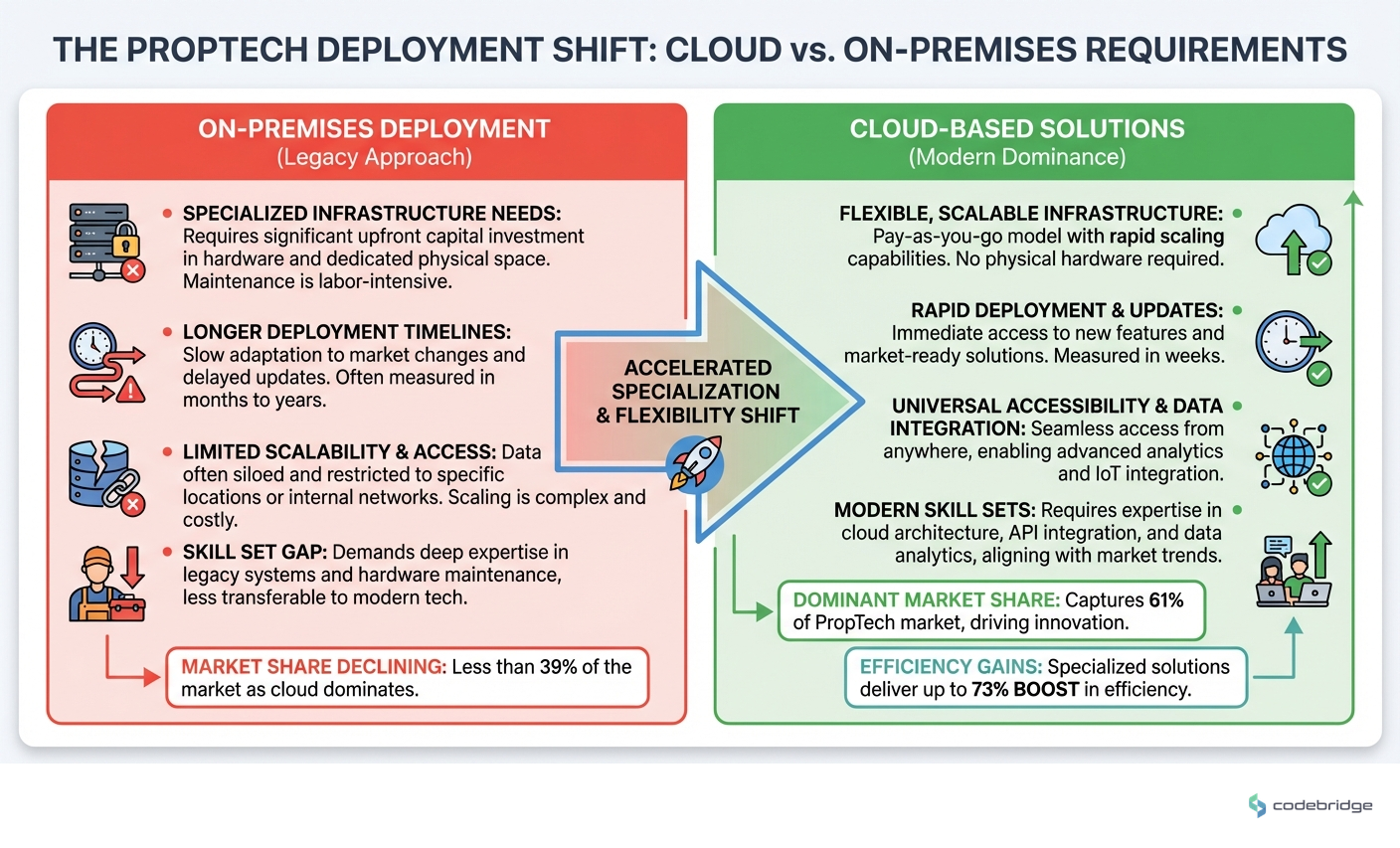
Second, commercial is outpacing residential. Residential PropTech holds 53% of the current market, but commercial and industrial segments are growing at 18% CAGR,the fastest in the sector. Smart building integration, IoT sensor networks, and energy management systems are driving this acceleration.
If your internal team built their expertise on residential technology patterns, the commercial opportunities arriving in your pipeline may require different skill sets.
The Pattern: How Prepared Organizations Handle Rare Projects
Organizations that navigate capability gaps successfully share a common approach: they treat rare project readiness as a strategic capability, not an operational problem to solve when it arises.
The first half of 2025 saw $2.3 billion in PropTech growth equity and M&A activity. That capital isn't flowing toward organizations that scramble when opportunities appear. It's rewarding those with clear capability maps and pre-established partnerships for specialized work.
This process flow shows how capability-ready organizations evaluate and respond to emerging project types:
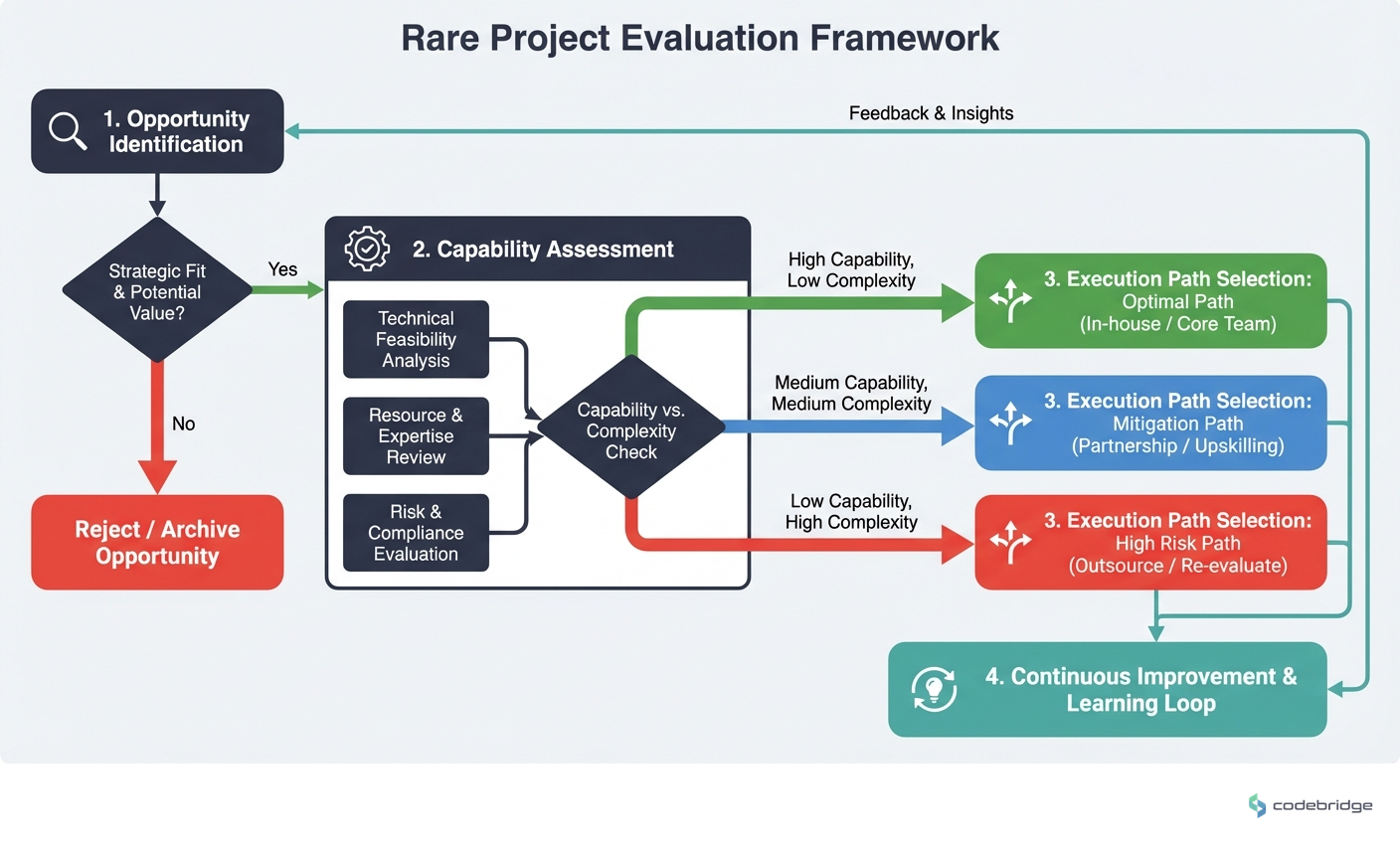
The distinction isn't between organizations with internal teams versus those who outsource. It's between those who understand their capability boundaries in advance and those who discover them under deadline pressure.
A Framework for Capability Readiness
Building readiness for rare but high-value projects requires systematic preparation, not reactive scrambling. Here's what the evidence suggests works:
1. Map Your Capability Boundaries Quarterly
Technology landscapes shift too quickly for annual planning. Every quarter, document what your team can deliver confidently, what they could stretch to accomplish with additional time, and what falls outside their current expertise. The 14% CAGR in real estate software means today's edge cases become tomorrow's standard requests.
2. Identify Your Specialization Gaps Against Market Growth
Cross-reference your capability map against the fastest-growing segments. AI integration (34.4% CAGR), commercial real estate systems (18% CAGR), and sustainability/energy management are the current acceleration points. If your team has no experience in these areas, you have predictable gaps,not surprises waiting to happen.
3. Establish Partnership Channels Before You Need Them
The worst time to evaluate external development partners is when a deadline-sensitive opportunity arrives. Build relationships with specialized teams during quiet periods. Understand their capabilities, communication patterns, and integration approaches when you have the luxury of time.
4. Create Hybrid Project Playbooks
Document how your internal team would collaborate with external specialists. Who owns architecture decisions? How does code review work across organizations? What security and access protocols apply? These questions become urgent obstacles if answered during project execution rather than in advance.
5. Budget for Strategic Flexibility
Allocate a portion of your technology budget specifically for capability-gap projects. This isn't a contingency fund,it's strategic capacity. Organizations with pre-approved flexibility move faster when opportunities appear.
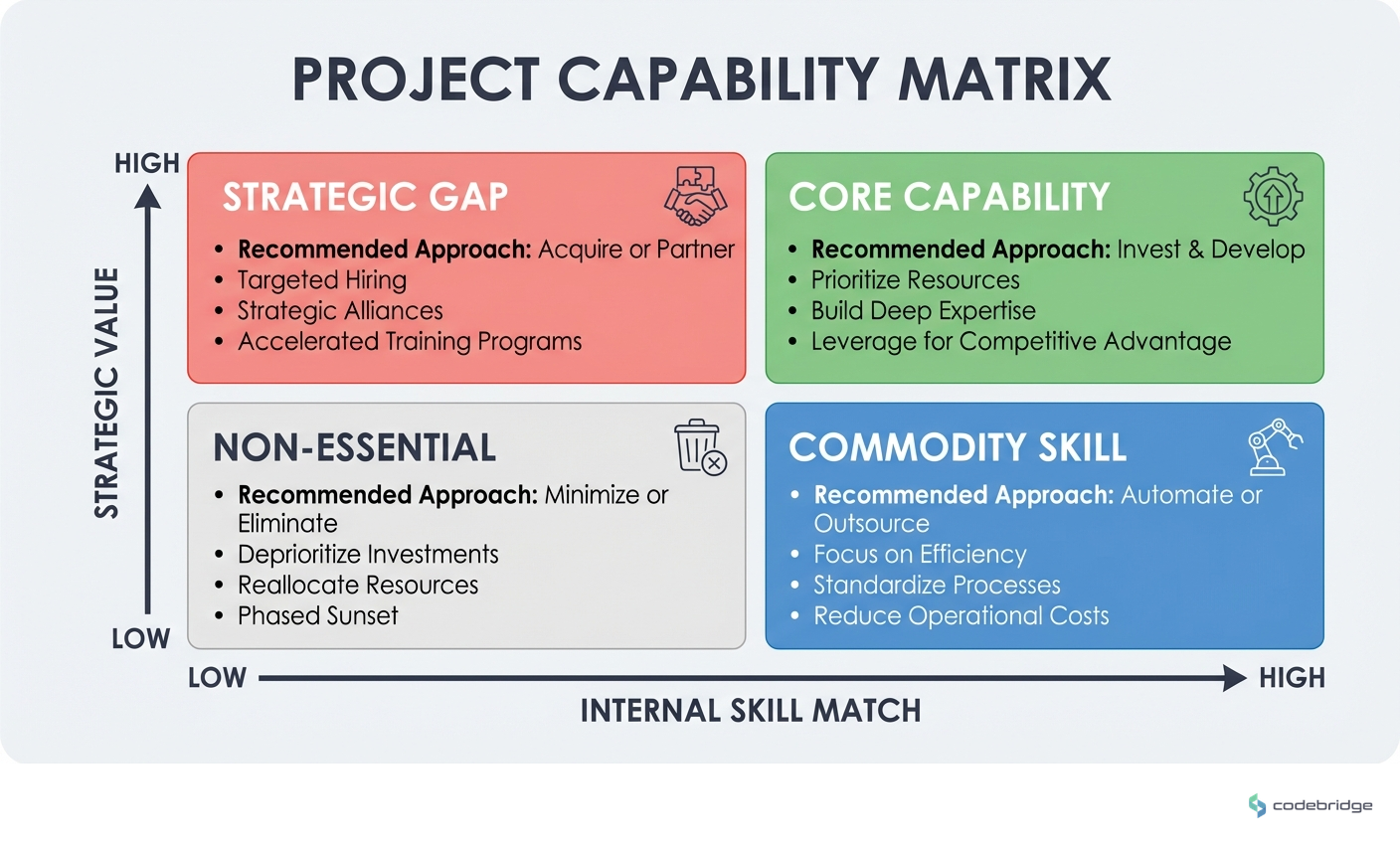
The quadrant below helps visualize how to categorize incoming projects based on internal capability and strategic value:
The Real Cost Calculation
When evaluating whether to stretch internal teams or engage specialized help for rare projects, most organizations focus on direct costs. The more significant calculation involves opportunity cost and capability development.
| Factor | Internal Stretch | Specialized Partnership |
|---|---|---|
| Time to delivery | Extended (learning curve) | Compressed (existing expertise) |
| Team focus | Diverted from core work | Maintained on priorities |
| Knowledge retention | Builds internal capability | Requires knowledge transfer |
| Risk profile | Higher (unfamiliar territory) | Lower (proven patterns) |
| Future flexibility | Depends on project frequency | Scales with demand |
The right answer varies by project. But making that decision strategically,rather than defaulting to "we'll figure it out",separates organizations that capture rare opportunities from those that watch them pass.
Preparing for What You Can't Predict
The scenario from our opening,a capable team facing a specialized request they can't efficiently handle,isn't a planning failure. It's an inevitable consequence of operating in a market growing at 16.4% annually with multiple specialized segments accelerating even faster.
The organizations that thrive aren't those with internal teams that can do everything. They're the ones that know exactly what their teams do brilliantly, have clear visibility into their capability boundaries, and maintain the relationships and resources to move quickly when rare opportunities appear.
Your internal developers are an asset. Protecting that asset means not forcing them into unfamiliar territory under deadline pressure when better options exist.
Wondering where your capability gaps might be?
Schedule a capability mapping session to identify your team's boundaries before the next rare project arrives.
Diagnostic Checklist: Signs You Need a Capability Readiness Strategy
Your team has declined or delayed opportunities in the past 12 months due to unfamiliar technology requirements
You have no documented capability map distinguishing "confident delivery" from "stretch projects"
Your last external development partnership was established reactively, under deadline pressure
You have zero budget allocation specifically for capability-gap projects
Your team has limited or no experience with AI integration, IoT systems, or cloud-native architecture
You couldn't name three specialized development partners you'd contact for a commercial PropTech project tomorrow
Your capability planning happens annually rather than quarterly
REFERENCES












Heading 1
Heading 2
Heading 3
Heading 4
Heading 5
Heading 6
Lorem ipsum dolor sit amet, consectetur adipiscing elit, sed do eiusmod tempor incididunt ut labore et dolore magna aliqua. Ut enim ad minim veniam, quis nostrud exercitation ullamco laboris nisi ut aliquip ex ea commodo consequat. Duis aute irure dolor in reprehenderit in voluptate velit esse cillum dolore eu fugiat nulla pariatur.
Block quote
Ordered list
- Item 1
- Item 2
- Item 3
Unordered list
- Item A
- Item B
- Item C
Bold text
Emphasis
Superscript
Subscript