Last quarter, a CTO told me something that stuck: "We have seven developers. We should be able to handle anything." Six months later, his team was drowning in a data migration that exposed every gap they didn't know they had. The project wasn't complex,it was just different from what they'd built expertise in. And that difference cost them three months of roadmap paralysis.
If you're leading a technology organization with capable internal developers and no immediate fires, you're in a comfortable position. But comfort has a shelf life. The question isn't whether you'll face a capacity crunch or skills gap,it's whether you'll see it coming in time to respond strategically rather than reactively.
KEY TAKEAWAYS
Internal team stability creates blind spots, particularly around emerging technologies and surge capacity needs.
The 29% CAGR in AI spending signals that "rare" specialized projects are becoming routine expectations.
Strategic preparation beats reactive scrambling,organizations that pre-qualify external partners respond 60% faster to unexpected demands.
Skills gaps compound silently until they become visible during the worst possible moment: a critical project deadline.
The Hidden Cost of Self-Sufficiency
There's a dangerous assumption baked into having a strong internal team: that current capabilities map to future needs. With global IT spending hitting $5.74 trillion in 2025,a 9.3% jump from the previous year,the technology landscape isn't just growing. It's mutating. The skills that made your team excellent at maintaining your current stack may have little overlap with what you'll need eighteen months from now.
That 29% CAGR in AI spending isn't just a market trend,it's a leading indicator of what your stakeholders will start expecting. When nearly 90% of notable AI models now come from industry rather than academia, the pressure to integrate these capabilities into your products and operations will intensify. Your Java developers didn't sign up to become ML engineers, and they probably shouldn't have to.
The Pattern That Separates Prepared Organizations from Scrambling Ones
Organizations that handle "rare" specialized projects well share a counterintuitive trait: they treat external partnerships as a strategic capability, not an emergency measure. They've already done the due diligence. They know which firms specialize in what. They have NDAs signed and procurement pathways cleared.
The comparison below illustrates the stark difference between these two approaches when an unexpected specialized project lands on your desk:
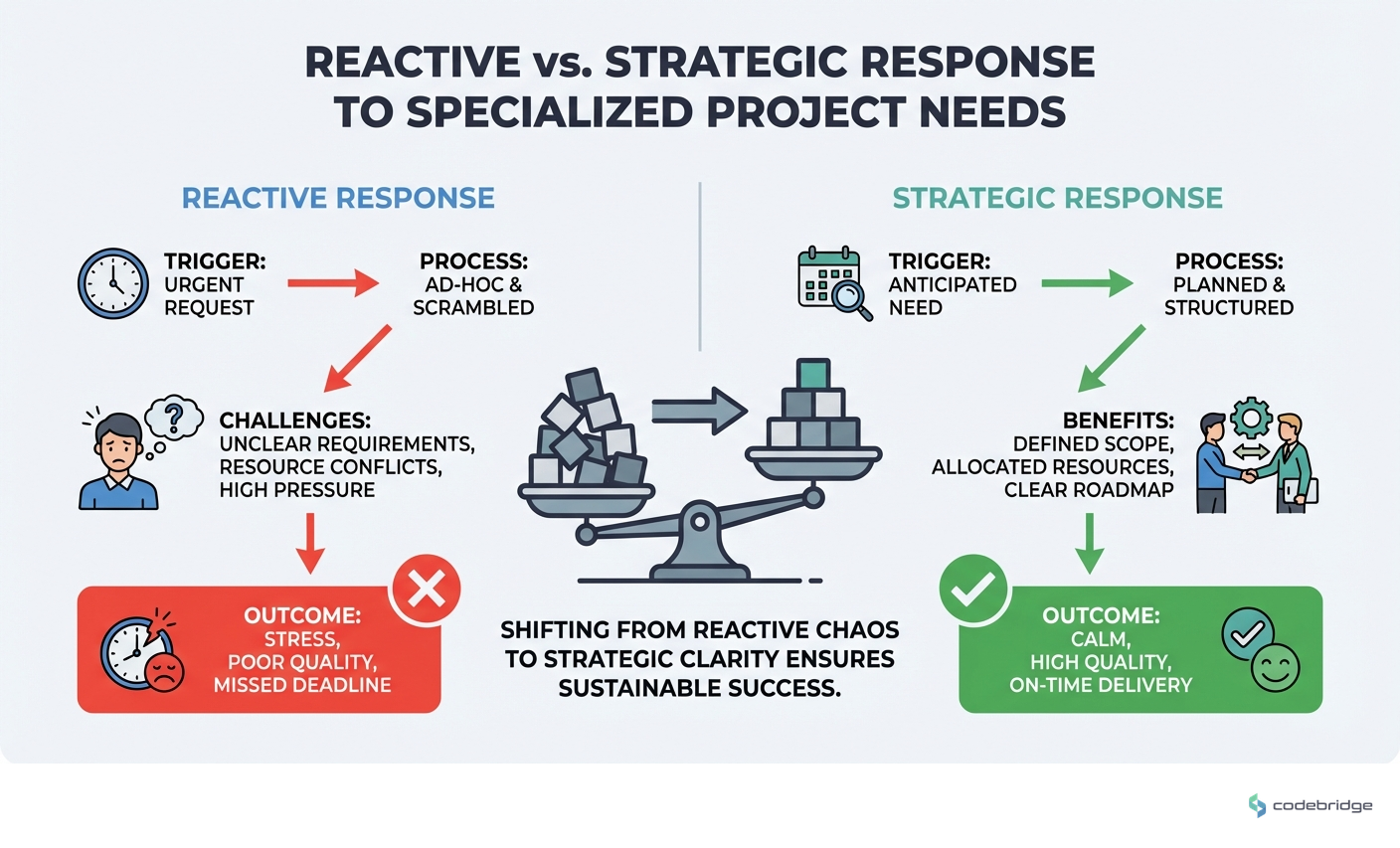
When a board member asks about implementing a real-time analytics pipeline or a customer demands an AI-powered feature, these organizations don't start from zero. They already have a shortlist. Meanwhile, unprepared teams spend their first three weeks just figuring out who to talk to,burning runway before any actual work begins.
The worst time to evaluate external development partners is when you desperately need one. Urgency kills negotiating power and due diligence quality.
What "Rare" Actually Looks Like in 2026
Let's be specific about the kinds of projects that blindside internal teams. They're rarely dramatic,they're just outside the team's practiced domain:
- Data center modernization: With data center systems spending growing 15.5% annually (the fastest-growing segment), infrastructure projects are becoming more complex and more frequent.
- Legacy system migrations: Moving from a system your team built to a platform they've never touched requires expertise they may not have,and shouldn't have to develop for a one-time project.
- Compliance-driven rewrites: When regulations change, you often need specialized knowledge of both the technical implementation and the regulatory framework.
- Integration with acquired company systems: M&A activity creates technical debt that your team didn't create and may not understand.
The following diagram shows how these project types typically flow through an organization's decision-making process:
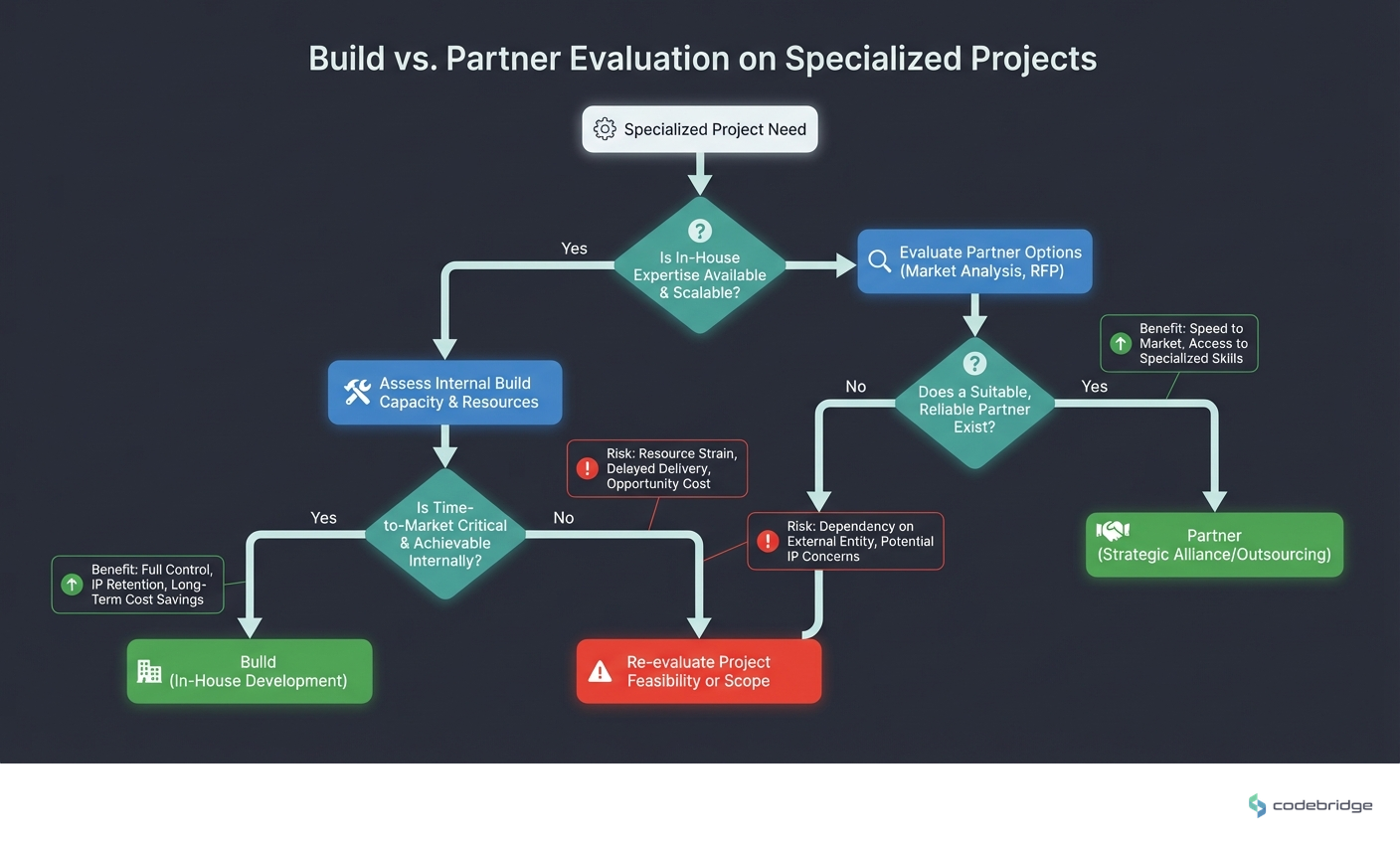
None of these are exotic. All of them can paralyze a team that's optimized for different work. With global data creation expected to hit 182 zettabytes in 2025 and double by 2028, the volume and variety of technical challenges will only increase.
The Strategic Preparation Framework
Here's what forward-thinking technology leaders do before they need external help:
1. Conduct a Skills Gap Audit (Quarterly)
Map your current team's capabilities against your 18-month roadmap and industry trends. Where are the gaps? Not the ones you'll fill with hiring,the ones that don't justify a full-time role. These are your "rare project" vulnerabilities.
2. Pre-Qualify Partners by Specialty
Identify 2-3 potential partners for each gap category. Run preliminary conversations. Understand their capacity, rates, and working style. Get NDAs signed. Do this when you have use,when you're not desperate.
3. Create a Rapid Engagement Protocol
Document what it takes to bring an external team up to speed on your systems. What access do they need? What documentation exists? What's your code review process for external contributors? Having this ready cuts onboarding time by half.
4. Budget for Optionality
Allocate 10-15% of your development budget as "strategic reserve" for specialized projects. This isn't waste,it's insurance. With software spending growing 14% annually to $1.24 trillion, the cost of being unprepared is rising faster than the cost of preparation.
5. Run a Fire Drill
Once a year, simulate a scenario where you need to bring in external expertise quickly. How long does it take to identify a partner, negotiate terms, and get them productive? The answer will either reassure you or terrify you,both are valuable.
The following visualization shows how these five elements work together as a continuous preparation cycle:
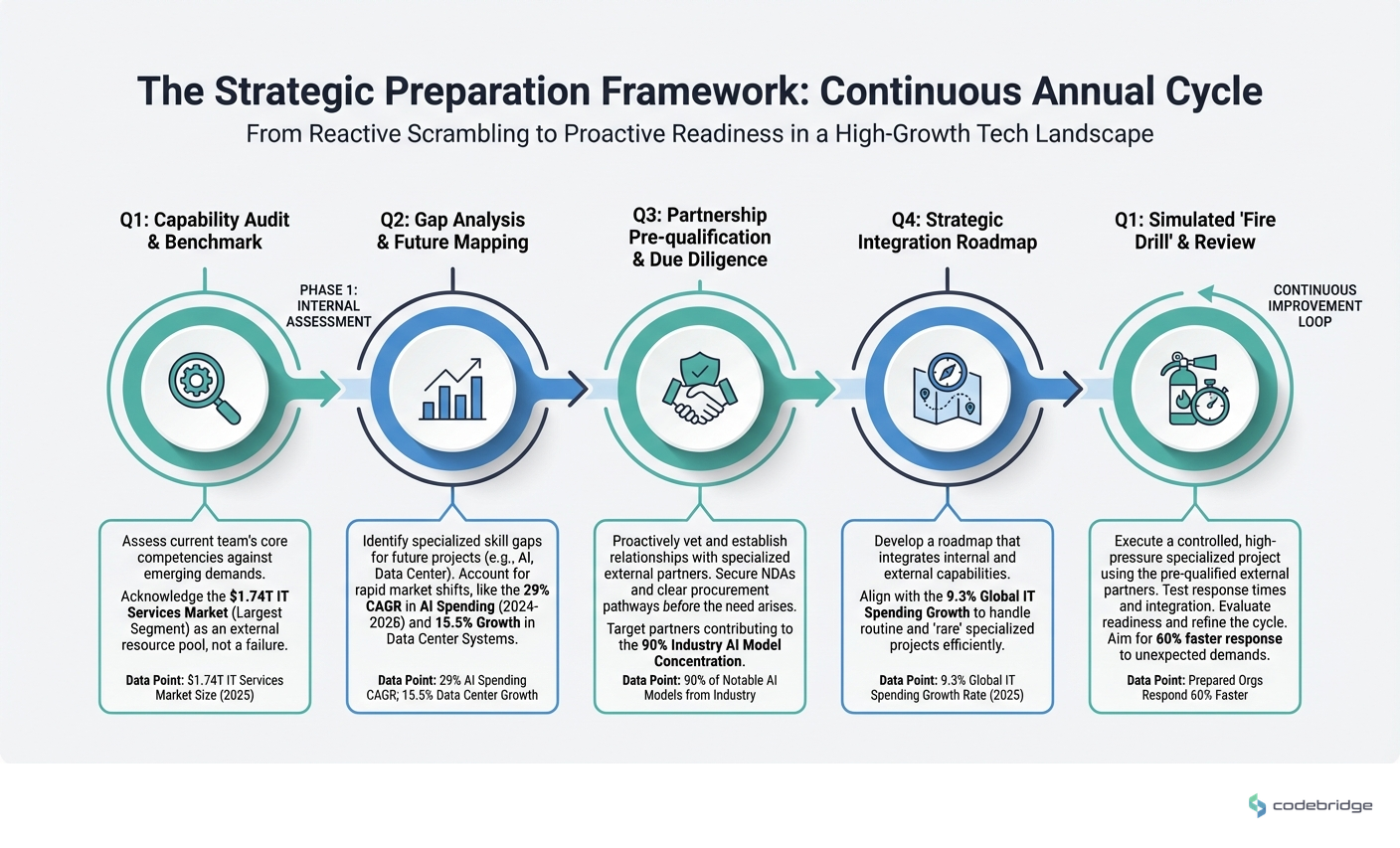
That $1.74 trillion IT services market exists because organizations consistently underestimate what they'll need and when they'll need it. The question isn't whether you'll tap into it,it's whether you'll do so strategically or desperately.
The Real Risk of "We're Fine for Now"
There's nothing wrong with not having immediate needs. But "no immediate needs" often masks "no visibility into upcoming needs." Server sales are projected to increase 146% by 2028,nearly tripling from 2023 levels. The infrastructure demands driving that growth will create ripple effects across every software organization.
Your internal team is excellent at what they do. That's precisely why you shouldn't burden them with work that falls outside their expertise. Stretching developers into unfamiliar territory doesn't develop them,it burns them out while delivering subpar results.
The best internal teams are protected from work that doesn't match their strengths. Strategic partnerships aren't a sign of weakness,they're a sign of mature resource allocation.
Bringing It Back
Remember that CTO with seven developers who thought he could handle anything? His mistake wasn't having confidence in his team,it was conflating current capability with universal capability. When the data migration project hit, he had no relationships with firms who specialized in that work, no budget allocated for external help, and no process for bringing outsiders into his codebase quickly.
The three months he lost weren't spent on the migration. They were spent scrambling to find help, negotiating from a position of desperation, and onboarding a team that should have been pre-qualified months earlier.
You have internal developers. You have no immediate needs. That's exactly the right time to prepare for the needs you can't yet see.
Start by mapping your team's capabilities against your 18-month roadmap.
The gaps you find will tell you exactly what kind of partnerships to explore,before you need them.
Diagnostic Checklist: Signs You're Less Prepared Than You Think
You couldn't name three qualified external partners for a specialized project within 24 hours
Your procurement process for external development services would take more than two weeks
You have no documented onboarding process for external contributors to your codebase
Your development budget has no allocation for unplanned specialized work
You haven't assessed your team's skills against emerging technology trends (AI, data infrastructure) in the past six months
Your last "urgent" external engagement took longer to set up than the actual project work
You're unsure what NDAs or security clearances would be needed to bring in outside developers













Heading 1
Heading 2
Heading 3
Heading 4
Heading 5
Heading 6
Lorem ipsum dolor sit amet, consectetur adipiscing elit, sed do eiusmod tempor incididunt ut labore et dolore magna aliqua. Ut enim ad minim veniam, quis nostrud exercitation ullamco laboris nisi ut aliquip ex ea commodo consequat. Duis aute irure dolor in reprehenderit in voluptate velit esse cillum dolore eu fugiat nulla pariatur.
Block quote
Ordered list
- Item 1
- Item 2
- Item 3
Unordered list
- Item A
- Item B
- Item C
Bold text
Emphasis
Superscript
Subscript