A VP at a tech company set an October deadline for a new microservices platform. Ten different teams were building services in isolation. Not a single developer had been consulted for estimates. Integration testing hadn't even started. One team lead put it bluntly in a developer forum: "Everyone agrees with me, but it seems like they are still telling upper management that we'll make it."
That team had internal developers. Experienced ones. They still couldn't prevent the slow-motion disaster unfolding in front of them. The problem wasn't talent,it was the assumption that having developers on staff meant being prepared for anything.
KEY TAKEAWAYS
Internal teams create a false sense of security,having developers doesn't mean having the right capabilities for emerging needs.
The skills gap is widening faster than hiring can solve,90% of notable AI models now come from industry, not academia, shifting what "developer" even means.
Market conditions change employment stability overnight,offshoring trends and project cycles can eliminate internal capacity without warning.
The offer is shifting,language-specific skills matter less than system design, architecture, and scaling expertise.
The Comfortable Myth of "We've Got This Covered"
Global IT spending hit $5.62 trillion in 2025,a 10% jump from the previous year. Software spending alone crossed the trillion-dollar mark, up 14% year-over-year. The technology sector isn't just growing; it's accelerating in ways that make yesterday's capabilities obsolete faster than most organizations can adapt.
Yet the most dangerous position in this market isn't being under-resourced. It's believing you're adequately resourced when you're not.
9.3%IT spending growth in 2025, with double-digit growth in data centers and software
Here's what that growth actually means: the complexity ceiling is rising faster than team capacity. Your internal developers might be excellent at maintaining what exists. But "rare future needs" have a way of becoming urgent present needs without warning,and the skills required are increasingly specialized.
A mid-40s software engineer shared his reality check in a UK developer forum. His project was wrapping up, fifty team members heading to the bench, limited internal roles available. Remote work had enabled more offshoring to India and Eastern Europe. His observation was sobering:
"I briefly checked the job market, and it's nothing like it used to be 7 years ago." There are fewer openings, and the ones I'm seeing pay noticeably less.
u/mid40s_dev, Reddit r/AskUK
Even experienced developers with stable internal positions should recognize the pattern: the market that made your team possible can unmake it just as quickly.
What Actually Changed in 2025
The Stanford HAI 2025 AI Index Report surfaced a statistic that should concern every technology leader: nearly 90% of notable AI models in 2024 came from industry, up from 60% in 2023. This isn't just about AI,it's about where capability now lives.
The common belief was that communication services would remain the top IT spending category. That assumption broke in 2025. IT services overtook communication services at $1.7 trillion,only the third time in history this category didn't lead. The implication: enterprises are paying for expertise they can't build internally.
The following comparison illustrates how spending priorities have shifted, revealing where organizations are placing their bets:
[DIAGRAM:comparison:IT Spending Categories 2024 vs 2025, Communication Services vs IT Services vs Software]
A developer exploring AI-assisted coding tools captured the transformation happening at the individual skill level:
"Python dev, React dev etc is already boomer talk." Nobody would be hiring for languages anymore. It's about people who can actually solve problems no matter the stack.
u/cursor_user, Reddit r/cursor
This isn't hyperbole. When AI tools shift from "helping write code" to "writing 100% of the code," the offer of internal developers changes. System design, architecture, DevOps, and scaling expertise become the differentiators,not language-specific coding skills.
The Pattern: What Prepared Organizations Do Differently
The Big Five tech companies, Amazon, Alphabet, Apple, Microsoft, and Meta,reached a combined market cap exceeding $13 trillion in February 2025. They didn't achieve this by assuming their internal capabilities would always be sufficient. They invested heavily in AI, cloud, and hardware innovation while maintaining the flexibility to acquire specialized expertise when needed.
AWS, Azure, and Google Cloud grew their combined market share to 66% by Q3 2022 by expanding cloud services with AI integration. The lesson isn't about scale,it's about recognizing when internal capacity needs augmentation before the need becomes urgent.
Organizations that wait until they "need" external expertise are already behind. The preparation window is before the deadline, not after the VP announces it.
Consider the medical centre that hired a web developer to build their website. Simple enough. But they needed ongoing content updates,weekly newsletters, staff profiles, basic changes. The developer insisted clients couldn't have any ability to make changes themselves. The centre's frustration was palpable:
"We don't need access to the website code itself if it's not necessary," just the ability to make certain changes like adding a new profile to the staff page.
u/medcentre_admin, Reddit r/webdev
This is the internal-team trap in miniature. The capability existed (a developer), but the architecture created dependency rather than flexibility. When building for future needs, always include mechanisms for adaptation,whether that's a CMS for content or a partnership model for specialized work.
Building Adaptive Capacity: A Framework
The U.S. technology market is projected to grow from $390.94 billion in 2024 to $722.89 billion by 2032. That growth will be driven by cloud computing, AI, and IoT adoption,areas where specialized expertise often outpaces internal capability development.
Here's how to position your organization for "rare future needs" that have a way of becoming common present ones:
1. Audit Your Capability Gaps Before They Become Urgent
Map your internal team's skills against the trends driving IT spending growth. Data centers and software segments are seeing double-digit growth. Gen AI chip demand is accelerating. If your team's expertise doesn't include these areas, identify the gap now.
2. Build Relationships Before You Need Them
The organizations that navigate market shifts successfully have partnerships in place before crises hit. This isn't about outsourcing,it's about having trusted external expertise you can activate when internal capacity is insufficient.
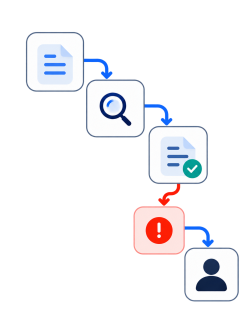
The following process flow shows how to build adaptive capacity before urgent needs arise:
[DIAGRAM:process_flow:Capability Gap Assessment to Partnership Activation, from audit to engagement]
3. Shift Evaluation Criteria from Language Skills to Problem-Solving
Whether hiring internally or engaging external partners, evaluate for system design, architecture, and scaling expertise. The 14% growth in software spending isn't going to language-specific coding,it's going to solutions that work across stacks.
4. Create Integration Testing Capacity Early
Remember the VP's October deadline with ten teams building in isolation? The failure point wasn't development,it was integration. Build the testing infrastructure before you need it, not after the deadline is set.
5. Maintain Market Awareness Regardless of Current Stability
The mid-40s developer who found the job market "nothing like it used to be" learned this lesson too late. Regular assessment of market conditions, offshoring trends, and industry shifts should be part of your operational rhythm.
$1.7Tspent on IT services in 2025,organizations are buying expertise they can't build
The 2026 Landscape: What's Coming
Three trends will define the next twelve months for technology organizations:
Accelerated gen AI chip demand is positioning data centers for continued double-digit growth. NVIDIA and Broadcom are early movers, and the ripple effects will reach every organization dependent on compute capacity. Communication and computer chips are projected to surpass auto and industrial sales.
Industry-led AI development is tightening. With 90% of frontier AI models coming from industry rather than academia, the gap between capability and internal team knowledge will widen. Worldwide AI spending is projected to grow at a 29% CAGR through 2028.
Sustainable IT practices are emerging as a competitive factor. Microsoft's sustainable cloud initiatives and Google's carbon-free energy commitments aren't just PR,they're positioning for a market that increasingly values environmental responsibility alongside technical capability.
The timeline below illustrates how these trends will unfold and when preparation windows close:
[DIAGRAM:timeline:2026 Technology Capability Timeline, Gen AI, Industry AI, Sustainable IT phases and decision points]
The Real Risk of "No Immediate Needs"
Back to that team lead watching the October deadline approach. Everyone privately knew it was impossible. Nobody escalated the reality upward. The internal developers were capable, experienced, and completely unable to prevent the organizational dysfunction.
The phrase "no immediate needs" is comfortable. It's also dangerous. In a market growing at 9.3% annually, where IT services spending jumped to $1.7 trillion because organizations need expertise they can't build internally, "no immediate needs" often means "needs we haven't recognized yet."
The global IT market is projected to reach $13.17 trillion by 2029. That growth will reward organizations that built adaptive capacity before they needed it,and penalize those who assumed their current team would always be enough.
Your internal developers are valuable. They're also not a complete strategy for a market that's changing faster than any single team can adapt.
Not sure where your capability gaps are?
Schedule a technical assessment to map your team's skills against emerging market demands.
Diagnostic Checklist: Signs You're Less Prepared Than You Think
Your team hasn't worked with AI/ML integration in production systems in the past 12 months
Deadlines are set without developer input on estimates
You have no external technical partnerships you could activate within 30 days
Your integration testing infrastructure doesn't exist until projects need it
Team skills are evaluated primarily by programming language proficiency
You haven't assessed how offshoring trends might affect your team's stability
Your systems create dependency rather than flexibility (no CMS, no self-service, no documentation)
"Rare future needs" haven't been specifically identified or planned for
REFERENCES
Discussion on r/ExperiencedDevs about deadlines imposed without developer input
Discussion on r/AskUK about mid-career software engineering market conditions
Discussion on r/cursor about AI-assisted coding and job market shifts
Discussion on r/webdev about developer-client dependency issues
Data Bridge Market Research: U.S Technology Market Size, Share, and Analysis Report 2032
Research and Markets: Information Technology Market Report 2025
AIPRM: 100+ Technology Statistics 2025











Heading 1
Heading 2
Heading 3
Heading 4
Heading 5
Heading 6
Lorem ipsum dolor sit amet, consectetur adipiscing elit, sed do eiusmod tempor incididunt ut labore et dolore magna aliqua. Ut enim ad minim veniam, quis nostrud exercitation ullamco laboris nisi ut aliquip ex ea commodo consequat. Duis aute irure dolor in reprehenderit in voluptate velit esse cillum dolore eu fugiat nulla pariatur.
Block quote
Ordered list
- Item 1
- Item 2
- Item 3
Unordered list
- Item A
- Item B
- Item C
Bold text
Emphasis
Superscript
Subscript