Picture this: Your internal development team just shipped a solid property management module. Everyone's celebrating. Then the CEO walks in asking about AI-powered predictive valuations, IoT integration for smart buildings, and real-time portfolio analytics,all by Q3. Your lead developer's face says it all. The backlog just exploded, and suddenly "we'll build it ourselves" doesn't sound so confident anymore.
This isn't hypothetical. It's the exact scenario playing out across real estate technology teams right now, and 2026 is about to make it worse.
KEY TAKEAWAYS
The AI in real estate market is exploding at 34.4% CAGR, creating capability gaps faster than internal teams can close them.
Commercial properties dominate software adoption at 63%, not residential,complexity drives demand, not transaction volume.
Analytics and BI represent the fastest-growing category, and most internal teams lack the specialized talent to execute.
The "rare requirement" pattern is predictable,smart teams build flexibility before the crisis hits.
The Capability Gap Nobody Talks About
Here's what the market data reveals: The AI in real estate market is valued at USD 303.06 billion in 2025 and projected to hit USD 988.59 billion by 2029. That's not gradual growth,that's a fundamental shift in what "competitive" means in this space.
Your internal team isn't failing. They're facing an impossible math problem. The technology landscape is expanding faster than any single team can master, regardless of talent level. According to Mordor Intelligence, analytics and business intelligence applications are now the fastest-growing IT category in real estate, driven by investor demand for real-time portfolio insights.
The teams that recognize this early aren't panicking,they're building strategic flexibility into their development roadmaps.
The Commercial Complexity Trap
There's a common misconception that residential real estate drives the highest software adoption because of transaction volume. The data tells a different story entirely.
Commercial properties hold 63% of the real estate software market share in 2025. Why? Complex lease management, smart building integrations, IoT sensor networks, and hybrid work demands create layers of technical requirements that residential simply doesn't match.
The diagram below illustrates how commercial real estate technology requirements have evolved compared to residential:
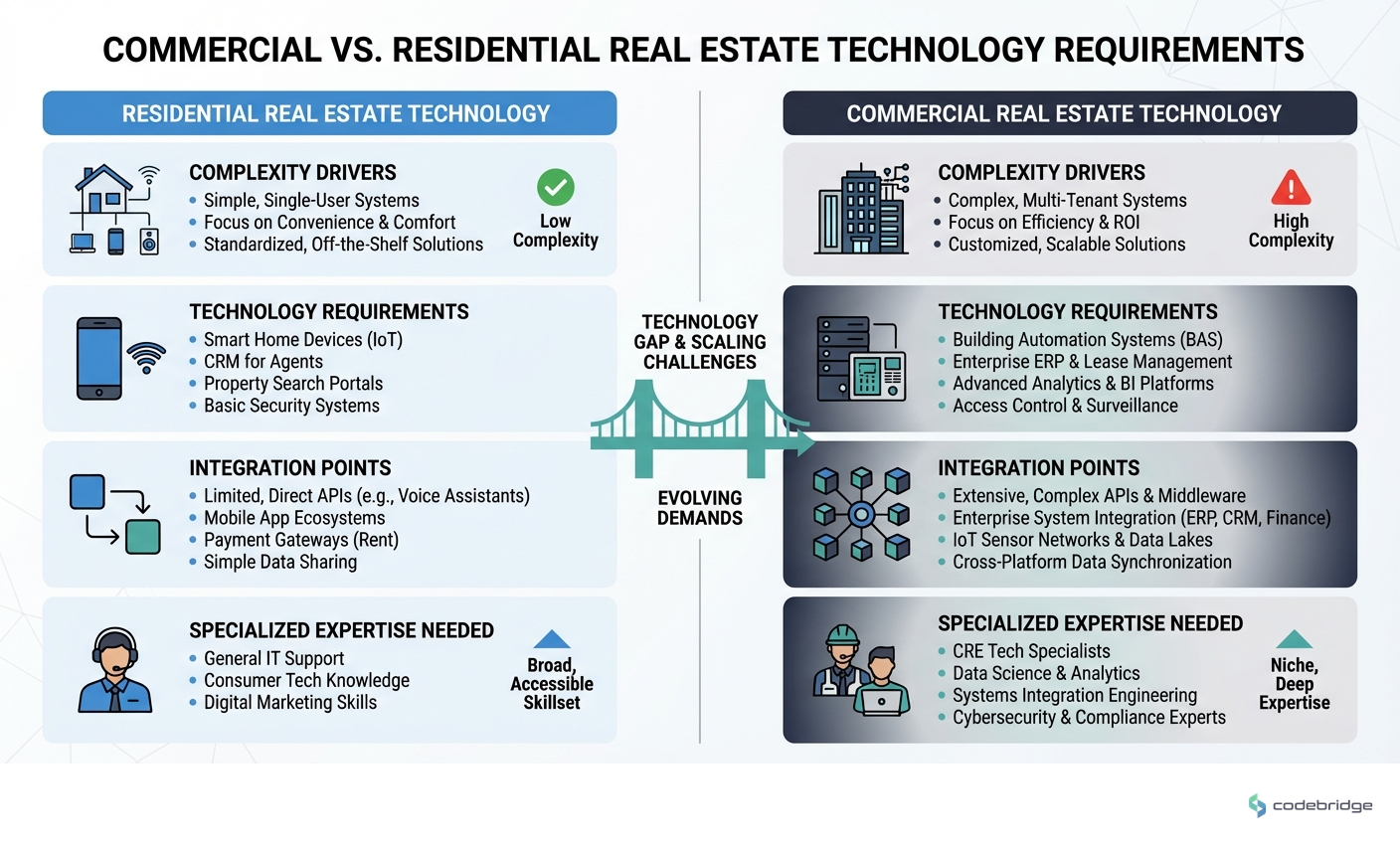
This complexity differential matters because it predicts where your "rare requirements" will emerge. If you're operating in commercial real estate,or your clients are,the technical demands coming in 2026 will be substantially more sophisticated than what your team has handled before.
The 63% commercial dominance isn't about budget size,it's about operational complexity requiring specialized solutions that generalist internal teams struggle to deliver efficiently.
What RSoft Technologies Learned the Hard Way
RSoft Technologies faced a challenge familiar to many real estate tech companies: inefficient client relationship management and lead prioritization were killing their sales velocity. Their internal team could have spent months building a custom CRM solution.
Instead, they launched RealtorsRobot,an AI-powered CRM with features their internal team would have struggled to develop alone: SIM-based auto-dialers, real-time tracking, automated follow-ups, WhatsApp automation, and over 1,500 integrations. The result? A 73% boost in call efficiency.
The lesson isn't "buy instead of build." It's that RSoft recognized which capabilities required specialized expertise versus which their team could handle internally. That strategic awareness made the difference.
The Pattern: How Successful Teams Navigate the Gap
After analyzing market trends and technology adoption patterns across the real estate sector, a clear pattern emerges among teams that scale effectively without burning out their internal developers.
The following visualization shows the decision framework successful teams use when evaluating build vs. partner decisions:
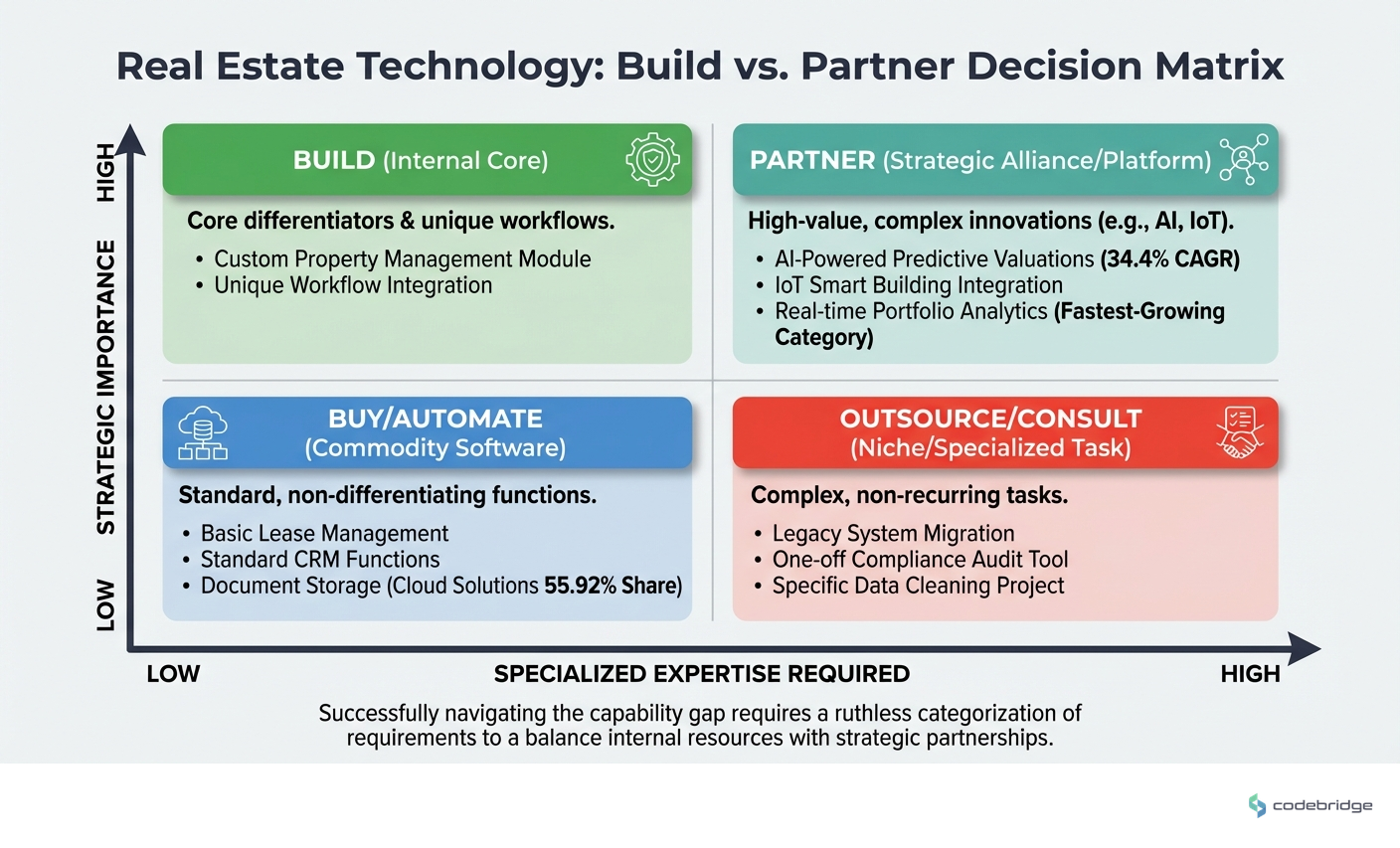
They categorize requirements ruthlessly
Core differentiators get internal resources. Everything else gets evaluated for partnership potential. When sales and marketing IT applications are growing at 9.02% CAGR,the highest in the sector,teams that try to build everything internally fall behind teams that strategically augment.
They plan for cloud-first architecture
Another misconception: cloud adoption supposedly lags in regulated real estate due to data sensitivity concerns. Reality? Cloud solutions controlled 55.92% of the market in 2025 and continue growing at 8.56% CAGR. SOC 2 compliance has made sensitive lease data storage viable, and subscription models cut capital expenses dramatically.
Teams that architect for cloud-native from the start can integrate specialized capabilities without massive refactoring later.
They build partnership infrastructure before they need it
The worst time to establish external development relationships is during a crisis. Smart teams create vendor evaluation frameworks, integration standards, and communication protocols during stable periods,so when that "rare requirement" lands, they can move immediately.
Your 2026 Preparation Framework
Based on where the market is heading, here's a concrete framework for building flexibility into your development strategy:
1. Audit your capability gaps against market growth areas
The PropTech market is valued at USD 40.19 billion and growing at 11.20% CAGR. Map your internal team's expertise against the fastest-growing segments: AI/ML for predictive analytics, IoT integration, real-time business intelligence. Identify gaps now, not when the CEO asks for them.
2. Establish integration standards before you need them
Document your API standards, authentication protocols, and data formats. When you eventually need to bring in specialized help,whether for a three-month AI project or ongoing analytics support,you'll integrate in days instead of weeks.
3. Create a "rare requirements" response protocol
Define what triggers external partnership evaluation: timeline constraints, specialized technology requirements, temporary capacity needs. Remove the emotion from the decision by establishing criteria in advance.
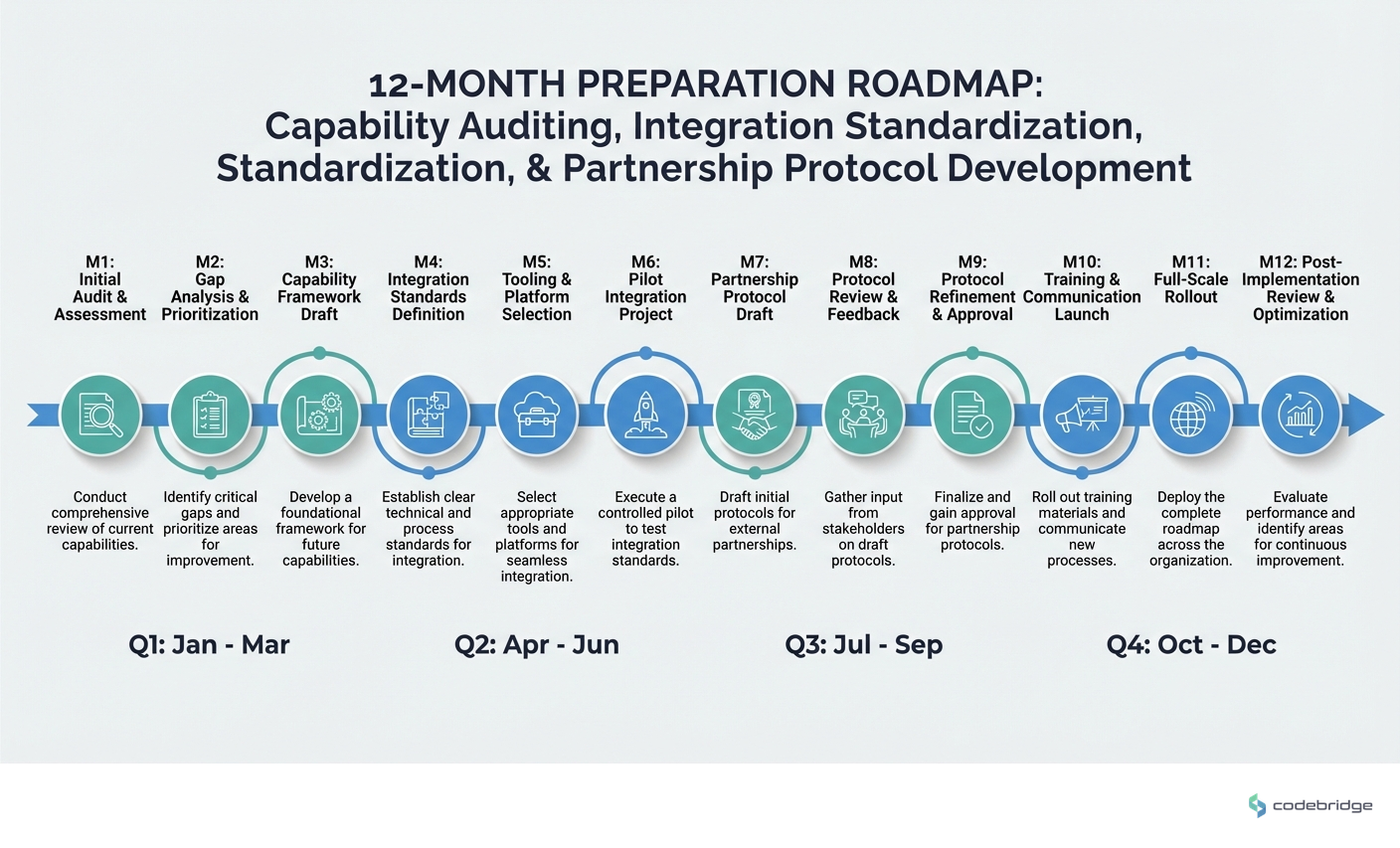
The timeline below shows how to phase this preparation across the next 12 months:
4. Maintain relationships with specialized partners
You don't need active projects to maintain relationships. Quarterly check-ins with potential development partners keep you informed about their capabilities and keep you on their radar for when you need fast response.
5. Protect your internal team's focus
Your developers' highest value isn't building commodity features,it's understanding your business domain deeply and creating differentiated capabilities. Every hour spent on generic integrations is an hour not spent on what makes your product unique.
The Regional Reality Check
Geography matters more than many teams realize. North America holds 63% of the real estate software market, with Asia Pacific at 22.9% and growing. If you're competing in North American markets, you're facing the most sophisticated competitive landscape globally.
This concentration means two things: higher expectations from users who've seen solutions, and a deeper talent pool for specialized capabilities,if you know how to access it.
Coming Full Circle
Remember that development team celebrating their property management module? The smart version of that story doesn't end with panic when new requirements arrive. It ends with the team lead saying, "We anticipated this. Here's our plan."
The real estate technology market will add nearly a billion dollars in value between 2025 and 2026 alone, according to Mordor Intelligence projections. That growth creates opportunity,but only for teams positioned to capture it.
Your internal developers aren't the problem. The problem is expecting any single team to master a market growing at 34.4% annually. The solution isn't replacing your team,it's augmenting them strategically, exactly when and where it matters most.
Not sure where your capability gaps are?
Request a technology audit to map your internal strengths against 2026 market requirements.
Diagnostic Checklist: Signs You're Heading Toward a Capability Wall
Your backlog contains AI/ML features that have been deprioritized for more than two quarters
Leadership has mentioned "predictive analytics" or "smart building integration" without a clear technical owner
Your team's last significant technology learning investment was more than 6 months ago
You have no documented API standards for third-party integrations
Your response to "can we add IoT sensor data?" would be "we'd need to research that"
You've never evaluated external development partners,only considered them during emergencies
Your cloud architecture doesn't support rapid integration of new services
More than 30% of your developers' time goes to maintenance rather than new capabilities
You're competing against companies with dedicated AI/analytics teams while yours is generalist
REFERENCES












Heading 1
Heading 2
Heading 3
Heading 4
Heading 5
Heading 6
Lorem ipsum dolor sit amet, consectetur adipiscing elit, sed do eiusmod tempor incididunt ut labore et dolore magna aliqua. Ut enim ad minim veniam, quis nostrud exercitation ullamco laboris nisi ut aliquip ex ea commodo consequat. Duis aute irure dolor in reprehenderit in voluptate velit esse cillum dolore eu fugiat nulla pariatur.
Block quote
Ordered list
- Item 1
- Item 2
- Item 3
Unordered list
- Item A
- Item B
- Item C
Bold text
Emphasis
Superscript
Subscript